Noor Huda Ismail: Changing the minds of ex-combatants

Courtesy of Noor Huda Ismail

Noor Huda Ismail said he was once a hardliner. When he studied at Ngruki Islamic boarding school in Central Java, he aspired to join the jihad in Afghanistan.

He wanted Indonesia to be an Islamic state, and joined the Darul Islam – a hardline group Jemaah Islamiyah is said to have splintered from — to support the movement.

Now, the 38-year-old is a moderate Muslim, fighting terrorism by embracing ex-combatants, “de-radicalizing” them using a personal approach, training and courses. He founded the Institute of International Peace Building (Yayasan Prasasti Perdamaian) to support his mission.

The father of one also advises foreign oil companies on security risks, and provides expertise on terrorist movements in Indonesia. One of the reports he co-authored with Carl Ungerer, which predicted the possibility of a violent strike from extremists, was released 24 hours prior to the July hotel bombings in Jakarta.

Huda said counterterrorism should be dealt with as one package, from foiling plots, arresting and trying suspects, to deradicalizing them. The deradicalization process, Huda said, was still lacking in Indonesia. Although the police, collaborating with clerics and ex-militants, has carried out deradicalization programs in the past, Huda said those efforts were not sufficient.

Through the Institute of International Peace Building, he tries to approach ex-combatants, although he said his work was just a tiny portion of what needed to be done.

Since 1999, the police has arrested more than 450 terror suspects. Some of them were released after serving their sentences. These people, he said, could easily go back to their old activities unless they shifted paradigm.

Exposure to different views and more liberal ideologies help Huda become more moderate, he pointed out. He was also brought up in a secular family. In a 2005 opinion piece published in The Jakarta Post, he wrote that his secular father — who worked as a parole officer mainly responsible for handling Islamic militants opposing former president and dictator Soeharto — had enrolled him in Ngruki so he could find out more about the group.

His schooling in a pesantren (Islamic boarding school), made him despise the New Order, which repressed excessive use of group symbols. The pesantren leader Abu Bakar Ba’asyir left for Malaysia as the regime deemed his fervent support for an Islamic state as subversive. Huda said his father was given a hard time for not wanting to vote for the Golkar Party, while his mother was discriminated against for wearing a headscarf.

“I felt that under the New Order, Islam wasn’t given much room,” he said. The Ngruki pesantren taught students to fight evil and be fearless except to Allah, he said.

His life might have turned out differently had he gone to Afghanistan. He failed to fulfill his dream of training in the country most of the terrorists responsible for the Bali bombings and church bombings had graduated from.

But at that time, he wished he had been chosen, he said. “I wanted to go jihad as well, but they didn’t choose me. I wanted to go because joining the jihad would have meant becoming part of history. In Ngruki, they taught us what evil meant and I read books about the greatness of Allah. That inspired me,” he said.

The ustadz (religious teacher) selected pupils they considered most dedicated to join the jihad in Afghanistan against Russian soldiers, Huda said. He joked that perhaps his teachers decided not to choose him because he liked the daughter of one of the Kyai (teacher).

Having missed out on Afghanistan, Huda continued college after graduating from Ngruki.

After living an ascetic life in the dorms of Ngruki for six years, he returned to his hometown in Yogyakarta and studied Arabic literature at the Sunan Kalijaga State Islamic University Yogyakarta. At the same time, he enrolled in a Communications Major at the University of Gadjah Mada. He worked as a tourist guide to support himself, interacting with foreign tourists.

He also left Darul Islam, which he joined while he was in Ngruki, after the group split into Darul Islam and Jemaah Islamiyah, a more radical group seeking to install a pan-Islamic state across much of Southeast Asia.

His views on hardline Islamic movements changed after he started to work as a correspondent for the Washington Post in 2002. “Working as a journalist influenced me a lot because as reporters we had to be critical,” he said.

The first 2002 Bali bombings killed 202 people. Three years later, another bomb exploded killing 88 people. Working for the US publication, he interviewed his former school friends in prison, who ended up choosing a different path in life.

While studying International Security at St. Andrews University in Scotland, on a Chevening Award scholarship, Huda said the deradicalization process in North Ireland had impressed him.

“Ex-combatants are facilitated and given courses,” he said.

Upon his return, he founded the Institute of International Peace Building and started a deradicalization program.

“Right now, we only work with 10 ex-combatants,” he said. The ex-combatants, spread across Jakarta, Surakarta, Semarang and Surabaya have experienced life in prison. The absence of deradicalization programs in Indonesia, he said, was worrying.

He worked on a prawn culture with them, and taught them how to trade online. “It’s giving them a normal life,” he said. The institute also worked in eight prisons. He said the only way to prevent the ex-combatants from joining hardline movements again was to help them have a normal life again.

He chooses to deal with ex-combatants labeled as in the “gray” area.

“White JI [Jemaah Islamiyah combatants] use violent methods. There are gray JI, and there are black JI, who have changed sides and work with the police,” he said.

“My analysis concludes that these people are considered tainted. They’ve revealed the secrets of the group to the court and authorities are constantly watching them,” he said.

“They are not accepted in their small [extremist] groups and stigmatized in bigger groups [society]. They cannot fit in either environment,” he said, adding that desperation could lead them to return to their old habitat.

Ex-Jemaah Islamiyah member Nasir Abas, who now helps the police analyze the JI group, said he supported Huda’s personal approach.

“Being a former Ngruki student makes it easier for him to approach former combatants and persuade them to change their ways,” he said.

Nasir added that Huda and him were fighting the same war in a different way. “He takes a more personal approach while I work with the police.”

Huda is currently writing a book titled My Friend the Terrorist, which tells the story Utomo Pamungkas alias Fadlulah Hasan, who was sentenced to life imprisonment for being involved in the first Bali bombing.

For Huda, this is the way to fight against terrorism in Indonesia. Being a former student of Ngruki acquainted with some of the people involved in terrorist activities has made the issue personal to him.
Another reason for joining the fight against terrorism using a more personal approach?  His one-year-old son. “I don’t want him growing up to be a terrorist.”

Prodita Sabarini, The Jakarta Post, Jakarta | People | Fri, March 26 2010
Fear of the religious starts early

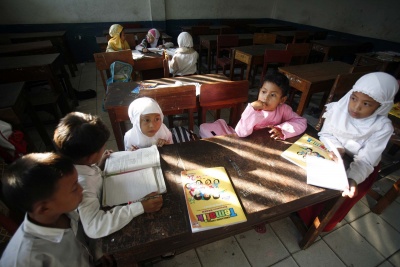
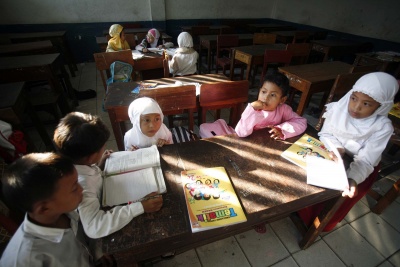
From the beginning: Children study in groups at an elementary school in Jakarta. Proselytizing in Indonesia’s public schools is on the rise, recent studies have shown. JP/J. Adiguna

Although Indonesia has long been a melting pot of religious and ethnic groups, differences in faith still breed curiosity, fear and even animosity.

When Kelik Wicaksono opened the door of his house to two leaders of his neighborhood one Saturday morning, he didn’t expect to hear the kind of news the two men brought him.

Kelik and his wife, both Christians, had been giving English lessons to children in their neighborhood in Pondok Cabe, South Jakarta, every Saturday afternoon.

“It was a very sad moment. The men came to tell us that two local ulemas from another village had voiced their concerns about the content of our class,” Kelik said.

“They were afraid because my faith is different from theirs. And they were worried I was teaching [the children] something else,” he said.

In fact, ulemas and neighborhood leaders were so concerned they held a meeting about the class at the sub-district level.

“What I don’t understand is why didn’t they come to me personally instead of talking behind my back and having a meeting about it?” he said.

The class, Kelik said, teaches children English in a fun way. Sometimes the 15 to 30 children, who are all Muslims, learn to sing and dance, other times they make origami artwork.

When the news of the day was the conflict between the National Police and the Corruption Eradication Commission (KPK), students took part in discussions on that topic. When asked what the duties of the police were, one of the girls in the classroom answered with certainty: “to catch the KPK”.

“Our class is very secular,” he said. “What we can see from it [the class], is that children are now more courageous and confident… because our class is very laid back,” he said.

Kelik and his wife are still holding the class and will meet with the neighborhood leaders to discuss how to address their concerns.

A few children have stopped coming to the class after their parents forbade them to do so.

“The children said, ‘They say you’re teaching us Christian sholat’,” Kelik said. Sholat is the Muslim prayer ritual.

Religious minorities are still persecuted in parts of the country, with certain groups more prone to having their freedom of worship violated.

While permission to build a mosque, the place of worship for Muslims, is easily attained, given the majority of people in Indonesia are Muslim, Christians at times find it more difficult to build their own places of worship.

Last March, Depok mayor Nur Mahmudi Ismail revoked the building permit for a Batak Protestant church in Limo, Depok. Last month, a mob burned down two Protestant churches and the home of a pastor in North Sumatra.

Kelik said he had talked to people around his neighborhood and found they were afraid of Christianization.

When it comes to Islamization however, people remain tightlipped and the state will rarely take any action to stop it, said Jajat Burhanudin, the head of the Center for Islamic and Society Studies (PPIM) at Syarif Hidayatullah State Islamic University in Jakarta.

According to Jajat, some public schools and universities are becoming hotbeds for radical Islamic thinking, with student religious groups preaching intolerant behavior towards people from different religions.

Jajat added that compartmentalized religious education in public schools and the conservative attitude of religious studies teachers contributed to religious intolerance in Indonesian schools.

In 2008, PPIM did a survey involving 500 Islamic studies teachers in Java and found that most teachers were opposed to pluralism, tending toward radicalism and conservatism. The worrying results speak for themselves.

The study shows 62 percent of the surveyed Islamic teachers, including those from Nahdlatul Ulama and Muhammadiyah – the country’s two largest Muslim organizations – rejected the notion of having non-Muslim leaders.

Almost 70 percent of the respondents were opposed to non-Muslims becoming their school principle and close to 35 percent were against having non-Muslim teachers at their schools.

Around 75 percent of the teachers didn’t want followers of other religions to build their houses of worship in their neighborhoods, the survey found.

Eighty five percent of teachers prohibit their students from celebrating big events perceived as Western traditions, while 87 percent tell their students not to learn about other religions.

In addition, 48 percent of the teachers would prefer female and male students to be separated into different classrooms.

The survey also shows 75 percent of the respondents had asked their students to call on non-Muslim teachers to convert to Islam, while 61 percent reject new Islamic sects.

In line with their strict beliefs, 67 percent said they felt more Muslim than Indonesian.

The majority of respondents also supported the adoption of sharia law in the country to help fight crime.

According to the survey, almost 60 percent of the respondents were in favor of rajam (stoning) as a punishment for all kinds of crimes and almost 50 percent said the punishment for theft should be having one hand cut off, while 21 percent want the death sentence for those who converted from Islam.

Only 3 percent of the 500 surveyed Islamic studies teachers said they felt it was their duty to produce tolerant students.

Jajat said the state had failed to take measures to contain a growing radicalization of Islam in public schools.
“The seeds of conservatism start early and educational institutions have always been the place to spread a certain ideology,” he said.

Islam-based political parties are actively collaborating with high schools to create “integrated” schools, he added. “It is part of a deliberate strategy to Islamize public schools,” he said.

While religious groups should not be stopped from opening day schools or boarding schools – even if those end up spreading their ideology, Jajat said, the situation becomes a worry when proselytizing happens in public schools.

“It shouldn’t happen in public schools. The government funds public schools with tax payers’ money. All religions should be treated equally,” he said.

He said democracy and universal values should be taught at school, while “the strengthening of primordial religious identity be avoided”.

Children should be exposed to different faiths as early as possible so they become accustomed to differences in society, Jajat said.

They should also be encouraged to have interfaith dialogues or join activities with people from different faiths.
“It can be something completely unrelated to religion, like how to tackle the problem of garbage,” he said.

The Indonesian religious education system, in which students are given religious studies based on the faith they adhere to, is very compartmentalized and does not stimulate tolerance and understanding between different faiths, Jajat lamented.
“At the same time, there is no effort to make the students see beyond religious symbols,” he said.

Recently a Facebook page titled “Replace religious education in high school with studies about ethics, humanity and basic philosophy” was created. The page now has 400 fans.

When asked about the page, Jajat said he fully agreed with the message.
“Basically, we should hold on to universal values,” he said.

One of the group’s fan, Karl Karnadi, an Indonesian atheist who lives in Germany, said he supported the group because he believed the current religious education system did not promote pluralism.

“In my opinion, intolerance tends to arise when a person is only taught about one religion all of his/her life without having been given the chance to know about other religions and their followers,” he said.

“Why not use religious studies for that? Teach people about more than one religion. Teach them at least about Indonesia’s six ‘official religions’. Give children a chance to get to know different religions outside the ones they adhere to. And in a descriptive way [like Wikipedia] rather than by indoctrinating them [like at church or with Koran readings],” he said.
“That’s an interesting idea, don’t you think?” Karl mused.

Prodita Sabarini, The Jakarta Post, Jakarta | Life | Wed, February 17 2010

Gugun Blues Shelter A phenomenal ascent

p28-a2_7

Two years ago, blues guitarist Muhammad “Gugun” Gunawan’s band, Gugun and The Bluesbug, was off the Indonesian music scene’s radar. Local jazz festival organizers deemed the band too insignificant to give it its own stage.

ump to 2010, the blues trio, now called Gugun Blues Shelter, drew significant crowds at the 2010 Java Jazz Festival that ended Sunday, with two shows of their own in the three-day festival.
Their expanding loyal fan base, who knew their songs by heart, begged the band members — Gugun, bass player John “Jono” Armstrong and drummer Aditya “Bowie” Wibowo — to play their favorite songs.

Asked about growing from an obscure band to finally being recognized as a phenomenal blues band, Gugun said: “That’s what struggling is all about”.

The shoulder-length tousled-hair guitarist was sitting behind the stage Saturday after giving an energetic performance.

“We keep trying and focusing on this type of music — and sticking to it. A lot of blues bands make one album, find that not many people are interested in that type of music and then change their style,” he said.

“I started in 1994, performing in blues festival, clubs, making albums and sticking to this type of music. Finally people are listening,” the 33-year-old said.

“It’s feasible for a blues band to make an album and to continue to exist in the music scene in Indonesia. You have to be focused and consistent,” he said.

The key, Gugun said, is to keep the gigs goings.

“You can’t just release an album and then not play your music, you have to perform,” he said.
Gugun Blues Shelter is doing just that. Aside from performing in local and international festivals as well as touring in the UK, they play in blues clubs, cafes, universities, art centers and also malls.
Gugun, who is said to remind blues aficionados of legend Stevie Ray Vaughan — when it comes to guitar playing, started Gugun and The Bluesbug as a solo project.

In 2004, he released debut album Get The Bug with Jono from the UK and Iskandar on drums. He recorded his second album Turn It On with Arditya on the bass and Agung on drums.

While the local scene hadn’t recognized Gugun’s genius guitar playing yet, the band received more attention outside Indonesia, especially when touring repeatedly in the UK.

In 2009, Gugun and his musicians were the only Asian band — out of a total of 30 — to perform at the Skegness Rock and Blues festival.

In 2008, Gugun teamed up with Bowie, a 25-year-old drummer prodigy whom Gugun dubbed as “the most wanted drummer in Indonesia”. Bowie has played with jazz singer Syaharani, jazz guitarist Tohpati and singer Alena.

In 2009, Gugun reunited with Jono, 30, and changed the name of the band to Gugun and the Blues Shelter.

Gugun said that since the Blues Shelter, the band was no longer his solo project, but real teamwork. “I really hope this [line up] will last.”

Jono, in fluent Indonesian, said he had met Gugun in 2003, jamming with him at BB’s blues bar in Menteng, Central Jakarta. He returned to the UK in 2006 to continue his studies.

After a little while, he decided to return to Indonesia in 2009. “I don’t like it in England and I really miss playing with the band,” he said.

“While I was in the UK, Gugun came three times and played there. And the audience reception was always very good. I see there’s a future for the band,” he said. “And for that I have to be in Indonesia for band practice and for it to be able to develop,” he said.

Meanwhile, Bowie said he had chosen to join Gugun because he felt he had found a family.
“I feel really comfortable with Gugun and Jono. Not only musically but also personally. The band is the family I have always dreamed of,” he said.

Gugun Blues Shelter has independently released a new self-titled album, which is a replacement of the planned Set My Soul on Fire album that failed to be released due to conflict with the band’s label.

Gugun said the new album was darker than previous Bluesbug’s albums. The new album is a means for the band to unload their emotional baggage from their fight with their label.

“It’s about the hurt and regret,” Gugun said.

The album also contains political songs criticizing officials appearing on large billboards in public spaces.

Bowie added the album had a gloomy song about the time they were recording in the UK. “It was minus 10 degrees there!” he said.

The band recorded the album in two months. Gugun described it as more spontaneous, rich in all instruments: Guitar, bass and drums.

They are scheduled to go on a summer tour in the UK this year, to perform at the Timbre Rock and Roots festival in Singapore late this month, which is making Gugun and his band members excited and nervous at the same time.

“The line up for the festival includes Buddy Guy, Gipsy King, George Holland, and Buena Vista. A lot are Grammy award winners. We’re quiet nervous but we’ll give it our best shot,” he said.

Prodita Sabarini, The Jakarta Post, Jakarta | People | Mon, March 08 2010

Kuntoro Mangkusubroto: Integrity, simplicity and asceticism

Kuntoro Mangkusubroto - JP/ R. Berto Werdhatama
Kuntoro Mangkusubroto – JP/ R. Berto Werdhatama

Kuntoro Mangkusubroto is not a minister, but he makes sure that ministries and government institutions work effectively under the presidential guidelines that he helped draw up.

At the first Cabinet meeting in November last year, President Susilo Bambang Yudhoyono said that Kuntoro, the former Aceh-Nias Reconstruction and Rehabilitation Agency (BRR) head, would, “if necessary, be my eyes, my ears and my hands”.

Two months after completing his five-year task of managing the reconstruction and rehabilitation of tsunami-devastated Aceh in April last year, Kuntoro was back to work, drawing up a five-year development plan for Yudhoyono, summarizing it in a 100-day and one-year program that would be the foundation for the country’s development toward 2014.

He told the President that the task to monitor the implementation of the plan should not be attached to a ministry but should instead be carried out by a special unit to give it more focus. As a result, Kuntoro now heads a strategic unit called the Presidential Work Unit for Development Monitoring and Control (UKP4).

When the 100th day of Yudhoyono’s second term fell on Feb. 1, Kuntoro, whose unit was to make sure all 34 ministries and governmental institution achieved their targets, red marked two ministries for failing to attain their goals.

The Agriculture Ministry failed to complete a large-scale commercial farming and food estate project in Merauke, Papua, while the Education Ministry fell agonizingly short of its target of upgrading the skills 30,000 school principals and supervisors by Feb. 1. Only around 27,000 had received the training.
Despite the Education Ministry updating its report two days after the deadline, highlighting an extra 2,700 teachers’ skills had been upgraded, Kuntoro still gave the ministry a red mark.

“I’m only following the President’s orders. There no goal that’s a half goal. It’s either goal or not, one or nil,” he said recently about the red marks. He said that even if the ministry had fallen short by one, he would still have given it a red mark.

Analysts have said that Kuntoro’s new unit, the first ever in Indonesia’s history, is similar to that of former British prime minister Tony Blair’s delivery unit or the White House’s West Wing. Kuntoro said the comparison was valid, but there are differences.

“Tony Blair’s delivery unit had the right to intervene. We don’t intervene. We only back up [the ministries] and remind them, ask them how they are progressing,” he said.

“We respect their authority. We just remind them by saying ‘Hey, watch out, you might miss your targets’,” he said.

Sitting in his office at the presidential secretariat complex, Kuntoro dressed casually in a short sleeved blue shirt. A graduate from the Bandung Institute of Technology and Stanford University in Industrial Engineering, Kuntoro said he’d had a zigzagging career path. He started out as a lecturer in 1972, worked as expert staff for the government, became director of state-owned mining companies, energy minister under Soeharto’s administration, director of state-owned electricity company (PLN), and head of the BRR.

While at the BRR, he headed a giant agency of 1,500 staff. He now employs 16 staff, most of whom have PhDs. With four deputies and 12 assistants, he said his team worked in a matrix system of management. Each person in his team could be involved in several projects as a team member or team leader. A deputy might be the team leader in one project and be a team member under an assistant in another project.

“No one is without work,” he said.

Overseeing the reconstruction of Aceh, Kuntoro said he had to start from scratch without any guidance. He learned from many mistakes on the job but kept his cool despite the frustrating conditions.

There was no blueprint for Banda Aceh’s master plan. To draw one, it would have to be approved by the City Council, which had collapsed. So we started building without a master plan. When we found that we had built houses on what was supposed to be a street, we had to demolish them. We learned from mistakes,” he said.

In the Presidential Work Unit, however, the work is so strategic that there is no room for errors, he said. “It’s very complex here, because we’re talking sectors such as agriculture, health, transportation,” he said.

“This is the top of government’s programs. We cannot make mistakes, because if we do, the impacts will be huge,” he said.

His staff work in one room and sit facing each other at a large oval table with laptops. He casually introduced his team members to The Jakarta Post: “That’s Tara. This is Aichida, an anthropologist,” he said. He pointed the other members of the team: “These two on the corner are from the Central Bank”.

Newspapers and several notebooks were strewn across the table. “They’re usually tidier than this,” he joked. The team works and holds meetings in the one room. “So that everyone knows what’s happening with each other,” he said.

Kuntoro said his team’s background has a very healthy mix. His members include a doctor in economics, a doctor in engineering, a doctor in urban spatial planning and a doctor in remote sensing.

His egalitarian approach to work seems to echo Kuntoro’s way of life. He said he was not too caught up with hierarchy or position. Kuntoro has always kept a clean image. For him integrity, simplicity and asceticism, are central to his set of values.

“We should live according to what we need,” he said. Kuntoro said he currently rides in his minister’s car, a Toyota Crown. “But after this position ends, I’ll go back to my [Toyota] Kijang,” he said.

“We should not see cars as a symbol of achievement. A car is for getting around.”

Given his busy schedule, Kuntoro said he liked to skip lunch and go for a swim. He spends his free time reading biographies of great men of science and with his family. He has five sons. “Four are married and have given me grandchildren,” he said.

He said he never preached the values he holds to his family. If a father was lazy, he added, no matter how much he preached about hard work, it would never work.

“In a family, there’s never an effective way to preach. They can see you, there’s not one second when they can be fooled.”

Prodita Sabarini, The Jakarta Post, Jakarta | Life | Mon, February 15 2010

Religious TV jeopardizing pluralism

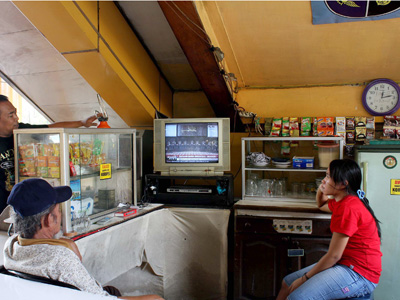
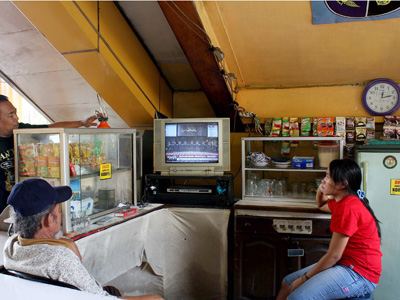
Pervasive medium: Three people watch a television program in a shop at a railway station in Jakarta. Activists argue that many religious TV programs play a symbolic rather than a substantial role in religion, and tend to marginalize minority groups. JP/Nurhayati

A recent episode of an Islamic religious program aired on a private TV station broached the topic of tattoos, questioning whether they were haram (prohibited) or halal (allowed).

The TV show presenter then pointed his microphone to people with tattoos, asking if they knew the marks on their skin were prohibited under Islamic law.

The episode in itself begs the following questions: Was singling out people with tattoos in a religious program right or wrong?

How about other minorities whose lifestyles are not in line with certain religious teachings, such as gay men and lesbians, or people who drink alcohol?

How would broadcasting a strict right or wrong label on people affect the pluralist nature of our society?

Religious programs, which have been around since the early days of TV — when the country only had one public television station, TVRI – usually take the form of sermons delivered by ulemas, priests or Buddhist monks.

In recent years, producers of religious programs have been experimenting with reality-TV types of shows. While some shows focus on one particular topic, such as debating whether something is halal or haram and then interviewing people about the matter, others are a blend of reality shows and religious programs, with family members attempting to get their relative who has strayed from religion to return to it.

Through religious programs, TVs are bringing into everyone’s living rooms strict interpretations of religious teachings in a modern context, which could jeopardize pluralism and religious tolerance.

The head of the Indonesian Broadcasting Commission (KPI), Sasa Juarsa Sendjaja, said Indonesian media was generally doing a good job promoting pluralism.

“However, there are attempts, here and there, from the majority to dominate the minority,” he said.

The majority of people in Indonesia are Muslims. The Indonesian Ulema Council (MUI) has often stipulated divisive edicts or fatwa. In 2005, the MUI released an edict stating that pluralism, liberalism and religious secularism were haram.

Since then, a number of fatwas have been released, including a ban on smoking, women riding on the back motorcycles, hair straightening, hair-dyeing and on taking pre-wedding pictures.

Artist and politician Guruh Soekarnoputra said TV programs promoting intolerance reflected the changes permeating Indonesian society.

“We’re not a Pancasila country anymore,” he said, referring to the country’s principles. The country has a motto, Bhinneka Tunggal Ika or Unity in Diversity that represents Indonesia’s pluralistic society.
KPI, Sasa said, regulates what can and cannot be broadcasted on TV.

“And one requirement is that television stations should respect pluralism. Minority groups like gay men and lesbians, not just people from different religions, should also be respected,” he said.

After all, the KPI – through the Press Board (Dewan Pers) – monitors news, entertainment or infotainment programs to ensure they adhere to a code of journalism ethics.

“For talk shows or regular television programs, we do the monitoring ourselves,” he said. “There are programs that could be construed as fuelling intolerance. But we have to see to what extent,” he said.
Director of the Jakarta-based International Center for Islam and Pluralism (ICIP), M. Syafi’i Anwar, said many religious programs on television acted more as symbols than anything else.

“Television makes sure religious programs are merely entertainment,” he said.

“The programs are artificial and symbolic. Therefore we see a lot of people go to haj but corruption is still rife; many mosques are being built while many people are still homeless,” he said.

Because programming on TV channels is driven by ratings and profits, much of the preaching or dakwah on TV is not educational, Syafi’I went on.

“Sometimes, the programs even contradict religious teachings.”

Syafi’i said dakwah should not be judgmental. “It [the preaching] should be persuasive instead.”

“Dakwah should be carried out with wisdom… meaning we should not be judgmental,” he said.

Even if religion disagrees with certain activities or attitudes, one should not be judged by them, he added.

“The only good way to preach is by highlighting role models, or leading by example, not by being judgmental.”

Islam spread across Indonesia through persuasion and dialogue, Syafi’i said. The nine wali or saints who spread Islam in Java in the 15th century used local arts and culture influenced by Hindu and Buddhist culture.

“That’s why Islam in Java has rituals such as sekaten… because of the mix of culture,” he said of the ritual welcoming the Islamic New Year.

Television is a very important media to promote pluralism, Syafi’I said. Religious leaders in TV programs should use a persuasive method that will give religion a friendly face.

Progressive Islamic scholar Maman Imanulhaq Faqieh who leads the Islamic boarding school Al-Mizan in Yogyakarta said intolerance stemmed from religious leaders applying religious teachings out of context.

“Some religious leaders lack wisdom when examining the problems plaguing society,” he said.

“Religion is supposed to be the energy that can bring change and promote messages to humanity.”

However many religious programs in Indonesia are still very shallow and do not touch the substance of complex problems in society, he said, as they have misunderstood how to apply religion to modern life.

“Therefore, [religious] TV programs now are merely judging and blaming people for society’s ills.
They do not try to delve into the problem, and in the end it alienates religion from society,” he said.

Maman said the current religious programs on television reflected a more Arabic interpretation of Islam, with preachers wearing long robes and sermonizing about strict interpretations of the religion.

When preaching religion, Ma-man said, religious leaders should focus on the liberating and emancipating aspects of the religion, and address human rights violations and other social problems in the community.

“It is time for religious leaders to tackle societal problems seriously. There should be a dialogue between religious leaders and the community, in which both parties respect and appreciate each other,” he said.

Prodita Sabarini, The Jakarta Post, Jakarta | Life | Wed, February 10 2010

In search of a good night’s sleep

First-time visitors to the country may be confounded by the various calls from the pushcart vendors hawking their goods around the neighborhood.

The clinging of spoon on a glass bowl is the sign for the meatball seller. The knocking on wood is the fried noodle seller, and the nasal singing sound of “Sio-Maaaay” is the sign of the dumpling seller.

But those au naturel sounds are not the only ones heard in the city. Blood pressure may rise along with the passing of the Evil Knievel wannabes on motorbikes or the honking of cars queuing behind a public minivan that cheekily stops midtraffic to pick up a passenger. And, last but not least, is the Indonesian love affair with the loudspeaker.

One can hear loudspeakers being used in shopping malls, in weddings processions, in meetings of a dozen people and at places of worship.

“I have, in the past, read messages on the Internet from other people complaining about the noise from loudspeakers from mosques near their houses. I’d always been thankful that I didn’t have that problem,” Glenn McGrew, 43, who lives in Semarang, Central Java said over the phone.

His peace lasted only until last June, when a military compound near his residential complex started to construct a large mosque and broadcast the calls to prayer, Koran recitations, and even children’s Islamic classes.

“Now, I have that problem,” he said.

Glenn is one of many expatriates disturbed by the city’s generous use of loudspeakers.

Glenn, who lives with his family in Candi Sari, Semarang, said before the new mosque was built, the area where he lived had several mosques in the vicinity, whose calls to prayer did not create any discomfort to the ears.

The noise from the new mosque drowned out the sound of the other mosques, which eventually forced the latter to increase their volume too to make themselves heard by their congregation.

Once, the broadcast went from Friday all through the weekend and ended on Monday, Glenn said.

The noise has hampered his family’s rest time, Glenn said. He lives in his mother-in law’s two-story house and is starting to teach his five-year-old daughter to sleep by herself in a room on the second story of his family’s house. As his daughter still feels daunted by the idea of sleeping by herself, he tucks her into bed and stays until she falls asleep.

“Just a couple of minutes after that, the mosque put its loudspeakers on again. And she wakes up and gets upset,” he said.

Glen is now wavering between asking his mother-in-law to sell the house and move to a quieter place or to stay put. “I feel I don’t want to uproot myself”.

Eka Heru Djunaeni, associate director from Colliers International, a consultancy company that provides real estate services for expatriates, said that being free from noise pollution was one of the requirements clients asked for in their search for housing. Except for expatriates hailing from countries that are used to loudspeakers from places of worship, most of Colliers’ clients look for houses that are far away from loud places of worships.

“They are usually not used to loud noise,” Colliers International associate director Lenny van Es-Sinaga said.

In Jakarta, the area that is quite accommodating to that demand is Pondok Indah, South Jakarta, Heru said.

Other expatriates areas are in Kemang, Pejaten, Cilandak, and Cipete in South Jakarta. “There are many, many mosques there. For someone who really cannot tolerate amplified calls to prayer, we will refer them to Pondok Indah,” Heru said.

Noise is not the only factor in finding housing. Location and the house itself are also in the equation.

What then can one do when one has found the perfect house in the perfect location but it has problems of noise pollution?

Lenny said that a prospective leaser could request double glazing in the windows as a noise buffer, at an extra cost. Lenny said that usually a 5 percent increase in the rental fee would be requested by the landlord. Houses and apartments recommended by Colliers are in a price range of US$1,500 to $4,000 and higher.

Those privileged with the funds then could find that perfect house in a quiet neighborhood or install double glazing for their windows. But for the majority of people, they would have to stay put and endure the noise.

Residents mostly feel powerless and afraid to complain, Glenn said. Many of his neighbors feel the same annoyance over the loudspeakers; however a lot of them are reluctant to complain to the mosque caretakers. He asked his neighbors how they felt about the noise. Their response was one of opposition but they would rather not confront the issue.

Meeting up with the people from the mosque apparently does not help either, Glenn found. He reasoned that the noise violated Indonesian laws and the spirit of Pancasila, the Indonesian philosophical foundation. “They do not want to compromise,” he said.

Not all expatriates, however, are annoyed by the loudspeakers from places of worship. Chris Holm, who has lived in Jakarta for more than six years, said that he had adjusted to the noise and was more concerned with the traffic problems in Jakarta and the lack of open green spaces.

He said that he noticed how noisy Jakarta was when he went away. “I’m from New Zealand and it’s very quiet there. You notice it when you leave [Jakarta],” he said.

“What’s amazing about the city … You can seem to get away from the noise if you’re in the right place. You get used to the hum of the city and the noise becomes the background,” he said.

Bulantrisna Djelantik, an ear, nose and throat specialist with the Free from Noise Society said that loudspeakers should be used sparingly. In neighborhood areas, one should bear in mind the comfort of residents in the area.

“It is fine as long as it does not disrupt people’s lives,” she said.

The group found that noise pollution had become an increasing nuisance in urban areas. The issue of noise pollution was still on the periphery, with people being timid in raising any objections to it.

Noise levels in the city have led to people losing their hearing without them realizing, the group claims, saying that 10.7 percent of people who conduct activities in the streets of Jakarta have hearing problems.

The group, which was founded last weekend, is aiming for urban areas that appreciate the auditory sense better, with the motto: “Respect ears, God’s gift.”

“Ears are the first sense to develop in a fetus. With ears, a fetus unconsciously knows about the world outside itself,” the group’s chairman, cultural activist Slamet A. Sjukur, said. “When death is closing in, a dying person might lose his ability to see and speak. But the last communication he receives will come through his ears.”

Prodita Sabarini, The Jakarta Post, Jakarta | Life | Mon, February 01 2010

Sleepy hollow: A scene at night outside Pondok Indah Mall in South Jakarta. The Pondok Indah neighborhood is a haven for expatriates in search of comfortable houses. JP/P.J. Leo

Comic artists reach for a wider audience

Wanting to shed the image of an exclusive community, the country’s comic artists are holding an exhibition in a South Jakarta mall, to showcase their work to the public.

The Indonesia Comic Community (MKI) together with the Bellezza Shopping Arcade in South Jakarta have organized “Comic Days”, a week-long comic exhibition with workshops and discussions.

“We want not only comic artists and comic fans to come, but also the general public,” head of the the MKI, Rizqy R. Mosmarth said Sunday.

Indonesia’s comic art scene is not as commercially successful at home compared to the numerous Japanese manga comics in bookstores.

After its heyday in the 1970s, Indonesian comic art, with titles such as Si Buta dari Gua Hantu (The Blind from the Ghost Cave), went into hiatus.

Independent comic artists and studios attempted to revive the scene in the early 1990s when comic artist groups such as Komik Nusantara, Animik and Apotik Komik started to emerge.

Now, numerous independent comic artists and studios produce comic books.

Rizqy said that through the exhibition, they wanted to reach a wider audience.

Comic artists such as Ahmad Thoriq and Anto Motul — founders of the MKI — as well as Tita Larasati are taking part in the exhibition and workshops.

Bellezza Shopping Arcade spokesperson Audrey Aristanty said that organizers would change the display of the comics daily during the event.

At Sunday’s exhibition, social criticism was abound in most of the comics displayed. The graphic diary of Tita Larasati on display portrayed people on the street calling out “bule” (foreigner) to children walking with a lady.

After they entered a public van, the boy asked the lady what “bule” meant and whether it was a bad thing.

“It’s the only way they know how to treat difference,” the lady answered the little boy.

Another comic on display was Studio Paragraph’s Bondan, Undul and Lila: The death of coral reefs.

The characters were two children, Bondan and Lila, who were able to swim underwater without equipment after a fish, Undul, gave them special necklaces. The comic touches on issues such as environmental degradation and poverty.

Rizqy said the studio had created the comic for an organization that works in conservation, the Terangi Foundation.

One beautiful work that was displayed was Azisa Noor’s comic, which is a modern interpretation of the wayang story Rama and Shinta.

Rizqi said that they would hold a workshop on Jan. 23.

Prodita Sabarini, The Jakarta Post, Jakarta | Jakarta | Mon, January 18 2010

Four workers died while cleaning sewer, employer negligence suspected

Agung Supriadi was a calm curly-haired 21-year-old man, whom women of his neighborhood loved. On Dec. 22, he left for work in the morning to clean a sewer in Kampung Melayu, East Jakarta.

He did not make it home alive.

Agung died with three of his friends, Ridwan, Alif and Andi — all in their twenties — reportedly from asphyxiation while removing garbage from the Kalibaru tunnel, after being pushed by a strong current and running out of oxygen. The workers had been hired by East Jakarta Public Works Agency.

“Agung was a strong swimmer,” Agung’s oldest sister, 29-year-old Aci Sutarsih, said. “But, maybe there was too much garbage,” she said.

In her modest home, a square room with big wooden windows in Cipinang Besar, East Jakarta, Aci said recently she was shocked on hearing the news of her brother’s death.

Aci, who lost her parents nine years ago, raised Agung and her sisters on her own. Having no money, Aci and her siblings did not continue their education past elementary school.

Agung used to do odd jobs such as cleaning service or helping people move, Aci said. He would also sometimes busk with Ridwan, Alif and Andi.

“They were close friends,” Aci said, adding that Agung and the others were “sehidup-semati” (friends in life and death).

Agung had worked for the Public Works Agency as a daily worker for around one year, Aci said. He would receive Rp 35,000 per day.

“Sometimes he helped out by giving me some money,” she said. But mostly he used his wages for his own needs, which included taking his girlfriend out.

“I heard from his friends that they talked about getting married,” she said.

Police suspected the deaths of the four men was a result of negligence. Jatinegara Police detectives found that none of the workers had been given safety clothing or equipment before entering the sewers.

One eyewitness said they only had a flashlight, and on the day of their deaths it had been raining, causing the water levels to rise up to their waists.

“We suspect they died as they ran out of oxygen and were trapped in the water,” Jatinegara Police chief detective First. Insp. Supardjiono told reporters a day after the incident.

The police have questioned several witnesses, but have not named any suspects.

Jakarta Public Works Agency chief Budi Widiantoro said safety equipment had been prepared for the task.

“The incident occurred because of a sudden increase in water levels,” he said.

Workers were recruited for public works projects according to necessity, Budi said.

“The recruitment of workers is based on occasional needs, and is usually on a short-term basis… we do not give them year-long contracts, so they are not paid any occupational insurance on top of their daily wage,” he said.

A lot of people work without social or health insurance. Firefighters for example, who work in very dangerous conditions, are among the many who work for the public good without insurance.

Aci said she had received a total of Rp 10 million from the city administration following the death of her brother.

“I want to use the rest of the money to beautify Agung’s grave,” she said, adding that she was not sure how much was left.

“I used it for the burial and it was like rain when you spend money on those times,” she said.

Jakarta Manpower and Transmigration Agency chief Deded Sukandar, whose office oversees the implementation of work safety in companies, said in the case of Agung and his friends the employers had done enough.

“They gave money to the families,” he said.

Prodita Sabarini, The Jakarta Post, Jakarta | Jakarta | Thu, January 07 2010

Papua series: Papua development program aims to lure the young back to farming

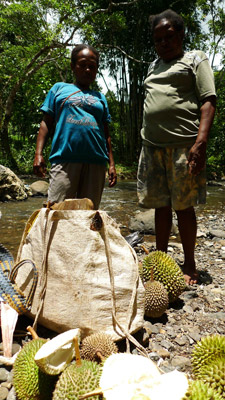
Durian feast: Two women stand over durian by the river in Serui, Yapen Islands. February is durian season and villagers in Serui can collect ripe durian from the ground and take them to market. (JP/ Prodita Sabarini)

As with many areas in Indonesia and around the world, people in Papua move from rural areas to the city.  However, having lived close to their land for thousands of years their competitive streak in setting up small businesses lags behind that of migrants who have for generations had the skills to run businesses, according to Rio Pangemanan, Oxfam program manager on the Papua Enterprise Development Program.

In no corner of the town of Wamena will one see a shop that is owned or run by indigenous Papuans. Indigenous women with their noken (traditional Papuan woven bags) hanging from their heads to their backs sell sweet potatoes or vegetables on a cloth in the street markets. Young strong-limbed Papuan men push rickshaws, some even in bare feet. Others  wander around  the markets, intoxicated from glue-sniffing.

UK based international development organization Oxfam is currently the only international NGO that is allowed to operate in the heavily policed province. Working with local partners, Oxfam has been supporting local farmers in five regencies in Papua in developing their farms and markets.

Oxfam supports the farmers according to the local needs and potential. For example, in Yapen Island, Oxfam has supported the Wamanuam Be Kitabono Yawa (WMY) Cooperative in cultivating vanilla beans. In Jayawijaya regency, the NGO has supported the Independent Business Foundation (Yapum) in cultivating and distributing sweet potatoes. Meanwhile in Paniai and Nabire Oxfam has supported their local partners in helping coffee farmers and in Jayapura, cacao farmers.

Oxfam’s contract ends next year, but Rio hopes that the NGO will get an extension for its programs. Rio said of the vanilla program in Serui that vanilla vines needed three years to produce beans, so new farmers would only have their first harvest in 2014. Rio said that by the end of 2014, he hoped the cooperative would be able to run independently.

Meanwhile in Wamena, Rio estimates that it will take two years for their partners to be independent in terms of management. He said that if the local government could take part in transportation and distribution of the produce, Oxfam’s partners, such as Yapum, would be able to operate independently once their management capacity had been strengthened.

In his office in Serui, Apolos Mora, the head of WMY cooperative said that for years vanilla trees grew in the wild in forests in Yapen. The Dutch brought the seeds when they opened coffee and chocolate farms on the island in the 1950s. “Before they [the Dutch] could teach the local people to cultivate vanilla, there was the transfer of power to Indonesia,” Apolos said.

One day in 2008, Apolos was reading about vanilla in the bookstore and an “Aha!” moment hit him as he realized that these plants were the ones that grew wild in the forest. When Madagascar, the largest vanilla pod producer in the world, had poor harvests, the price of vanilla pods skyrocketed to Rp 3 million (US$309) per kilogram, Apolos said. Apolos then decided to cultivate vanilla vines and trained the farmers joining his cooperative to plant vanilla too. He sells the pods to Manado, where they are exported to Europe, the US, Australia and New Zealand.  Recently, the price for dried vanilla pods was Rp 115,000 per kilogram.

PDEP manager, Rio Pangemanan, said that Oxfam supported programs according to the characteristics of the area. The island and coastal areas are more developed than the mountain areas due to ease of access to other islands in Indonesia. The mountain areas meanwhile are more isolated. This results in a different variety of crops that can be profitable to produce. While farmers in Serui can sell their crops in Manado, in Wamena farmers can only sell locally.

In Jayawijaya, Oxfam supports farmers revitalizing their sweet potato farms. Partnering with Yapum, they have developed 20 sweet potato collecting points in Jayawijaya that will distribute the crops to the markets in Wamena. Rio said that these collecting points had become a place for farmer’s advocacy and education to motivate the community to return to their farms instead of leaving for the city.

Local NGOs such as Yapum and WMY cooperative say that it is not always easy advocating for farmers to cultivate vanilla beans or sweet potatoes. Farmers’ programs in Papua are often project-based, in which farmers are given money to open rice paddies or fishponds. Once the funds dry up, the projects become neglected.

Eli Tabuni, the secretary of one of the sweet potato collecting points was one of the farmers who questioned the program. “This [sweet potato farming] is our culture, why are you making a project out of this?” he asked Yapum and Oxfam during their visit there. He said that many of the programs were only temporary and were not really helpful.

Kiloner Wenda, Oxfam Sweet Potato project officer in Jayawijaya, answered Eli in the Lani language with another question. “Where are the young people now who will work on the farms?” he said. “If we don’t start now, then our culture will slowly disappear,” he said.

Rio said that the projects aimed to support indigenous Papuan farmers in developing their business sense and opening their access to markets. In Wamena, women carrying their sweet potatoes from their villages to the market have to pay for transportation to the market for their heavy bags.

Yapum encourages them to sell the potatoes for Rp 5,000 per kilogram, and they only need to drop their crops at the collecting points. This way, the women did not have to travel far to the markets and could save on transportation, Rio said.

In Serui, the program has managed to attract young farmers, but in Wamena, whether the program will succeed in bringing the young back to the farms is yet to be seen. For the kids that like to play in the farm, their dreams are to be pilots and teachers, they say. But they will always love eating sweet potatoes.

— JP/Prodita Sabarini, Yapen, Serui

Prodita Sabarini, The Jakarta Post | Reportage | Wed, March 27 2013

Papua series: Laboring mamas, chopped fingers

Taking a breather: Weldemina Mora looks at a waterfall in Serui, Yapen Islands regency. In Serui, some Papua vanilla vineyards are located on customary land belonging to the Yawaunat people. (JP/ Prodita Sabarini)

A mama walks barefoot under the skin-burning sun in a hamlet in Piramid district, Jayawijaya regency. With their traditional woven bags (noken) dangling from their heads, Papuan women, lovingly called mama-mama, dig into the earth to harvest sweet potatoes.

Orina, 30, is one of the mama-mama. Last week was harvest time in her village, Yonggime. Carrying her 3-year-old-son Samuel to the field on her shoulder, she steadies the weight of her noken on her head.

“It’s hard work,” she says. “We sweat a lot and we dig using shovels,” she said. The shovels that the women use are made from thin long metal with flat tips. Most tiring, she said, was that they had to carry their noken and their babies or toddlers with them to the field. Sometimes women carry three bags on their head, one for their offspring and the others for collecting the harvest.

The bulk of the work on farms in Papua falls to women. Most indigenous Papuans in the mountainous highlands such as in Jayawijaya regency live from farming. Families grow sweet potatoes for their daily meals, as well as for their pigs. The rest, they sell in the markets. Women are usually the ones who travel to the markets carrying heavy loads on their heads. The sweet potatoes, or hipere in the local language, can grow as big as a newborn baby, weighing around 5 to 10 kilograms each.

“Men open the fields, build the fences and dig irrigation channels, but that’s it. The people who tend the fields, plant and toil, harvest and feed the cattle, are the women,” Patricio Wetipo from the organization, Humi Inane (Women’s Voice) Foundation, said in Wamena recently.

In Indonesia’s easternmost province, indigenous women are marginalized and often become victims of violence both from outside and inside their communities. The security approach in the restive province has seen many women suffer sexual violence at the hands of Indonesian Military (TNI) personnel, as documented in a 2009 study by the National Commission on Violence Against Women (Komnas Perempuan).

Women are also second to men within their communities. Besides having a heavier workload, they were not included in decision-making in tribal communities, Patricio said. Polygamy and adultery was rife, he added, and with Papua being the Indonesian province with the highest rate of HIV/AIDS, a lot of women contract the virus from their husbands. Patricio said that his organization had documented 370 reports of violence against women in Jayawijaya alone.

One can see the stark difference between men and women with the grieving customs of communities in the central mountains. Women in those tribes cut off the phalange of a finger as a sign of grief when a member of their family passes a way. The men, meanwhile, make only a tiny slice in the tip of their ears. The government has banned this particular practice, but one can still see many women with short, stumpy fingers, including younger women.

But conditions for women are changing — albeit slowly; development programs that incorporate gender equality are opening up access for women to become community leaders.

In Wamena, Sarlota Itlay, 42, stands out as the head of a farmers’ group in Musaima village, a position that she’s proud to hold. The single mother of four describes her position as “one that’s rare in Papuan custom”. When development NGO Oxfam started a Papua Enterprise Development Program (PEDP) in Wamena in 2009, the single mother joined the group of 55 farmers that opened 10 hectares for sweet potato cultivation.

She was the only woman that spoke a lot during discussions with Oxfam and the Independent Business Foundation (Yapum), Oxfam’s local partner, she said. In 2010, she was appointed head of the farmers’ group. Her leadership caught the eye of the local Hubikiak district administration and she was appointed as the village secretary, giving her a role in the day-to-day administrative affairs.

Rio Pangemanan, Oxfam’s PEDP manager, said that when devising programs to support entrepreneurship within indigenous Papuan communities, they ensure that women’s ideas and roles are clear. They separate discussions between women, men and community leaders to ensure that women’s aspirations are heard before planning the program.

Patricio also uses this technique in his awareness-raising campaigns.

“We talk with the women in the communities about women and men’s positions in customary law, whether there is violence or not and, if so, what forms of violence they experience,” he said. Patricio then talks with the men on the same topics. In the end, the men and women gather for a dialogue about women’s roles and violence against women in their community.

Change was slow, he said, but women were becoming more confident and courageous in expressing their objections about things they felt were unfair.

In Wamena, religious institutions are also playing a role in empowering women. In a Catholic boarding house for girls in Wamena, some 30 girls sit on a carpeted floor and discuss their rights as women. Led by Deacon John Jonga, a Catholic priest and human rights activist, the girls, who are in junior high and high school, shared their stories of how they felt having a lower status compared to their brothers. They also said they had to work harder on the farms during their school breaks compared with their brothers.

Deacon John had the girls laughing when he cracked a few jokes about how hard it must be for them having been born girls. But he was very serious when he asked them what they wanted when they grew up.

“Do you want to be the young wife of an old tribal leader?” he asked. “I know a woman who used her savings to pay the dowry for her husband’s new wife. Would you like that?” he asked. The girls giggled and shook their heads. Marcela Logo, 17, said that if her future husband treated her badly and had another woman, she would leave him.

“You are worth it, you’re equal to men, and you deserve to be free from violence,” Deacon John said. The girls’ eyes grew wider, and an optimistic glint showed in their smiles.

— JP/Prodita Sabarini, Wamena, Jayawijaya

Prodita Sabarini, The Jakarta Post | Reportage | Wed, March 27 2013