Papua series: Money in the farms
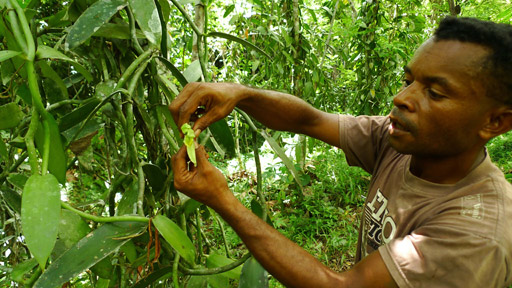
Gentle handling: A vanilla farmer pinches vanilla pods to help pollination. Farmers in Serui, Yapen Islands regency, Papua, are starting to cultivate vanilla for export to Europe and the US. (JP/ Prodita Sabarini)

Returning to the land may be one way to improve food security and welfare in Papua. The Jakarta Post’s Prodita Sabarini was recently among a group of journalists invited by the Britsh NGO Oxfam to examine a few of their programs in Serui and Jayawijaya regencies in Papua. Below is her report.

Seth Jenggo Mora sits under vanilla vines in Serui, a town in Yapen Island off the northern coast of Papua that resembles a bird’s neck. He sings a Yawaunat tribe song about the perils of leaving one’s home. “If I leave and return to my village/what will I have there?” he sings. “If we go abroad, when will we become a man?”

His red lips and teeth, reddened from chewing betel nuts for more than half a century, formed a smile as he finished his song. From Yapen where Serui lie to hamlets in the central mountains of Jayawijaya, traditional songs hold a deep meaning in Papuan culture. When reporters and NGO workers visited a village in Piramid district of Jayawijaya regency, Papuan men greeted visitors with tearful alments expressing their gratefulness of having guests from faraway places.

The song that Seth sung has relevance in today’s Papua, where urbanization has taken some of the young away from the rural areas to the big cities, leaving the traditional farms neglected.

As indigenous Papuans trail behind in education and economic power compared to migrants from Sulawesi, Java, or Sumatra, some young people who live in the cities end up turning to petty crimes or prostitution.

A large number of residents have contracted HIV, sending the number of infected people to the roof. According to the Health Ministry, Papua has the highest number of HIV infections in Indonesia, recording 7,572 cases between 1987 and 2012.

The Central Statistics Agency (BPS) said that urbanization in Papua has increased by 3.76 percent between 2000 and 2010, when 25.96 percent of the population, or 735,629 people, lived in cities, compared to 22.2 percent a decade before.

In Papua, more than 70 percent of the people live from farming. Taking extractive industries out of the equation, agriculture contributed 25.74 percent to Papua’s gross domestic regional product (GDRP) in 2012.

The mining industry in the resource-rich province contributed 46.52 percent to Papua’s GDRP in 2012, but absorption of local workers has been low. In 2010, only 26,747 people, mostly migrants, worked in extractive industries. In Timika, more than 70 percent of the population are migrants, according to the 2010 census.

As agriculture holds an important role in the lives of indigenous Papuans, developing the local economy by empowering farmers might help realize their basic rights for sustainable livelihood, according to Rio Pangemanan from Oxfam, which has a number of programs involving farmers in Papua.

Farmers and NGO workers in Papua report that a change of eating habits, with the introduction of rice as staple food from Java and with the government programs of rice for the poor, has jeopardized the self subsistence of villages and the livelihoods of young people in Papua.

Jayawijaya Agriculture Agency head Paulus Sarira said that five years ago, 94 percent of the population consumed sweet potatoes as their main staple. “Now only around 16 percent of the people consume sweet potatoes. Some have turned to eating rice,” he told a seminar on food security in Wamena early this month.

Chris Manuputty, the special assistant to the Jayawijaya regent for governance and social welfare, said that the unchecked change of eating habits from sweet potatoes to rice might lead to a food crisis in Wamena in the coming years.

Petrus Wenda, 70, a farmer from Yonggime, a hamlet in Piramid district in Jayawijaya, is one of the local farmers who mourn the loss of young people from his village. In his sweet potato farm in the Baliem Valley of Jayawijaya, Petrus told visiting reporters that sweet potatoes were part of his culture. Small framed, Petrus became animated in telling the story of the benefits of sweet potatoes, or hipere in the local language.

He stepped back and jumped over an irrigation ditch to better express his feelings. His voice became louder and his movements became more animated. “See my right arm? I can defeat five men with this,” he said while stretching his right arm. “See my left arm? I can defeat five more with this,” he said, reaching out his hand. Petrus then stretched his right leg and said “I can kick with this”, displaying how hipere made him strong and healthy. “Rice tastes good but it makes your stomach ill,” he said.

There is a reason why Petrus is so passionate about sweet potatoes. According to him and other elders, the introduction of rice has made young people leave the villages for the city to earn money so they can buy rice instead of preparing their land for the women to grow sweet potatoes.

“A lot of young people go to the city and become robbers. They live there [in cities] and they end up dead,” Petrus said. “Now young people don’t want to plant sweet potatoes. All of them think they can make money in the city. In fact, the money is here,” Petrus said.

The Jakarta Post | Reportage | Wed, March 27 2013

Paper Edition | Page: 8
Election Series: Striving for 30 percent quota for women

Nihayatul Wafiroh, 33, granddaughter of a popular Islamic boarding school founder in Banyuwangi, East Java, had turned down offers from political parties to contest past elections. This year she relented and agreed to run for next year’s general election.

The researcher and consultant, who will represent the National Awakening Party (PKB) for the East Java electoral district covering Situbondo, Bondowoso and Banyuwangi, said that she was once apathetic to politics.

Coming from a family of Islamic clerics that runs the Darussalam Islamic boarding school founded by Mukhtar Syafa’at, the biggest in Banyuwangi with around 4,000 to 5,000 students and alumni, some political parties see her as an asset, she said. She is also the first woman from her family to earn her Masters in the US (for Asian studies) and the first to pursue doctoral studies. PKB had been trying to persuade her for the last two years and she constantly refused until late last year.

What changed her mind? “Last year I conducted research for Search for Common Ground [an international conflict and peace-building NGO] and interviewed female legislators […] I traveled to Yogyakarta, Kendari and many other cities. The quality of a lot of the female legislators that I interviewed was very low,” she said. “In NTB [West Nusa Tenggara] a female legislator was very shy just talking to me! Who am I? Imagine her having to talk and debate in the council or with her party members that are mostly men,” she said over the phone.

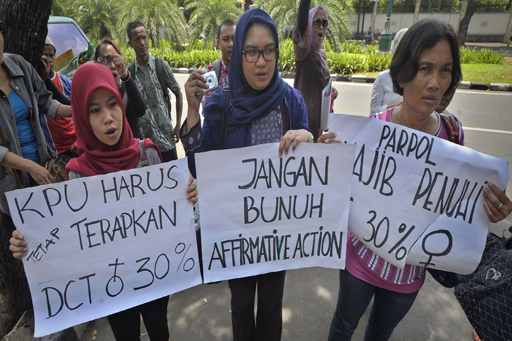
Indonesia is gearing up for the 2014 legislative election scheduled a year from now on April 9, 2014. Based on the latest amendment to the law on political parties, aimed to increase female representation in politics, the General Elections Commission (KPU) last month ruled that parties not meeting the 30–percent quota for female candidates would be disqualified from districts where they failed to meet the requisite number.

Nihayatul agreed to run on one condition — that her name should be on the party’s top list. “At least I should be number two on the ballot,” she said.

In the last election of 2009, and in 2004 after the law first mentioned the quota for women candidates for legislative bodies, many female candidates were among those who failed to be elected. While observers pointed to the fact that many were not popular, advocates for women also decried the practice of political parties of assigning them low numbers on the ballot, thus reducing their chances of people voting for them. The number on a ballot still determines a candidate’s chance to win a seat in the House of Representatives, while the number of votes designates their fate on the local legislative councils.

The question of quantity over quality became the hot topic raised by some political parties facing difficulties in reaching the quota. A number of parties have questioned KPU’s disqualification threat, arguing that parties would simply meet the quota irrespective of the quality of candidates. Activists have pointed out that political parties have had 10 years to prepare female cadres since the 2003 law on parties stated they “can” recruit 30 percent of women among their legislative candidates.

An NGO focusing on elections, Cetro, produced a book profiling 100 potential women interested in running for the 2004 elections. Cetro pointed out that many women were ready, as long as there was sufficient support from their families, communities and political parties, apart from national affirmative action policies.

Nihayatul’s political calling came from her personal experience that made her see the need for qualified female legislators. But many are still reluctant. A council member from Pasuruan, East Java, Rias Nawang Kartika of the Indonesian Democratic Party of Struggle (PDI-P) said that she would not run again for next year’s election. “That’s enough for me. I’d like to focus on my business,” the 51-year-old said. Her sister, who heads the regental branch of the Pasuruan Democratic Party, Evi Zainal Abidin, is applying as national legislator, only after being persuaded by many people, Rias said.

Political parties’ functionaries say there is a lack of interest in women to enter politics. “Many are reluctant, they think about their family, especially their children,” said PKS spokesman Mardani Ali Sera. The Indonesia Democratic Party of Struggle (PDI-P) head of cadre recruitment and selection, Idham Samawi, echoed the sentiment.

“Unfortunately, women are raised with the idea that they are konco wingking, confined only to housekeeping activities. We are trying to challenge this idea […] We have created special activities in which we want to convince women that they have the same opportunities and capabilities that men have,” he said.

Idham admits that there are more male party members than females, but added that PDI-P has numerous female cadres that have become regents and deputy governors. “Bantul regency, Yogyakarta, the place where I come from, has more than 30 percent female legislative candidates who are qualified,” he said.

PKS has also reached the quota, Mardani said. He said women make up some 37 percent of 15,462 candidates for national and regional legislators that the party plans to submit for the preliminary candidate list.

The head of the candidate selection task force of the Democratic Party, Suaidi Marasabessy, said last week that the party has exceeded the quota in total numbers, but not in some electoral districts. “If there are still some districts that have yet to reach the quota, we’ll move the candidates around,” he said on Wednesday. Both the Democratic Party and Great Indonesia Movement Party (Gerindra) said they are finding it difficult to reach the quota in rural electoral districts such as North Maluku.

The country has seen a gradual increase in female representation in parliament, but the percentage is still far from the 30-percent quota first introduced a decade ago in the law on political parties. The 2009 election brought 101 female legislators to the national parliament, or 18.04 percent of the total 560 seats. The 2004 election brought in 61 female legislators or 11.5 percent of the total number of legislators. Meanwhile, the 2009 election brought an average percentage of female representation to 16 percent at the provincial level and 12 percent at the regency and municipality levels.

Prodita Sabarini and Sebastian Partogi, The Jakarta Post | Reportage | Tue, April 09 2013

Election Series: Want to run? Show me the money first

When applicants to be legislative candidates for the Great Indonesia Movement Party (Gerindra) were interviewed, one of the questions they were asked was “Do you have enough money to run?” a Jakarta branch official said.

“Maybe they don’t have money. Or they do, but they borrowed it from someone,” said Syarif, the secretary of Gerindra’s Jakarta chapter. They should have their own money “because they have to order flags and T-shirts for their own campaign.”

It has often been said that politicians and elected leaders get involved in graft to pay off the debts incurred during their campaigns.

Running in an election costs money. Excluding the vote buying that sometimes besmirches elections, candidates need money to travel, put up banners and posters, order T-shirts, etc. “For people to know who they are, candidates have to campaign. Coffee for their team is the minimum expectation,” Syarif said.

“We ask candidates how many votes they expect to win and to calculate the cost of reaching that number of people,” he said.

Gerindra has yet decided how much money each candidate needs for the race. Syarif estimates that candidates running for local legislative bodies will need at least Rp 100 million (US$ 10,000), with that figure rising to about Rp 300 million for those running for the House of Representatives (DPR). Syarif said the costs were also needed to ensure the maximum presence and performance of party observers on voting day.

Former student activist Hendra Gunawan, cofounder of the Jabodetabek University Students Community Forum (Forkot) that helped topple Soeharto, reckons that having a lot of money does not necessarily determine the election result. “A lot of people perceive running for office to be very costly,” he said. Hendra is running for the Indonesian Democratic Party of Struggle (PDI-P) and tells of another candidate who spent Rp 20 billion on campaigning but failed to win a seat. Hendra did not mention how much he will spend on his campaign.

The Prosperous Justice Party (PKS) West Jakarta branch secretary Agung Setiarso said that the Islamic party receives donations from its widespread Koran reading groups. “We can raise Rp 1 million in each meeting,” Agung said. He also said that each neighborhood branch of the PKS usually has an election fund.

“Since most of the candidates are chosen by the membership, they automatically have to support their candidate,” Agung said. Agung is running for the Jakarta council, and he said that the party and the members would help him.

Prodita Sabarini and Sebastian Partogi, The Jakarta Post | Reportage | Tue, April 09 2013

Election Series: Parties struggle to seek right candidates

From April 9 to April 22 the 12 national political parties and three local parties eligible to contest the 2014 general elections are submitting their preliminary lists of candidates for the national and local legislative bodies to the General Elections Commission (KPU). The following is a glimpse of the recruitment process that involves the search for more than 240,000 candidates for over 20,000 seats. Based on interviews in Jakarta, The Jakarta Post’s Prodita Sabarini and Sebastian Partogi filed the following report.

In January, the Great Indonesia Movement Party (Gerindra) made an unprecedented move in the country’s politics: advertising in the national media to call for applications to run as legislative candidates with the party in next year’s election.

A number of other parties followed suit. The Democratic Party (PD) also made a public call with posters and banners as well as an announcement on their website with the tagline “The People Call for the Nation’s Best Sons and Daughters”.

Gerindra succeeded in attracting thousands of applicants, but it also raised skepticism of the effectiveness of such methods in netting qualified candidates.

The legislative election is one year from now and the General Election Commission (KPU) opens submissions for parties’ candidate lists starting from today until April 22. Ahead of the presidential election, the legislative race in April 2014 will contest over 20,000 seats for the House of Representatives and provincial, municipal and regental legislative councils (DPRD).

Over the past weeks the 12 national political parties and three local parties in Aceh province have been scrambling to prepare their shortlists. If all parties manage to get candidates for all available seats, there will be more than 240,000 candidates contesting the legislative elections.

Gerindra’s deputy chairman Fadli Zon said recently that nearly 3,000 people applied to run for House seats with the party. More than half of the applicants were new recruits from outside Gerindra, he said. But this also included those from parties that could not join the election, due to an increase of the electoral threshold to 3.5 percent of national votes. In the last polls, 34 parties joined the race.

Similarly, more than half of Gerindra’s 600-plus applicants for the Jakarta council were new recruits, according to Syarif, the head of Gerindra’s Jakarta chapter for its cadre division.

The Prosperous Justice Party (PKS) says it does not conduct recruitment that is open to the public. Its spokesperson Mardani Ali Sera said such methods would make the recruitment process seem like a regular job application. Similarly, a blogger in the citizen forum Kompasiana.com suggested anyone unemployed could apply to be a legislator.

Hopes are high that next year’s election will bring better legislators compared to the previous batch in the parliament and local legislative councils. The Corruption Eradication Commission (KPK) has urged parties to select better candidates, as legislators that were arrested and tried in court have been found guilty.

The recruitment and selection process differs from one party to the other. Parties that select candidates from within their political machine have started their preparation earlier than parties that recruit from the outside. The former tend to select candidates based on their track record in the party’s activities.

The Golkar party started preparations from February last year by holding functionaries’ orientation programs. “We don’t enlist candidates out of nowhere,” said Binny Buchori, head of Golkar’s Center for Membership Development and Leadership Training. “We have a rule that only cadres that have been in the party for five years and have gone through the functionaries’ orientation can run for legislative candidacy,” said Binny.

Incumbent legislators are also obliged to participate in the program if they want to reenter the race. Up to now, Binny said, around 2,500 cadres have graduated from the program. She said that more than 560 people are on the long list of candidates for the House.

Party leaders will select the names for the short list, based on their dedication to the party and their electability. Most of the incumbent legislators are running again. Binny, who failed to win a seat in the 2009 election, is among the prospective candidates.

PKS and the Indonesian Democratic Party of Struggle (PDI-P) started their preparations last November. PDI-P recruited prospective candidates from within the party from last November to late January. Its selection process started in February this year and included psychological tests, interviews, written tests and drug tests.

According to Idham Samawi, the PDI-P’s head of cadre recruitment and selection, party chairwoman Megawati Soekarnoputri had suggested the use of psychology tests in late 2011. “Ibu Mega was concerned over problems involving party members. Those who jumped ship to other parties, those implicated in criminal misconduct and those who bickered with fellow party members […] She decided that we needed to capture the psychological profile of party members,” Idham said.

He added that the test was also to determine candidates’ interest and capability.

Idham said that ideology was an important part in the selection process of PDI-P, known to be staunchly nationalist. He cited that if a prospective candidate appeared to have an agenda or a mindset about changing Indonesia into an Islamic country, the latter would not pass selection.

The PKS West Jakarta branch secretary, Agung Setiarso, said that in November the party started to announce in mosque gatherings that party cadres should recommend names to be listed for candidacy. He said that PKS’ selection process comes from the bottom up.

The West Jakarta branch fielded more than 30 names to recommend to the party’s Jakarta branch for the local councils and House seats.

PKS spokesperson Mardani said that they rank the candidates based on recommendations from each party level. A recommendation from an individual party cadre is worth one point; that of the party branch in the neighborhood unit is worth 10 points. The score multiplies by 10 up to the party’s national headquarters, where the recommendation is worth 10,000 points.

“You can’t really apply to be a candidate, you have to be chosen by others,” Agung said.

However a female prospective candidate for the PKS said that she approached the party leaders in Lampung province, expressing her interest in running in the election, and became short-listed.

So far PKS has fielded 15,462 prospective candidates for the parliament and local councils.

“We’re not forcing ourselves” to have candidates for all seats if applicants were not qualified enough, Mardani said. He added that 20 percent of their prospective candidates were from outside of the parties.

Parties that recruit from the general public started their recruitment and selection process this year. Gerindra started to publish its ads in the media late January and opened the application period for the whole of February.

Meanwhile, the Democratic Party made its public announcement in March, and opened the application process from March 6 to 31.

Officials of the Democratic Party’s recruitment division said that up to Monday some 1,070 applicants had applied to run for parliament seats. Some 30 percent of the applicants were new recruits.

The ruling party that has been plagued with graft scandals weighs the applicants based on their resume. Nurita Sinaga of the party’s recruitment section said applicants did not have to go through an interview or written tests.

“We rank them based on their resume, because from there we can judge their level of activity and networks,” she said.

The ranked list would then be submitted to the Democrat’s Supreme Assembly for selection.

Gerindra required applicants interested to run for national parliament seats to include videos of them meeting with the community.

The video shows whether the public is familiar with the applicant and whether the applicant can gather a crowd, Gerindra Jakarta branch secretary Syarif said.

Meanwhile, for applicants interested to run for local councils Gerindra required them to submit 1,500 copies of IDs, as proof that people in their respective electoral basis know them.

For the next step, Gerindra’s selection committee hires university students to verify the applicants’ diplomas and their local popularity. “You know there are a lot of fake diplomas out there, so the students go to the applicants’ university and ask whether they really graduated from those institutions,” Syarif said.

A student helping Gerindra, Lukman B Permana, said that some residents gave poor comments about applicants. “A lady said ‘Oh that guy, yeah, I know he’s running. He’s not active in the community.’ She seemed to dislike him a lot,” Lukman said, adding that the findings were submitted to the selection committee.

The last step for Gerindra was the interview. No less than the party leaders and founders — brothers Prabowo Subianto and Hashim Djojohadikusumo — were among the interviewers. “The interview for DPR candidates lasted for hours. The applicants came out red faced, some saying they regretted applying to Gerindra,” Syarif said.

Fadli said applicants to Gerindra included former authorities, celebrities and athletes. “There are also former bureaucrats, former soldiers and professors,” he said.

The race for legislative seats is set to be more competitive than at the last election. Parties are looking for votes from a society that is increasingly disenchanted by the poor performance of lawmakers.

Voter turnout has been dwindling from 93.3 percent in 1999, just after the fall of president Soeharto, to 84.9 percent in 2004 and 70.9 percent in 2009. The Indonesian Survey Institute (LSI) predicts that next year’s election will only see 60 percent of voters turn out.

Even Lukman, who traveled to corners of Jakarta to help Gerindra’s verification process, said that he would abstain from voting.

“I don’t believe in our system,” the student said. “Yet, this is the only one we have.”

The Jakarta Post | Reportage | Tue, April 09 2013

Election Series: Scrambling, grumbling on candidacy submission

Parties are grumbling while scrambling to submit their legislative candidate lists to the General Elections Commission (KPU). Parties have from today until April 22 to submit candidate lists for the elections on April 9, 2014.

Understandably, parties are complaining about the KPU’s last minute changes in candidacy requirements. The commission only recently confirmed the rule on the female candidate quota, followed by the cancellation of its ban against candidates for local posts joining the race for national legislative seats.

“We had to change quickly to accommodate that,” Prosperous Justice Party (PKS) spokesperson Mardani Ali Sera said last week. The Crescent Star Party (PBB) and the Indonesian Justice and Unity Party (PKPI) only received confirmation of their eligibility late last month.

The Democratic Party, the most successful in the last election, only finished verifying applicants’ documents on Monday. Suaidi Marasabessy, head of its candidate selection team, said the KPU’s late release of the 2014 application forms held back their recruitment process, which started on March 6. They have around 1,070 prospective candidates, he said.

Most of the Democratic Party’s incumbents plan to run again. Suaidi said that 136 of the 148 party legislators have submitted applications to the selection team. Mardani of the PKS confirmed that most of their legislators are reentering the race too.

Among those applying to run for a different party is former PKS legislator M. Misbakhun, who has applied to run for the Golkar party.

Prodita Sabarini, The Jakarta Post, Jakarta | Headlines | Tue, April 09 2013

Paper Edition | Page: 1

Reports from Papua

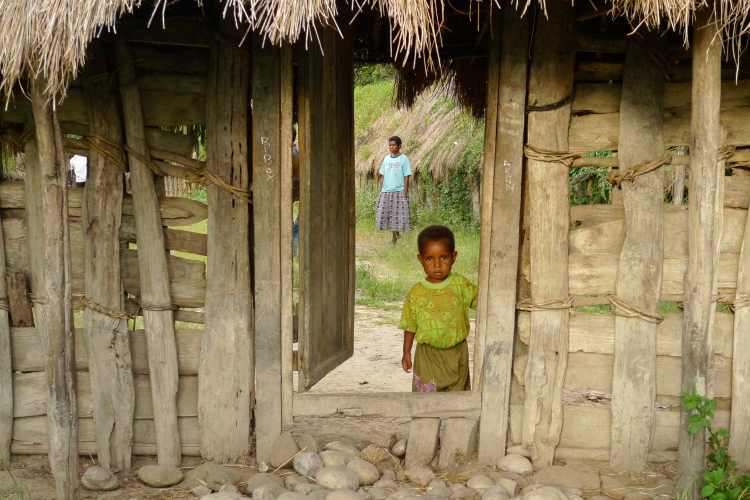
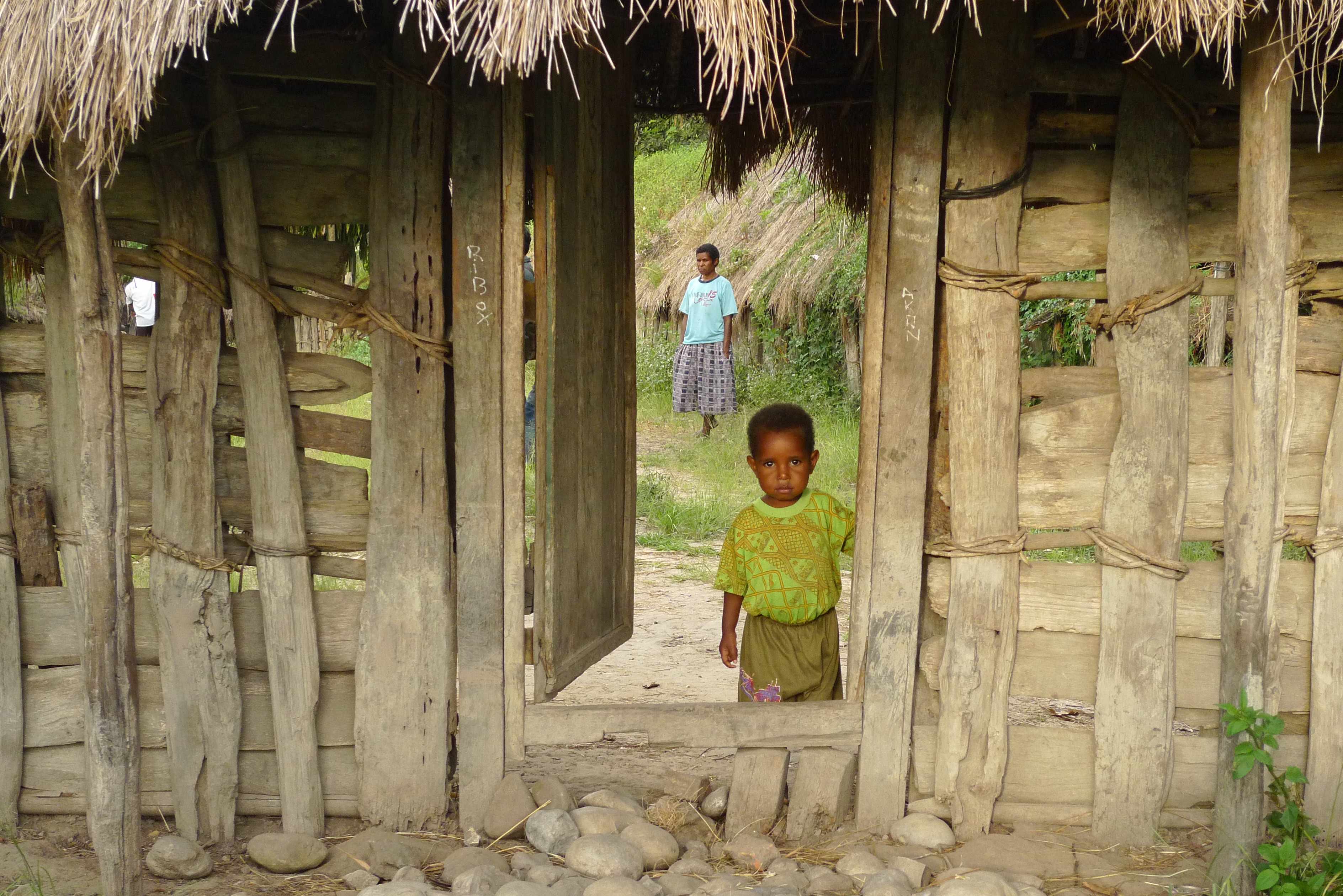
A little boy looks out from the gate of his house in Jiwika, Jayawijaya Papua. Photo by Prodita Sabarini

I’ve always wanted to go to Papua, ever since I read an opinion piece in The Guardian by exile Papuan independence leader Benny Wenda two years ago. It’s such a faraway place from where I grew up and the tales that have been told to me is also so far from the reality there. When I finally set my foot to Papua, the land that people call a piece of heaven on Earth, I was mesmerized by its beauty. The layers and layers of undulating hills and valleys covered in mist was like out of this world. But, it’s a sad place too, the people witness and suffers from violence from the military and injustice from the Indonesian government. I’m Indonesian, Javanese, but when I traveled to Papua, I question the insistence of the government for a unified Indonesia, when it takes away the right to self-determination of peoples. How come an imaginary line be so important as to keep people in chains? Going to Papua, I felt like traveling to time and space, to Java in Colonial times, when all the people despised the Dutch Colonial power and yearned for freedom. But then, it all makes sense why they want to keep that imaginary line, to be able to take away what they wouldn’t be able to take if the line disappears.

Click here for the links

https://proditasabarini.com/2013/04/11/papua-series-papuas-politics-a-case-of-homo-homini-lupus/

https://proditasabarini.com/2013/04/11/papua-series-traditional-voting-system-may-create-conflict-customary-leaders/

https://proditasabarini.com/2013/04/11/papua-series-collective-grief-leads-to-dream-of-freedom/

Papua series: ‘Collective grief’ leads to dream of freedom

For Papuans, their graves are a reminder of the grief that besieges their land.

In front of the Justice and Human Rights Advocacy Network office in Wamena is the grave of Opinus Tabuni, a member of the Papuan Indigenous Council, killed in a military crackdown on World Indigenous Peoples’ Day in August 2008.

Human rights activist Theo Hesegem sat just a few feet from the grave. He recently said that the government’s attitude to the complex social and political problems in Papua would not end the violence.

In 2011, UP4B was established to accelerate development and growth in the most impoverished region in Indonesia. The hope was to improve the welfare of indigenous Papuans and quell their discontents.

But the source of discontent is not about having food on their plates. Theo said that Papuans’ main problem “is not eating and drinking. It’s not about welfare. We don’t know how many children, how many families, how many people have been shot or killed — that’s the problem”, Theo said.

Researchers at the Indonesian Institute of Sciences (LIPI) believe that decades of political violence has led Papua to a collective memory of grief, or memoria passionis.

While the government attempts to speed up development in the region, it retains a military approach. In 2009, security forces killed Free Papua Movement (OPM) leader Kelly Kwalik, and despite of his death, sporadic attacks from the OPM continue. According to the National Intelligence Agency (BIN), last month’s ambush was partly due to rebel fighters unhappy with a new military district command (Kodim) in Puncak Jaya.

“People can’t assume that the issue of Papua is finished. It’s about ideology. You can’t shoot a person and say his ideology is dead. There are other people. That person has children who will continue to think that ‘my father was shot because of Papua’,” Theo said.

Melianus Wantik, 29, member of the National Committee for West Papua (KNPB) which campaign for secession from Indonesia, said that the grave of They H. Eluay, the assassinated leader of the independence movement the Papua Presidium Council, was an important place for KNPB.

Young activists in Papua established KNPB after Theys was killed. During the founding of KNPB Melianus said they camped at Theys.

KNPB members themselves are now on the police wanted list, accused of shootings and bombings. KNPB leader Victor Yeimo reports that 22 KNPB members were killed last year, including the KNPB leader Mako Tabuni.

For Papuan Indigenous Council (DAP) Baliem area head, Yulianus Hisage, the killings no longer have a shock effect on him. “Killing people, shooting people in Papua: It’s normal. For us, the indigenous community, it’s normal because it’s not the first time we’ve seen it,” he said.

Yulianus, who is part of the Jakarta-based conflict resolution NGO, the Titian Perdamaian Institute and often travels outside of Papua, does not feel safe in his own land. “When I leave Papua, for Yogya I feel safe. Back in Papua, I worry when I will be killed,” he said.

From various sources

From various sources

Prodita Sabarini, The Jakarta Post | Reportage | Thu, March 28 2013

Paper Edition | Page: 21

Papua series: Traditional voting system may create conflict: Customary leaders

Look who I voted for: A woman in Woma district, Jayawijaya regency, holds her ballot up before placing it in a noken (traditional Papuan woven bag) in the January gubernatorial elections. (Antara/Rico)

Papuans have been allowed to reject secrecy as one of the principles of general elections. The open-ballot system is permitted there, but customary leaders say the open election system as it stands in Papua today has no roots in tradition and could easily cause conflicts in the already restive province.

The heavily militarized province held its gubernatorial election on Jan. 29 using open ballots. Known as the noken system, its name is taken from the traditional woven bag that replaces the ballot box. During the election that saw Lukas Enembe and Klemen Tinal victorious, voters in Papua placed their ballots in one of several noken. The number of bags corresponds to the number of candidates. The bags are hung in the open for all to see.

“It’s a dangerous system,” Damianus Wetipo, a polling station official in Asolokobal, Jayawijaya said. He said that lack of secrecy meant that village or customary leaders were able to pressurize their people to vote according to his choice, and if there was any defiance, people could end up fighting each other.

The Constitutional Court (MK) recently rejected a lawsuit against Papua General Elections Commissions (KPUD) by five campaigns in the Papua gubernatorial race. They claimed that fraud had been widespread in the election and that the noken system was undemocratic.

Under the 2007 Law on General Elections, the principle of secrecy is part of elections, along with elections being direct, public, and free.  However, MK judges ruled that the noken system was not a violation, stating that it was part of the Papuan culture.

Traditionally decision-making in Papua has been a collective consensus, in which the tribal head can be a proxy for his tribe. The noken system was invented to translate this to modern election practice, where every citizen has suffrage. Each citizen is expected to place the ballot themselves.

The Papuan Indigenous Council (DAP) Baliem region head, Yulianus Hisage, said that the noken system was unknown to their tradition.

Damianus said that the noken itself was part of their culture but having people choose a bag to place a vote, to and thereby choose their leader, was not.

Damianus said that Papuans, many in rural and isolated areas, have been used to the ballot box in elections for a very long time. He recalls that the noken system was first used during the first free presidential election in 1999 after the New Order authoritarian era, but he was unsure of the reason for the change of system.

The village officials said that the system holds a huge potential for inciting conflict. In regency elections, Papuans can become fanatical and very belligerent in their support of their candidates.

Indeed, it is not just in the regency elections that violence can flare up. During the gubernatorial election the system took its toll. Tolikara regency councilor Husia Yosia Karoba from the Golkar Party was beaten to death by Democratic Party supporters, the winners of the election. Husia reportedly urged people to vote for the Golkar candidate.

The open system is not the only problem with Papua elections. The Democracy for Papua Alliance (ALDP) reported electoral fraud in the handling of leftover ballots. The fixed voter’s list was, they claim, higher than the actual number of voters. This challenge was echoed by five candidate pairs and went all the way to the Constitutional Court. The court explained that the number of eligible voters was based on a census by the Papua Population and Transmigration Office.

ALDP reported that in Hesatum village the number of ballots was around 300, while the actual village population was 138.

The village officials then confirmed the inflation of the voter list. Damianus knows all the people living in his village, but the names in the list included people from a neighboring village and those who had passed away. “Rocks and trees were given a name and put on the list,” he said jokingly.

The unused ballots were placed in Lukas and Klemen’s noken, who eventually won.

Village heads say they were pressurized to cheat as the regency has power over their positions. Moreover, defying the directives runs the risk of having their children unable to get jobs in government. Most educated indigenous Papuans look for jobs in the public service, which creates a dependency on the whims of political elites.

Prodita Sabarini, The Jakarta Post | Reportage | Thu, March 28 2013

Papua series: Papua’s politics, a case of ‘homo homini lupus’

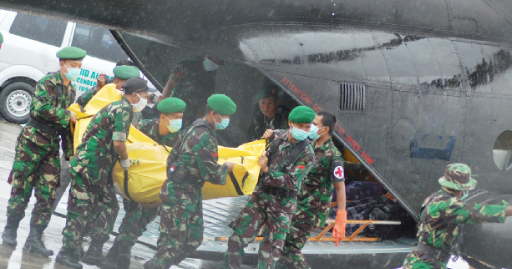
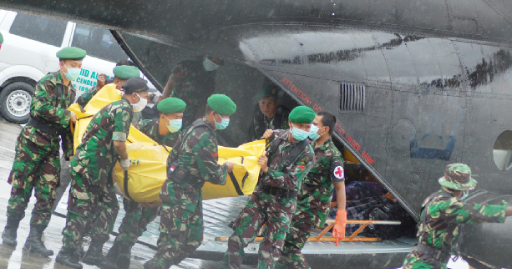
Going home: Soldiers carry the body of one of the victims of an ambush at Sentani airport, Feb. 24. Authorities said the military wing of the Free Papua Movement (OPM) attacked soldiers and civilians in Sinak in Puncak regency and Tingginambut, Puncak Jaya regency. Eight soldiers and four civilians died in the attack. (Antara/Anang Budiono)

Papua continues to be plagued by violence. Last month gunmen shot at an army helicopter, as the military was to evacuate victims of an ambush which killed eight soldiers and four civilians. Activists say the solution lies in a mediated comprehensive dialogue, but the government rejects any attempt to revisit history. The Jakarta Post’s Prodita Sabarini reports on the political dynamics after a visit to Wamena in Jayawijaya regency.

Describing the violent political situation affecting his people, a young indigenous Papuan man quoted a Latin saying: Homo homini lupus.

“Man is a wolf to [his fellow] man,” said Demianus Wasage, 28, a Papuan from the Yali tribe. The provinces of Papua and West Papua are Indonesia’s part of New Guinea, a resource rich, bird-shaped archipelago north of Australia. The region has a history of social unrest and has been home to rampant military abuses since part of it officially became part of the country in the early 1960s. More than four decades later, and after being given special autonomy status, the provinces remain gripped in a spiral of violence, with external and internal discord permeating Papuan politics.

Demianus was born in a rural village in what is now Yalimo regency. He said that earlier generations still practiced cannibalism when he was growing up. He wore the koteka, Papua’s penis gourd, until he was in elementary school. He said he was glad that missionaries brought Catholicism to his village when he was growing up, so he did not have to follow the ancient practices he disagreed with.

He was proud of his traditional garb, which he sometimes used when accompanying foreign tourists in Papuan villages. “I’m not ashamed of wearing a koteka, I’m proud of my culture,” he said.

Many Papuans believe that their black skin and Melanesian culture distinguish them from the Malay majority in Indonesia. Academics say gradual preparations for Papuan independence by the Dutch in the 1950s also developed a Papuan sense of nationhood. But the US, eager to stave off Soviet influence in Indonesia, brokered a New York agreement between the Dutch and Indonesia in 1962 that officially transferred Papua to the control of the Indonesian government. What is widely believed to have been a sham of a referendum in 1969 stopped short of any chance of Papua being recognized as an independent territory by the United Nations. Demianus said that Papuans were not included in the negotiations that decided their fate. “Even until the end of time, Papuans will always want to be free,” he said.

In February this year, an attack by the Free Papua Movement’s (OPM) military wing, the Papua Liberation Army Front (TPN), killed eight Indonesian soldiers and four civilians in Puncak and Puncak Jaya regency, strongholds of the TPN, authorities said the attack was the latest incident in four-decades of sporadic fighting between the Indonesian Military (TNI) and Papua’s rebels.

Human rights defender Theo Hesegem from the Justice and Human Rights Advocacy Network said that OPM personnel hiding in the jungle viewed the military and the police as their enemies.

“They [the Indonesian security forces] are armed and the OPM are armed too,” he said. “But […] whether people passing by are soldiers, construction workers, or business people, as long as they have straight hair the OPM sees them as Indonesians and shoots at them,” he said.

According to Indonesian Institute of Sciences (LIPI) researcher Adriana Elisabeth, unlike the former Free Aceh Movement (GAM), which had a centralized command, the OPM is fragmented into several guerrilla groups and small organizations. The organization is heavily based on the tribal identities of the leader and members.

Yulianus Hisage, the Baliem area head of the Papuan Indigenous Council (DAP), an organization of customary and tribal leaders that advocates for indigenous rights and Papuan culture, said studies showed that Papua had around 250 ethnic tribes. “In reality there’s more than 300,” he said.

Relations between tribes in Papua were complex, Yulianus said, with conflicts settled through tribal warfare. In the Baliem Valley alone, in the mid highland region, a hotbed for OPM guerrillas, there are 14 tribal alliances.

In 2011, when the third Papuan People’s Congress was held, declaring Papua and West Papua independent from Indonesia, the congress appointed DAP leader Forkorus Yaboisembut as president. However, Lambertus Pekikir, an OPM/TPN leader in Keerom regency, Papua Province, did not acknowledge the congress. Forkorus is now imprisoned for treason and three people were killed during the authorities’ crackdown on the congress.

More moderate groups gathered under the Papua Peace Network (JDP) believe that dialogue is the key to peace in Papua. The LIPI’s Adriana said that for this to work, the Indonesian government should first halt its military approach to the provinces. Theo said international mediation was required to resolve the issue. “If it’s just Indonesia, the odds [for resolution] are slim. We’re talking about ideology. Indonesia wants a unified Indonesia, while Papuans want independence. The dispute would never end,” Theo said.

Amid a lack of cohesion in Papuan communities, the National Committee for West Papua (KNPB), an independence campaign movement led by young Papuans, has emerged as a formidable component, with strong connections to the Papua independence movement overseas. Catholic priest and award-winning human rights activist John Jonga said the group was “Quite a brilliant movement”.

“They have a lot of creativity, they can gather people together and they are very firm in their stances. It’s clear they have overwhelmed the government — especially the military and the police — because their number is huge,” John said.

Melianus Wantik, a self-styled touring ambassador for the KNPB, said that the organization was born after seeing the Papuan independence movement lose its leader with the assassination of Theys H. Eluay, who was the leader of the Papua Presidium Council in November 2001.

“The KNPB was born because we saw that Papua needed a rational political leader. Not someone who is factional, egoistic and doesn’t stand with the grassroots,” he said.

In its heyday, the KNPB organized independence rallies across the Papua region, with thousands of people — many in traditional garb — taking part. Their grass roots campaign in 2011 was connected to the Free West Papua campaign led by British-based Papuan exile Benny Wenda, and the rallies coincided with an international conference of parliamentarians on Papuan independence.

“Our connection with Benny is very strong. We work based on his instructions with the International Parliament for West Papua and International Lawyers for West Papua,” Melianus said.

But since the killing of KNPB leader Mako Tabuni, the organization has adopted a low profile in rallies. In 2011, Papua was wrought with cases of violence that the police dubbed as being perpetrated by “unidentified assailants”.

A spate of killings in June and August 2011 saw more than 20 people killed. The police have linked the violence to the KNPB and have said they would use the 2003 Terrorism Law against those attacking police stations. However, Melianus said there was no evidence and the allegations were only aimed at discrediting the movement.

Human rights activists have criticized the police’s heavy-handed approach toward KNPB members. KNPB leader Victor Yeimo reported that in 2012, 22 KNPB members had been killed. Papua Police chief Insp. Gen. Tito Karnavian has defended the Terrorism Law in Papua by saying that it was required to ensure that criminals did not hide behind veneer of the freedom movement.

Benny recently toured Australia, New Zealand and the Pacific island countries to rally support for Papuan independence. But in Papua, the KNPB held no rallies. “We should have shown support because every time Benny visits these countries, we should go on the street and rally, but our room for democracy is blocked. The Indonesian government sees us as terrorists, [guilty of] treason and separatism. Our room for movement is shrinking,” Melianus said.

Catholic priest John said that in Jayapura, during Mako Tabuni’s leadership, the KNPB sometimes used intimidation so that people would join the rallies. “In Jayapura, they forced Papuans to follow them. Sometimes it involved beating people. Some journalists were not only intimidated but also beaten,” he said.

But John strongly doubted that the killings and bombings in Papua were linked to the KNPB. “They’re the ones who are getting shot at,” he said.

John, who has served in Papua for more than 25 years, said that Papuans wanted independence. “This spirit of independence is supported by social and economic problems, violence, violations of human rights and indigenous peoples rights, as well as the exploitation of resources. So in meetings, they express that,” he said.

The priest also spoke of another big problem plaguing the provinces — the corruption of local Papuan politicians. Since Papua received special autonomy (Otsus) status in 2001, only indigenous Papuans are eligible for regional head positions in the provinces.

The government has so far disbursed Rp 30 trillion (US$3.08 billion) in Otsus funds to West Papua and Papua provinces to speed up development. But more than a decade later, Papuans remain the poorest in Indonesia. The Supreme Audit Agency (BPK) found that Otsus funds of Rp 66 billion in 2010 and Rp 211 billion in 2011 were unaccounted for.

According to John, pro-independence Papuans must also face their own political elites that are benefiting from their current positions as regional heads. “A small number of people will feel that their finances or positions are being threatened. If their main concern is their own welfare, then these people might even kill their own people,” he said.

John said that in Indonesia, people supported and opposed Papuan independence for various reasons. “But Papuans themselves say that whatever happens, be it famine or civil war, these are problems that can be dealt with later,” he said. “So, the future is full of question marks.”

The Jakarta Post | Reportage | Thu, March 28 2013

Paper Edition | Page: 21

Indonesia’s political parties gears up for next year’s legislative election

Checks and balances: The Democratic Party selection team checks documents submitted by would-be legislative candidates at the party’s headquarters in Kramat, Central Jakarta, on April 3. Eligible political parties have until April 22 to submit their legislative candidacy lists for the 2014 election to the General Elections Commission (KPU). JP/Prodita Sabarini
I covered political parties’ preparation in recruiting and selecting prospective legislative candidates for next year’s election.
Sometimes watching the people sitting in parliament feels like watching a comedy show, until you realize that no one’s joking. Then you realize it’s more like watching a horror movie, and you get spooked a bit, until you remember that what you’re seeing is not a movie, it’s real life. Anti pornography law? Remember the porn-watching lawmaker from the Islamic Prosperous Justice Party nonetheless – after they release the anti-porn law? And now all this ridiculousness on witchcraft and living outside of marriage being criminalized in the Criminal Code.
So, I was quite excited covering the whole process of choosing candidates of people that will REPRESENT other people in deciding how we run this country. Admittedly, a lot of people don’t care about who will represent them in the election. So many say they’ll abstain from voting because they don’t trust politicians. But maybe if we pay more attention to this, we’ll actually can get people who really do care into the parliament.
I got help from The Post new cub reporter in covering for this reportage. Here are the reports