Tash Aw: Mapping invisible worlds
JP/Stanny Angga
JP/Stanny Angga

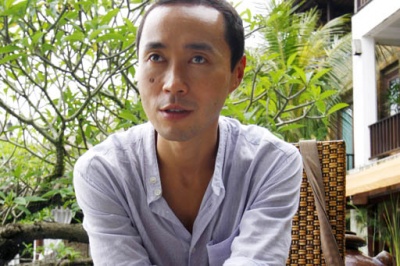
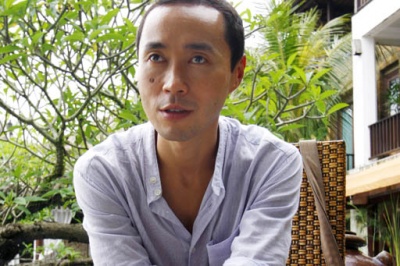
Malaysian author Tash Aw grew up knowing Indonesia was his country’s closest and most influential neighbor. But when he moved to England for college, he found there was little mention of Indonesia in the Western world.

“It was virtually invisible,” Aw said. This inspired him to title his second novel, set in 1960s Indonesia and Malaysia, Map of the Invisible World. “This was my way of drawing attention to Indonesia, of mapping it,” Aw wrote in an email recently.

Aw’s debut novel, The Harmony Silk Factory, won the Whitbread Award and the Commonwealth Writers’ Prize for Best First Novel in 2005, and was longlisted for the MAN Booker Prize. Set in 1940s Malaya, The Harmony Silk Factory has become an important voice in telling a Southeast Asian story to an English-speaking audience. With his 2009 Map of the Invisible World, Aw returns to Southeast Asia, this time further south to Indonesia.

Map of the Invisible World tells the story of two orphaned brothers. A wealthy Kuala Lumpur couple adopts the older brother, Johan, while the younger, Adam, is adopted by a Dutch-Indonesian man. The story begins on an island east of Bali, where Adam witnesses Karl, his adopted father, being arrested by the army during the time of Sukarno’s anti-imperialist rhetoric. Adam is an orphan once again, and journeys to Jakarta, meeting Karl’s former flame, Margaret, a university lecturer, and her assistant Din, who entices Adam to join in revolutionary struggle.

The title of the novel recalls the plight of its main characters, Aw says. “All the characters in the novel are physically present in one place, but their emotional lives are caught in another place, another time — in another world that has ceased to exist, or which may never have existed, a world that is now invisible,” he said.

Aw’s characters view home as an abstract and fragile thing. He may have drawn this from his own life experience, of finding a home in another country while continuing to view Malaysia as home. Aw writes about Adam’s view of home: “In those days he did not yet understand that Home was not necessarily where you were born, or even where you grew up, but something else entirely, something fragile that could exist anywhere in the world.”

Aw moved to England when he was 19, to study law at Warwick University and Cambridge University. He stayed in England, working as a lawyer for several years while working on his writing — a childhood ambition. Aw completed a degree in Creative Writing in 2002 at the University of East Anglia.

Asked where his home is, Aw’s reply was: “Home — that is the million dollar question for me!”
Aw says he owns an apartment in London, which makes London technically his home. “But I spend a lot of time in Kuala Lumpur and the rest of Southeast Asia. I think Malaysia will always be my point
of reference.”

Aw’s story of two brothers setting off on different paths is also a metaphor for how Aw views Indonesia and Malaysia.

“The two countries were often thought of as ‘brothers’ — with a shared language and religion and set apart from the other non-Muslim countries in Southeast Asia. We share music, TV and film. But it also struck me that in many fundamental ways the two countries could not be more different, both in terms of history and everyday contemporary life,” Aw says.

“So I decided to write a novel about two brothers and two countries, whose differences were most clearly highlighted in the 1960s during the time of Konfrontasi. The 1960s were a very turbulent time for Southeast Asian countries, most notably Indonesia, which is why it seemed the natural starting point for the novel.”

Aw has traveled extensively in Indonesia, including to Lombok. Last month, Aw took part in the Ubud Writers and Readers Festival in Bali.

Aw recognizes the love-hate relationship between Indonesia and Malaysia. The two countries have had bumpy relations, starting with Konfrontasi when Sukarno waged a war against Malaysia under the pretext that the latter was a neo-imperialist puppet.

In recent years, more spats have occurred because of misunderstandings about the use of traditional music and dance, or because of unclear borders. On the web one can gauge the strong animosity between the two countries, with harsh words and name calling on both sides.

Aw likens this to sibling rivalry.

“The animosity between Malaysia and Indonesia is, and always has been, a kind of sibling rivalry. I think it is the kind of tension that might arise if two children who shared much in common happened to have very different paths in life. Essentially I think it boils down to wealth, and how the two countries see themselves in relation to each other.”

Aw said Indonesia has had a much tougher time, particularly in the 20th century. “History has not been kind to Indonesia — Malaysia has had much more luck in this respect.”

Malaysia’s smaller size made its problems smaller in scale, he said. “We were able to become relatively prosperous and have more of a middle class earlier than Indonesia. But Indonesia has a much
older, richer and more varied history and culture — it is, after all, a far bigger country.

“I sometimes think Malaysia knows this and has a kind of inferiority complex that manifests itself in a kind of nouveau-riche arrogance,” he adds.

Despite the seeming animosity, Aw said ultimately there was more closeness between the countries than tension.

Prodita Sabarini, The Jakarta Post, Ubud, Bali | People | Thu, November 04 2010
Etgar Keret: Israel’s urban challenge

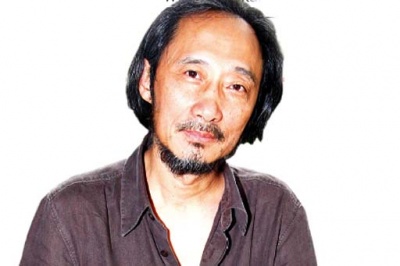
Israeli writer-director Etgar Keret, 43, said Jewish people usually gave their children names with meanings.

Keret’s first name means challenge. His last name means urban. “So my name means urban challenge,” he said.

He explained this in a prelude as to why his short stories are mostly based in urban settings. Keret is Israel’s best-selling short story writer who writes absurd and humorous tales of urban life in Israel. His works have been published in 30 languages and are included in Israel’s high school curriculum.

Having lived in Tel Aviv all his life, an urban life is the only one he knows, he says. “I think there’s something really urban about my mind… I love nature. But the most interesting thing for me is people. That’s why an urban setting is something that I like because you condense people together in small spaces. It heightens tension. It kind of pumps it out. So I like writing about urban life. And it’s also the only life I l know,” he said.

Keret was in Ubud, Bali, recently for the Ubud Writers and Readers Festival. When it was suggested he would find Jakarta interesting, he said that his visa for Indonesia
only allowed him to travel to Bali for the festival. Coming from a country that does not have a bilateral relationship with Indonesia, Keret jokingly says: “I was born with the wrong passport!”

He was almost could not attend the festival and had to wait five days in Bangkok for his pass, “But I’m really glad I made it,” he said. When he received the invitation to the festival, he said he was very excited. “Because [Indonesia] is a part of the world that I can’t travel to normally. I was very curious,” he said.

Sitting in an Ubud restaurant over a plate of Greek salad, Keret said that one of the purposes of his writing was to humanize Israel in the eyes of people. “Not to make us saints,” he points out “but to make us human.

“Regardless of all the trouble that I have in my country, we are people. Some of us are better, some of us are worse,” he said.

Keret, a son of a holocaust survivor, has for a long time been a spokesman for peace, writing witty and poignant criticism in his op-eds about the war. In a 2007 interview, he once said that his family was like a microcosm of Israel. Keret, the youngest of three siblings went into the arts. His stories do not show any political leanings, never putting things in black or white. His brother, currently living in Thailand, is a peace activist who founded the legalizing marijuana movement in
Israel. His sister became ultra-orthodox. Her 11 children are forbidden on religious grounds to read Keret’s graphic novels, which he dedicated to them.

Keret said his wish was to reach out to different communities. “Just so they have a glimpse of how [Israelis] live,” he said.

His short story collections have entered bookstores in Muslim countries. “I’m the only Israeli writer since the second intifada [whose works are] translated and published in Palestine,” he said. His books are published in Turkey as well.

Keret’s works have been translated in to 30 languages but the Indonesian language is yet to be one of them. “Nothing would make me happier to have an Indonesian one,” he said.

Reading Keret’s short stories, one sees the high-paced energy of urban life situations in his flowing sentences. But Keret’s surreal imaginations are what make his stories special.

During the festival opening, Keret read out his short story Fatso that tells of a man whose girlfriend morphs into a hairy man with no neck who wears a gold ring on his pinkie finger.

Fatso is a quirky love letter to Keret’s wife, Shira Geffen. They live in Tel Aviv with a 5-year-old son. Keret has co-directed the film Jellyfish with Geffen, based on a story that she wrote. The film went on to win best first feature at Cannes Film Festival.

Keret’s wild imagination in Fatso is only one example of how Keret’s mind explores the absurd. In Second Chance, he tells a story about a service that allows people to experience events and emotions that would occur if they had taken a different path in their lives simultaneously to the life they experience now. In Nimrod’s Flip Out, which also became the title of one of his short-story collections, he tells a story about how Nimrod’s suicide affected three friends who all experience mental episodes.

Keret said that writing had taught him to learn more about himself. Keret said he was an angry person when he was young. “I couldn’t articulate it but I had feelings that maybe I was being self-destructive. I just wanted to do something with my life. But I didn’t know how to do it. It was very frustrating,” he said.

Keret said the fact that he did not know what he wanted to be when he grew up “stoked deep fear in me”.

“Aggression usually comes from fear and incompetence. And I think writing taught me to be less afraid. And I became less angry. I know more about myself because of it.”

Keret has published his latest collection of short stories this year called Suddenly, A Knock on The Door.

He said that he would be traveling and has yet to think about his next project. “Between projects, I’m free falling. I don’t know what’s going on,” he said.

“There is something about writing. It’s like a gift. You can’t force people to give you a gift. If it comes, it comes,” he said.

Even now, Keret said, he felt uneasy about calling himself a “writer” on forms that ask his profession. “It’s what I do now. I don’t know if I will do it later. You know it’s like somebody who’s happy. They’re happy now. But who knows if they will be happy later.”

Prodita Sabarini, The Jakarta Post, Jakarta | People | Sat, October 30 2010

Ma Jian: A note to remember

JP/Stanny
JP/Stanny

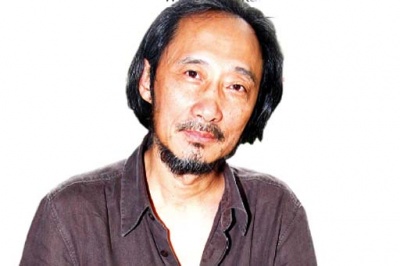
Chinese writer Ma Jian, 57, whose works are banned in his home country, never tires of reminding people of the Tiananmen Square massacre in Beijing, which took place more than 20 years ago.

His latest book, Beijing Coma, recounts the story of a young student activist who falls into a coma after being shot during the Tiananmen protests. Through Ma’s protagonist Dai Wei, the reader finds out what it must have been like to grow up under communist rule.

For Ma Jian, who was present during the 1989 protests, his protagonist’s comatose state is a metaphor for the Chinese people, who after 20 years have either forgotten or ignored the death of the thousands of unarmed citizens on June 4.

“This is a problem in Asia as well as China. As long as people’s living standards improve and they live a comfortable life, they don’t care so much about abuses of human rights,” Ma Jian said recently in Ubud, Bali, as translated by his wife Flora Drew. He noted that many East Asian countries had grown economically but remained undemocratic.

Ma said he wrote Beijing Coma “not only to remind the young people [of China] about this history they may not know about but to also tell them about the idealism and optimism of young people 20 years ago”.

But given Ma’s books are banned in China, youth there is not able to access his books freely. Ma, who lives in London, said he knew more about what was happening in China than the people living there because of the government’s tight policy on information dissemination. He also has more freedom to express his views compared to his friends who live in China.

“Some writers in China perhaps feel they have freedom of expression – that things have improved but they are fooling themselves,” he said.

“Young Chinese writers have grown up in this culture. They are somehow able to circumvent it through the Internet but they can’t use sensitive words, otherwise access to their content will be blocked,” he said.

Ma hopes the Internet will help Chinese youth read his works.

Ma and Drew attended the Ubud Writers and Readers festival. The day Ma talked to The Jakarta Post, the Norwegian Nobel Committee announced imprisoned Chinese and human rights activist and writer Liu Xiaobo had won the Nobel Peace Prize.

“These things indicate the West is putting pressure on China to respect freedom of speech,” Ma said.
Ma moved from Beijing to Hong Kong in 1987 shortly before his books were banned there. He now lives in London with Drew and their four children. Every time he came back to China, he was under constant monitoring, he said. In 1989, he joined the student protests, but a few days before the day of the massacre, Ma returned to his hometown in Qingdao as his brother fell into a coma after an accident.

Ma said that had he stayed in China, one of two things would have happened. “One, I would have remained a writer and would be in jail. Or, I would have given up writing altogether because if I cannot write freely, I would prefer not to write.”

Ma met Drew in 1997 on the night Hong Kong was handed over to China. Drew, who had studied Chinese in London, was at that time making a documentary for an American television station. She read Ma’s books, which he showed to her, and was convinced they needed to be translated into English.

After Ma moved to London, Drew translated his memoir Red Dust for almost two years while he was writing. The book about Ma’s precarious three years of traveling in China in his early 30s, at a time where travel permits were required to travel anywhere inside China, went on to win the Thomas Cook Travel Book Award.

Red Dust was published in China under a pseudonym, but only after half of the content was censored, Ma said.

Ma set off on the journey because he wanted to see China through his own eyes. He was a state journalist before and explained everything that was shown to him was pre-arranged to paint a rosy picture. When he reached Tibet, he penned his findings in his first book Stick Out Your Tongue, about Tibet’s underbelly.

China is still Ma’s spiritual homeland, which he will continue to stay connected to. He said living away from China helped him see the country more clearly, like looking at a mountain from afar.

Prodita Sabarini, The Jakarta Post, Ubud, Bali | People | Thu, October 21 2010

Teater Garasi: Embracing the in-between

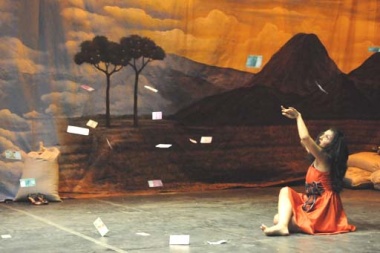
Drops of fortune: Actress Hanny Herlina looks up at money falling from the sky. Garasi actors impersonate Tarling-Dangdut performers, who in real life, receive money thrown or given to them by the audience. — Photo by courtesy of Festival Salihara

The sight of a big-eared red Teletubby with a Mohawk pushing dangdut singing women on a yellow makeshift boat into a crowd of amused art lovers is bound to create a surreal and absurd image.

So do women performing the traditional tari topeng (mask dance) using plastic masks of robot action heroes to the otherworldly sounds of blipping techno music.

But, these vignettes, part of experimental artist collective Teater Garasi’s latest play Tubuh Ketiga: Pada Perayaan yang Berada di Antara (The Third Body: On Embracing the In-Between), are not mere imaginary visions popping out from the minds of the Yogyakarta-based collective.

Directed by Yudi Ahmad Tajudin who collaborated with members of Teater Garasi, Tubuh Ketiga is an essay in the form of a visual art performance based on observations of Tarling-Dangdut art from the Indramayu community.

A coastal city near the border of Central and West Java, Indramayu is a crossing point between strong Sundanese and Javanese cultural centers; the urban life of Jakarta and sleepy rural village life; an industrial and agricultural area; and tradition and modernity.

Teater Garasi’s Tubuh Ketiga became a tribute to the people who live in the space in between, celebrating the latter’s relaxed openness to different cultures from virtually every direction.

The people from Indramayu have developed their own brand of art namely Tarling-Dangdut, a mixture of electric guitar, percussion, Sundanese flute with gamelan sensibility, combined with India-influenced Dangdut music and even techno sounds created from old chips.

By way of bricolage, Indramayu people take popular culture references and use them as their own. Beyond the tackiness of the performances, Teater Garasi sees a soupçon  of nonchalance in the meeting of different cultures — a refreshing attitude amid some of today’s fear-filled reactions toward change in the form of fundamentalism and chauvinism.

Teater Garasi presented Tubuh Ketiga on Oct. 11 and 12 at Salihara. Like a warm village reception, friends of Garasi formed a line and greeted the audience. Steamed bananas, peanuts and glasses of water were served to spectators, who took their places on the floor, the low-wooden platforms or stood at the back of the theater.

Guitar riffs accompanied poet Gunawan Maryanto, the night’s MC. His singsong voice kept on rolling word after word, until the white curtain located behind a metal bench adorned with fake flowers — and bearing the sign “Congratulations for a new life in the globalization era” — was torn down.

As the curtain fell, the audience saw a painting of the sun setting behind the mountain, rice paddies and factories on screens surrounding Salihara’s black box theater walls. The play about Tarling-Dangdut singer Shanti Revaldi began.

In the 70-minute performance, tari topeng maestro Wangi Indriya danced with Sri Qadariatin, and Hanny Herlina with Theodorus Christanto.

The play featured a varied selection of songs from Kucing Garong (Wild Cat), Mujaer Mundur (Backward Fish) to Bjork’s It’s not up to You.

The most profound moment of the play was Wangi’s singing of the song Rhizomatic while Hanny swayed her hips and mouthed the lyrics as if singing in slow motion. The two women sat on the makeshift boat, while the red Teletubby pushed the boat, slicing into the crowd of people.

Members of Teater Garasi started taking interest in Indramayu two years ago when they produced
Je.ja.lan, a play inspired by street life in Yogyakarta, Jakarta and Indramayu.

“We’re very interested in culture formed through the meeting of different cultures,” Yudi said.
Given Indramayu’s reputation as a crossing point, it was the logical place to go.

Garasi went to Indramayu in April after the harvest to observe the festivities.

“There was an extraordinary social phenomenon. Post-harvest, Indramayu turns into a center of festivals. Everywhere there are stage performances, in which Tarling-Dangdut becomes the main event,” Yudi said.

For Yudi, the people from Indramayu’s relaxed attitude toward different cultures surrounding them is valuable. “They arbitrarily take from here and there and recreate.”

In today’s interconnected world, an individual is no longer a construct of one single culture, which makes the question of identity becomes less important, Yudi added.

“The question is not about identity. The question is not ‘Who am I?’ but ‘What can we create?’” Yudi went on.

“In fact, many cultures construct the ‘I’. The traditional, the modern, the authentic, the alien — they all construct ‘I’, the subject.”

As in Garasi’s Je.ja.lan “dance-theater-cum-theater of images” production, the audience occupied almost the same space as the actors. Spectators were continually interacting with the actors, as the latter would use the entire theater as their stage.

“I place the audience and actors in the same space. The boundaries between stage, actor and audience become blurred,” Yudi said.

“Because, what is important for me in the two works is dialogue, interaction. It’s not the fiction or the art. I’m underlining communication rather than aesthetics. The play is merely a medium, my way to create dialogue on the issue of the idea that is being conveyed,” he said.

Tubuh Ketiga was indeed a fun dialogue.

Prodita Sabarini, The Jakarta Post, Jakarta | Art and Design | Mon, October 18 2010

Royston Tan: Something to remember

up p28-a_103.img_assist_custom-400x267

Singaporean filmmaker Courtesy of Royston TanRoyston Tan’s biggest fear in life is losing his memory. He is afraid that one day his brain will give up on him and he won’t be able to remember a single thing.

That is why he makes films. If ever that uneventful day occurred, he said, his films could be played to him in hospital.

“[My biggest fear] is not cancer, or anything else, but that I may lose my brain. In each of my short films, there’s a story. But there’s also a personal story behind it. I want to remember all of this,” he said.

His latest short film project is Ah Kong. Commissioned by Singapore’s Health Promotion Board, the film focused on the issue of dementia. Tan said he had to confront his fear during his research while he talked to people with dementia.

An award winning filmmaker, Tan is one of Singapore’s most prominent directors. His famous short film on Singapore’s street gangster youth subculture, 15, which became a feature-length film, transformed him into a sort of Singaporean cult icon. In 2004, at the age of 28, he entered the list of Time’s Asian Heroes for pushing the creative envelope of Singapore’s cinema.

Jakartans were delighted when they had the chance to see his short films, selected by Tan himself, at the 9th Q! Film Festival. His films were screened for two nights on Sept. 25 and 26, before the Islam Defenders Front (FPI) brouhaha, in which the radical Islamic group rallied in front of the venues demanding the closing of the LGBT (Lesbian, Gay, Transgender, Bisexual)-themed film festival.

His film screening showcasing four of his short films were packed. Tan also said he could hear the audience sobbing as they watched. A good thing, he said, as that meant his films touched them. He also noted that Jakarta was the only place in which he received long emails from people after his film screenings. He received emails after the screening of his musical 88 at the 2008 Jakarta International Film Festival (JiFFest), and the Q! Film Festival was not that much different, he said.

The Jakarta Post met up with Tan recently before his departure to Malaysia. Busy as a bee, the young director will soon be film-festival hopping to Japan, Korea, France and Germany. “I’ll be away from Singapore for five weeks,” he said.

Sitting over a glass of cream mocha, he talked about his passion for short films and brushes with his country’s censorship board. One short film screened at Q! was Cut, a hilarious short film lambasting Singapore’s censorship body. Tan made Cuta year after the censorship board cut 27 scenes from his feature film 15.

Tan said that despite the country’s strict censorship policy, he did not expect 15 to receive such a heavy hand. An honest depiction of Singapore’s fringe society, Tan said the film was important for Singaporeans. Tan likened the scene cuts to having delivered a baby in hospital only to be told that the baby was evil and had to have its arms and legs amputated.

The film 15 has received many awards and has been screened all around the world. It was screened once in Singapore, in which it was sold out in 45 minutes, he said. “It shows that Singaporeans are very curious about what is real. It’s a shame that authority refuses to admit that,” he said.

“I just feel that censorship is outdated,” he said, adding that the Internet era could not stop anyone from accessing information. For Tan, censorship only deprives people from discussion. “Witholding content deprives people of knowledge. Through distributing more content, you make them think and reflect on what is right and wrong,” he said. “Let people make a choice.”

With four feature films and 25 short films to his name over his 14-year career span, Tan said he aimed to express what he wanted to say through his works and re-introduce to Singaporeans what was “rightfully theirs”. “Sometimes in the midst of shaping the country, certain things are filtered out. I think what is missing is our real identity”.

Tan’s films are mostly social realist films as well as several experimental ones. For 15, he hung out with Singaporean teenage gangsters for one year before shooting.

His observation skills come from being a misfit, he said. Growing up in a kampung, Tan said he was one of the last to move to Singapore’s housing estates. He said the experience of moving from the kampung to apartment blocks was traumatizing as a seven-year-old.

“So my childhood was different. I grew up with animals. I grew up with people and nature — and [with] people who are generally making do with what we have in the environment. And when I went to elementary school, I realized that the way people did stuff was different,” he said.

Tan said he had trouble communicating with people, and spent a lot of time alone talking to his imaginary friends. He would quietly observe the people around him, he said.

He found his life path as a filmmaker at the end of secondary school. He took video-production class and soon found himself borrowing the camera over again.

His newest project premiered in Sapporo on his birthday, Oct. 5. The 3-D film titled Fishlove is a tribute to Hiroaki Muragishi, the actor of Tan’s experimental award-winning short film Monkeylove. Muragishi died in 2006 in a swimming accident in a river in Kouchi, Japan. The actor played an orange simian in search of his stolen heart during the cold Japanese winter. The monkey could not remember who stole his heart, walking through the snow to ask the mountain for clues.

“I wanted to make this film Fishlove to commemorate [Muragishi]. It’s a story about a fish that kept having memories about him walking through the snow,” he said.

Tan said he would give the film to the actor’s mother. “His mother said, ‘When my son gave me a copy of the short film I was joking with him, laughing. Because why would my son give me this funny film about him being a monkey to me? I just laughed. But now that he has passed away, I know it is to remind me that inside the film he’s always alive’.”

Prodita Sabarini, The Jakarta Post, Jakarta | People | Thu, October 14 2010

Nani Zulminarni: Dare to be a woman

up p24_0.img_assist_custom-400x267

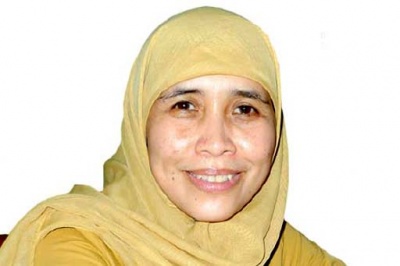
Women’s empowerment activist Nani Zulminarni had a few reasons to be angry in the late 1990s.

Her marriage broke down, her husband married another woman, and to top it off, she was discriminated against at work for being a divorcee.

So she resigned from her job as the director of the Center for Women’s Resources Development (PPSW).
But when one door closes, another one opens. And sure enough, in 2001, Kamala Chandrakirana, the head of the National Commission on Violence Against Woman (Komnas Perempuan), asked Nani to work on a project documenting widows in conflict areas, starting in Aceh. The project morphed into a comprehensive program she is now heading called Pekka, or Women-Headed Household Empowerment.

Nani successfully turned her anger into a relentless source of energy for the next decade, helping women who are the sole breadwinners in the household — widows, women abandoned by their husbands, and unmarried women who have dependants — organize themselves into self-reliant groups.

These women, who just like Nani carried the burden of providing for a family without a husband, were at the bottom of the system, Nani explained.

It is for this work that Nani received the Saparinah Sadli award last month. The award, named after the 83-year-old feminist scholar who founded Indonesia’s first women’s studies program at the University of Indonesia, is given to women who play an influential role in empowering women.

More than 1,000 Pekka self-reliant groups of women have mushroomed across eight provinces, with the program reaching 10,000 families. Pekka is planning to create groups in nine more provinces in Indonesia.

Sitting in her office in East Jakarta, Nani said she felt the award was an acknowledgement of the struggle of thousands of widows in Indonesia.

According to the 2007 National Economics Census, 6 million households in Indonesia are headed by women, covering more than 30 million citizens.

Nani explained households headed by women were generally poor and in many cases, the poorest among the poor in Indonesia.

Women joining the program are usually between 20 to 60 years old, more than 38.8 percent are illiterate and have never received formal education. They have up to six dependents and mostly work as farm laborers or in other informal sectors including small trade.  Upon joining, they usually earn less than one US dollar per day.

For Nani, Pekka has been a spiritual journey that helped her find the meaning of her life.

When she started Pekka, she was at the lowest point of her life.

“Pekka is a healing process. That’s why it feels like I didn’t fight for other people [but I fought for myself],” she said.

The incredible spirit of Pekka women constantly facing hardship inspired her, she went on.

As part of her work empowering women economically and socially, Nina trained Pekka members to save up for business ventures, and taught them the basics of micro-financing.

Financial aid, provided by Pekka and funded by the Japanese government through a World Bank trust fund, was channeled through a government program at the district level. “We made sure the money was not embezzled,” Nani said.

It was hard work to train the women at first, Nani said, as many of them had never finished school.

“At the beginning [of the training], members would sometimes write Rp 100,000 with four zeroes,” she said.

The training, estimated to run for a year, was carried out over 18 months.

Some groups were very successful, with one growing its capital from Rp 50 million to Rp 300 million.
“We didn’t want the money to just be handed over to the women and then spent.”

After coordinating Pekka for three years, Nani finally forgave herself and her former husband. “After I let go of my anger, I felt so good and happy.”

She explained discrimination toward women stemmed from people’s interpretation of religious texts, which places the woman as a subordinate and defines how good women should behave.

“Women are always defined in relation to other people. A woman is a daughter at first. Then she becomes someone’s wife, and after someone’s mother.”

Women in today’s society are still brought up to be wives, she said.

“Ask any parent in any part of Indonesia. They will be ashamed if their daughter does not marry,” she said, adding that if a marriage ended, society still blamed the woman.

Nani recalled suffering from discrimination on several occasions. During her divorce trial, for instance, the judges stated she was to blame for her husband remarrying. During a meeting with women in Aceh, a village leader asked her how she could organize Pekka if she couldn’t hold a marriage together.

Nani believes there should be a new way of interpreting religious text that is more egalitarian. She said women should have choices and be able to make smart decisions in life.

Her advice to women? “Cross the line and get out of the box.”

Prodita Sabarini, The Jakarta Post, Jakarta | People | Mon, September 13 2010

Paving the way for sexual rights

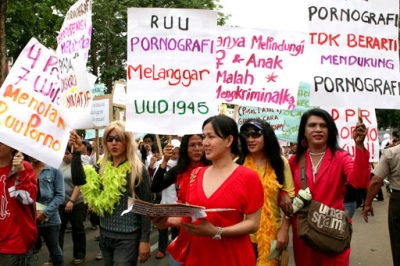
Sexual rights: Transsexuals join a rally to protest against the Pornography Law in Jakarta. JP/Arief Suhardiman

In a Semarang court in Central Java, a prosecutor groped a transgender woman charged with running away as well as having sex with a teenage girl, and said: “You have breasts, you’re a woman”.

Before the trial, the teenage girl’s family had beaten the transgender woman.

The court sentenced her to five years in prison. Soka Handinah Katjasungkana from the Indonesian Women’s Association for Justice (LBH APIK) Semarang, who advised her in her last trial, said that despite the transgender woman’s obvious violation of the children’s protection law, she had been discriminated against because of her sexual orientation.

In the country’s rural areas, parents continue to encourage their teenage daughters to marry young. But, because the charged person had defied cultural and religious norms by having same-sex relations, she was reported to the police by the girl’s parents. “Compare that to teenage girls being wed off to middle-aged men as their second or third wives,” Handinah said.

In Indonesia, where heterosexual relationships are considered the norm, discrimination and violence against people with different sexual orientations and gender identities is widespread.

However, a movement to bring equal rights irrespective of sexual orientation and gender identity by researchers and activists in Asia is gaining ground.

Handinah presented the convicted transgender’s case study at an International Policy Dialogue on sexuality last week in Yogyakarta. The three-day workshop, held at Gadjah Mada University’s Center for Population and Policy Studies (CPPS), and attended by 45 researchers and activists from India, Brazil, Bangladesh, the Netherlands, Syria, Egypt, and the Philippines, discussed issues under the theme “Bridging the gap between sexuality research and advocacy for sexual rights”.

Organized by an Asian research network for women/gender studies, Kartini Asia, and the Amsterdam-based SEPHIS (The South-South exchange program for research on the history of development), it was the first international meeting to discuss sexuality, including the rights of Lesbian, Gay, Transgender and Bisexual (LGBT) individuals, after the failed International Gay and Lesbian Association conference held in March in Surabaya that was stopped by hard-line religious groups.

In the opening speech, Muhadjir Darwin, the head of CPPS, set the tone for the rest of the conference: “[Human] sexuality is not a dichotomy, either black or white, male or female. It’s created. God created diversity. It is against humanity, against human rights, and against god’s will to discriminate against people on the basis of their sexual orientation and gender identity,” he said.

Muhadjir’s statement was still a far cry from the mainstream view in Indonesian society, Asia and around the world. According to a 2010 ILGA study, it is a crime to be gay in 76 countries.

Last year, Indonesia’s westernmost province Aceh released a bylaw criminalizing homosexuality and stipulating adulterers should be stoned to death. The controversial pornography law also criminalizes homosexuality.

But while intimidation and discrimination against LGBT still exists in Indonesia, it is also the place where the first international principles on the application of International Human Rights Law in relation to sexual orientation and gender identity, the Yogyakarta principles, were signed.

Outlined in Yogyakarta, the principles were drawn up at a meeting between the International Commission of Jurists and human rights experts from around the world at Gadjah Mada University in November 2006. The first principle states: “All human beings are born free and equal in dignity and rights. Human beings of all sexual orientations and gender identities are entitled to the full enjoyment of all human rights.”

In its third decade, Indonesia’s LGBT advocacy movement has come a long way since the 1980s when gay men, transgender and lesbian women networked exclusively through the first and — at that time — only gay magazine, GAYa Nusantara. Since then, more LGBT rights groups have emerged — such as Arus Pelangi and Ardhanary Institute — and fought for the right of sexual orientation to be acknowledged as part of Indonesia’s universal human rights.

But as the LGBT movement seeks more space in the public arena, hard-line minority groups are showing resistance through violence and intimidation, instilling public fear, said Soe Tjen Marching, the founder of two publications on sexuality.

Legal practitioners advocating sexual rights have warned that LGBT groups’ increasing advocacy work might end up being counterproductive for the LGBT movement, suggesting they should focus on winning people’s hearts first.

Ratna Batara Munti, who headed the Network of the Pro-Women’s National Legislation Program (JKP3) — an association of various NGOs, including the Women’s Health Foundation (YKP) and LBH Apik — explained that while the association was fighting for universal access to reproductive health care in the revised Health Law, a book titled Indahnya Perkawinan Sesama Jenis (The Beauty of Same Sex Marriage) was released.

Legislators shocked by the contents of the book felt compelled to push through Article 72 in the revised Health Law, stating that “Everyone has the right to a healthy and safe reproductive and sexual life, free from force and/or violence, with his or her lawful spouse”. In other words, the Health Law they passed only protects legally married couples, according to Ratna.

“Legal advocacy runs the risk of being counterproductive. There should be more advocacy work at the socio-cultural level. [Starting with] the space they [LGBT] have, in which they can work, socialize, and in some cases have relationships without being harassed — let these spaces be wider first,” Handinah said.

To address this gap at the socio-cultural level — and widen the public’s openness to different sexual orientations and gender identities, Soe Tjen runs two publications: Bhineka, a free magazine on pluralism issues and Jurnal Gandrung, a journal on critical sexuality studies.

Jurnal Gandrung, the first journal on sexuality in Indonesia, launched its first edition in June. The journal’s first essay, written by progressive Islam scholar Siti Musdah Mulia, focuses on Islam and homosexuality, calling for a reinterpretation of Islam’s understanding of homosexuality.

Kartini Asia coordinator and human rights activist Nursyahbani Katjasungkana also pointed out that the issue of sexual rights was not limited to discrimination against LGBTs. The problems with violence against women stems from the issue of sexuality as well, she said.

There is a need to link research findings and activism, Nursyahbani went on. Many studies on sexuality can be used by advocacy groups, but the problems disseminating research findings to advocacy groups hamper the exchange.

For example, bringing together researchers from different countries could create an exchange and dialogue on sexual rights issues in their respective countries.

Prodita Sabarini, The Jakarta Post, Jakarta | Feature | Wed, August 25 2010

Tesa Casal de Vela: A fine line

JP/Prodita Sabarini
JP/Prodita Sabarini

As Theresa “Tesa” Casal de Vela and her daughter joined a rally organized for Manila’s gay pride two years ago, they heard Christian fundamentalists shout at marchers that they were going to burn in hell and needed to repent.

Casal de Vela, a Filipino feminist scholar and activist, recalled her then five-year-old daughter asking: “Why are they shouting at us mama? Why are they angry with us?”

“I said ‘You know, because they think that God does not like us and that’s not true because God loves everybody’,” she went on. So when the fundamentalist groups yelled at them, her and her daughter shouted back: “God is Love”. Later on, her daughter started singing the Barney I love you song, which goes: “I love you / You love me / We’re a happy family.”

It wasn’t the last time Casal de Vela witnessed rejection from religious fundamentalist groups toward Lesbian Gay Transexual and Bisexual (LGBT) individuals. The former director of Isis International Manila — an organization that promotes women’s human rights by facilitating networking as well as information sharing between women’s movements — attended the International Lesbian and Gay Alliance (ILGA) conference in Surabaya earlier this year, which was cut short by radical groups’ disruptive behavior.

She joined ILGA in 2005 as part of Isis, one of the feminist organizations that became a member of ILGA. Her aim since 2005 has been to foster what she calls “intermovement” or collaboration between the feminist and LGBT movements. She was about to promote her message at the failed ILGA conference in March, themed “Moving Forward”. “But, in fact we weren’t allowed to move at all,” she said.

She was recently in Indonesia for an International Policy Dialogue on gender and sexuality in Yogyakarta, which ran from Aug. 9 to 11. Casal de Vela talked to The Jakarta Post about LGBT rights in the Philippines, discovering her sexuality, and the need for several levels of activism for sexual rights.

According to the 41-year-old senior lecturer at the International, Humanitarian, and Development Studies of Miriam College in the Philippines, one could argue her home country has a strong LGBT movement, with LGBTs in academia and prominent jobs in public office.

“This [state of affairs] — co-exists with a situation where we can’t get an antidiscrimination against LGBT bill passed. We have Christian fundamentalist groups protesting against a gay pride march,” she continued. There are incidences of police raiding gay bars to extort money from bail. “And if you don’t know your rights, you will let them arrest you.”

She recalled her journey in discovering her sexuality as “strange”. A heterosexual until college, Casal de Vela explored her sexuality after she became involved in feminist movements. After college, she was in a relationship with a woman and told her parents she was a lesbian. They were shocked by the news — but only for a couple of hours.

Once her family and community accepted her sexuality, she fell in love with … a man. “So I had to tell my family again. And they were like ‘Wait, we already accepted you as a lesbian’.”

So she explained to her family that she was in love with the man. “I still like women, but I fall in love with a person’s soul. You know whatever that outer part that person looks like is not my main concern.”

She eventually married the man and gave birth to her daughter. The marriage then dissolved. Casal de Vela said that she had been with her current female partner for seven years.

In the research she is currently carrying out on sexuality, preliminary findings show discrimination against Lesbian, Bisexual and Transgender (LBT) women differs depending on the group or particular identity. A bisexual woman who looks “straight” or heterosexual, will experience less discrimination in the workplace compared to “butch” or “masculine-looking” lesbians and transgender women, she added.

“For instance, my partner and I are both feminine [looking] and teachers in a school. And we’re OK. I think it’s because we’re ‘feminine-looking’ lesbians, so people can also accept that easily,” she said.

“Two feminine women with a baby, [will stimulate this kind of thought:]‘ Isn’t that nice; that’s so sweet; that’s so cute’. But people have a problem when they see the butch [looking woman] and a femme.

“It’s worse for transgender individuals,” She explained, especially for those entering the workforce.

“It’s easier to get work if you can pass as a straight person,” she said. For her research, she interviewed transgender women with PhDs who could not find jobs. “Because the only work available is in entertainment, or hairdressing, you know that kind of thing. But, they have PhDs in psychology.”

When advocating the rights of women and LGBTs, she said there should be several levels of activism, campaigning for matters which may be seen as trivial, such as the use of female public toilets for all women, including “butch-looking” lesbians and transsexuals, to promoting the involvement of LGBT individuals in political organizations.

Prodita Sabarini, The Jakarta Post, Jakarta | People | Thu, August 19 2010

‘Jurnal Perempuan’: Facing off against fundamentalism

The stronger sex: Jurnal Perempuan is currently one of the leading publications on gender, women’s rights issues and feminism in Indonesia.

The Jurnal Perempuan Foundation (JPF), which launched the country’s first feminist journal Jurnal Perempuan, has come a long way from distributing photocopied newsletters on feminism writing as complementary material at university.

Entering its 15th year, Jurnal Perempuan has significantly contributed to the development of women and gender thought in Indonesia. It is now reaching a larger audience, as the JPF is producing work in more media forms — radio, TV documentaries and a youth magazine.

At the same time, the journal is facing a new challenge in its pursuit of enlightenment and equality: The rise of religious fundamentalism.

In her public lecture on July 30, Gadis Arivia, a feminist scholar and the founder of Jurnal Perempuan, said the idea of publishing the journal, which germinated 15 years ago, generated two types of responses.

“Some people assumed Jurnal Perempuan was a magazine about cooking. So bookstores offered to place the journal in the cooking book section. Others, such as magazine vendors in the Senen area, assumed it was a magazine that published pictures of women in provocative poses,” she said.

“It’s difficult to explain [what] a feminist magazine [is about] when the spectrum on offer is either food or erotica.”

When Jurnal Perempuan first hit bookstores, around 500 to 1,000 copies were sold, said JPF director Mariana Amirudin. Today, the journal has 6,000 subscribers and sells 5,000 copies in bookstores.

The foundation then branched out to produce radio shows to reach a larger audience, partnering with 191 radio stations in Indonesia. “The journal’s content was analysis and in-depth writing about various women issues. It has become very intellectual and now caters to the academic world,” she said.

“We chose radio programs as the medium of choice in 1996. Radio can be a means to reach people in the lower-middle class bracket who do not necessarily read, but listen.”

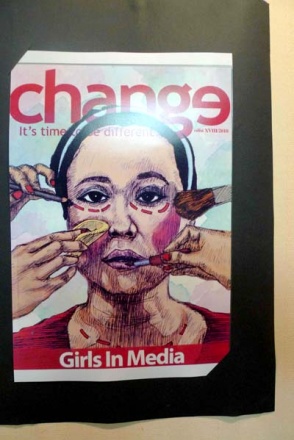
The JPF also produces documentaries and has a website. In 2008, the foundation launched a youth magazine called Change.

Women studies expert Sulistyowati Irianto said the journal helped deconstruct the rigid image people have of women and their role in society. It grew alongside the development of women’s movements and feminist thought after the reform era.

“Indonesian women had their own movement but the New Order controlled and silenced it,” she said.

Under the New Order regime of president Soeharto, the women’s place in society was institutionalized through the marriage law, which defines the role of the husband as the head of the household, and the wife as a homemaker.

In her lecture, Gadis said the image of women broadcast by the state and the state-controlled media during the New Order was that of Dharma Wanita — a group of wives of officials who spent their time organizing many charity — not empowerment programs.

Gadis explained the Ibu-ibu (motherly woman) image prevalent during the New Order was not without a design or ideology. “It was ideal to erase from the public’s memory the image of a more radical, empowered woman active in civil movements.”

The Indonesian Women’s Movement (Gerwani), the largest women’s organization before the New Order, had played a big role in women’s empowerment during the Old Order regime. It was also one of the organizations that helped build Indonesia, Gadis said.

“Gerwani had a clear ideological line and was affiliated to the communist party. When the pogrom
of the communist party took place, and people sympathized with the communists, Gerwani was also annihilated especially as its members were accused of killing the generals,” Gadis said.

The journal aims to deconstruct the image of women having limited roles in society. Mariana said the road to equality between genders was a change of mindset, which is what the JPF attempts to nurture.

Sulistyowati said Jurnal Perempuan’s continuity contributed significantly to the development of women’s thought and movement. “The issues discussed are those women talk about. The [Jurnal Perempuan] writers know their fields and understand feminist perspectives,” Sulistyo said.

“Their contribution is huge because many other journals don’t survive,” she said. “Jurnal Perempuan has succeeded in maintaining its presence in print media. The people behind Jurnal Perempuan have done a very good job [of maintaining this presence].”

But it is not without difficulties, Mariana went on. In the first years, Gadis had to sell her car to cover the cost of publishing the journal.

She said Jurnal Perempuan measured its success against the number of people subscribing to the journal. “That’s a few steps to what we call enlightenment and equality in society.

“It will take a long time to produce an enlightened society.”

Jurnal Perempuan changed Mariana’s life. A former Islamic fundamentalist, Mariana joined Jurnal Perempuan in 2003, after studying women’s studies. She used to be a member of the NII, a group advocating the creation of an Indonesian Islamic state.

“I read the journal and began going through books written by Nawal El Saadawi,” she said, referring to the Egyptian feminist. Mariana enrolled in women studies at the University of Indonesia. “My mindset changed radically,” she said.

She became a feminist because she put a critical thinking cap on and used common sense. “I knew I still had a brain and I could tell something didn’t make sense,” she said. “I was very uncomfortable with
my past. By learning about feminism, human rights and social science, I regained confidence in myself.”
Gadis’ lecture at the Antara building in Thamrin was the first of what Jurnal Perempuan hopes will be a long tradition of yearly lectures.

Attending the lecture was Constitutional Court judge Maria Farida Indrati, the only woman in the court and the only judge voicing doubts about the necessity of the Pornography Law, as well as gay rights activist Hartoyo.

Gadis’ lecture, titled “Media, State and Sex” is a timely issue. At a time when the state and the media cannot differentiate between the public and private domain, and view women’s sexuality as a moral threat, Gadis’ lecture delved into the issue of how the media depicted women in rigid, limited roles, how the state was controlling women by defining their roles and even their sexuality in the form of various legislations — such as the Marriage Law that states a husband is the head of household and the wife a housewife, the “vague” Pornography Law and the revised Health Law controlling women’s reproductive rights.

Jurnal Perempuan grew in the freedom experienced during the reform era, Mariana said. “We were the agent of change that was partying with the freedom we had.”

The challenges the journal are facing today, Mariana added, was the political standoff between the progressive liberals and the religious fundamentalists.

“There are many setbacks in our society, be it the state of democracy and the rise of fundamentalist groups that hate women,” she said.

Gadis ended her lecture by asking how to improve the state’s attitude toward sex. “A state smart about sex will create a smart society as well.”

“It’s proven that ignorance in sex education has brought ineffective policies, creating a society
that has a phobia of women’s bodies, has ensured children misunderstand [what] sex [is about] and provided an environment for violent, scary and radical groups that can only create harm.”

Prodita Sabarini, The Jakarta Post, Jakarta | Feature | Fri, August 13 2010

Nursyahbani Katjasungkana: A new perspective on sex

JP/Prodita Sabarini
JP/Prodita Sabarini

Sex remains a taboo subject in Indonesia, causing discomfort and a sense of panic when discussed in the public domain.

Lawyer and human rights activist Nursyahbani Katjasungkana is dead set on changing this state of affairs by carrying out research and policy advocacy.

In Yogyakarta last week, the former house member from the National Awakening Party (PKB) talked to The Jakarta Post on her way to Gadjah Mada University where she was scheduled to speak at the International Policy Dialogue on gender and sexuality.

The dialogue, organized by women’s/gender studies research network Kartini Asia and Amsterdam-base SEPHIS (South-South Exchange Programme for Research on the History of Development), was part of Nursyahbani’s endeavor to build a movement on sexual rights in Indonesia. It brought together Indonesian and international researchers as well as activists in the field of sexuality to find better strategies when carrying out advocacy work.

Soft-spoken, with intelligent and warm eyes behind her black-rimmed glasses, Nursyahbani explained why examining sexuality was crucial when defending human rights.

“Sexuality is not only about having sex. It controls human’s behaviors when they interact with each other. It encompasses people’s sexual orientation. Homosexuals, heterosexuals and bisexuals are within a continuum line in which the pendulum can lean either to the left or right,” she said. The control over women’s bodies in a patriarchal society also stems from a fear of women’s sexuality.”

In 2003, she co-founded Kartini Asia, a research network focusing on women and gender studies in Asia that aims to create synergies between women’s/gender studies and feminist activism in the region.

In 1990, she said, she had the harrowing experience of putting her six-month-old daughter under the knife for the Islamic tradition of female genital mutilation.

“The first time I saw clearly how female sexuality was oppressed was in the case of my own daughter. I knew that female circumcision was not compulsory – that it was a means to control women’s bodies and their sexuality. I read several hadith – which might be weak – that it [female circumcision] existed to control women so they would not be promiscuous, and have affairs.”

Nursyahbani and her sisters also underwent female genital mutilation as babies, she recalled.

“My mother, through my sister, kept pressuring me into continuing this practice. Both would always ask whether my daughter had been circumcised yet. I gave in after six months.”

Her mother who comes from a traditional Betawi community said it would be a sin not to carry out the circumcision.

“Finally, after six months, I brought my daughter to the doctor. I remember I had goose bumps walking into the hospital. My daughter was taken by the midwife and nurse inside, and I heard her screaming. When she came out, her diaper was covered in blood.”

Medical practitioners in big cities like Jakarta carried out the procedure until the mid 1990s. Nursyahbani said a doctor had performed the procedure on the baby of one of her fellow feminist scholars when she came to give birth in a prominent hospital in Jakarta, without obtaining her consent. Only in 2006 did the Health Ministry release a circular to end the practice of female genital mutilation.

Nursyahbani said she deeply regretted agreeing to her daughter having her female genitalia cut. As her daughter reached maturity, Nursyahbani told her about the genital mutilation and her own experience.

“That was my first experience — of seeing female sexuality shaped by a social construct and women perceived merely as sexual creatures. The regional bylaws on obscenity depicting women as obscene humans and the cause of rape stem from that way of thinking,” she said.

Her work as defending female workers and pregnant teenagers finally strengthened her conviction that sexuality and sexual rights had to be addressed as human rights issues.

She added that researchers and activists needed to keep collaborating to work on policy advocacy. Changing society’s perception on sexuality issues and eventually behavior will take a long time, Nursyahbani went on.

Nursyahbani, a renowned advocate for legal justice and the protection of human rights for Indonesian women, co-founded the Indonesian Women Association for Justice and became the first secretary general for Indonesia Women’s Coalition for Justice and Democracy.

“It took us seven years to pass the Domestic Violence Law,” she said. “Seven years,” she repeated in a whisper.

“Change does not come easily.”

Prodita Sabarini, The Jakarta Post, Jakarta | People | Mon, August 16 2010