International researchers and activists gathered in Yogyakarta to network and develop better strategies to advocate sexual rights.
The International Policy Dialogue was held from Monday to Wednesday and carried the theme “Bridging the Gap Between Sexuality Research and Advocacy for Sexual Rights”.
The dialogue was the first international meeting to discuss issues in gender and sexuality after the International Lesbian and Gay Alliance Conference in Surabaya was abruptly cancelled in March due to intimidation from a radical Islamic group.
Participants discussed the sexual rights of women and lesbians, homosexuals, bisexuals and transgendered (LGBT) people.
Sexual rights activist Soe Tjen Marching — who edits the Surabaya-based Bhinneka, a magazine which focuses on pluralism, and Jurnal Gandrung, a newly launched journal on sexuality — said in her presentation that intimidation and acts of violence by fundamentalist groups, such as the Islam Defenders front (FPI), have created a public fear, which is the dominant factor in determining people’s behaviors and decisions.
“Public fear can indeed work to the favor of fundamentalist groups. It can be their biggest ally,” she said.
“The fundamentalists don’t have to do a single thing sometimes. The public already responds on their behalf,” she added.
For example, two universities in Surabaya refused to accept Bhinneka and Jurnal Gandrung because they did not want to be seen as supporting or facilitating discussions of sexuality due to fear of the religious fundamentalists, Soe Tjen said.
Human rights activist Nursyahbani Katjasungkana said that the cancellation of the Surabaya conference was example of discrimination against LGBT rights. Radical groups base their arguments on morality, culture and religion, she said.
Gadjah Mada University’s policy studies center head Muhadjir Darwin said the public believes that sexual orientations that differ from heterosexuality are immoral.
“They just have a different sexual orientation from the dominant group,” he said.
Nursyahbani, who is also the coordinator of the Kartini Asia Network, said organizers chose Yogyakarta to host the workshop to commemorate the Yogyakarta Principles.
In 2006, international human rights activists in Yogyakarta defined universal principles for international human rights law in relation to sexual orientation and gender identity.
The Yogyakarta principles say: “All human beings are born free and equal in dignity and rights.
Human beings of all sexual orientations and gender identities are entitled to the full enjoyment of all human rights”.
The Policy Dialogue was organized by Kartini and SEPHIS (South-South Exchange Program for Research on the History of Development) with the collaboration of Center for Population and Policy Studies of Gadjah Mada University.
Hartoyo — an activist who was once tortured and humiliated by police in Nanggroe Aceh Darussalam due to his sexual orientation — said he was lonely in his struggle for rights and has yet to see many LGBT people fight for their rights due to discrimination.
Nursyahbani said the workshop aimed to bridge the gap between research on sexuality and advocacy at the grassroots level.
Several scholars have said that research on sexuality is a long process, which sometimes do not meet the need of fast action in the part of advocacy groups.
Researchers and activists agreed that research on sexuality is an important for advocacy groups.
Prodita Sabarini, The Jakarta Post, Yogyakarta | National | Thu, August 12 2010
rwan Martua Hidayana, the University of Indonesia’s sexuality and gender expert, said when he reached puberty, he was at a loss at who to ask questions about his wet dreams. The only sources were his peers, who were as unknowing as him.
That was more than 30 years ago. Recently he asked his male students during class on gender and sexuality about who they turned to talk about their coming-of-age wet dream experiences.
“Did they ask their father, mother or another adult?”
They didn’t. They said they only talked to their friends. It’s amazing that after more than 30 years, there has been no change,” he said. “They experienced the same thing as I did.”
Information on sexuality is lacking for young people in Indonesia, Irwan said. While children in Indonesia can easily access pornography through DVDs, access to sex education is lacking.
According to Lisa Poniman, a 17-year-old high school graduate, children do learn about reproductive organs in biology and physical education class.
“But a thorough sex education is very important. As we grow, our curiosity grows as well. As teenagers, it’s normal to want to know more about our sexuality,” she said. “It’s not possible to hide the realities of life.”
In the aftermath of the sex videos scandal that involves Indonesia’s top celebrities, National Education Minister Muhammad Nuh reportedly said students do not need formal sex education in schools.
Human rights and gender activist Firliana Purwanti said people should not think that sex education meant a lesson in sexual intercourse. “Sex education and a sex lesson are different things,” she said.
One institution, the National AIDS Commission, recently filled the gap in information by launching Wednesday an interactive sex education website (www.sexxie.tv) which it says aims to connect teens and young adults with health experts who can provide them with accurate information on sex.
Irwan said the issue of female sexuality was also important to discuss as double standards usually existed. “For example, men are tolerated to be sexual and have sexual experiences before marriage.
Women, however, have to keep their virginity,” he said.
Arranti (not her real name), 17, said that it was important for her to remain a virgin. She said that while she made out with her boyfriend, she would never cross the line by having sex.
“If I lose it, it would ruin my future. I can’t imagine if I lost my virginity before marriage. And for a woman there’s a stigma.
“So, unless you’re married, I think you should keep it.”
Arranti, however, said she would not mind if her future partner was sexually experienced.
“If I really care about him, it would not matter,” she said.
— JP/Prodita Sabarini
Prodita Sabarini, The Jakarta Post, Jakarta | Feature | Wed, July 07 2010
Ancient teaching: A relief at Sukuh Temple near Surakarta. The 15-century Hindu-Buddhist temple depicts reliefs on life before birth, having sexual education as its main theme. JP/Ani Suswantoro
Sex is a big part of Indonesians’ daily lives. Everyday people laugh at dirty jokes. Open flirting is common, even between work colleagues, which some may view as verging on sexual harassment.
Watching pornographic films has long been an “educational” past time for school children curious about sex.
In the workplace, it’s not rare to see several people with their eyes glued to a computer screen playing pornographic movies. And sex workers never have quiet nights except maybe during fasting months.
However, Indonesians relaxed attitude toward sex is ambiguous. In a way, Indonesian society is permissive in laughing at the jokes, in its knowledge of the steamy stories in the two volumes of the book Jakarta Undercover, open flirting, of having mistresses in unregistered marriages, and living side by side with the many sex brothels across the country.
In another way, its sexuality is repressed, with society quick to condemn anyone who engages in sexual activities outside a heterosexual marriage.
So come the stories of raids on unmarried couples living under the same roof, of transvestites being chased by public order officers and of the hard-line religious groups intimidating the lesbian, gay, bisexual and transgender (LGBT) community.
The recent love story of Alterina Hofman, who suffers from Klinefelter’s syndrome — a rare case where a male has an extra X chromosome — and Jane Hadipoespito, is another case of sexual repression.
Jane’s parents denounced the couple’s marriage and filed a lawsuit against Alterina for document
fraud because he previously declared he was a woman on his identity cards. Police then took Alterina to prison, ignoring the latest report from a doctor that confirmed he was a man.
People, of course, are still in tune with the sex-video scandal that befell pop band Peterpan vocalist, Nazril “Ariel” Ilham. The 28-year-old divorced father of one, famed for his guttural singing, is now in police custody, charged under the controversial 2008 Pornography Law for allegedly featuring in the sex video with his girlfriend actress Luna Maya and another video with presenter Cut Tari.
In short: You can joke about it. You can even do it. But, if you are not heterosexual and unmarried, do not get caught doing it.
An expert on gender and sexuality from the University of Indonesia, Irwan Martua Hidayana, said the issue of sexuality in Indonesia was largely influenced by religious and cultural norms. “People see sex in the frame of marriage,” he said at his office on the Depok campus.
“So, when you’re not married, either men or women, ideally, normatively, should not have sex,” he said.
“When there are unmarried people who are sexually active, they will get a social sanction. They will be condemned from a moral point of view as deviant and decadent,” he said.
For Firliana Purwanti, a human rights and gender activist, and author of The “O” Project, a social sanction may be acceptable but criminalization by the state is not.
In light of Ariel’s case, Firli wrote an opinion piece in Koran Tempo daily, stating that instead of arresting Ariel, the police should arrest the person who uploaded the videos on the Internet and the people who were distributing DVDs.
“When I decided to write about Ariel’s case, I was fed up. I’m fed up with all the hypocrisy in this country,” she said.
“This is a matter of human rights. It can happen to any of us. The most relevant area that was touched in this case is the right to privacy,” she said.
“Your privacy is yours, although, the private domain can be political as well. The limitations to your freedom in your private space are three things — violence, discrimination and force,” she said.
Firli said that even the Pornography Law, a controversial piece of “legislation due to a vague definition on pornography that polarized the nation between moralists and liberals, acknowledged the right to privacy.”
Ariel would be the first celebrity charged under the Pornography Law, passed in 2008 after years of heated debate on whether such a law was needed.
Police say he is also charged for violating another controversial law on electronic information and transactions, which punishes those who spread indecent images, and for violating the Criminal Code.
The pornography law stipulates anyone who produces, makes, copies, circulates, broadcasts, offers, trades, loans or provides porn content can face up to 12 years in prison.
National Police chief detective Comr. Gen. Ito Sumardi said detectives had collected enough evidence to charge him.
According to Irwan, the Pornography Law is a way for the state to control its citizens. “Any country will try to control its citizens. One way is by controlling their sexuality and bodies,” he said.
It is not the first time the state has attempted to control its citizens’ personal lives, Irwan said. “The family planning program for instance; that was an example of how the state controls the bodies of its citizens, especially female bodies,” he said.
Within the state, he says, lay ideologies. “Formally, we have the ideology of Pancasila. But for feminists, they may say a patriarchy ideology exists, which puts men before women,” he said.
As a secular country with millions of religious people, most adhering to Islam, moral standards of those religions feature as well, he said.
These moral standards, associated with sexuality, Irwan says, evolve with changes in society.
At the time Hindu and Buddhist kingdoms in Java ruled, society had a more open attitude toward sexuality, evident in the reliefs at the Sukuh Temple near Surakarta that depict sexuality openly. Irwan also mentioned the Centini scripture that discusses sexuality openly.
“Changes always happen in culture. There used to be acceptance of different genders and sexual activities, such as homosexual acts between warok and gemblak in Ponorogo,” he said.
Warok is the leader in the Reog Ponorogo dance, who was prohibited from having sexual intercourse with women, making them have gemblak, or young boys as sexual partners.
The Bugis people in Makassar, Irwan said, acknowledge five types of gender: female, male, calalai (masculine female), calabai (feminine male) and bissu (androgyny).
The entering of major world religions such as Islam and Christianity, and modern western views of monogamy, has slowly changed how Indonesians view sexuality. Now, he says, moral control becomes stronger and limited to heterosexuality. With moral control, sexuality becomes a taboo topic because it is viewed in a negative light, Irwan said.
This results in moral panic when cases of sexual activity outside the accepted norm surfaced, Irwan said, such as Ariel’s case, with media sensationalizing and condemning it simultaneously, and two ministers rejecting the importance of sex education.
Irwan said the sex videos scandal could actually be momentum to develop a sex education program for students.
“Because people see sex in a negative light if it occurs outside the marriage framework, moral panic always results” he said.
“If people have knowledge about sexuality, they can be more responsible in protecting themselves.”
Idy Muzayyad, former Nahdlatul Ulama youth-wing activist and member of the Indonesian Broadcasting Commission (KPI), says in their activities people should take into account the norms in the society they live in.
“In France a minister can have a baby without being married, and people would be OK with that. Here, that’s not possible, because we have different values.”
He emphasizes, however, that while society can give social sanctions, the state should not inter-
fere in the private domain of its citizens.
“There’s a way to heaven and the way to hell, and even God gives humans the choice,” he said.
Firli said legislative processes in Indonesia were prone to bias. “We’re used to making policies that are heterosexist and patriarchal,” she said, giving the health law as an example as it regulates access to reproductive health for married couples.
“That’s unrealistic. Because our policies have always been religiously biased, it has never been effective in solving problems in the field. So many people don’t follow religion strictly anyway. And with a secular country, why [is the government] introducing religious values in policies.”
Many studies since the 1980s and 1990s show that the younger generation is sexually active, Irwan said.
“I think our politicians should accept that this is what’s happening in society. They should not be in denial.”
Prodita Sabarini, The Jakarta Post, Jakarta | Feature | Wed, July 07 2010
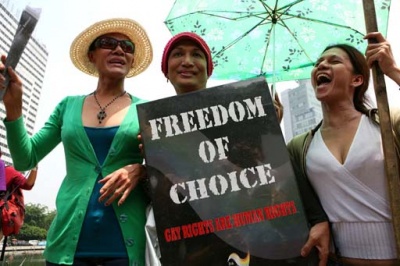
Solidarity rules: Three transvestites, also members of the Transgender Solidarity Network, commemorate the International Transgender Day, on Nov. 20, 2009.JP/Arief Suhardiman
In its third decade, the LGBT (Lesbian, Gay, Bisexual, Transgender) advocacy movement has progressed far from the days of the 1980s when gay men, transgender and lesbian women networked exclusively through the first and – at that time – the only gay magazine GAYa Nusantara.
The movement is now, according to LGBT rights expert Baden Offord, facing one of the most critical periods in its development as it attempts to be more visible in the public sphere and seeks to engage more broadly with mainstream Indonesian society.
More LGBT rights groups have emerged and have been fighting for the right of sexual orientation to be acknowledged as part of Indonesia’s universal human rights.
In modern urban areas, gay men and lesbian women are becoming more visible in the workplace and within friendship circles. Increasing numbers of families are becoming more accepting of their gay sons and daughters’ sexual orientation.
Popular culture has also become an avenue in which the existence of homosexuality is being recognized, with breakthrough films such as Arisan (Savings Gathering) depicting scenes of gay love.
A festival of films with homosexual themes, Q Film Festival, has successfully been held in the last nine years, drawing larger crowds each year.
Offord, an associate professor at the Southern Cross University and author of Homosexual Rights as Human Rights: Activism in Indonesia, Singapore, and Australia, said the Indonesian LGBT rights movement was beginning to take their discussions to regional and international levels, not just keeping them in localities.
But as the LGBT movement seeks more space in the public sphere, hard-line minority religious groups are showing resistance through violence and intimidation, while the state apparatus does nothing to protect the movement’s right to freedom of expression.
Back in March, the police stood by and, according to the eyewitness-account of lesbian activist Rr. Sri Agustine, were even sharing rice boxes with a mob of hard-liners from the Islamic Defenders Front (FPI) who had forced their way into a Surabaya hotel, demanding participants of a planned congress on sexual orientation in the East Java city to leave the country.
The hardliners told the conference organizers not to make a media statement, then vandalized GAYa Nusantara’s office, writing “ILGA = Terorist Moral” (ILGA = Moral Terrorists).
Organizers of the International Gay and Lesbian Association (ILGA) Asia Conference eventually canceled the event, citing “security reasons”, after the police refused to grant them a permit, fearing protests from religious groups. Politicians and civil society organizations have quickly condemned the thuggery and police negligence as unconstitutional and violating human rights.
Tom Boellstorff, author of The Gay Archipelago and professor at the department of Anthropology, University of California, said that the critical issue was the failure of the police to protect the people at the conference.
“Will they be reprimanded?
Why did the police issue a permit but then take it away for no reason? Will new protocols be put
in place? Will those responsible for the intimidation, particularly the FPI, be arrested or otherwise reprimanded?
“If they can get away with these kinds of illegal activities, then that says something very negative and sad about the current state of democracy in Indonesia — not just for LGBT persons, but for everyone,” he said in an email interview.
The police responded saying that they had not issued a permit for the event, but were obliged to be present because they acknowledged that the “fierce” objections from dozens of mass organizations may have violated the security of East Java.
Offord said: “The problem faced by the LGBT movement is summed up in one phrase — ‘explicitness’. LGBT rights are now a central litmus test for Indonesian democratic society.”
Indonesia’s LGBT rights champion Dede Oetomo who founded GAYa Nusantara said that LGBT activists “believed that Indonesia — with all its problems — was a democratic country, in which such conferences could be held”.
He said that Surabaya, the home base of GAYa Nusantara, was chosen because there had never been any previous violent incidents like those of March, 26, when the FPI stormed the hotel.
Dede, who is also a lecturer at the social and political science department of Airlangga University in Surabaya, said that Indonesian activists also wanted to show a homegrown LGBT movement to the international world.
LGBT organization Arus Pelangi founder Ridho Triawan said that if local LGBT activists managed to host the fourth ILGA-Asia conference it would give bigger political power for the movement.
Offord said that in the short term the LGBT movement would be chastened by the conference cancellation. “It has tested the democratic pulse of the Indonesian nation and found that the pulse is weak,” he said.
In the long term, however, he thought that it will actually strengthen the LGBT movement to become a more cohesive and deliberative movement. “There will be a lot of reflection on how to negotiate the present political and social climate,” he said.
By contrast, Dede thinks that GAYa Nusantara is actually becoming more cautious and low-key, because of this recent intimidation. The head of the Women Rainbow Institute (IIP) Kamilia Manaf refused to be interviewed for precisely this reason.
“Activists will understand the need to ally themselves with other progressive civil society groups. They will need to understand and practice human rights, and have political awareness.” He said that the new generation of LGBT movement activists were passionate, educated and braver, however, which he finds solace in.
Boellstorff said that the LGBT movement in Indonesia is flourishing but was facing many challenges, most of which have to do with the acceptance of LGBT persons in Indonesian society.
“If Indonesia is truly to live up to its motto of ‘unity in diversity’, then there needs to be a national conversation regarding who is going to be included in that diversity.
“Since LGBT Indonesians exist in great numbers and have always been a part of the archipelago, they are part of that diversity.”
Prodita Sabarini, The Jakarta Post, Jakarta | Feature | Tue, June 29 2010
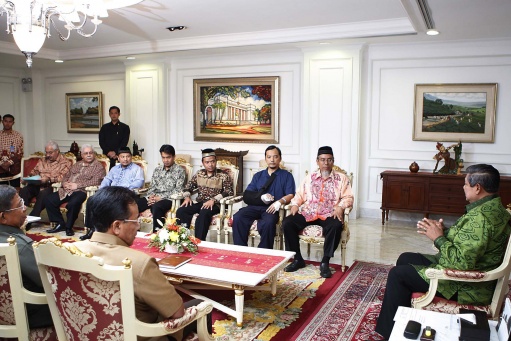
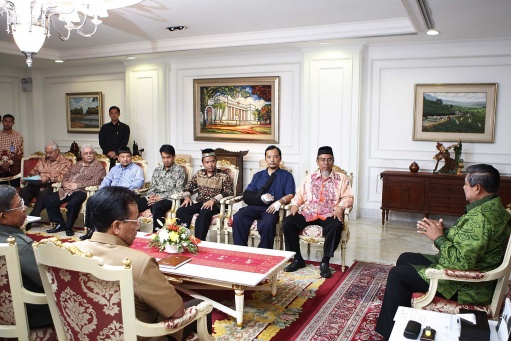
Welcome back: President Susilo Bambang Yudhoyono (right) receives five of the 12 Indonesian volunteers who were deported by the Israeli government after boarding the “Freedom Flotilla” en route for Gaza, at the Presidential Office. Courtesy of the Presidential Palace/Abror Rizki
In the house of Muhendri Muchtar, one of the Indonesian volunteers aboard the Turkish “Freedom Flotilla” bound with humanitarian supplies for Gaza, Palestine, which was intercepted by Israeli soldiers, a handmade poster festooned with flower petals decorated the otherwise bare wall.
“Buya, a Gaza fighter” was written across the poster. Buya, a Minang word, translates as father in English.
Muhendri, the vice chairman of KISPA, (the Indonesian Solidarity Committee for Palestine), received a warm homecoming upon returning to Indonesia on Monday after being deported by the Israeli government. He was one the first five Indonesians — out of 12 — on board the Mavi Marmara ship that was raided by Israeli commando forces in international waters, to return home. Nine of the 700 peace activists and journalists were killed during the Israeli raid of the flotilla that was bringing medical equipment and humanitarian aid to a blockaded Gaza.
In his second day back in Jakarta, Muhendri arrived at his house at Cipayung, East Jakarta, around 9 p.m. after meeting with President Susilo Bambang Yudhoyono and members of parliament. A couple of friends had been waiting for a while at his house to welcome him back.
“I had an hour’s rest yesterday,” he said in his house last Tuesday. After a homecoming ceremony at the Foreign Ministry affairs, him and his wife Farita returned home close to midnight. Farita explained the neighbors had put the poster up.
“There were a lot of friends and neighbors already waiting for him. And so he chatted for a while,” she said.
The next day, before sunrise, Muhendri was already on his way to a television news station to give a live interview. Quite a stark contrast to his life a little over a week ago, where he was onboard Mavi Marmara, the main ship in the Freedom Flotill”.
He animatedly recounted the events that unfurled during the raid. Muhendri said that a night before the raid, the captain of the Mavi Marmara had divided the passengers into several groups to guard the ship in case Israeli force decided to launch an attack on the flotilla. The group of Indonesians and Malaysians Muhendri belonged to was in charge of the port (left) side of the ship’s fourth floor, he went on.
Around the time of dawn prayer on May 31, Muhendri said he heard someone shouting, “They’re here! They’re here!”
“Not long after, we heard gun shots and explosions. There were tear-gas bombs and shots that sounded like real bullets,” he said.
“The sound of shots ricocheting on metal was terrifying. We could hear gun shot sounds ‘doog dug doog dug’ and bullets hitting metal ‘tang tang, tang tang’,” he said.
His group then caught a glimpse of a boat filled with Israeli soldiers next to the ship. “We shouted ‘God is great’ and sprayed them with water. The soldiers on the boats looked hesitant, advancing and then retreating after we sprayed them,” Muhendri said.
He saw a helicopter flying really close to boat and not long after, his colleague from KISPA, Okvianto Emil Baharudin, was injured. “I think he was a bit shocked after seeing the blood run on his arms. He said ‘I’m bleeding. I’m bleeding’.” Okvianto was taken to the medics onboard, and Muhendri did not see him again until a week later in Indonesia.
Muhendri and others’ presence onboard the Mavi Marmara showed that a number of Indonesian volunteers were willing to risk their lives to go to a conflict stricken area.
The Medical Emergency Rescue Committee (MER-C) still has volunteers in the Middle East, who were onboard the Mavi Marmara, and is attempting to reach Gaza again, to build a hospital there.
The MER-C founder has already collected Rp 13 billion (US$1.4 million) to complete the project, which has been approved by the Palestinian Authority in Gaza. The people of Gaza have also donated a piece of land for the hospital, while the organization has also signed a memorandum of understanding with the Palestinian Authority’s Health Ministry.
Peaceful movement: Bulent Yildirim, head of Turkey’s Islamic and pro-Palestinian rights group The Foundation for Human Rights and Freedom and Humanitarian Relief (IHH), talks to activists on a Turkish ship as they sail into the international waters of the Mediteranean Sea as part of a humanitarian convoy on May 30, 2010. Reuters
Volunteer endeavors in a conflict-torn area can be motivated by a number of reasons from humanitarian principles to religious solidarity.
Indonesia, with its Muslim-majority population, has for a long time sympathized with the plight of Palestinians in the Middle Eastern conflict. Although the Indonesian government does not have formal diplomatic links with Israel, it is open to meetings focusing on setting up a Palestinian state.
For Muhendri, who visited Gaza after the 2009 Israel offensive to distribute Rp 3 billion worth of donations collected by KISPA, joining the Freedom Flotilla was not only a humanitarian mission. He insisted that he supported the Palestinian cause first and foremost because he was Indonesian, and second because he was Muslim.
“First of all, I’m an Indonesian citizen. In the preamble of our constitution, our founding fathers mandated us with a clear mission: ‘Whereas freedom is the inalienable right of all nations, colonialism must be abolished in this world as it does not confirm with humanity and justice’.”
He quoted a hadith (a prophet saying) about a woman who was punished by God for locking up a cat in a room without feeding it and leaving it to die. “Can you imagine, if God expressed his wrath for one cat? Around 1.7 million people [in Gaza] have lived under a blockade for four years. What can we say in front of Allah? If one says that all Muslims are brothers, where’s the proof?” he said.
A veteran volunteer in the Middle East, chairman of the Aksi Cepat Tanggap (Rapid Relief Action/ACT) foundation, Ahyudin, said people volunteering in conflict zones were perceived differently from those volunteering in natural-disaster areas because of the political nature of a conflict zone.
Labels are easily dispensed on people involved in conflict zones. In the case of the Palestine-Israel conflict, volunteers or aid workers might be dubbed terrorists, anti-Semites or pro-Zionists.
“Volunteers, aid workers, should not be concerned with being stigmatized like that,” he said. “Aid workers should go to conflict areas and help anyone there,” he said.
“The principle behind volunteering is that one should be independent … One must be neutral. One has to be independent,” Ahyudin said, emphasizing his point.
ACT did not join the Freedom Flotilla as it was busy delivering humanitarian aid in some of the country’s disaster-hit areas, including Padang, Karawang and Bandung. ACT said it would send a humanitarian mission to Gaza around August to coincide with the holy months of Ramadan, a program that has been held in the last five years. He added that the Freedom Flotilla incident had provided momentum for people to push for a reassessment of the blockade.
Ahyudin explained some individuals enlisted as volunteers for altruistic reasons. But volunteering could also be a way to deal with frustration arising from governments’ inability to address problems of justice and welfare.
Volunteering can be step toward a better world, Ahyudin said. His organization is currently setting up a volunteer course dubbed Volunteer University, with classes teaching principles of humanity and volunteer skills.
“It’s good to spread the spirit of volunteering. We can create a better civil society with it,” he said.
Prodita Sabarini, The Jakarta Post, Jakarta | Feature | Mon, June 14 2010
In the eyes of a quirky artistic couple, the chaos and randomness of Jakarta is a huge playground waiting to be explored. And guess what? They are asking the people of Jakarta to come and play with them.
Duo visual communication artists Irwan Ahmett and Tita Salina have created a game called “Urban Play”. To play it, they create art in the form of installation, photography, performance and video using the city’s rich elements. The city space becomes their muse, their instrument, and their exhibition ground, all at the same time.
It is a mixture of urban and multimedia art serving as subtle but effective criticism of urban life in Jakarta, based on their experience and observation of the city’s minutiae.
From this game/art project, the two have created five artworks so far. Their first one, titled Color Blindness Test, was a result of “playing” in one of Jakarta’s traditional wet markets. It is a picture of the word “play”, arranged in the fashion of the Ishihara color test using four rattan tray filled with chilies, melinjo fruit, limes and tomatoes.
The innovative and creative spirit of Urban Play is bound to remind us of traditional D-I-Y toy-making – such as creating a toy-car using Pomelo skin – from the days before consumerism dulled our “Macgyver spirit”. Urban Play, however, is modern in every sense, starting from the setting: the urban city space; the documentation tools: still-camera and video camera, and the art gallery: the Internet.
The artworks can be seen at dgi-indonesia.com in the online exhibition section. There, one can see their Play*2: Public Furniture installation, a little cave-like seating area, arranged from long wood blocks at a material shop on the side of the street at Jl. Pasar Minggu. In Play*3: Dancing Umbrellas, a short video shows how street vendors created an aesthetic arrangement of umbrellas.
Play*4: Monorail Slalom is a satire on the wasted columns of the defunct monorail project, while Play*5: Jakarate, uses humor to criticize vandalism of public property.
Irwan and Tita make a conscious decision to exhibit their work on the Internet, instead of in a formal art gallery, to underline the people of Jakarta’s growing use of the Internet and limited mobility as a result of traffic jams, Irwan said.
“It’s possible to see an intersection between the concept of Jakarta and the online *world*. First of all, our mobility is limited as a result of traffic jams. And second of all, the web enables information to spread to a wider audience than through a conventional exhibition,” he said.
“It’s how viral communication happens in the online world, accommodated by the conventional world,” he said recently in a Jakarta caf*.
The two artists at first just wanted to create art by responding to the space in the city. For an example, they wanted to create a new type of font inspired by Jakarta’s bus, the metromini. In the end, they realized the city space was not a vacuum and that Jakartans were a dominant part of the city, which made it essential for them to interact with people occupying the space to create their art.
“We cannot just pick random stuff and make it into art. We have to involve people and interact with them,” he said.
The challenge, they say, was to create something using only improvisation, innovation, creativity and negotiation. This, Irwan said, could result in visual art or art as a “scale” concept.
The Dancing Umbrella project was an example of a “scale” concept, he said. It showed that street vendors – usually viewed by city officials as a menace to order – were willing to cooperate and able to organize their space into an aesthetic arrangement, using negotiation skills.
“The negotiation process is the interesting part. And that process is what’s missing in Jakarta. We found vendors are more artistic than the average artists,” he said.
Tita said the response from people asked to participate in their project went far beyond their expectations.
“It was a gamble for us. We were initially pessimistic *about people taking the time to participate in our project*. But people ended up being so kind, they took the trouble to help us,” she said.
“We had to present our concept to people who had no idea about *urban* art in two to three minutes. They could then choose to participate,” Irwan said.
In Dancing Umbrellas, they had to negotiate with local Pasar Minggu market thugs. When they were shooting the vendors moving the umbrellas around, the thugs ordered them to stop.
“But, they really just wanted us to tell them what we were doing. Once they found out, they let us continue,” Irwan said.
From their playing around Jakarta, they said they found a little blessing in each game/project. For their Public Furniture installation, present at the material shop Fajar at Jl. Raya Pasar Minggu from May 7 to 11, they obtained free Wi-Fi connections at the site from the restaurant across the street.
For the Monorail Slalom, they encountered dozens of people doing their Sunday morning jog from Senayan and asked them to run slalom style at the abandoned monorail project.
Irwan and Tita said they would present nine artworks by the end of this month. The next project Irwan said would be about how people living in Jakarta were in a perpetual state of denial.
“People are in denial that they’re living in Jakarta. They know that Jakarta is in the tropics, but rather fixing the design *of buildings*, they install lots of air conditioning units,” he said.
“Floods are a frequent occurrence in Jakarta; people raise their houses as a result. The streets have a 3-in-1 rule, people then use 3-in-1 jockeys,” he said. “I’m just saying, don’t deny that you are living in Jakarta,” he said.
Whether this project will work out as planned still remains to be seen. They make changes to their project as they go along, they say; such as the Jakarta Monorail Slalom, which they first wanted to do with a car, but decided to do it with passers-by instead.
Iwang said he wanted to stimulate people to see Jakarta in more detail through Urban Play. “Jakarta is rich with detail. A society cannot be called a great society if they neglect detail. If people are used to what’s going on and never complain, they won’t realize something wrong is going on *in the city*,” he said.
“I see Jakarta with enthusiastic eyes. I came to Jakarta with a dream, if Jakarta could not grow with me, the dream couldn’t be achieved,” he said, adding that he was originally from Ciamis.
Tita meanwhile said that she wanted to ask people to “pay more attention to Jakarta”.
“Jakarta has given us so many things, but have we ever stopped to think what we have given to Jakarta? If Jakarta was a person, he/she would feel like the most used person,” Irwan said.
Irwan said they wanted to bring Urban Play to other cities in Indonesia and other countries, to watch the different characters of cities coming out.
The couple, who owns the communication visual company Ahmett Salina, funded the art project themselves.
“It’s a game for me. A golf trip costs millions, so does an outdoor trip. I spend money for this as a game for myself. This is an outlet for me,” Irwan said.
It is also a therapy for Jakarta to feel more intimate, he said. “If this game can reflect a bigger picture, then it’s good,” he said.
Prodita Sabarini, The Jakarta Post, Jakarta | Feature | Mon, May 31 2010
The guy, Irwan Ahmett, was possibly hyperactive as a child, and having grown up into a playful adult, he now has frequent bursts of energy and ideas.
The girl, Tita Salina, is calm and quirky, and somehow gets the guy’s crazy ideas. After a few conversations, before Irwan even expressed his love to Tita, he told her: “I don’t know why, but I feel that I can make my dreams come true with you”.
He was 23. She was 25. Fast forward twelve years later, the two of them are married and had founded a design company: Ahmett Salina.
For the fi rst time since they got together, the two artists are collaborating in a breakthrough urban art project that combines site-specifi c city elements, interaction with people and multimedia tools. In the
project, dubbed “Urban Play”, they create art in the form of installation, photography, performance and video, based on elements of the city, and exhibit their artworks both in the city and cyberspace.
Both studied at the Jakarta Arts Institute (IKJ). Tita graduated, but Irwan didn’t. This, however, did not stopped Irwan from setting up a graphic design company with Tita, all the while setting up art movements, and participating in art exhibitions in Indonesia as well as abroad.
Irwan is the brainchild behind 2005 Change Yourself Project, where he went on a road show toting his Apple notebook computer and hundreds of round, blue stickers to Jakarta, Yogyakarta and Bandung, meeting young people and giving presentations, in which he suggested ways people could change for the better. He also held a solo exhibition of installation art at Ruang Rupa gallery, titled “Happiness”.
In all Irwan’s projects and exhibition, Tita supported him in the background.
Sitting in a Central Jakarta coffee shop, Tita answered “no” when asked whether she would like to have her own exhibition. “I’m the kind of person who likes to be behind the scenes,” she said.
In Urban Play, however, Tita is as much of a front person as Irwan. Leading and presenting their projects in the short videos of Urban Play, these can be seen at dgi-indonesia.com in the online exhibition section.
Tita’s calm and low-key personality complements Irwan’s front-man persona. The two also share a passion for design and have a strong affinity with Jakarta.
In fact, they complete each other’s sentence. They talk about the hardship they faced during the beginning of their relationship and tell their tear-jerking drama-series-style love story with relaxed humor.
Just like in the typical plot of a romantic series, they disliked each other at fi rst, Tita said.
“The first time I saw her was when she was making a speech. She was running for president of the
student senate,” he said and paused for a moment. “That was the worst speech I’ve ever seen.”
Irwan, a freshman at IKJ, said he swore he would not vote for her.
“Little did I know I would choose her as my wife later,” he said.
Tita said that she only knew him in passing. “I had other boyfriends,” she said. “All I knew was that he was in the senate, and he was a pain.”
Irwan said that despite not paying much attention to her, he had always been interested in her artworks and appreciated them.
Their love began to blossom after university along with their collaboration in design. Tita’s best friend
lived in the same place as Irwan. As she visited the place to meet her best friend, Tita and Irwan fi nally started chatting.
“I instantly became attracted to her after talking to her a couple of times,” Irwan said. Irwan had many ideas in his head and liked to discuss them with Tita. With her art background, she responded and gave him feedback.
“I see him as the dark side of me.
I’m a plain person. My parents are conservative. My crazy ideas are in him. He can channel that side of me,” she said.
They finally collaborated for the first time, and their project was the cover of Naif band’s 1998 self-titled debut album. The two fi nally founded their design company Perum Desain Indonesia, which they later named Ahmett Salina in 2006.
But Tita’s parents disapproved of their daughter going out with Irwan, who had dropped out of college, resigned from work, and just started setting up a company.
“Tita’s late father summoned me and said: ‘Can you explain your plans for your future with Tita?’” Irwan said.
He told Tita’s father that he liked music, fi lm, art, and performing. “If I combine all this I can sell my dreams to people. I can sell my imagination to people. This potential is a field that I’m trying to develop right now,” Irwan re-told what he said to Tita’s father.
“Now, I know that was a wrong answer,” he said.
Tita resorted to tears and constant pleading, but her parents did not budge, she said.
“At one point he [Irwan] gave me an ultimatum, stating that I had to give him an answer in two days or he would leave. I was like ‘Noooo, I don’t want to lose you’,” she said in a dramatic fashion.
Finally she went up to her father at dawn after a sleepless night. “I said to my dad, ‘I want to get married, and I want to marry him’.”
Finally her father gave in. They tied the knot shortly after. Now they live just above their offi ce in Pasar Minggu, East Jakarta.
“At first we were worried; being together 24 hours a day. But we stay professional in our work and give
each other space,” she said.
Tita said Irwan and she created non-commercial art as a catharsis.
“Sometimes our work clients don’t agree with our ideas. So, this is a venue where we can express ourselves freely,” Tita said.
Irwan, who hailed from the small town of Ciamis, said he was possibly hyperactive as a child, as he could not stand still and concentrate at school. His father, a teacher, let him play as much as he liked and never pushed him to study. Creating art, he said, was a game to play for him.
Tita and Irwan said they had many ideas in their head for their future projects. But one of those ideas they want right now is a child to play with. “That’s our project we haven’t completed yet,” Irwan said,
and laughed.
Prodita Sabarini, The Jakarta Post, Jakarta | People | Mon, May 31 2010
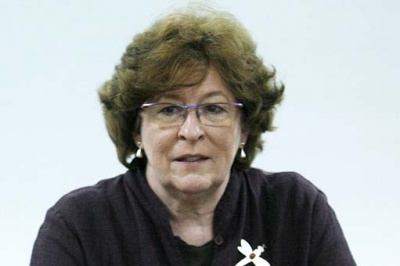
Having worked as the chief prosecutor for two international criminal tribunals, as the United Nations high commissioner for human rights and now assuming the post of the president of the conflict prevention organization International Crisis Group, 63-year-old Canadian judge Louise Arbour says that conflict is part of human life.
JP/R. Berto Wedhatama
“Conflict, I think, is part of human life. The real issue is conflict resolution; how to handle conflict. You cannot avoid conflict. The key is how you can respond to it; how you anticipate it; how you manage it; and how you resolve it,” she said recently.
Arbour who took up the position as president of the International Crisis Group (ICG) in July 2009 after ending her four-year term as the UN’s high commissioner for human rights a year before, was recently in Indonesia, one of ICG’s bases for Southeast Asia.
Arbour was in the region to meet with her colleagues and look at the situation in the region. Arbour last visited Indonesia in 2007 as high commissioner. On Indonesia, she said the country had established a point of leadership in the Association of Southeast Asian Nations (ASEAN). Domestically, the country has managed to achieve and maintain stability post-1998 reform era.
“Looking at the current situation in Indonesia, there is cause to be optimistic that Indonesia is much better equipped today to deal with these kinds of challenges than it has been in recent history,” she said.
Coming from her, the comment can be considered a compliment for the country. Arbour is famous for her frank — and for some, controversial — comments. In 2006, at the height of the Israel — Lebanon war she issued a statement that, “The scale of the killings in the region, and their predictability, could engage the personal criminal responsibility of those involved, particularly those in a position of command and control”. These words were seen by many as directed toward Israel, and were rejected by Israel’s ambassador to Canada.
Now, working in a civil society organization, Arbour said the organization had tremendous freedom to work, which was different to her work in the UN organization. International Crisis Group publishes more than 80 reports and briefing papers annually, as well as the monthly CrisisWatch bulletin assessing the current state of play in some 70 countries or areas of actual or potential conflict.
“There’s a very big difference in the scope and authority of the two positions. The high commissioner for human rights is a high-ranking official in the United Nations with a very large staff. But at the same time, inside the United Nations, as a UN official you are constrained by what member states are prepared to allow or not allow. The political framework of the United Nations is that the shareholders are the 192 states. At times, they are very much in conflict. At other times, they are firm in preventing a certain course of action. So, in a sense, it’s a role that has considerable influence, but not a lot of power,” she said.
She said as high commissioner her only mandate was human rights. “Not conflict resolution. Not political consideration. You just have to be an advocate for human rights protection and promotion,” she said.
Meanwhile, in ICG it was a little more complex, she said. “We’re still guided by human rights principles but we are driven by something that is also pragmatic, which is, at the end of the day, if you’re doing conflict management or conflict prevention or conflict resolution, you have to balance the purity of the principle and the likelihood of obtaining the right result. There is always tension between the desirable and the feasible,” she said.
She said the question was to find a point where there was a chance to achieve a result. “So it’s principles and pragmatism coming together,” she said.
“As a civil society organization, or a nongovernmental organization, we have tremendous freedom to work where we choose to work, assuming again we’re welcome by the government, we can’t impose our presence.
“I think over the years, the ICG has developed enough credibility that most governments understand that, even though we might not agree with everything they say we will always represent their point of view accurately. Even if we disagree with it, our analyses are not biased. We don’t work for anyone, we don’t represent any country,” she said.
Arbour’s first brush with human rights issues, she said, was as a lawyer in Canada. In 1992, Canada passed a new constitution that guaranteed all the fundamental human rights and civil liberties.
“To me, it profoundly changed the nature of Canadian society, of political discourse. My first interest was criminal law. But slowly I became more interested in human rights issues,” she said.
“My first opportunity internationally was sort of a mixture of the two,” she said. In 1996, then UN secretary-general Boutros Boutros-Ghali appointed her as chief prosecutor of war crimes before the International Criminal Tribunal for Rwanda and the former Yugoslavia in The Hague.
In 1999, she was appointed to the Supreme Court of Canada. She took the post as high commissioner in 2004.
Arbour said she believes strongly in the universality of human rights. She disagrees with the notion of cultural relativism of human rights, which was championed by Southeast Asian leaders in the 1990s, such as former Singapore prime minister Lee Kuan Yew and former Malaysia prime minister Mahathir Mohamad.
“I think in all the work I’ve done all my life, I’ve never met one single person on earth that, given the choice, would renounce any of the rights that are guaranteed, the right to life, to health, to freedom, to be free from torture. Everybody wants that,” she said.
Prodita Sabarini, The Jakarta Post, Jakarta | People | Tue, May 18 2010
“She could be the finance minister anywhere in the world,” says James Castle, founder of the consultancy Castle Asia. “She’s that good”.
JP/Arief Suhardiman
Castle told that to Newsweek magazine last year on Indonesia’s outgoing finance minister Sri Mulyani Indrawati. She is stepping down from her post, which she had held since 2005, to join the top ranks of the World Bank under its president Robert Zoellick.
President Susilo Bambang Yu-dhoyono approved of her resignation to work for the World Bank.
In a televised statement Yudho-yono on the departure of Mulyani, who was crowned as the best finance minister in Asia by Emerging Market Forum and finance minister of the year in the world by EuroMoney in 2006, said her departure was “a big loss”.
He said he would ensure however that her successor would carry on the financial and tax reforms she had initiated during her tenure.
Mulyani, 47, will start June 1 as one of the Washington-based bank’s three managing directors, the highest rank under Zoellick.
She will replace Juan Jose Daboub, former minister of El Salvador, who will complete his four-year term June 30, overseeing 74 nations in Latin America, the Caribbean, East Asia and the Pacific, the Middle East and North Africa, the World Bank said.
Analysts said this was a good exit for Mulyani, who with Vice President Boediono, was the target of an opposition campaign accusing them of abusing their authority during the Rp 6.7 trillion (US$716 million) bailout of Bank Century in 2008.
“The appointment is like a win-win solution,” said Purbaya Yudhi Sadewa, an economist at the Danareksa Research Institute in Jakarta. The new job can help Sri Mulyani save face. “She has been facing a lot of political pressure,” he said as quoted by Bloomberg.
Mulyani’s support for the decision to bail out Bank Century in 2008 in order to avert a wider systemic banking and financial crisis was the subject of a highly politicized parliamentary inquiry. The Corruption Eradication Commission is currently investigating the case and has questioned Mulyani on her policy decision.
Legislators had proposed to remove Mulyani from her official duties during any investigation or legal process. The government refused this proposal.
However, apart from the Century saga, her work in dismantling the structure of crony capitalism built during Soeharto’s authoritarian regime, slashing public and private debt, and spearheading sweeping reforms in customs and tax administration is testament to her outstanding achievements in the field of Indonesian economic reform.
During Mulyani’s time as finance minister, Southeast Asia’s largest economy has become a member of the group of 20 leading economies and one of the fastest growing in the region.
Fitch upgraded the country to “BB+”, a notch below investment grade, in January 2010 primarily in recognition of the improvements to sovereign credit-worthiness arising from improved fiscal policy discipline and falling debt ratios. Indonesia is expected to achieve the coveted investment grade within a couple of years to be on par with the emerging market elite of Brazil, Russia, India and China, known as the BRIC nations.
The World Bank said that Mulyani had navigated successfully in the midst of the global economic crisis.
“She has been an outstanding finance minister, with in-depth knowledge of both development issues and the role of the World Bank Group,” Zoellick stated in a press release.
Mulyani, born in 1962 in Tanjung Karang, Lampung, completed her doctorate in economics from the University of Illinois. She has been an avid fighter for Indonesia’s economic reform since the days following the 1997 Asian economic crisis. She was then the head of the University of Indonesia’s Institute for Economics and Social Research (LPEM UI).
Together with 13 other young economists, including Mari Elka Pangestu (now trade minister), Miranda S. Goeltom (former senior deputy governor of Bank Indonesia), and Anggito Abimanyu (now the Finance Ministry’s head of fiscal policy), they presented the Declaration for Saving Indonesia’s Economy.
Mulyani and Anggito later became the members of president Abdurrahman Wahid’s economic advisory team. Wahid’s presidency lasted less than a year and ended in July 2001 with the rise of president Megawati Soekarnoputri.
When rumors spread on Mul-yani’s candidacy in the new cabinet, she silenced them by heading to Atlanta in the US, to work as a consultant for the US Agency for International Development. In October 2002, she was appointed as the executive director of the International Monetary Fund to represent the Southeast Asian countries in its Washington, DC headquarters.
Indonesia’s next president, Susilo Bambang Yudhoyono, came to power in October 2004 and managed to lure her back as the state minister for national development planning.
A year later, in 2005, during a cabinet reshuffle, Mulyani was made the head of the Finance Ministry.
Mulyani in an interview said that as finance minister the goal of government economic policies was for people “to develop, be prosperous, get enough income, be able to meet all their needs from the day they were born until the day they die: education, food, health, recreation, all at affordable levels”.
Prodita Sabarini, The Jakarta Post, Jakarta | People | Thu, May 06 2010
A proponent of religious dialogue, Swiss-theologian and Catholic priest Hans Küng is a highly respected ecumenical advocate and a controversial figure within the Catholic Church.
He established the global ethics project, a global peace movement that started in the early 1990s to find shared values between religions and humanistic beliefs despite “dogmatic” differences. Küng is also an outspoken critic of the Roman Catholic Church and the current pope, Benedict XVI.
The 82-year-old recently visited Jakarta and gave seminars on global ethics, dogmatism and religious fundamentalism. Sitting in a hotel meeting room in Central Jakarta, the silver-haired controversial
priest talked to The Jakarta Post about his views on Catholicism today, the role of religion in a more secularized society, his calling towards priesthood and his belief in the existence of god.
Born in 1928, Küng said his decision to become a priest came at a very young age — in his early teenage years. He studied theology and philosophy at the Pontifical Gregorian University in Rome and was ordained in 1954.
He has been a firm advocate for church reform most of his life, becoming the first major Catholic theologian to reject the doctrine of papal infallibility. In 1971, he released a book Infallible? An Inquiry, in which he maintained that papal authority was made not by God but by man and was therefore reversible. This prompted the Vatican to rescind his ecclesiastical teaching permission in 1979 as Küng refused to withdraw his challenge against papal authority. Küng however continued to serve as a tenured professor of ecumenical theology at the University of Tübingen, Germany, and was also director of the Institute for Ecumenical Research until his retirement in 1996.
Recently, in conjunction with the fifth anniversary of the election of Benedict XVI as pope, Küng wrote an open letter to the church bishops published in the Irish Times, motivated by “profound concern for our church, which now finds itself in the worst credibility crisis since the Reformation”. The Catholic Church has been under a spotlight after revelations of clerical abuse of children and adolescents, in the US, Ireland and Germany.
He appealed to the bishops to set about reform and call for a council, a conference of bishops.
Both Küng and Ratzinger, now Pope Benedict XVI, were in the second Vatican council (1962 to 1965), the latest ecumenical meeting of bishops, which dealt with the Church and its relation to the modern world.
The Vatican II resulted in liturgical reform, religious freedom, ecumenism and inter-religious dialogue.
Küng deemed that Benedict had yet to make the spirit of the Second Vatican Council “the compass for the whole Catholic Church, including the Vatican itself”.
He said the problems with the Catholic Church had to do with papal absolutism, the role of clericalism and the law of celibacy. Clericalism placed the priest above everybody as a holy man, he added. “They are not holy men, they are servants of the people,” he said.
With regards to the law of celibacy, introduced in the 11th century, Küng said it should be abolished and that women should be allowed into the ordination. Küng added that although sexual abuses also happened in other institutions such as families and schools, it was prevalent in the Catholic Church under celibate leadership. In the New Testament, he pointed out, Jesus and Paul practiced celibacy but allowed full freedom in this matter to each individual.
He also said that the rule of celibacy had prevented thousands of people from entering priesthood, causing a lack of new blood in the Catholic Church.
While he advocated reform within the Catholic Church, he voiced the need to put aside fundamental differences and build bridges
with the goal of attaining world peace through dialogue based on shared values.
In the seminar on Monday, Küng elaborated the four basic principles that all religions shared: “You shall not kill, murder, torture, rape. In positive terms, this means to have respect for life. You shall not steal, exploit, bribe or corrupt, which translates in positive terms as dealing honestly and fairly. You shall not lie, deceive, forge or manipulate.
“In other words, you must speak and act truthfully. You shall not commit sexual immorality, cheat, humiliate or dishonor. In positive terms, this means to respect and love one another”.
Küng’s opponents might find his dissenting opinions on the Catholic Church un-Catholic. But Küng responded they might not have read his books thoroughly. Küng has written prolifically — two memoirs, books about Christianity, the Catholic Church, Islam, science and religion, and global ethics.
Religion still plays a role in society, despite the process of secularization, he went on, which came about as a result of progress in science, democracy, philosophy and industrialization.
The world is an invitation to think about God, he noted, “not in a sense of rational proof but by credible reasons… It should be seen as a cosmic vision, which can run side by side with very serious science.”
Religion will still hold a place for people to find out about the meaning of life, about suffering and how humans can overcome it, and also to think about life after death, he said.
While he has always been inquisitive and critical, Küng has never doubted the existence of God.
“I doubted more the argument of his existence, than God himself. As a matter of fact, I never had the idea that God cannot exist. I would have found it irrational. To think that everything just comes out from nothing is not a rational position,” he said.
“But I do not accept rational proofs for God because that’s another dimension. This other dimension you can have reasons to believe, reasonable arguments for believing God, but not rational proofs.”
Prodita Sabarini, The Jakarta Post, Jakarta | People | Fri, April 30 2010



 Peaceful movement: Bulent Yildirim, head of Turkey’s Islamic and pro-Palestinian rights group The Foundation for Human Rights and Freedom and Humanitarian Relief (IHH), talks to activists on a Turkish ship as they sail into the international waters of the Mediteranean Sea as part of a humanitarian convoy on May 30, 2010. Reuters



 Prodita Sabarini