An open heart

p28-a2_21.main story

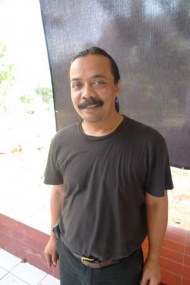
To visit artist Iman Soleh’s house in Ledeng, Bandung, one must walk through an alley even motorcycles cannot pass.

Despite this limited access, his house, located behind the busy public transportation terminal of Ledeng, is the center for community-based theater Celah-celah Langit (CCL), also known as the Ledeng Cultural Center (CCL).

His large front yard, where children can be seen running around while chickens peck the dirt, is where rehearsals for CCL productions take place, including for the recent play Tanah: ode kampung kami (Land; ode to our kampung) presented at Taman Ismail Marzuki cultural center in Cikini, Central Jakarta.

The theater community stages performances there around three to four times a year. Iman said they also hold surveys and perform in different villages to bring art closer to the people.

“I am not against art and cultural spaces but I think that art should come to the people,” he said.

Iman, 47, a seasoned theater player who has joined different theater companies in Japan, France, the Reunion Islands and Australia, said cultural centers should be built near narrow alleyways where people live.

“Even in the most densely populated area… That’s where cultural centers should be built,” he said at Taman Ismail Marzuki recently. Iman was in Jakarta recently to prepare for the play Tanah.

His area in Ledeng has traditionally been an arts and cultural hub, Iman said. The terminal building in Ledeng changed the social landscape there with the communities that grew around it.

However, it isn’t the government that initiated any arts or culture conservation projects there. Iman explained the leader of his neighborhood was a puppet master; not far from his house lived a calung (traditional Sundanese bamboo musical instrument) player, and a bringbrung (traditional Sundanese percussion) player. A traditional Sundanese martial art pencak silat center is located near his house too.

“These rich culture and art communities should not disappear into thin air because they are the ones who bring art closer to the people,” he said. “We are the ones who become snobbish and make barriers because we want it to be representative. I think art should be representative, not the building,” he said.

That is why he opened his house to CCL.

Many have often wondered how his family can retain privacy in his very open home.

“If you want your lives to be beneficial to other people, you have to open your house [to them],” he said.

“Don’t be stingy with what you have if you want to give your life to people.”

During Iman’s childhood, one of his neighbors used to leave a water jug in front of her house for people who were thirsty.

“I would walk pass her house and drink her water and then shout ‘Hatur nuhun bu!’,” he said, which means thank you in Sundanese.

For the play Tanah, 25 people stayed in his living room. “But they are so diligent,” he said. “Learning about art is learning about life. When learning about beauty, the first thing you have to do is learn about cleanliness,” he said.

Iman plans to set up a small library so children can come and read there.

Before the center was called Celah-celah Langit, the place was already a hub for Bandung artists. Iman said poet Acep Zamzam Noor, painter Tisna Sanjaya used to hang out there. It was named Gang Bapak Eni Community, after the name of the street. After the fall of president Soeharto in 1998, the community was called Celah-celah Langit. “Because we can see the sky from the front yard,” Iman said.

A group of international actors from Germany, Brazil, Australia, Japan, in 2007 stayed with CCL for three months in an Indonesia-Australia collaboration between CCL and the Sidetrack performance group.

Their collaboration gave birth to a play called Tangled Garden directed by Brazilian Carlos Gomez.

Iman said he grew up surrounded by the arts in Ledeng. The idea of studying theater came to him when he was studying acting and then directing at the Indonesian Arts College (STSI) — now the Indonesian Arts Institute (ISI). He is currently taking a postgraduate degree at the Jakarta Arts Institute.

He joined the Studi Klub Teater in Bandung and then Teater Kecil headed by Arifin C Noor before travelling around the world.

During his travels, he saw there was a gap between the arts and people in many countries.

“I don’t want Indonesia to be like that,” he said. That is why CCL often performs in villages, to bring art closer to the people he said.

“Art should be representative,” he said. That is why he always starts from facts when creating art.

Iman likes to talk to people around him. After the dawn prayer at the mosque, he goes to the public transportation terminal and has coffee with the buskers there.

“That way we can know what they are worried about,” he said.

CCL is preparing three productions at the moment, including a children’s play, Iman said.

Iman puts these plays together to preserve local art. “Art is the main ingredient in a social world. I don’t want our lives in Ledeng to be dry”.

Iman added that CCL had received support this year from Kelola Foundation, a not-for-profit organization on art and culture, and the Theater Embassy from the Netherlands. “Last year we just managed on our own.”

“The government and the private sector are very stingy. But we don’t need to get upset about this. It’s
OK. If we want to build a community we have to think this way: Forget the existence or absence of  the government. Forget the existence or absence of the private sector. If you can manage on your own, just do it.”

Prodita Sabarini, The Jakarta Post, Jakarta | People | Wed, May 04 2011
Our land, our people

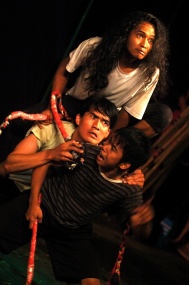
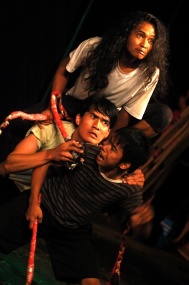
Powerful voices: Without the help of microphones, the actors rely on the strength of their voices during the performance. Antara/Agus Bebeng

The ground beneath our feet is the foundation of our lives. Last Friday night’s performance of community-based theater Celah-celah Langit (CCL) was a poignant representation of how people are losing their life foundations — their home and livelihood — by selling land to greedy property developers.

At Sanggar Baru in Taman Ismail Marzuki cultural space, 15 Central Jakarta actors enacted Tanah: ode kampung kami (Land: ode to our kampung) in a powerful one hour 10 minutes performance.

Accompanied by music from traditional Sundanese musical instruments, the actors told a story through 13 scenes of roaring dialogue and energetic dance moves.

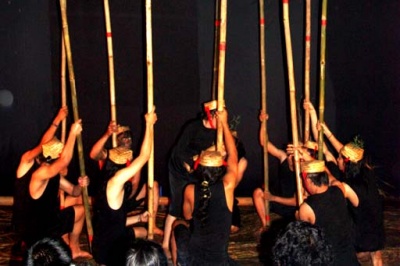
The actors, dressed in black, showed physical and audio strength in their performance. They moved in movements that were slightly acrobatic, showing their bamboo pole skills.

They began the play with a jovial funny scene in which they were enjoying themselves in the fields.

What belongs to the people: Tanah: ode kampung kami (Land: ode to our kampung), a powerful 1 hour 10 minutes play that was presented last weekend at Taman Ismail Marzuki (TIM) cultural space, delves into the issue of land. Courtesy of Celah-celah Langit

Without the help of microphones, the actors relied on the strength of their voices. Holding dry rice leaves, they talked about the importance of land. The only female actor, Anita Bintang, who played the mother, a metaphor of the land, recited the poem Tanah ode kampung kami: Land is the beginning/in land we exist/we are the land/hurting the land hurts ourselves/pleasing the land pleases ourselves/don’t sell your land/selling the land sells ourselves/selling land sells your mother.

In the next scene, the actors held a big bamboo pole together close to their chests. The mother hung on to the bamboo pole using her arms and legs, outstretched.

The story portrayed two men luring people to sell their land. They told the landowner he could spend the money to go on the haj pilgrimage. “Tell all your neighbors. The whole village can go on the haj and to heaven together,” a land broker said.

One person did not want to sell his land and tried to persuade the others not to sell theirs. But his efforts were to no avail. The mother was surrounded by tall bamboo, representing the buildings and skyscrapers. “My children!,” she cried out.

Each actor then dropped the bamboo poles until they surrounded Anita. She was then lifted up and left to die.
Angry faces: Actors from the Tanah play perform at TIM cultural space in Jakarta last Friday. Antara/Agus Bebeng

The play is an adaptation of the voices of the people of Lembang, Bandung. The hilly area in Bandung has undergone many transformations over the years with many  businesspeople buying up the land there.

Iman Soleh, director of the play and founder of Celah-celah Langit or also known as Ledeng Cultural Center, prepared this production as a theater for development and educational project supported by Kelola Foundation, an NGO for the arts and culture and the Theater Embassy from the Netherlands.

In November 2010, he held a writing workshop with the people of Lembang to determine their opinions on the land issue. These 25 compiled texts were then discussed and adapted into a play.

“Art should always start from facts. If it do not come from facts we are detached from the problems of the people. What good is art when it is detached from the people’s concerns,” he said.

This makes the process of playwriting a long one, but Iman said they just had to be patient. “We talk to them about what they want to convey. ‘I will make art so that your message can be delivered’,” Iman said.

Egbert Wits, the coordinator for theater for development and education from the Theater Embassy, said the production aimed to “give a voice to the people through art”. The workshops of theater for development can give the people new skills such as writing, poetry reading, singing and dancing.

Wits added that theater for development aimed to stimulate dialogue between people about the issues communicated in the play.

Iman added that the story of Lembang was only an aperçu, which fit into the bigger problem of land in general. “Is there land for the people?” he asked. “People come to Jakarta and big cities because they don’t have anything in their villages,” he said.

He pointed out that land rights were given to only a few big companies who claimed they created jobs, while the government did not empower the people with land.

“I ask, do [the companies] guarantee their laborers good welfare? Young people no longer want to be farmers,” Iman said, adding that this was because they could not survive in this trade.

The play is presented in Jakarta, Iman said, because the capital also had its own unique land problems. “There are 1,007 land cases in Jakarta and 125 are unresolved,” he said.

Iman, a theater performer, who has joined various theater groups in Japan, the Philippines, France, Reunion Island and many other countries, founded the CCL community. The CCL creative process takes place in his front yard in Ledeng, Bandung. He witnessed his father’s village in Cigondewah convert from paddy fields into an industrial area. He also saw how the Ledeng public transportation terminal transformed the area into an arts hub.

The area is home to hundreds of university students renting boarding rooms, Ledeng residents, vendors, buskers and children. Iman said they usually performed in villages to bring the art closer to the people. Iman said that most actors in the play were university students.

Tanah will be presented in Jatiwangi as well as Lembang, Bandung.

Prodita Sabarini, The Jakarta Post, Jakarta | Entertainment | Wed, May 04 201

Bandung performers to present the story of land

Land is key: The play Tanah, to be presented this Friday at Taman Ismail Marzuki, focuses on the issue of land. Courtesy of Celah-celah Langit

A community-based theater from Bandung will present their play Tanah (Land), which delves into the issue of land at Taman Ismail Marzuki (TIM) cultural space this Friday night.

The theater community Celah-celah Langit or the Ledeng Cultural Centre, headed by performer Iman Soleh, based in Ledeng, Bandung has been preparing the production of this one hour and 10 minutes show since November 2010.

The play will be open to the public and take place in Sanggar Baru, TIM. Celah-celah Langit opened their première of Tanah in Bandung. After Jakarta, the theater will also perform in Jatiwangi.

The play is part of a theater for development and educational project supported by Kelola Foundation, a not-for profit organization for the arts and culture and Theater Embassy from the Netherlands.

The 13 scenes of the play are based on 25 texts produced by the people of Bandung hilly area in Lembang who have been affected by Lembang’s changing landscape.

Iman said the idea for this play had germinated in Lembang in 2009. With the Netherlands Theatre Embassy and Kelola Foundation, Iman held writing workshops in Lembang to find out the experiences the Lembang people had with the changing of the land.

“The writings were diverse, with diverse language as well. We held continuous discussions around the writings that were collected,” Iman said. “The discussion process was longer than other explorations [for the play],” Iman said.

He added that the story of Lembang was only an apercu, which fit into the bigger problem of land in general. The play is being presented in Jakarta, Iman said, because the capital also has its own unique land problems. “There are 1,007 land cases in Jakarta and 125 of them are unresolved,” he said.

Iman pointed out that 26 people were involved in the production including musicians, costume designers and lighting crew. There are 15 actors in the play.

Bamboo and hay will be prominent theater props to convey a feel of the agrarian life.

“We brought 20 long bamboo poles from Bandung,” he said.

Egbert Wits, the coordinator for theater for development and education from Theater Embassy, said the production aimed to “give voice to the people through art”.

The people can benefit from the production process with new skills such as writing, poetry reading, singing and dancing.

“The people become more confident and become brave in speaking in public,” he said.

Wits added that the theater for development aimed to stimulate a dialogue between people about the issues that was being put forth in the play.

Prodita Sabarini, The Jakarta Post, Jakarta | Feature | Fri, April 29 2011

A beautiful mind

Showing solidarity: Participants to the World Autism Day held on April 2 walk down the streets of Yogyakarta. Antara/Wahyu Putro

For the first 10 years of her son’s life, Sri Astuti never heard him utter a word.

Her son Raditya Parasadi is autistic. When he was growing up, information on autism was hard to come across, Sri explained.

Now, 13 years later, Raditya communicates freely. He can hold conversations on various topics from religion to marriage. He also has a penchant for designing clothes.

While he has now blossomed into a talented young man, Sri said raising an autistic child wasn’t easy, mainly because society perceives autistic children or people as strange and freakish.

Raditya once worked in a hotel, Sri said, but when his old boss moved on, Raditya was laid off because his new superior wasn’t open to having an autistic employee.

Actress-cum-activist Christine Hakim recently launched a campaign to eliminate the negative stigma surrounding autism, which was accompanied by a documentary film on autistic children.

Christine, through her foundation Christine Hakim Feature, aims to educate the public about autism.

“People say the [autistic] children looks crazy, while in fact they [children] are not. We have to approach them to understand them,” Christine said during the launch of the documentary.

For her campaign, Christine is working with neurologist Andreas Harry as a producer and advisor, and Ricky Avenzora, a lecturer in child recreation and disabilities, as a documentary film director.

Sri said that meeting with Christine, Andreas and Ricky was like a miracle.

“I don’t shed tears anymore. I’ve cried too much already,” she said.

“I say stop the tears. Don’t be sad. It’s a miracle from god. Our child is a gift we should care for. Give as much love as you can,” Sri said.

Autistic children and their parents gathered recently in a restaurant in a central Jakarta office tower for lunch. They came to share their stories and watch an extract of the documentary film on austistic children Love Me as I am.

Christine, award-winning actress who has produced documentaries on Indonesian heritage, started doing research for the documentary on autism in January this year. The film’s launch on April 1 was meant to coincide with Autism Day on April 2. Christine plans to screen the documentary film in schools, to change the perception that autistic children should not attend regular public schools.

Studying in a regular school allows autistic children to interact with other children who aren’t autistic, she went on. Children who aren’t autistic also benefit because they get to know about autism, and stop stigmatizing it.

Documenting the lives of autistic children and their families has been both painful and inspiring for Christine. She said she wanted to educate people about what autism was really about.

Autism is not a disease, according to the medical community, Andreas said. It is a syndrome caused by a different anatomic structure in the brain, Andreas explained. Difficulties in verbal and non-verbal communication, including difficulties making eye-contact; unstable emotions and having one repetitive single interest were the general symptoms of autism.

According to Andreas, the film plays an important role raising awareness about autism among society.
“There are more children born with autism than before,” he said.

In 2008, eight out of 1,000 babies were born with autism, compared to one in 1,000 in 2000, Andreas stated.

Andreas, whose child is autistic, said autistic children had great potential in several fields. “My child is a doctor at 21,” he said.

He added that researchers in the UK claimed Einstein might have been autistic. He has symptoms of Asperger’s syndrome, which is a form of autism.

The documentary recounts the stories of autistic children with exceptional talents. One of the talented children is 7-year-old Michael Anthony. He is autistic and blind.

The sound of his fingers dancing on the piano keys comes out like that of an adult maestro playing classical music. Christine said that listening to Michael play brought tears to her eyes.

Michael can play around 100 songs, including sonnets from Mozart, Bach and Beethoven. His mother said he first listened to his brother playing the piano, and then started to play around with the piano himself.

Andreas said that at his age, Michael could still be exposed to different areas of interest. Music might just be one of many areas Michael possesses talent in, he said.

“He might have more than one talent,” he said.

Emilio, another autistic child, does paintings with vivid colors. One of his paintings could have sold for US$5,000, but Emilio and his family declined to sell it.

Christine said it was important for the government and the public to get rid of any misconception about autistic children. The latter should be allowed to study in public schools and interact with non-autistic children, she said. Denying them a place in regular schools was a violation of human rights.

“Because our principle is education for all,” she said.

Irma, a mother of two children, said her autistic son had learned to interact socially with his younger sister, who isn’t autistic.

Christine explained that autistic children improved their social skills when studying alongside other children in regular schools. Children who are not autistic care more for their autistic friends and help the latter at school.

She cited as an example Global Mandiri School, which has 59 autistic students.

“The students [who are not autistic] do not tease their autistic friends. They are caring and they help them out,” Christine said.

Andreas added that autistic people could have an independent and meaningful life.

“In the end they are able to fall in love and form families. We want to go to that direction,” he said.

Prodita Sabarini, The Jakarta Post, Jakarta | Life | Wed, April 13 201

The love life of transsexuals

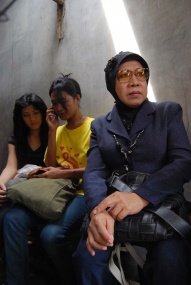
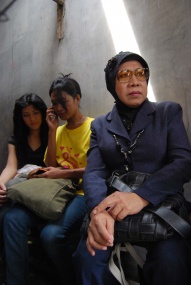
Caring souls: (From left to right): Adel, Shanti and Nency sit in a waiting room at Cipto Mangunkusumo Hospital, in Salemba, Jakarta, after fellow transsexual and AIDS activist Shakira was shot by unidentified assailants at Taman Lawang in Central Jakarta at dawn last month. JP/Wendra Ajistyatama

For many transgendered women, loving a man means letting him go. Only few dare to wish for an everlasting romantic partnership.

Yuli Rettoblaut, Mariyani and Rully all share the same story: They were in long-term relationships where they eventually told their partners to leave them and marry a “real” woman.

“I feel I’m destined to not have a partner,” Rully said in Yogyakarta.

Rully said she had been in a 7-year relationship with a man. Being a devout Muslim, Rully encouraged him to find a wife. “Whenever we talked about children and other stuff, we came to a dead end. I suggested he end this [relationship] and marry [another woman],” she said.

In the beginning, her partner refused to leave her but eventually agreed to end the relationship.

“I’ve concluded that it’s enough to feel love in our hearts; we don’t need to have it written down because there is controversy [in the issue of same sex or transgendered marriages], and we might not have the courage to always be known as something that defies long-held rules in society’s norms,” she said.

Those who do marry often come to loggerheads with Indonesian law. Recently, Fransiska Anastasya Oktaviany, also known as Icha and Rahmat Sulistyo, 19, was arrested for alleged identity fraud. Icha had been married for six months to Muhammad Umar, 32. Umar said he did not know Icha was a transgendered woman.

Hartoyo, director of LGBT rights organization Ourvoice, said in a press statement that Icha’s gender identity and sexual orientation was Icha’s and Umar’s private concern. “However, Icha has a different gender role and sexual conduct so she had to forge her identity card. The problem of why Icha forged her identity should be highlighted by the State… Many transgendered people do the same thing, and some of them are permitted by local authorities to change their sex on their ID card,” Hartoyo said.

Despite the fact that the State, through the Ministry of Health in 1993, has stated that homosexuality, bisexuality and transsexuality are not diseases or mental illness, the 2006 Demographic Administration Law has not accommodated transgendered people as a separate identity and still designates gender identity according to physical anatomy, Hartoyo said.

Mariyani, who runs an Islamic School for transgendered women, once encouraged her partner to leave her and marry another woman. But, after that relationship, she found someone new and was married under religious law.

“A female religious leader married me off,” she said. Her husband apparently already had a wife and children, so Mariyani and her husband separated. Mariyani adopted a child and decided to live on her own with her daughter.

Lulukaszyura Surahman (Luluk), 28, said until a couple of years ago, she wouldn’t admit she was a transgendered woman. “I felt I was a woman and I was very against telling people that I’m a waria [transgendered],” she said.

Men would court her, and she would be responsive. Eventually, she would ask her friend to tell the man courting her that she was a transgendered woman. “They usually disappeared after that,” she said.

Now she tells people from the start that she is a transgendered woman.

“So, he would know from the start,” she said. Luluk added that she would not want to stay single the rest of her life.

“It doesn’t feel good to be alone all the time,” she said. “Every person wants to love and be loved,” she said.

— JP/Prodita Sabarini

Prodita Sabarini, The Jakarta Post | Feature | Mon, April 11 2011

Life as a (special) woman

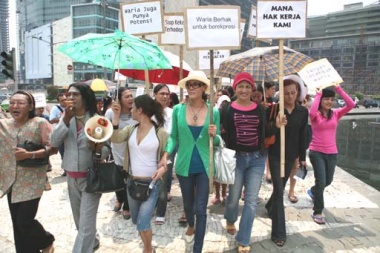
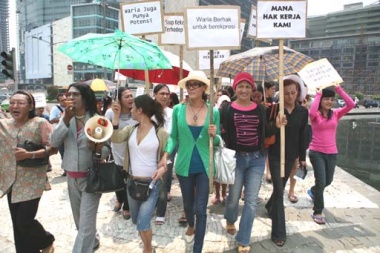
Action time: Dozens of waria who are members of a solidarity network gather for a protest at Hotel Indonesia’s traffic circle. JP/Arief Suhardiman

What makes a woman a woman? What makes a man a man?

For Lulukazyura Surahman (Luluk), 28, being a woman is a question of identity. It is all in the mind and in the way one behaves. It has little to do with one’s sexual organs.

“I’m a woman even though I have a penis,” she said. “I’m a woman, but I’m special.”

And a beautiful one she is. With long black hair, curly lashes and a big easy smile, she said people often did not realize she was transgendered.

Luluk struggled with questions of identity while growing up, from forcing herself to act manly to questioning God. But, despite her struggles to accept herself, Luluk is one of the lucky ones. Her family, with a moderate Muslim Nahdlatul Ulama background, never rejected her for being transgendered and made sure she completed her education until university level. She got her undergraduate degree in sociology and worked as an activist at Srikandi Sejati, an organization that works with LGBT issues.

Other transgendered women have not been so lucky while undergoing the soul-searching process of accepting their gender identity. Often they embrace their identity at the expense of rejection from family and society.

Once they have established their gender identity and found peace with who they are, issues of societal acceptance like teasing and barriers in the workplace continue to haunt their lives.

Many transgendered women end up on the streets and disconnected from their families, while at the same time isolated from mainstream society. Living in exclusive transgendered communities, they busk on the street or solicit sex for money or to find sexual partners.

Vinolia Wakijo, 51, the founder and director of the Yogyakarta Transgendered Women’s Organization (Kebaya) said a lot of transgendered women lived a life steeped in violence.

“They lack social experience since they leave their families at a young age. Life on the street is harsh, especially in the [transgendered] community. Where do they learn ethics? They race to get the best in whatever way. In the end, they live a harsh life,” she told The Jakarta Post at Kebaya’s headquarters in Yogyakarta.

In Jakarta, the transgendered women’s community hangs out at Taman Lawang park. That is where Faizal “Shakira” Harahap was shot earlier this month. Shakira, a transgendered woman, was killed and two other transgendered women, Agus “Venus” Yuliaman and Tantang “Astrid” Stianugraha, were injured. The police are still investigating the case.

In Aceh, Cut Yanti Asmara, a transgendered woman who worked at a moving beauty salon, was killed last week. The suspect, Fuadi, is now in police custody. He allegedly called Cut Yanti “bencong” which loosely translates as “tranny”. Yanti became enraged and came at him with a knife and was reaching for a shovel when the latter allegedly hit her with a crowbar.

In 2008, the Central Jakarta Public Order Agency was accused of violence that led to the death of a transgendered woman in Taman Lawang. The transgendered woman died after leaping into the Ciliwung River while fleeing a hail of stones thrown by public order officers.

Transgendered women in Indonesia are prone to becoming victims of violence, starting from the rejection of their families to cheating customers and bigoted strangers.

For Lenny Sugiharto from Srikandi Sejati, transgendered women have to be emotionally stronger in dealing with mocking and teasing from people.

“When one has chosen to live their life as a waria they have to be ready for the consequences,” she said. She added, “don’t let the teasing get to you.”

Discrimination against transgendered women in the workplace is also a huge problem. Up to now, Indonesian society accepts transgendered women only in specific areas, such as beauty salons and the entertainment industry.

Rully, 50, had to give up being a teacher in a school in a remote area in West Sumba. Raised in Makassar, South Sulawesi, Rully, who has dressed as a woman since she was a child, defied the education system in the early 1980s and presented herself in class as a transgendered woman.

Rully explained to her students from the beginning that she was a transgendered woman. “So they don’t develop the wrong understanding about waria,” she said,

She taught third to sixth graders. “Almost all the students respected me. [There were] only one or two cases, for example a student once said ‘trannies like to suck d*cks’. They didn’t know that I am a devout Muslim. In the early struggle this really hit me hard,” she said.

In the end, Rully felt pressured by the education agency. The head of the provincial education agency called her in. “I was summoned because I’m a waria,” she said.

In the one year that Rully taught, she concluded that mentally she was not ready to “go public” as a transgendered woman. “Almost every day I waste my energy with conflicting thoughts,” she said.

She resigned from being a civil servant. Rully now works with Vinolia in Kebaya as coordinator for support for transgendered women.

While, Luluk and Rully are transgendered women who received family support early in their childhood and completed their higher education without having to run away from home, Vinolia experienced the “dark side” of being a transgendered woman — working as a sex worker.

Mariyani, the founder of an Islamic school for transgendered women in Yogyakarta, led a similar path, living the life of a sex worker before settling down and setting up a beauty salon and in 2006 an Islamic school.

From her work at night, Vinolia was exposed to the outreach activities of Yogyakarta PKBI (Indonesian Planned Parenthood Association) and became a volunteer herself.

Vinolia said many transgendered women are not confident interacting in the community. Constant rejection and mocking from society causes them to have low self-esteem. Vinolia said transgendered women should push themselves and talk to their neighbors and be social. Both Vinolia and Mariyani joined an arisan (savings gathering) with women in their respective neighborhoods in order to be social and accepted in the areas they live in.

But, even among transgendered women their gender identity can be different from one another. Luluk believes she is a woman, and is open to the possibility of a sex change. Meanwhile, Rully, Mariyani and Vinolia believe they are waria (transgendered women).

“We’re women at heart, male physically. These two things together build what is man and women,” she said.

“We are transgendered physically and mentally,” she said.

“I will not have an operation,” Mariyani said. “I don’t want to defy God’s laws.”

She said that as long as she still feels it is a sin, she will never undergo a sex-change operation.

“I’m satisfied like this, I feel pleasure like this, I’m comfortable like this,” she said.

Prodita Sabarini, The Jakarta Post, Yogyakarta/Jakarta | Life | Mon, April 11 2011

Dwiki Dharmawan: An ambassador of music

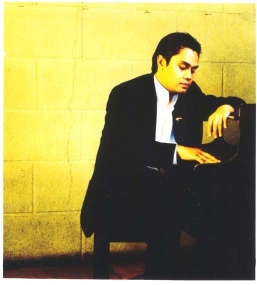
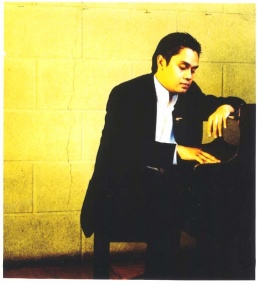
Courtesy of Dwiki Dharmawan

Dwiki Dharmawan gave the cue to five men with string instruments. “From the top!” he said and brilliant staccato jazz rhythms ensued.

The 44-year-old internally acclaimed pianist was in a studio at the renowned music school he runs in South Jakarta rehearsing for a concert at the Salihara Cultural Space on Thursday.

Four members of the band came from the Jogya String Quartet, led by cellist Dimawan Krseno Aji, while the man on acoustic bass was Donny Sunjoyo.

Dwiki usually performs with big bands or an orchestra when playing with his world music group, Krakatau, which is famous for combining traditional Indonesian music and jazz.

This time around, he said he opted for a simpler format to soak in the detail and movements of all the musicians he jammed with.

“When I listen to minimalistic music, the details stand out more — and the interpretation of every player can be felt more,” Dwiki said.

Inspired after seeing jazz great Chick Corea performing in a quartet, Dwiki decided to team up with the Jogya String Quartet and Donny.

The collaboration merged two different styles, Dwiki said: Donny and Dwiki have jazz backgrounds, while the string quartet is a classical music ensemble.

“I want to encourage [the band] to improvise,” he said. “Playing music is not like reading a book.”

Dwiki, Donny and the string quartet plan to tour Asia in 2011. Afterwards Dwiki said he would to take his musical experiment to Europe alone and try the format with local musicians.

His passion for exploring and mixing traditional ethnic music and contemporary jazz has made him one of Indonesia’s music virtuosos.

Dwiki has performed in more than 30 countries, effectively becoming an ambassador of Indonesian music.

It’s a moniker he proudly accepted; as a child he wanted to be a diplomat. “Then I discovered music, so I wanted to be a diplomat who is good in music. But then I decided to be a musician and let my music do my diplomacy,” he said.

Dwiki’s music speaks of Indonesia. Krakatau, renowned for fusing ethnic and contemporary music, has released eight albums since 1987. The group last released Rhythm of Reformation in 2006. Dwiki’s solo album, Nuansa (Nuance), was released in 2002 with the support of a host of international musicians.

Sax player Andy Suzuki, Yellowjackets bass player Jimmy Haslip, oud player Kamal Mussalam, percussionist Steve Thornton and more than 100 other musicians joined Dwiki’s World Peace Orchestra (WPO) in 2008.

Local talents guitarist Dewa Budjana, drummer Sandy Winarta and singer Dira J. Sugandi rounded off the musicians in the WPO.

The idea for an international orchestra came to Dwiki after he played in Jakarta’s Java Jazz festival. “I saw a lot of international musicians coming and they kept to themselves. There was no synergy afterwards,” he said.

“The project aims not only to promote Indonesia and multiculturalism, but [also] peace,” he said. WPO is a fusion of East and West. “There’s Arabic, European, and Indonesian styles of music,” he said.

The WPO inspired Dwiki to work on another project drawn from his experiences travelling in the Middle East. When visiting the region, Dwiki said, he thought combining jazz and Middle Eastern music would be wonderful.

Then he met Kamal Mussalam in 2009. Kamal played the oud, a distant relative of the lute used in Middle Eastern and North African music.

“Communication in music usually takes place in jam sessions,” Dwiki said. However, Kamal and Dwiki did communicate through music. The pair are now collaborating on a project called Eastmania with legendary jazz drummer Billy Cobham.

As if all that was not enough, Dwiki said he planned to return to Sulawesi for his Celebes Fantasy project, which traces its origins to a visit he made to the island in 2010 for a festival.

Intrigued by Sulawesi’s traditional music, Dwiki teamed up with a local music group, Phinisi, and plans to release Celebes Fantasy in 2011.

Dwiki’s love of Indonesia is evident from his exploration of the country’s music. His projects have always explored traditional Indonesian music, albeit in a contemporary way. “Krakatau brings Indonesia’s traditions to the global sphere by ‘contaminating’ — for example — the gamelan tradition with jazz,” he said.

His musical mission has taken a more serious turn over recent years, Dwiki said. “At first I felt happy playing music and happy that I could make other people happy with my music. But as time goes by I want to find meaning in life by way of creating music for the country and the people.”

Dwiki was introduced to music at an early age. His mother was a singer and introduced him to singing and music. He started studying the classical piano at the age of six and the jazz piano, under the late Elfa Secioria, when he was 13. In 1985, he formed Krakatau with Pra Budi Dharma, Donny Suhendra and Budhy Haryono.

In 1995 he married singer Ita Purnamasari.

As his purpose in creating music has shifted to a more nationalistic side, he said that goals such as fortune, fame, or even mere personal happiness did not matter.

A lot can be learned from music, Dwiki said.

“I really like multiculturalism in music. People respect each other, show tolerance towards each other and appreciate one another, he said.

“Why can’t everyone be like this?”

Prodita Sabarini, The Jakarta Post, Jakarta | People | Mon, April 04 2011

Autistic children should be able to go to regular schools

Autistic children should be allowed to attend regular schools so they can learn how to interact with others, activists say.

Doctor Andreas Harry and actress Christine Hakim, who is active in campaigning for autism awareness, said Friday that it was better for autistic children to study in regular schools with children without autism than at special schools.

She said that studying in a regular school would allow autistic children to socially interact, while children who are not autistic will be able to learn more about autism and help to eliminate the stigma that surrounds it.

Andreas said many schools do not accept autistic children. Christine said rejecting a child enrolling at a school for being autistic was a violation of human rights, “because our principle is education for all,” she said.

“For children who do not have multiple syndromes, it’s possible for them to attend regular school,” she said, adding that children who had syndromes other than autism, like schizophrenia, would need different treatment.

Christine said at schools where autistic kids were part of the class, their social skills were more developed. Christine said children who were not autistic cared about their autistic friends and helped out the latter at school.

She cited the example of Global Mandiri School, which has 59 autistic students. “The students [who are not autistic] do not tease their autistic friends. They are caring and they help them out,” she said.

The award-winning actress, together with her foundation and Andreas, produced a documentary film on autistic children Love Me as I Am to commemorate world autism day today.

The 45-minute film, directed by Ricky Avenzora, will be taken on a road show and screened in schools in a bid to change people’s perceptions of autistic children. It features several autistic kids, including seven-year-old Michal Anthony, who has exceptional talents in classical piano. He is autistic and blind.

The research for the documentary began in January, Christine said. Andreas said the film was important in spreading awareness about autism in society. “There are more children born with autism than before,” he said. Andreas said that in 2008, from 1,000 births eight were born with autism. That figure is higher than 2000’s one in a thousand births.

Parents of autistic children said that some members of society perceive autistic children as having a mental disorder. “People will say, ‘Your child is crazy’,” Sri Astuti, who has a 23-year-old autistic son, said. Her son, Raditya Parasadi, did not speak until he was 10 years old. Now, he communicates with people freely and designs clothes.

Christine said that the aim of the film was to change that negative perception about autism and for society to accept people with autism and not isolate them. Christine aims to reach all members of society, including the government.

“We want to open people’s eyes. There should be no more children who are shackled, who are locked up or put away in a dorm even though their parents can look after them,” she said.

Autism is not a disease according to the medical community, Andreas said. He said it is a syndrome caused by a difference of anatomic structure in the brain. Andreas said symptoms of autism were difficulty in verbal and non-verbal communication, including difficulty in making eye-contact; unstable emotions; and having one repetitive single interest.

Andreas, whose child is autistic, said that autistic children have great potential in several fields. “My child is a doctor at 21,” he said.

Prodita Sabarini, The Jakarta Post, Jakarta | Features | Sat, April 02 2011

Michel Wieviorka: Discussing Multiculturalism

up p28-a_221.img_assist_custom-400x267

While Indonesians pride themselves on having a multicultural society with hundreds of ethnic groups and languages, a French sociology professor said his countrymen view the word multiculturalism as not politically correct.

“France is the only place in the world where multiculturalism is not politically correct. It’s a word the French don’t like to use,” Michel Wieviorka said.

The professor at the Ecole des Hautes Etudes en Sciences Sociales said he was one of the few social scientists to use the word.

Wieviorka, the former president of the International Sociological Association, was in Indonesia to give a series of lectures on democracy in universities across the country. His first lecture, held on March 11 at Salihara cultural center, centered on the French notion of laicité, or secularism, and diversity. His following lectures were at Gadjah Mada University in Yogyakarta, the University of Indonesia in Depok and Airlangga University in Surabaya.

Wieviorka who holds an amiable smile under his thick mustache, shared some of his thoughts with The Jakarta Post at Gran Mahakam Hotel before giving his lecture at Salihara. He talked about multiculturalism, the reason he became interested in that topic, and why he would never be a politician.

First, he explained why there was such a negative attitude toward multiculturalism in France. Wieviorka said the French hold very highly the freedom of each individual. They fear the cultural becoming much stronger than the individual, which could result in repression of those who have less power; for example women. This is what the French call “communitarianism”, where the community is stronger than individual rights.

But, there is another possible danger apart from this “communitarianism”, which is “abstract universalism”.

“Here [In France], we don’t recognize cultural differences. We only recognize human individuals as such. And human individuals as such all have the same rights and same responsibilities; which is wonderful, but also very theoretical,” he said.

“In real life, it is not like that. If you say human rights is [a] good [thing], but you don’t make it possible, really, then you have made it abstract.

“I consider multiculturalism very interesting, because it can bring an answer to this problem,” he said.

According to him, the one area where multiculturalism flourishes is “quite surprisingly a place where one has a strong sense of belonging to a nation”. He added that multiculturalism was very difficult though. “It needs a strong democracy at the very least.”

“Multiculturalism isn’t about a society having many different cultures. Its’ a political and institutional proposal to build with these differences, and build this in a democratic way.”

That is why he is against France’s policy of banning the use of niqab. He said he had two students who did their thesis on women wearing niqabs. Most of the women they interviewed had started wearing the niqab after converting from Catholicism to Islam. These women said they felt stronger wearing a niqab. Therefore Wieviorka said wearing a niqab wasn’t “a deep provocation against the French values”.

Wieviorka became interested in multiculturalism very early in his career.

“I started as a sociologist many years ago. At that time, even the word multiculturalism did not exist,” he said.

His first interest was in social movements. When he started his career in the early 1970s, the working class movement was ending and a new movement led by students was starting.

Having been an intellectual for many years, Wieviorka was very realistic about the role of intellectuals.

He acknowledged their ideas or recommendations would not be embraced by policymakers easily.

“It’s not like people will listen to them and the population will be happy to have this solution that has been invented by intellectuals. It doesn’t work like that,” he said.

“Because the truth is that politicians don’t listen to intellectuals and they don’t have to listen to intellectuals.”

Wieviorka, who supports the French Socialist Party, said he knew many politicians on a personal basis.

“I have wonderful discussions with them and they might accept my ideas,” he said. “But,
they [then] go back to their constituency and they know their constituency will not follow my ideas.”

The important thing is to create a dynamic between the world of intellectuals — and their ideas — and the world of politicians, he went on.

Despite his interest in multiculturalism and social change, Wieviorka is not interested in e ntering politics.

He said only a few sociologists could be good in politics, citing as an example Fernando Enrique Cardoso, the former Brazilian president, who is a sociologist.

Wieviorka’s contribution will be in the form of books he has written, he explained. His most recent book is The Next Left and the Social Sciences.

Prodita Sabarini, The Jakarta Post, Jakarta | People | Wed, March 23 2011

Giving a voice to the voiceless

Underwater world: Farid and Yunus dive between Kaledupa and Hoga islands near Wakatobi, Southeast Sulawesi.

Ahmad and Farid kept a travelogue on Zamrud-Khatulistiwa.com, shot more than 70 hours of video tapes and took 10,000 photographs. They plan to write seven books from their journey.

They have recently finished Indonesia: Mencintaimu Dengan Sederhana. (Indonesia: Loving you in a simple way). Farid authored a number of books about mangroves as well as Indonesia’s coral reef.

How did these two prepare for such a trip? The first thing they did was get a diving certificate, Farid said. Farid put his skills to the test in Raja Ampat, Papua; Togean in Sulawesi and many other places in Indonesia.

Farid and Yunus also learned how to protect themselves from malaria, mostly by skipping day naps.

“Because when you nap during the day, you become food for mosquitoes,” Farid said.

There were not so many difficulties in their journey, Farid and Yunus said. Farid added that Yunus’ cooking skills came in handy, as the latter would cook for families they stayed with. It was the perfect icebreaker.

“We wanted to feel like they were strangers. We didn’t want to be trapped into thinking that ‘oh they’re indigenous people’,” Yunus said. “We didn’t see the people we met on our travels as isolated. We saw them as a humans and we tried to integrate into their lives. We tried to be as honest as possible with who we were and everything,” he said. “That’s when people started opening up”.

For Yunus, who was trained at media organization Pantau and worked for Playboy magazine, the journey was a way to apply one of journalism’s core principles.

“I saw this as an opportunity to give a voice to the voiceless. That motivated me to work more seriously. And for young journalists, this has to be one of the biggest challenges that can be taken on,” Yunus.

For Farid, the journey allowed him to witness first hand the sheer extent of exploitation in rural areas. He saw how important it was to be critical of public policy on foreign investment.

“Foreign investment doesn’t make sense if its benefits do not trickle down to locals,” he said.

Yes, the journey was a revelation for Farid, who said he discovered so much about the country through his travels.

“But even with this extra knowledge, there are still so many things I don’t know about.”

— JP/Prodita Sabarini

The Jakarta Post | Feature | Wed, March 16 2011