For Papuans, their graves are a reminder of the grief that besieges their land.
In front of the Justice and Human Rights Advocacy Network office in Wamena is the grave of Opinus Tabuni, a member of the Papuan Indigenous Council, killed in a military crackdown on World Indigenous Peoples’ Day in August 2008.
Human rights activist Theo Hesegem sat just a few feet from the grave. He recently said that the government’s attitude to the complex social and political problems in Papua would not end the violence.
In 2011, UP4B was established to accelerate development and growth in the most impoverished region in Indonesia. The hope was to improve the welfare of indigenous Papuans and quell their discontents.
But the source of discontent is not about having food on their plates. Theo said that Papuans’ main problem “is not eating and drinking. It’s not about welfare. We don’t know how many children, how many families, how many people have been shot or killed — that’s the problem”, Theo said.
Researchers at the Indonesian Institute of Sciences (LIPI) believe that decades of political violence has led Papua to a collective memory of grief, or memoria passionis.
While the government attempts to speed up development in the region, it retains a military approach. In 2009, security forces killed Free Papua Movement (OPM) leader Kelly Kwalik, and despite of his death, sporadic attacks from the OPM continue. According to the National Intelligence Agency (BIN), last month’s ambush was partly due to rebel fighters unhappy with a new military district command (Kodim) in Puncak Jaya.
“People can’t assume that the issue of Papua is finished. It’s about ideology. You can’t shoot a person and say his ideology is dead. There are other people. That person has children who will continue to think that ‘my father was shot because of Papua’,” Theo said.
Melianus Wantik, 29, member of the National Committee for West Papua (KNPB) which campaign for secession from Indonesia, said that the grave of They H. Eluay, the assassinated leader of the independence movement the Papua Presidium Council, was an important place for KNPB.
Young activists in Papua established KNPB after Theys was killed. During the founding of KNPB Melianus said they camped at Theys.
KNPB members themselves are now on the police wanted list, accused of shootings and bombings. KNPB leader Victor Yeimo reports that 22 KNPB members were killed last year, including the KNPB leader Mako Tabuni.
For Papuan Indigenous Council (DAP) Baliem area head, Yulianus Hisage, the killings no longer have a shock effect on him. “Killing people, shooting people in Papua: It’s normal. For us, the indigenous community, it’s normal because it’s not the first time we’ve seen it,” he said.
Yulianus, who is part of the Jakarta-based conflict resolution NGO, the Titian Perdamaian Institute and often travels outside of Papua, does not feel safe in his own land. “When I leave Papua, for Yogya I feel safe. Back in Papua, I worry when I will be killed,” he said.
From various sources
Prodita Sabarini, The Jakarta Post | Reportage | Thu, March 28 2013
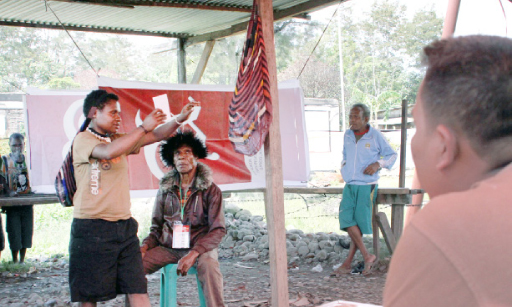
Look who I voted for: A woman in Woma district, Jayawijaya regency, holds her ballot up before placing it in a noken (traditional Papuan woven bag) in the January gubernatorial elections. (Antara/Rico)
Papuans have been allowed to reject secrecy as one of the principles of general elections. The open-ballot system is permitted there, but customary leaders say the open election system as it stands in Papua today has no roots in tradition and could easily cause conflicts in the already restive province.
The heavily militarized province held its gubernatorial election on Jan. 29 using open ballots. Known as the noken system, its name is taken from the traditional woven bag that replaces the ballot box. During the election that saw Lukas Enembe and Klemen Tinal victorious, voters in Papua placed their ballots in one of several noken. The number of bags corresponds to the number of candidates. The bags are hung in the open for all to see.
“It’s a dangerous system,” Damianus Wetipo, a polling station official in Asolokobal, Jayawijaya said. He said that lack of secrecy meant that village or customary leaders were able to pressurize their people to vote according to his choice, and if there was any defiance, people could end up fighting each other.
The Constitutional Court (MK) recently rejected a lawsuit against Papua General Elections Commissions (KPUD) by five campaigns in the Papua gubernatorial race. They claimed that fraud had been widespread in the election and that the noken system was undemocratic.
Under the 2007 Law on General Elections, the principle of secrecy is part of elections, along with elections being direct, public, and free. However, MK judges ruled that the noken system was not a violation, stating that it was part of the Papuan culture.
Traditionally decision-making in Papua has been a collective consensus, in which the tribal head can be a proxy for his tribe. The noken system was invented to translate this to modern election practice, where every citizen has suffrage. Each citizen is expected to place the ballot themselves.
The Papuan Indigenous Council (DAP) Baliem region head, Yulianus Hisage, said that the noken system was unknown to their tradition.
Damianus said that the noken itself was part of their culture but having people choose a bag to place a vote, to and thereby choose their leader, was not.
Damianus said that Papuans, many in rural and isolated areas, have been used to the ballot box in elections for a very long time. He recalls that the noken system was first used during the first free presidential election in 1999 after the New Order authoritarian era, but he was unsure of the reason for the change of system.
The village officials said that the system holds a huge potential for inciting conflict. In regency elections, Papuans can become fanatical and very belligerent in their support of their candidates.
Indeed, it is not just in the regency elections that violence can flare up. During the gubernatorial election the system took its toll. Tolikara regency councilor Husia Yosia Karoba from the Golkar Party was beaten to death by Democratic Party supporters, the winners of the election. Husia reportedly urged people to vote for the Golkar candidate.
The open system is not the only problem with Papua elections. The Democracy for Papua Alliance (ALDP) reported electoral fraud in the handling of leftover ballots. The fixed voter’s list was, they claim, higher than the actual number of voters. This challenge was echoed by five candidate pairs and went all the way to the Constitutional Court. The court explained that the number of eligible voters was based on a census by the Papua Population and Transmigration Office.
ALDP reported that in Hesatum village the number of ballots was around 300, while the actual village population was 138.
The village officials then confirmed the inflation of the voter list. Damianus knows all the people living in his village, but the names in the list included people from a neighboring village and those who had passed away. “Rocks and trees were given a name and put on the list,” he said jokingly.
The unused ballots were placed in Lukas and Klemen’s noken, who eventually won.
Village heads say they were pressurized to cheat as the regency has power over their positions. Moreover, defying the directives runs the risk of having their children unable to get jobs in government. Most educated indigenous Papuans look for jobs in the public service, which creates a dependency on the whims of political elites.
Prodita Sabarini, The Jakarta Post | Reportage | Thu, March 28 2013
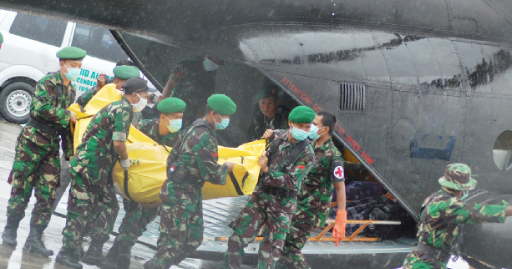
Going home: Soldiers carry the body of one of the victims of an ambush at Sentani airport, Feb. 24. Authorities said the military wing of the Free Papua Movement (OPM) attacked soldiers and civilians in Sinak in Puncak regency and Tingginambut, Puncak Jaya regency. Eight soldiers and four civilians died in the attack. (Antara/Anang Budiono)
Papua continues to be plagued by violence. Last month gunmen shot at an army helicopter, as the military was to evacuate victims of an ambush which killed eight soldiers and four civilians. Activists say the solution lies in a mediated comprehensive dialogue, but the government rejects any attempt to revisit history. The Jakarta Post’s Prodita Sabarini reports on the political dynamics after a visit to Wamena in Jayawijaya regency.
Describing the violent political situation affecting his people, a young indigenous Papuan man quoted a Latin saying: Homo homini lupus.
“Man is a wolf to [his fellow] man,” said Demianus Wasage, 28, a Papuan from the Yali tribe. The provinces of Papua and West Papua are Indonesia’s part of New Guinea, a resource rich, bird-shaped archipelago north of Australia. The region has a history of social unrest and has been home to rampant military abuses since part of it officially became part of the country in the early 1960s. More than four decades later, and after being given special autonomy status, the provinces remain gripped in a spiral of violence, with external and internal discord permeating Papuan politics.
Demianus was born in a rural village in what is now Yalimo regency. He said that earlier generations still practiced cannibalism when he was growing up. He wore the koteka, Papua’s penis gourd, until he was in elementary school. He said he was glad that missionaries brought Catholicism to his village when he was growing up, so he did not have to follow the ancient practices he disagreed with.
He was proud of his traditional garb, which he sometimes used when accompanying foreign tourists in Papuan villages. “I’m not ashamed of wearing a koteka, I’m proud of my culture,” he said.
Many Papuans believe that their black skin and Melanesian culture distinguish them from the Malay majority in Indonesia. Academics say gradual preparations for Papuan independence by the Dutch in the 1950s also developed a Papuan sense of nationhood. But the US, eager to stave off Soviet influence in Indonesia, brokered a New York agreement between the Dutch and Indonesia in 1962 that officially transferred Papua to the control of the Indonesian government. What is widely believed to have been a sham of a referendum in 1969 stopped short of any chance of Papua being recognized as an independent territory by the United Nations. Demianus said that Papuans were not included in the negotiations that decided their fate. “Even until the end of time, Papuans will always want to be free,” he said.
In February this year, an attack by the Free Papua Movement’s (OPM) military wing, the Papua Liberation Army Front (TPN), killed eight Indonesian soldiers and four civilians in Puncak and Puncak Jaya regency, strongholds of the TPN, authorities said the attack was the latest incident in four-decades of sporadic fighting between the Indonesian Military (TNI) and Papua’s rebels.
Human rights defender Theo Hesegem from the Justice and Human Rights Advocacy Network said that OPM personnel hiding in the jungle viewed the military and the police as their enemies.
“They [the Indonesian security forces] are armed and the OPM are armed too,” he said. “But […] whether people passing by are soldiers, construction workers, or business people, as long as they have straight hair the OPM sees them as Indonesians and shoots at them,” he said.
According to Indonesian Institute of Sciences (LIPI) researcher Adriana Elisabeth, unlike the former Free Aceh Movement (GAM), which had a centralized command, the OPM is fragmented into several guerrilla groups and small organizations. The organization is heavily based on the tribal identities of the leader and members.
Yulianus Hisage, the Baliem area head of the Papuan Indigenous Council (DAP), an organization of customary and tribal leaders that advocates for indigenous rights and Papuan culture, said studies showed that Papua had around 250 ethnic tribes. “In reality there’s more than 300,” he said.
Relations between tribes in Papua were complex, Yulianus said, with conflicts settled through tribal warfare. In the Baliem Valley alone, in the mid highland region, a hotbed for OPM guerrillas, there are 14 tribal alliances.
In 2011, when the third Papuan People’s Congress was held, declaring Papua and West Papua independent from Indonesia, the congress appointed DAP leader Forkorus Yaboisembut as president. However, Lambertus Pekikir, an OPM/TPN leader in Keerom regency, Papua Province, did not acknowledge the congress. Forkorus is now imprisoned for treason and three people were killed during the authorities’ crackdown on the congress.
More moderate groups gathered under the Papua Peace Network (JDP) believe that dialogue is the key to peace in Papua. The LIPI’s Adriana said that for this to work, the Indonesian government should first halt its military approach to the provinces. Theo said international mediation was required to resolve the issue. “If it’s just Indonesia, the odds [for resolution] are slim. We’re talking about ideology. Indonesia wants a unified Indonesia, while Papuans want independence. The dispute would never end,” Theo said.
Amid a lack of cohesion in Papuan communities, the National Committee for West Papua (KNPB), an independence campaign movement led by young Papuans, has emerged as a formidable component, with strong connections to the Papua independence movement overseas. Catholic priest and award-winning human rights activist John Jonga said the group was “Quite a brilliant movement”.
“They have a lot of creativity, they can gather people together and they are very firm in their stances. It’s clear they have overwhelmed the government — especially the military and the police — because their number is huge,” John said.
Melianus Wantik, a self-styled touring ambassador for the KNPB, said that the organization was born after seeing the Papuan independence movement lose its leader with the assassination of Theys H. Eluay, who was the leader of the Papua Presidium Council in November 2001.
“The KNPB was born because we saw that Papua needed a rational political leader. Not someone who is factional, egoistic and doesn’t stand with the grassroots,” he said.
In its heyday, the KNPB organized independence rallies across the Papua region, with thousands of people — many in traditional garb — taking part. Their grass roots campaign in 2011 was connected to the Free West Papua campaign led by British-based Papuan exile Benny Wenda, and the rallies coincided with an international conference of parliamentarians on Papuan independence.
“Our connection with Benny is very strong. We work based on his instructions with the International Parliament for West Papua and International Lawyers for West Papua,” Melianus said.
But since the killing of KNPB leader Mako Tabuni, the organization has adopted a low profile in rallies. In 2011, Papua was wrought with cases of violence that the police dubbed as being perpetrated by “unidentified assailants”.
A spate of killings in June and August 2011 saw more than 20 people killed. The police have linked the violence to the KNPB and have said they would use the 2003 Terrorism Law against those attacking police stations. However, Melianus said there was no evidence and the allegations were only aimed at discrediting the movement.
Human rights activists have criticized the police’s heavy-handed approach toward KNPB members. KNPB leader Victor Yeimo reported that in 2012, 22 KNPB members had been killed. Papua Police chief Insp. Gen. Tito Karnavian has defended the Terrorism Law in Papua by saying that it was required to ensure that criminals did not hide behind veneer of the freedom movement.
Benny recently toured Australia, New Zealand and the Pacific island countries to rally support for Papuan independence. But in Papua, the KNPB held no rallies. “We should have shown support because every time Benny visits these countries, we should go on the street and rally, but our room for democracy is blocked. The Indonesian government sees us as terrorists, [guilty of] treason and separatism. Our room for movement is shrinking,” Melianus said.
Catholic priest John said that in Jayapura, during Mako Tabuni’s leadership, the KNPB sometimes used intimidation so that people would join the rallies. “In Jayapura, they forced Papuans to follow them. Sometimes it involved beating people. Some journalists were not only intimidated but also beaten,” he said.
But John strongly doubted that the killings and bombings in Papua were linked to the KNPB. “They’re the ones who are getting shot at,” he said.
John, who has served in Papua for more than 25 years, said that Papuans wanted independence. “This spirit of independence is supported by social and economic problems, violence, violations of human rights and indigenous peoples rights, as well as the exploitation of resources. So in meetings, they express that,” he said.
The priest also spoke of another big problem plaguing the provinces — the corruption of local Papuan politicians. Since Papua received special autonomy (Otsus) status in 2001, only indigenous Papuans are eligible for regional head positions in the provinces.
The government has so far disbursed Rp 30 trillion (US$3.08 billion) in Otsus funds to West Papua and Papua provinces to speed up development. But more than a decade later, Papuans remain the poorest in Indonesia. The Supreme Audit Agency (BPK) found that Otsus funds of Rp 66 billion in 2010 and Rp 211 billion in 2011 were unaccounted for.
According to John, pro-independence Papuans must also face their own political elites that are benefiting from their current positions as regional heads. “A small number of people will feel that their finances or positions are being threatened. If their main concern is their own welfare, then these people might even kill their own people,” he said.
John said that in Indonesia, people supported and opposed Papuan independence for various reasons. “But Papuans themselves say that whatever happens, be it famine or civil war, these are problems that can be dealt with later,” he said. “So, the future is full of question marks.”
Checks and balances: The Democratic Party selection team checks documents submitted by would-be legislative candidates at the party’s headquarters in Kramat, Central Jakarta, on April 3. Eligible political parties have until April 22 to submit their legislative candidacy lists for the 2014 election to the General Elections Commission (KPU). JP/Prodita Sabarini
I covered political parties’ preparation in recruiting and selecting prospective legislative candidates for next year’s election.
Sometimes watching the people sitting in parliament feels like watching a comedy show, until you realize that no one’s joking. Then you realize it’s more like watching a horror movie, and you get spooked a bit, until you remember that what you’re seeing is not a movie, it’s real life. Anti pornography law? Remember the porn-watching lawmaker from the Islamic Prosperous Justice Party nonetheless – after they release the anti-porn law? And now all this ridiculousness on witchcraft and living outside of marriage being criminalized in the Criminal Code.
So, I was quite excited covering the whole process of choosing candidates of people that will REPRESENT other people in deciding how we run this country. Admittedly, a lot of people don’t care about who will represent them in the election. So many say they’ll abstain from voting because they don’t trust politicians. But maybe if we pay more attention to this, we’ll actually can get people who really do care into the parliament.
I got help from The Post new cub reporter in covering for this reportage. Here are the reports




 Prodita Sabarini