Law enforcers participate in sexual exploitation of children


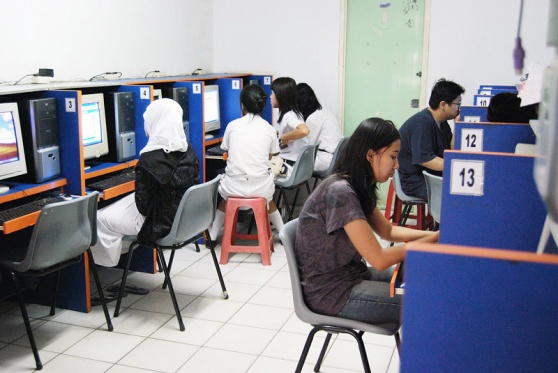
Visitors surf the web at an Internet cafe. (JP/Wendra Ajistyatama)

She saw the boots that he wore, and in his bag she saw a uniform. “He brought his police uniform with him,” said a girl identified as W, 20, as she recounted her experience.

She was 17 when she started to meet with adult men “mostly in their 30s and married” in her hometown of Bandung for sexual transactions.

From her experience, she said that police officers and soldiers looked for underage girls for sex. Being men of the law did not stop them from looking for instant sexual satisfaction, she said.

UNICEF estimated that 30 percent of female prostitutes in Indonesia were under 18 years old and that around 40,000 to 70,000 children in Indonesia have been victims of sexual exploitation.

Indonesia has signed, but has yet to ratify, the optional protocol of the UN Convention on the Rights of the Child on the sale of children, child prostitution and child pornography.

Indonesia enacted the 2007 Anti-trafficking Law and set up an anti-trafficking task force, but few improvements have been achieved since, according to Arist Merdeka Sirait, director of the National Commission for Child Protection (Komnas PA).

In Bandung, the Bahtera Foundation, an NGO that works in child protection, has reached out to more than 600 children who are involved in child prostitution.

According to the foundation’s director, Tamami, children in Bandung became involved in commercial sexual exploitation through peer pressure and a drive toward consumerism.

Irwanto, the director of ECPAT Indonesia — an NGO that works against child pornography, exploitation and trafficking — said that in the country’s fight against sexual exploitation and sex trafficking of children, the government had not yet put forth a serious effort in protecting children.

Further, Irwanto said law enforcers were sometimes part of the problem and that the lack of proper sex education led children to search for answers in the “wrong places”.

Endang Supriyati, the director of the Bandungwangi Foundation, an NGO set up by sex workers, said that it was really difficult to break the chain of child sex trafficking as corrupt police are easily bribed.

She said the police would take bribes from owners of bars and cafes that employed underage girls as sex workers.

Endang, 28, said that she was a victim of child sex trafficking. Hailing from West Java, she was sold by her parents to work in the red-light district in Jatinegara when she was 12.

She said that corrupt police officers would tip off owners of clubs and bars that employed underage children when a raid was about to happen. “They were already paid [by the bar owners],” she said.

And if underage girls were caught in a police raid, Endang said, they were treated “as if they were robbers” and endured sexual harassment, rather than being treated as victims. “When the girls are taken away in a police van, they touch the girls’ behinds,” she said.

Worse, she said, was that there were some officers who abused their power and forced child prostitutes to have sex with them without paying.

Endang said that the children were helpless in reporting this sexual violence to the police, as they were in a marginalized position and were forced into prostitution.

The biggest factor behind the reluctance to speak out, Endang said, was that the adults involved in trafficking rings were often from the child’s own family.

“I hate that I was sold to work as a prostitute, but I could not report my own mother. She’s my own mother after all,” she said. “The uncle, the father, the grandfather, the cousin, all are related and work there,” she said.

Rather than focusing on law enforcement issues, the Bandungwangi Foundation takes a different approach to fighting child prostitution. “We find that focusing on law enforcement is futile and not our job. Here in Bandungwangi, we try to reach the girls, provide some guidance and slowly give them the confidence to say ‘no’ and walk away from forced prostitution,” she said.

Out of the 20 people that the foundation has reached, eight have stopped working in the sex industry.

“Sometimes the problem is just fear and a lack of confidence. These children feel that they cannot say no to their parents and feel that they have already been stigmatized by society,” she said.

— JP/Prodita Sabarini

The Jakarta Post | Reportage | Sun, January 27 2013

Looking for safe ground on the Internet

Children test the free Internet connection at a children’s festival in South Jakarta in this file photo. (JP/P.J. Leo)

New technologies are forever a blessing and a curse, as in the case of inevitable exposure of the young to unknown abusers in cyberspace. The Jakarta Post’s Prodita Sabarini reports on the issue from Jakarta, Bogor and Bandung, on the preparedness, or lack of it, in preventing children from falling victim to sexual predators.

According to ECPAT International, cyberspace is home to more than 1 million images of tens of thousands of children being subjected to sexual abuse and exploitation. A 2010 report from the International Watch Foundation states that 17 percent of the world’s child sex abuse web addresses are based in Asia.

From a two-month survey conducted by ECPAT this year, the foundation discovered 137 cases of commercial sexual exploitation that used social media or mobile messenger services in Jakarta, Bandung and Batam.

The director of ECPAT Indonesia, Irwanto, said that the pervasiveness of the Internet in children’s live made children to vulnerable to sexual predators lurking online. “This can happen to anyone,” he said.

The mother of a 14-year-old girl from Depok who fell prey to an online sexual predator and was nearly trafficked to Batam, said she hoped the government would take firmer action against sexual predators who exploited the Internet to search for their victims.

She endured sleepless nights when her daughter, identified as SAS, did not return home in late September after saying that she was going to visit a sick friend before heading to church choir practice.

SAS was allegedly kidnapped and taken to Bogor, drugged and repeatedly raped by Catur Sugiarto, 24, a man who befriended her on Facebook. Child activists believe a child sex trafficking ring was involved as SAS said that her kidnapper told her she was to be shipped to Batam, an island that is a notorious sex trafficking destination. SAS was found on Sept. 26 at the Depok bus terminal after her alleged captor left her there. SAS’ lawyer, Dwi Handi Pardede, said that her kidnappers probably became scared because of the media coverage of the missing girl and returned her to Depok.

SAS also said that she saw at least four other girls between the ages of 14 and 17 in the house where she was held captive.

SAS’ abduction brought the issue of online-based sexual violence against children to the fore. But it also showed a sinister side of some members of the public against victims of sexual violence. SAS was denounced and humiliated in front of other students by her former school principal on her first day back at school after the ordeal.

Education and Culture Minister Mohammad Nuh made a controversial statement about underage victims of rape, implying that a lot of girls consented to sex and then claimed rape.

The minister made this comment despite the fact that consent is irrelevant in sexual relations between an adult and a minor. Under the Penal Code and the Child Protection Law, any kind of sexual relationship between an adult and a minor is a crime.

SAS’ mother said that her daughter was trying to rebuild her life and that she had changed schools. She worried though about other girls as her daughter’s kidnapper remained at large. “The police haven’t caught the perpetrator. The government has to act more firmly. Other victims are at risk,” she said.

Indeed, SAS’s story is hardly the only incidence of sexual violence. The National Commission for Child Protection (Komnas PA) this year received 129 reports of missing children. The commission believes that 27 of them went missing after meeting their abductors through Facebook.

With the many risks that come with social media, parents should monitor their children’s online activity, a child activist says.

Irwanto, the director of ECPAT Indonesia, a child protection NGO, said that parents should be aware of the dangers posed by social media and take active steps to protect their children.

Irwanto said that one way was to install monitoring software on their computers to monitor their children’s social media accounts.

Software developers and security firms have released applications for parental monitoring. Among the paid products and services available are ZoneAlarm SocialGuard, TrueCare and SocialShield. MinorMonitor also provides free monitoring software.

These applications allow parents to monitor their children’s online activity, including alerting parents to the existence of their chidren’s acquaintances with a low number of mutual friends and identifying online friends that might be too old.

Children’s activities online leave them vulnerable to sexual predators, cyber-bullying, pornography and sharing too much personal information online.

Irwanto said that parents should also try to have an open discussion about sex education. “Many teenagers do not know who to talk to about sex,” he said. He said that children were at risk of looking for answers among their peers, which could lead to risky sexual behavior and sexual exploitation.

The Jakarta Post | Reportage | Sun, January 27 2013

Children defenseless against online crimes

The Jakarta Post
The Jakarta Post

The advent of social media and mobile messenger services has increased the risk of social exploitation for children. In Bandung, adults use BlackBerry Messenger or Facebook to approach teenagers for sexual encounters. But as the danger increases, adequate protections have failed to keep up.

While the adults — mostly male — get away with sexually exploiting young girls scot-free, their young victims are left with an experience that has been forever etched in their memories.

“If I look back, automatically I would not have done it had I knew that my life would be ruined,” said C, 20, a former child prostitute. C said that she was a curious and hard-headed child. She disliked school and got expelled when she was an eighth-grader. “They [the teachers] knew that I was troubled,” she said. She was also estranged from her family due to her sexual orientation. “My father continued to scold me because I liked women,” she said.

Ridden with teenage angst, she joined a motorbike gang, became a child prostitute and later became the “Ibu (mother)”, pimping out young girls her age to older men.

C said she used BlackBerry Messenger to communicate with clients. “We can send a video and they can see how the girl looks,” she said. Another girl, W, said that she was solicited on Facebook after men looked at her profile picture.

Irwanto, the director of ECPAT Indonesia, an NGO that works against child pornography, sexual exploitation and trafficking, said that whatever the circumstances surrounding sex with a minor, the child was always the victim. “They [children] are not emotionally developed yet. They have yet to understand the consequences of their actions,” he said.

But far from protecting the girls from sexual exploitation, C said that when the police arrested her for working as a pimp, they traded her freedom for sex with one of the young girls that she managed.

Social media is extremely popular among Indonesians, including among children. Indonesia is home to more than 50 million of the 550 million Facebook users worldwide.

A 2012 survey by Minormonitor shows that 38 percent of Facebook users are children under the age
of 13. The microblogging site Twitter is also popular among Indonesians, with the country representing the sixth-largest number of users in the world.

Further, smartphone technology has made it easier to connect with people through mobile messaging services such as BlackBerry Messenger and Whatsapp.

But the increase in children’s knowledge of using social media and networking services has not yet been met with an equal awareness of the dangers of sexual predators. Further, national legislation to protect children online from being lured into sexual exploitation is non-existent.

At an international conference on sexual violence against children online, Women’s Empowerment and Child Protection Minister Linda Amalia Sari said that sexual predators used the Internet to trick, seduce and eventually traffic children to be exploited sexually and to be forced into prostitution.

According to data from the ministry, around 100,000 children are trafficked each year. UNICEF estimates that around 40,000 to 70,000 Indonesian children have been victims of commercial sexual exploitation.

In the case of sexual violence against children online, Irwanto said that it was hard to estimate the number of cases in Indonesia.

“[The perpetrators] are hidden and they work in secret syndicates,” he said. Victims are also ashamed to come forward due to the stigma against victims of sexual violence.

Prodita Sabarini, The Jakarta Post, Jakarta | Headlines | Sun, January 27 2013

Samarinda floods blamed on mining

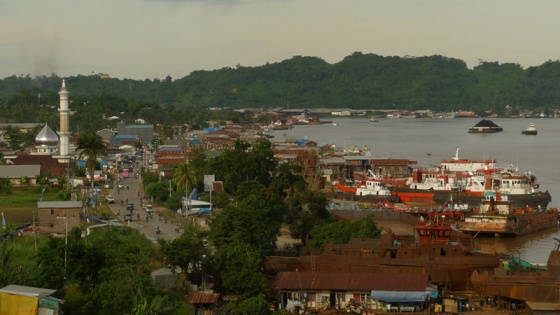
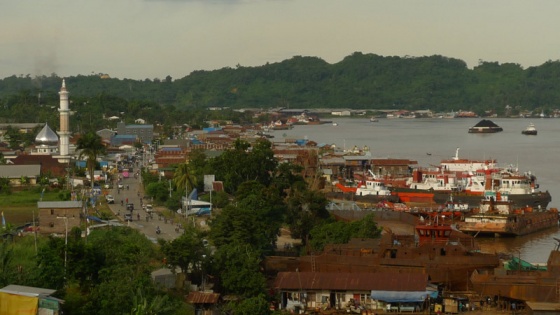
Panorama: A view of the East Kalimantan town of Samarinda and the Mahakam river, taken from Lipan Hill. (JP/Prodita Sabarini)

As it goes in Jakarta, so it goes in Samarinda: heavy rains bring big floods.

A lack of water catchment areas has made flooding a certainty in Samarinda, according to local residents. And many residents of the East Kalimantan provincial capital blame the ubiquitous coal mines around the city.

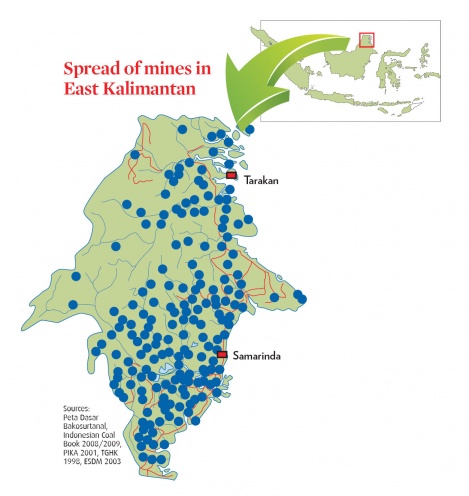
East Kalimantan is known for its wealth of natural resources. The last decade has seen a boom in the region, especially in Samarinda, which has given out 76 mining concessions comprising more than 70 percent of its area. East Kalimantan has more than 1,000 mining concessions in total, in addition to numerous oil and gas blocks.

The transmogrification of green hills into open mine pits has left the once-forested city bare. The East Kalimantan Mining Advocacy Network (JATAM) has reported that Samarinda has reserved only 690 hectares of forest for water catchments, about 1 percent of its total area. Further, JATAM coordinator Kahar Al Bahri said that most of the city’s swamps had been converted into residential or industrial areas.

“When it rains in Samarinda it always floods now,” Kahar said.

Environmental experts have estimated that the city needs to designate at least 27 percent of its land as urban forests for water catchment. The city is 19,000 hectares short of that target.

Conditions are different in Balikpapan, the business capital of East Kalimantan.

Bakro, a Samarinda resident who hails from Malang, Central Java, said that Samarinda and Balikpapan, two of the most important cities in the province, were run quite differently.

“Balikpapan is better managed. They don’t provide licenses to mine willy-nilly,” he said.

Samarinda, on the other hand, seemed to be managed rather haphazardly, he said. “But because of that it’s easier to survive in Samarinda. You can go and be a street vendor anywhere in that city,” according to Bakro. “You can’t do that in Balikpapan.”

Despite the ease in finding informal work in Samarinda, environmental degradation in the city has taken its toll on its residents. Early last year, the dam that held water discharged by the mine of Samarinda Prima Coal burst and inundated hundreds of houses in muddy water, JATAM reported.

Local residents and a coalition of NGOs then launched a class-action suit against the Samarinda administration, claiming that officials had mismanaged the city and harmed residents by granting too many
mining concessions.

Samarinda Deputy Mayor Nusyirwan Ismail said that he was aware of the environmental destruction that could be wreaked by mining companies. He told The Jakarta Post that the city administration had a “creative way” to intensify its monitoring of coal mining.

The local mining agency and environmental agency monitor miners based on their adherence to environmental standards.

Companies with a low level of compliance are shut down for a month and told to repair any environmental damage.

“If after one month there is no significant improvement — or in other words no progress up to 70 percent — then their permits will be rescinded,” Nusyirwan said.

According to the deputy mayor, the permits of four companies have been rescinded for poor adherence to environmental regulations.

Nusyirwan said that there have been many conflicts between local residents and mining companies on environmental issues. “Samarinda is growing and has more than 926,000 residents. There can be frictions.”

“That’s why as a political contract, we will not issue new permits.”

– JP/Prodita Sabarini and Nurni Sulaiman/Samarinda

The Jakarta Post | Special Report | Fri, January 18 2013

Mining, the big challenge in guarding the environment

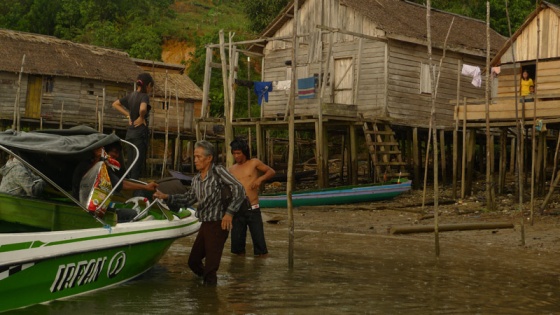
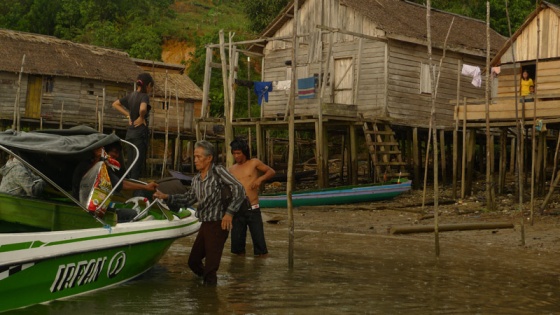
Coming home: An indigenous man unloads his belongings from a small boat in Sekatak district, Bulungan regency. (JP/Prodita Sabarini)

This is the second of a two-part report on East Kalimantan, which has recently been split into North and East Kalimantan. The Jakarta Post’s Prodita Sabarini and Nurni Sulaiman report from the richest province outside Java, which also faces severe environmental challenges. 

Young idealists in East Kalimantan dream to make a difference

Sarah Agustiorini studies biology. She loves plants, she says. The 22-year-old spent her early years marveling at the many different shades of green in the forest that surrounds her home in Samarinda, the provincial capital.

She grew up watching how the forest changed. First the trees were chopped down and were replaced with uniform trees for the timber industry. Now, from her home in Sambutan district she sees hills being scarred by the digging for the coal underneath.

Early this month, she led The Jakarta Post and a couple of curious university freshmen to Makroman village, a farming area where coalmines are quickly closing in.

Three years ago, Sarah joined the Mining Advocacy Network (JATAM), when the organization searched for volunteers through a writing workshop at Mulawarman University in Samarinda. Sarah is now the coordinator for women and mining issues, while she finishes her studies in conservation biology. Makroman is one of the areas where she works with the community.

In East Kalimantan, young people, who will inherit a land spoiled by the exploitation of natural resources, are eager to guard the environment and to learn to not make the same mistakes.

Sarah, for example, decided to advocate for the rights of the local community with JATAM after seeing mines spring up around her house and watching deforestation make many of Samarinda’s once readily available local fruits become increasingly hard to come by. At the East Kalimantan JATAM office, she is the youngest member of the team and the only woman.

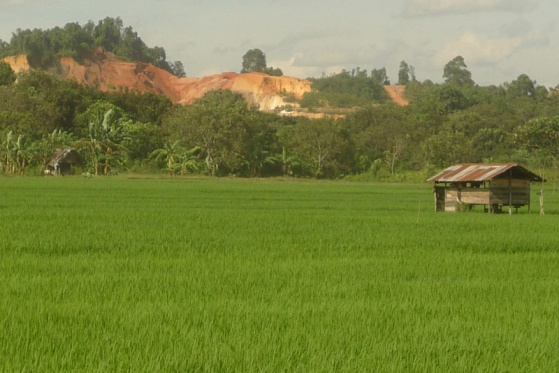
In Makroman, she passes rice fields and heads towards a hill. She walks swiftly, tackling the hill, covered in tall wild grass. As she reaches the top of the hill, the vista changes abruptly from green rice paddies to grey, steep-walled pit mines. After the mines started operating in Makroman, farmers say their yields dropped by half as chemical seepage from the mines drastically reduced the quality of water used in their rice fields and fishponds.

“Everywhere I go the complaints are similar. How can they make the mines go [away]? How they have trouble getting water. How dusty the air has become. How it’s hard to sleep at night because of the noise from the mines. And they don’t know where to go, so they always come to JATAM,” Sarah said.

Next month, Sarah will graduate. “I want to be a taxonomist, but I will continue my advocacy work with JATAM,” she said.

A similar kind of idealistic drive to guard East Kalimantan’s environment has touched Muhammad Azrar Munir. A 17-year-old freshman at Mulawarman, Azrar chose to major in agriculture despite the mining boom in the region. He came along to Makroman as he was visiting JATAM’s office with a friend. “I want to learn more about how local farmers live,” he said.

Azrar comes from Penajam regency in East Kalimantan. The mining industry there has yet to flourish as it has in Samarinda, where 70 percent of the land has been given out in mining concessions; or Kutai Kartanegara regency, with the largest number of mining concessions, covering 1.2 million hectares; or East Kutai — home to Bumi Resources’ Kaltim Prima Coal. However, Sarah’s observation was that they were heading in that direction.

Azrar said he hoped that his regency would take lessons from other regencies and do a better job of planning. “Mining is fine, but mines should not be close to residential or farm areas,” he said.

“I chose agriculture because mining is booming. I want to develop the agriculture sector more,” he said.

“I have a dream to develop the agriculture sector even though the mining industry is booming because in the past few years, we have been facing a food crisis in Indonesia,” he said. He pointed out that Indonesia has been importing rice, while the country should be a rice exporter.

Sarah said that for all the progress that the mining industry had brought, she had yet to see any company significantly impact real human development. “Development here amounts to nothing much, except that consumerism is increasing rapidly. But progress for the people? I don’t see much,” she said.

She said that people’s way of life was changing as they moved from farming to working in mining. They experienced rapid increases in income, but were forced in to a consumerist lifestyle. “And still, some of the people don’t have electricity, like in Sempaja, Sambutan and North Samarinda,” she said, referring to districts in Samarinda.

For Sarah, Samarinda and East Kalimantan’s progress has merely focused on exploiting natural resources and has neglected investments in infrastructure and in human capital.

Sarah and Azrar are among the few young idealists that dream to create change in the region. But more young educated people like them are needed to effect change in the future.

The government of East Kalimantan seems to have realized its dependency on extractive industries and is starting to invest in its young people. The provincial government and the Education and Culture Ministry are planning to establish a new Institute of Technology in Kalimantan. Some 300 hectares of land had been prepared in Balikpapan for the new school, East Kalimantan governor Awang Farouk Ishak said. Construction is planned for 2013 and some 100 people were sent to study at Institute of Technology in Surabaya.

Hopes are high that the institute will churn out skilled workers that will fuel progress in the region. Whether the institute will, in the long run, instill a similar sense of idealism as Sarah and Azrar hold, remains to be seen.

The Jakarta Post | Special Report | Fri, January 18 2013

Indigenous Dayaks struggle to hold on to their lands

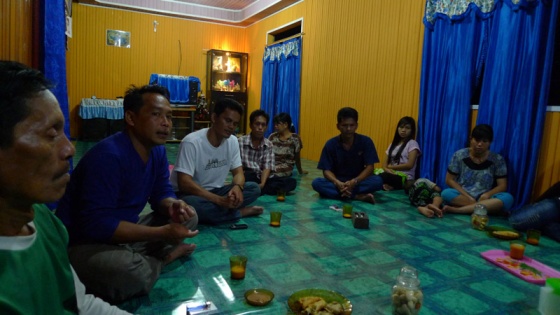
 Village meeting: Yua (far left) and village leader Yohanes (second from left) participate in a local community gathering in Sekatak district, Bulungan regency. Yua witnessed the forceful eviction of indigenous people in Bulungan during the Soeharto era to make way for a wood manufacturing company. (JP/Prodita Sabarini)

Village meeting: Yua (far left) and village leader Yohanes (second from left) participate in a local community gathering in Sekatak district, Bulungan regency. Yua witnessed the forceful eviction of indigenous people in Bulungan during the Soeharto era to make way for a wood manufacturing company. (JP/Prodita Sabarini)

Yua is a small man with fine lines on his face. He does not know how old he is but he remembers vividly the time when he was newly married and saw men with green uniforms holding rifles entering his village in the forest near the Sekatak River in Bulungan regency.

He is from the Bulungan tribe, one of the 400 Dayak ethnic groups in Kalimantan. He said that the men in uniform came into his village in the early 1970s and forced the people to move closer to the river. Four decades have enabled him to recall the forceful relocation with humor.

“They soaked them,” Yua said, chuckling. He was sitting on the floor in the house of Yohanes, 35, a village leader in Sekatak district. Yohanes explained that those who resisted the relocation were made to go into the river by the soldiers and stay neck-deep in the water for hours.

“They stripped them,” Yua added. “They pointed their guns.”

Under former president Soeharto’s rule, many indigenous groups in East Kalimantan that are connected to the land and forest around them have been forced to relocate, their ancestral lands given away as concessions for mining and timber production.

Yohanes said that seven indigenous settlements from the tribes of the Punan, Kenyah, Tidung, Belusu and Bulungan were relocated to what is now the Sekatak district. The central government gave the ancestral lands to Intraca Wood Manufacturing, a timber producer, owned by Hartarti Murdaya, he said.

The Reformasi era after the fall of Soeharto, which included decentralization, did not do much to change the plight of indigenous people. Their lost lands remained in the hands of private companies.

Internationally however, the rights of indigenous people are starting to gain ground through the non-binding UN Declaration of the Rights of Indigenous People, which includes the rights of indigenous people to “free, prior and informed consent” of projects in their customary lands. In Indonesia, legislative members are deliberating a bill on the recognition and protection of indigenous people.

In Samarinda, the National Alliance for Indigenous People (AMAN) East Kalimantan coordinator Margaretha Seting Beraan said that the tension between the Unitary State of the Republic of Indonesia (NKRI) concept and indigenous people’s rights could be seen in the difference between the latter’s suggested draft of the bill and the legislature’s. In the bill, recognition for indigenous people’s rights was conditional on the principle of NKRI.

“Actually, I don’t agree with the concept of NKRI if they homogenize groups. I only agree with the NKRI concept if pluralism is respected,” Margaretha said. “Basically we come from different cultures with different customs and laws that come together in one country,” she said.

Back in Sekatak, village leaders say their people rely on the forest and land. Having been pushed out from their ancestral forest, many of their people have been criminalized for illegal logging. “We have at least 50 people jailed for illegal logging,” said Zainal Abidin, 37, leader of Ujang village in Sekatak.

He said that people used the wood to build their houses, climbed the trees searching for honey from giant beehives and planted fruit trees and rice.

Margaretha, who comes from the Dayak tribe called Kayan, said that Kalimantan’s indigenous people came from Yunnan, the southwest part of China that borders Southeast Asian countries such as Laos,
Vietnam and Burma.

“Some come from Sumatra and some come from the Philippines,” she said. “The Punan was believed to be the oldest group that came here and the rest mixed with people who came later and created subgroups,” she said.

Each group would settle on a plot of land and develop its language and customs, she said. The borders of each group’s land are usually determined by the hills and rivers. “If the water from the mountain flows down toward a tribe’s village then it’s considered part of that tribe’s land. If the water flows the other way, then that belongs to another tribe,” she said.

Each ethnic group understands the respective borders, she added, and customary leaders usually settled disputes using customary law. The authority of administrative governments and their power over land however, undermines customary ways. This not only worked to the government’s advantage in giving concessions to private companies, but also caused conflict between villages like in the case of Muara Tae, West Kutai, according to Margaretha.

Kutai Barat regency has made concessions on Muara Tae’s land to a palm oil company. Masrani, a village leader, said the palm oil company started to bulldoze the ancestral forest there, which belonged to the Dayak Benoaq in Muara Tae, after a neighboring village claimed that Muara Tae’s land was theirs. He said that people from Muara Ponak village gave away land that was within Muara Tae’s customary village border to a palm oil company in 2010.

While bulldozers have started to cut off the forest, the regent, Ismael Thomas, released a decree saying that the 638 hectares of land that were cleared were Muara Ponak’s. “But this is our land that has been passed on for generations. Our village border with the neighboring village is nature’s border. We have different rivers with Muara Ponak, there’s a hill and that becomes our border,” he said.

Margaretha said that disputes of customary land could be solved using customary law, but that the government’s commercial interests in those lands undermined these laws.

In West Kutai, customary leaders even had to be officiated by the administrative government, which made it easier for the regional government to control local communities there. “The customary leaders become government pawns because their position depends on the government,” Masrani said.

As the national law does not explicitly recognize the protection of customary land, Margaretha said that the Muara Tae had community fought for their rights through various avenues, including by filing a complaint to the Kuala Lumpur based-Roundtable on Sustainable Palm Oil. Despite these efforts, the palm oil company continues to operate on their lands.

East Kalimantan province has a slogan for its 2009-2013 development plan: “Building Kaltim for all”. The government is preparing big projects to speed up development. One of them is the Maloy Industrial Zone and International Port. Margaretha is worried how it will affect indigenous people in the area.

When Governor Awang Farouk Ishak was asked whether the development would consider the rights of indigenous people, he answered: “We do not differentiate between religious groups or ethnic groups. Every one should enjoy progress.”

Margaretha says indigenous groups are concerned because experience shows that the government’s approach has exploited nature, while the groups themselves have learnt to live and care for their natural surroundings.

JP/Prodita Sabarini and Nurni Sulaiman, Bulungan/Samarinda

The Jakarta Post | Special Report | Fri, January 18 2013

‘Stop thinking we are rich’: Kutai Kartanegara regent

Rita Widyasari: (JP/Prodita Sabarini)

The media likes to dub East Kalimantan regency Kutai Kartanegara as the richest in the country.

At a glance it appears as if it is; the region lies on the former Kutai Kartanegara sultanate and is assigned the biggest regional budget. In 2013, Kutai Kartanegara will have Rp 7.5 trillion (US$776.79 million) to spend, around 33 percent higher than 2012’s budget of Rp 5 trillion.

Moreover, the area is rich in coal, with more than 1.2 million hectares of its land allocated to more than 680 mining concessions.

Yet, its regent, the feisty 39-year-old Rita Widyasari, the former local council speaker, refused to call her regency “rich”. It was actually her father, former graft convict and regent Syaukani Hasan Rais, who made Indonesians aware of Kutai Kartanegara’s wealth when he announced free health and education services. Syaukani’s legacy was tarnished when he was implicated in a corruption case that involved Rp 103.5 billion in funds and sentenced to six years by the Supreme Court. He received a controversial presidential pardon and served only three years.

In her residence in Tenggarong, Kutai Kartanegara’s center of governance, Rita, once a fellow at Harvard University’s Executive Education Training program, was seated on a brown leather sofa. Her young daughter runs around the room.

Rita, who took office in 2010, said that she was well aware of the wealth of natural resources that her regency holds. The regency produces around 70 million tons of coal per year, nearly half of East Kalimantan’s coal production.

Kutai Kartanegara’s budget, she said, was “incomparable with the sheer size of the region”.

“Before I became regent Samarinda had a budget of Rp 1.8 trillion for 700 square kilometers. We have Rp 5 trillion [in 2012’s regional budget] and we’re 27,000 square meters, 39 times bigger than Samarinda!” she said.

“We should have their budget of 1.8 [trillion rupiahs] times 39 and then we can build infrastructure that’s connected like Samarinda,” said Rita. She was educated in Bandung’s Padjadjaran University in West Java, graduating in social sciences and continued a masters program at the Jend. Sudirman University in Purwokerto, Central Java.

Rita also compared Kutai Kartanegara to Surakarta, a mere 44 square kilometers.

“We are 600 times bigger than Surakarta whose infrastructure has been built already!” she said. Rita’s aide Abriyanto also pointed out that Kutai Kartanegara is 40 times the size of Jakarta.

Rita said that the argument that Kutai Kartanegara has a small population — little more than 600,000 people based on the 2010 census — was not strong enough.

“Our population is dispersed, so we have to build infrastructure to reach 1,000 people here, 1,000 people there. We have to connect districts and make resources closer to the people,” she said.
Source: East Kalimantan Statistics AgencySource: East Kalimantan Statistics Agency
With its huge size, Kutai Kartanegara still needs roads to link the different areas. Rita said that only
40 percent of their roads were in good condition.

The other 30 percent are in bad condition and the rest are in dire condition, she said.

“I’ve calculated the cost to build roads and connect the entire regency. It’s Rp 65 trillion,” she said.

Rita said that the regency was still overly dependent on non-renewable resources.

Abriyanto, said that in the long term, Kutai Kartanegara was to be the center of agricultural products — an alternative to non-renewable resources.

The regency is allocating 10,000 hectares of land to develop cassava farms with farmers. Cassava can be made into ethanol and tapioca flour. Abriyanto said that Kutai wanted to fill the gap in Indonesia’s cassava shortage. He said that the farmers involved in this program would have a say in the industry as well as 10 percent of the shares in the industry.

Meanwhile, regarding investing in human capital, Rita created the program “One teacher, One laptop” to assist teachers. Some 13,000 teachers were given laptop notebooks. The total cost for the program was Rp 83 billion.

“If they are able to work faster and prepare classes better with the laptop, then the quality of teaching will be better and children will learn more,” she said.

She said that because many of Kutai Kartanegara’s residents are isolated and still lack access to roads it was not yet appropriate to call the regency rich.

“There’s still a lot of work to be done,” she said.

— JP/Prodita Sabarini and Nurni Sulaiman, Tenggarong
The Jakarta Post | Reportage | Thu, January 17 2013

The woe of Samarinda

In a Makroman farming district, half an hour from the center of Samarinda, the chirps and quacks of fowl in rice paddies compete with trucks’ roaring engines.

Samarinda’s administration gave a mining company permission to dig up the earth in the capital’s farming area in 2007. A year after the mine operated, chemicals from the mine seeped into farmers’ water source and entered fish ponds and rice paddies, causing farmers’ yield to fall to half of its original production output, according to Baharudin, a leader of the local farming group.

East Kalimantan has experienced a mining boom in the past decade. The boom has brought foreign and local investors to the area. The pervasiveness of the mining industry is most pronounced in the capital, Samarinda, where mining concessions are granted without the consideration of the local community.

In 2009, the House of Representatives passed the law on mineral and coal that limited regional administrative power in the issuance of mining permits. Before regional powers were limited in the concession licensing, Samarinda issued 38 new licenses between 2005 and 2009, according to data from the Mining Advocacy Network (JATAM), giving the city a total of 76 mining concessions.
The mining concessions area more than doubled from around 20,000 hectares to more than 50,000 hectares. The mine that polluted Makroman farmers’ rice paddies and fishponds was one of these concessions.

More than 70 percent of Samarinda’s area has been allocated to mining concessions. They have reached the residential areas too. In Makroman, the mines are next to rice paddies. In Loa Kulu, a mine pit is behind an elementary school. In 2009, resident’s houses in Loa Kulu were destroyed due to a landslide caused by mining activities.

When The Jakarta Post visited the area, the pit had been covered with soil. However, in 2012 more than 100 pits around the city were yet to be reclaimed according to data from Samarinda’s Environmental Agency.

East Kalimantan JATAM coordinator Kahar Al Bahri said that the Samarinda administration maneuvered the 2009 law on mineral and coal through the property business, an area where land is also in the hands of private companies.

He said that even after the 2009 law on mineral and coal was passed, new mines still opened up. The
Samarinda administration gave rights of resources to property developers that found coal on their land, Kahar said.

“If the property developers find coal on their land they can exploit the source first and then build property,” he said. In fact, some property developers were not interested in building houses at all but used this loophole to get to the coal, Kahar added.

Recently, the Constitutional Court ruled that regional administrations have the right to issue permits, after Kutai Timur regency, which is also part of East Kalimantan and home to mining concessions of Kaltim Prima Coal of Bumi Resources, requested a judicial review.

Samarinda’s leaders say they are striving for damage control. Since taking office on Nov. 23, 2010, the “political commitment” was to cease the issuance of new mining business permits, said Deputy Mayor Nusyirwan Ismail.

With so many concessions already — and with the city’s rapid development and its population of over 926,000 — environmental conflicts are becoming “highly sensitive”, Nusyirwan said. The district of North Samarinda is of particular concern, with further growth expected with the new airport.

As for mine hunters in the guise of property developers, the official said procedures were being tightened in the issuance of land permits.

Integrated teams check the area prior to property work and any suspected activity other than property development is reported to the police. The result of regular inspections are announced and published through the media on the 25th of every month, Nusyirwan added.

The procedures carried out since last February have resulted in the revocation of permits of four companies, he said. The announcements also include the companies that are operating well and not damaging the environment; those that gained written warnings, those whose operations are suspended for a month during which the surrounding environment must be repaired; and those whose permits would be revoked if progress was considered below 70 percent after one month.

JATAM representative Kahar argues that the environmental and safety control over the mines remains lax. Many of the pits excavated close to residential areas have been abandoned without reclamation, often with fatal consequences. Five children fell in abandoned mine pits filled with water in 2011 in Sambutan district. Two of the children died.

Back in Makroman, Komari, 70, a farmer who has worked the land for nearly 30 years, said that the water had changed in his area, affecting his produce.

“In the old days, it was so clear,” he said while walking barefoot among the rice paddy.

“I used to produce 8 tons [of rice]. Now, if we can produce 4 tons, we consider ourselves lucky,” he said.

Komari said that there had been little support for farmers. At the JATAM office, Kahar said that many politicians in the Samarinda and East Kalimantan council had a vested interest in mining, as they or their families were in the business.

Komari’s house is within Samarinda city limits, but the family is still not connected to the power grid. A generator is used to light the house at night and to power the water pump.

JATAM has been advocating for the rights of farmers in Makroman since 2008. Kahar muses about the lack of electricity there.

“Isn’t it ironic that we’re sending our coal overseas to power other countries’ power plants and next
to the coal mines here, houses are powerless?”

— JP/Prodita Sabarini and Nurni Sulaiman


The Jakarta Post | Reportage | Thu, January 17 2013

Escaping the ‘resource curse’: E. Kalimantan at the tipping point

Back to back: A coal mine adjacent to a rice field in Makroman, Sambutan district in Samarinda, the capital of Indonesia’s third-richest province. Its deputy mayor has said the municipality is determined to tighten supervision of the industry in the face of environmental degradation and “highly sensitive” issues regarding mines around the rapidly growing city. (JP/Prodita Sabarini)

Can East Kalimantan become the “center of growth for East Asia?” This is the claim made by the East Kalimantan governor in what is indeed a promising province, judging by its economic figures alone. But, how can East Kalimantan’s leaders and people overcome this province’s ills; most notoriously, its environmental degradation? Prodita Sabarini and Nurni Sulaiman report from the cities of Samarinda, Tarakan and Tenggarong for this first of a two-part series.

Tugboats pulling pontoons filled with towering piles of coal glide along the Mahakam River at 8 a.m. Each of the pontoons can carry between 6,000 and 8,000 tons of coal.

Within 10 minutes, nearly 48,000 tons of coal pass underneath the Mahakam Bridge and are transported out to the Makassar Strait where it will be shipped to fuel power plants in other countries, such as China, Japan and South Korea. Indonesia was the largest exporter of coal in 2010, mostly due to activities like this in East Kalimantan. Government figures show that in 2011, the province produced 204.99 million tons of coal, 45 percent more than 2010’s 140.75 million tons.

The date Jan. 9 marks East Kalimantan’s anniversary since the creation of the province in 1957, when Kalimantan was split into three regions 12 years after Indonesia’s independence. Today, East Kalimantan is at a tipping point between either escaping or falling into the “resource curse”, a condition of dependency on the extractive industry hampering development of other sectors, and where a region’s growth will stagnate or contract as non-renewable resource reserves deplete.

The province’s leaders are optimistic. “The province is no longer a ‘sleeping giant’,” Governor Awang Faroek Ishak told The Jakarta Post, recalling President Susilo Bambang Yudhoyono’s assessment of the province.

The assessment is true in two ways. Its size is less gigantic: in October 2012, the House of Representatives passed a bill to create a new North Kalimantan province, splitting the area of East Kalimantan into East and North Kalimantan. Previously, East Kalimantan was the second-largest province in Indonesia after Papua. The second truism in the assessment, which was what Yudhoyono was referring to, is development and the region’s potential.

“East Kalimantan is running fast,” Awang said. He added that in the long term, East Kalimantan would be the “center of growth for East Asia”, pointing to the region’s strategic location and natural resources.

The realization of Awang and Yudhoyono’s dream is yet to be seen as East Kalimantan plans a number of projects, such as a special industrial zone and international port in Maloy, East Kutai regency; 6 million hectares of oil palm plantations, also in Maloy; and a Balikpapan-
Samarinda toll road that will be the local equivalent of the Pantura (Java’s North Coast Road). “All these are long-term programs. The third governor after my tenure will enjoy the fruits of this,” Awang said.

A day before the province’s 56th anniversary, Awang stood before the provincial legislative council in Samarinda and listed the achievements of the province — the highest contribution to the country’s export output; third in competitiveness after Jakarta and East Java; third in the value of foreign and local incoming investment; and so on. Awang, 67, is a big man, whose public-speaking mannerisms resemble that of the President. His hands waved and bounced in the air as he spoke.

Awang’s speech highlighted that resource-rich East Kalimantan was a rising region in Indonesia. Millions of dollars of investment are pouring in and commodities, mostly oil, gas and coal, are pouring out. Awang mentioned that the province contributed the most in 2011 to the country’s export output with a value of US$37.97 billion. This was more than 50 percent higher than the previous year’s export output of $25.12 billion. As of October 2012, its export output stood at $27.71 billion. In 2011, it had the highest gross regional domestic product (GRDP) per capita in the country, standing at Rp 105.85 million (US$10,986) per year.

But East Kalimantan’s achievements are not without consequences. A ride around the capital shows the environmental destruction of Samarinda. Being the capital, it is a telling example of the shape of things to come in the rest of province’s regions. The city is surrounded and squeezed in by mines. In all directions from the city center, hills are sliced and chopped. Red and dusty barren land has replaced the once green jungle. The mines are very close to residential areas, causing in 2009 houses in a Samarinda district called Loa Kulu to subside due to a landslide, according to Said, a local resident.

Concerns are also mounting, given that the province’s coal reserves will eventually be exhausted, that East Kalimantan’s non-renewable-resource economy faces the inevitable risk of coming to a halt. The province is highly dependent on these resources with more than 70 percent of its GRDP coming from them.

The East Kalimantan Mining Advocacy Network (JATAM) likens the current mining boom to that of the logging boom two decades ago, when the timber industry thrived between the late-1970s to late-1990s. Coordinator for JATAM’s East Kalimantan chapter, Kahar Al Bahri, said that the timber industry, which had evicted indigenous people from their ancestral forestland, folded when the forest could no longer produce timber. “The same thing will happen with coal mining. We predict a 20-year cycle of a resource boom. It was 20 years for the timber industry, and we estimate the coal boom will not last longer than 20 years. By 2030, the coal resources will be depleted,” he said. Government figures estimated that East Kalimantan coal reserves in 2011 stood at more than 8 billion tons, lasting 50 years based on the assumption of 150 million tons being produced each year.

Kahar said that extractive industries showed the illusion of economic growth as they required millions of dollars worth of investment and yielded millions of dollars in profits for companies. “But they don’t create that many jobs,” he said. While the province’s GRDP is highly dependent on extractive industries, only 5.6 percent of the working population is employed in these industries. More than 50 percent of the population depends on agriculture.

“At the village level, there seems to be an effort to destroy village communities. People used to be able to live off the forest and have farms, but their yields have now halved and farming areas are shrinking to make way for mines,” he said.

On paper, the government appreciates the yawning gap between extractive industries and other sectors and the environmental degradation the industries are causing. The government is working to change the economic structure of the province by prioritizing agriculture and oleo-chemical industries.

However, skepticism is strong. The government’s plan for agriculture focuses on large-scale agriculture rather than on small landholdings, such as the 50,000-hectare Food Estate Delta Kayan Bulungan in Bulungan regency, now part of North Kalimantan. Margaretha Seting Beraan from the Alliance of Indigenous Peoples (AMAN) also doubts whether indigenous people’s rights will be respected during the establishment of industrial zones in Maloy.

Meanwhile, another sector that needs attention to escape the resource curse is human capital. East Kalimantan has allocated Rp 70 billion for scholarships since 2009, with more than 73,000 recipients through 2012. In collaboration with the Education and Culture Ministry, the province plans to also establish a Kalimantan Institute of Technology in Balikpapan. A hundred people were being sent to study at the Surabaya Institute of Technology (ITS), Awang said, and some 300 hectares of land would be allocated for the new school.

“We want to have our own ITB [Bandung Institute of Technology] and, hopefully, one that is better than that,” Awang said.

The Jakarta Post | Reportage | Thu, January 17 2013

Making sure the children are safe

Not learning much: Young inmates gather in their cell at Serang prison in Banten on Wednesday. The nation’s jails or child detention centers do not work as correctional or reform institutions , but rather transform underage inmates into hardened criminals. (JP/Ricky Yudhistira)

Reported violence against children increases every year, although it is not clear whether organizations advocating children encourage victims to report their cases. Some of the incidents involve child perpetrators, and some are constant victims of abusive elders. Of the children who manage to get help, who takes care of them? The Jakarta Post’s Prodita Sabarini reports on the issue.

Sixteen-year-old W wears her hair in a ponytail with thick bangs. Her face is round with soft edges, revealing her youth. While other girls were studying hard at school or just busy being teens, for years W had to work far away from home as a nanny to other people’s children.

A child looking after children, W is a victim of child trafficking. She said she only finished fifth grade and was immediately sent from her home in Malang to work in Batam, a short ferry ride from Singapore.

“I looked after a 6-year-old and a 5-year-old,” she said. She never saw any of her earnings as all her money was remitted directly to her parents.

W now stays at the Social Affairs Ministry’s Bambu Apus Safe House (RPSA), a shelter for children who are in need of protection, in East Jakarta.

Out of earshot of W, Hasrifah, the head of Bambu Apus Safe House, told The Jakarta Post that they were looking for a boarding school for W as she would not be safe from being trafficked again if she returned to her family.

Often, parents of the children are part of the trafficking. Hasrifah said that W’s mother was part of the problem. “W seems to be between knowing and not knowing that her mother worked with the traffickers,” she said.

Under the Constitution, the government is responsible for caring for neglected children. Many Indonesians know by heart Article 34 (1) of the 1945 Constitution: the State takes care of the poor and neglected children. Protection for children is further reinforced in the 2002 law on child protection and the recently passed 2012 law on the juvenile justice system.

Indonesia has made progress in the legal protection of children since the passing of the 2002 Child Protection Law. The Bambu Apus Safe House was established under a 2002 joint-ministerial decree by the Social Affairs Ministry, the Women’s Empowerment and Child Protection Ministry and the National Police to provide a safe house, a trauma center and a recovery center.

The safe house, opened in 2004, shelters children who are victims of abuse, trafficked, facing the law, abandoned or separated from their families. Twenty-five similar shelters are modeled on this safe house and are spread across the country.

The recently passed 2012 law on the juvenile justice system, for example, includes protection for child victims and child witnesses.

“This is progress because the previous 1997 law on the juvenile court did not mention child victims and child witnesses,” the Social Affairs Ministry’s subdivision head in charge of children facing the law, Puti Hairida, said.

But, it is not only progress in protection for child victims and witnesses. While previously in the 1997 law on juvenile courts children as young as 8 years old could be legally processed for criminal offenses, the new 2012 law on the juvenile justice system increases the age limit to 12. It also stipulates that children below 14 years of age cannot be detained. Furthermore, under the 2012 law, the status of children of the state will be eliminated.

The 2012 law on the juvenile justice system also prioritizes restorative justice rather than criminal punishment for child offenders. MA and BS, who both have committed violence, currently stay at the Marsudi Putra Handayani Social Center in East Jakarta. The two are examples of when children are given restorative justice instead of criminal punishment.

Standing tall, MA, 13, would almost reach the shoulder of a 6-foot adult man. His petite frame and soft voice belies the life that he has lived.

On Feb. 16, MA stabbed his school friend Sonny (not his real name), 12, after a quarrel over a cellular phone. Sonny had alleged that MA had stolen his phone. MA then assaulted Sonny on their way to school in a housing complex in Cinere, Depok. “I was consumed with anger, I brought a knife from home and stabbed him,” MA said. Sonny survived after a security guard found him in a gutter.

MA said that according to police records, he stabbed Sonny 19 times. “I didn’t realize it at the time … my body was under the influence of the devil,” he said.

He now lives here with other child offenders. BS, 17, for example, is also serving time at the center. In June last year, he participated in a group assault in Matraman, Central Jakarta, that left one person dead and another three crippled.

Puti said that child offenders are in reality victims as well. “It is not their fault but that of surrounding elements: us adults,” she said.

According National Commission on Child’s Protection (Komnas PA) data, reported cases of violence against children increases every year.

In 2011, some 2,508 cases were reported, an increase from the 2,335 cases the previous year. The majority of victims are girls. Some 1,601 girls and 892 boys were victims of violence in 2011, an increase from 1.432 girls and 887 boys in 2010.

The Bambu Apus Safe House has sheltered more than 700 children since it opened in 2004. While the safe house provides shelter, counseling and case management for abused children, it does not provide a permanent home for them. Hasrifah said that they worked with a network of child foundations, NGOs, boarding schools and religious institutions to refer children for a permanent home until they reach the age of 18 or until they become independent.

For children whose parents are the perpetrators of abuse, the government searches for other ways for the children to be raised and taken care of without their parents. Hasrifah noted though that in Indonesia, the first solution was to still return the children to the family.

“There is nothing that can match family care. Even if a child is being cared for in a center that is luxurious compared to a family home, it is still better to be cared for by their family,” Hasrifah said. She said that in a center three carers can be responsible for 10 babies. “While in a family, one child can have undivided attention from its family,” Hasrifah said.

Hasrifah said that the center would locate a child’s parents and cooperate with village leaders to mediate between the parents and the child. If it is not possible for the child to return to their parents due to severe physical abuse and/or sexual abuse, the center looks for the next of kin of the child, such as the grandparents or aunt and uncle.

If returning to the family would not be beneficial to the child, then the center refers the child to a boarding school that works together with the Social Affairs Ministry.

A child’s search for help can come in different ways. At the Bambu Apus Safe House, children who are victims of abuse might arrive there escorted by the police or staff of a children’s NGO. Some might be so desperate that the children come by themselves on an ojek (motorcycle taxi) or in a cab.

When that happens, Hasrifah has to chip in with at Bambu Apus staff to pay for the ojek or taxi fare. “They [the children] would not have the money to pay the taxi fare, so we chip in to pay,” she said.

The Jakarta Post | Reportage | Mon, December 03 2012