Welcome to Jakarta’s shoe-box living

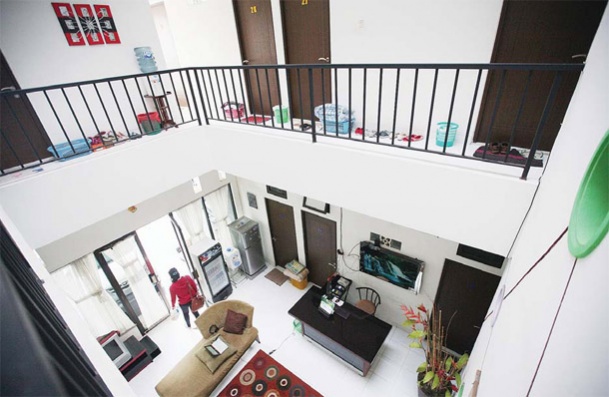
Communal living: The foyer of a boardinghouse in Kemanggisan, West Jakarta. Some owners are oblivious to the city rule requiring business registration. JP/ Ricky Yudhistira

The night sky in the capital was its usual reddish-magenta hue and Jakarta newbies Ele Williams and Philip Martin could see glimpses of it from their open-air dining area, beyond the walls of a three-story building containing 20 rented rooms. They sat facing each other at the dining table, a tiny space in the nook of a small garden. A gas stove and a kitchen sink were nearby, part of a communal kitchen for the building’s entire occupants.

Both Williams and Martin are UN volunteers, living in Jakarta on a budget. When Williams, 29, moved to Jakarta from Canberra, Australia, she knew what she was in for. Having lived in boardinghouses in Yogyakarta a few years back and having made short visits to Jakarta, she knew that the city placed demands on its residents. But after two months living in a nine square-meter room, though conveniently near her place of work, Jakarta is starting to get to her. Lacking space, her kos (boardinghouse) around Menteng did not feel like home. “I’m feeling very claustrophobic,” she said.

As the country’s economy soars — 6.4 percent growth in the second quarter, bucking the global trend of slow growth — and Jakarta becomes a busy business center, more and more people are coming to the city. Young expatriates such as Williams and Martin join the throngs of thousands of Indonesia’s young professionals searching for a living.

For many, it is not so much enjoying living in the capital as it is surviving the daily challenges that is poses, with infrastructure development lagging behind an increasing population. Jakarta’s population has exceeded 10.1 million and the sprawling Greater Jakarta (Jakarta, Bogor, Depok, Tangerang and Bekasi) area is home to 27.9 million according to the 2010 census. Real estate consultancy firm Jones Lang LaSalle estimates demand for new residential units in Greater Jakarta to stand at 200,000 units per year.

Lang LaSalle reported the current supply by property developers and state housing projects could only supply a quarter of the demand, standing at 40,000 to 50,000 units per year. Most of this — 75 percent — is still landed housing in Jakarta’s outskirts and satellite cities. The rest are high-rise condominiums and low-cost apartments.

With high demand for housing, Jakarta, driven by the development of housing complexes, condominiums and offices, has been experiencing a property boom in the last two years. Indonesia Property Watch director Ali Tranghanda cited Bumi Serpong Damai, a residential area south of Jakarta, where prices have gone up by 60 to 70 percent since last year.

Yet the luxury of adequate personal living space in Jakarta is limited and expensive. For the moment, it is reserved for high-income earners.

In inner city Jakarta, developers are constructing 27,000 more condominium units to add to the city’s 77,000, with selling prices between Rp 12 million (US$1,250) to more than Rp 25 million per square meter.

City figures show Jakarta’s income per capita in 2011 was Rp 101.01 million per year, which means that to purchase a lower-middle-grade 31 square-meter condominium, an average Jakartan would have to spend nearly four years worth of their yearly income. The same amount of money can buy a 63 square-meter plot of land on the city’s outskirts. The trade-off for a home and a tiny garden for middle-class Indonesians means hours of commuting in Jakarta’s endless traffic or unreliable public transport.

Land owners and small individual investors riding the wave of a rising housing demand for Jakarta office workers saw this as a business opportunity and grabbed it. Boardinghouses have always been a part of Indonesia’s cities that have migrant populations. But in the last few years, “executive” boardinghouses targeting office workers mushroomed in residential areas near the capital’s business districts.

Ranging from Rp 2 million to Rp 5 million per month, these rooms are more expensive than your basic fan room but are relatively cheaper than renting an apartment. They provide meager personal living space but are equipped with facilities that help one wile away the time (WiFi, cable TV), sleep sweat-free in the heat of the city (air-conditioned rooms) and not have to walk to the nearest mini-market for a bottle of soda (refrigerator). These rooms are options for office workers who want to either save money or time.

Those who, like Williams, are scared of being caught up in Jakarta’s snarling traffic, have no choice but to live in fanned or air-conditioned “shoe boxes”.

Martin, 33, said that if only there was more sense of community in boardinghouses, the experience would not be too bad. His neighbors, he said, were “awkwardly unfriendly”.

“If people come down here and have a glass of wine or beer every so often it would be great. It could be really fun, but it’s not like that. Probably people are tired after work,” he said.

Prodita Sabarini, The Jakarta Post | Reportage | Wed, September 26 2012

‘This is the Life We Live’: Seeing Papua through friendly eyes

Image

Papua province, Indonesia’s easternmost territory, is so far from the country’s capital — geographically, culturally and historically — that many people in Jakarta have little understanding of what life is truly like on the faraway island.

Development worker Mitu M Prie has had the opportunity to live and work in both Jakarta and Papua during the last 10 years.

Working on public health campaigns, she travels to the highlands of Papua, crosses the deep and often choppy waters of Lake Sentani, plunges her feet onto the beaches in Beiji and looks out to the Pacific from Jayapura.

There, she meets Papuan people, learns their languages and falls in love.

Mitu travels with her several cameras. There are professional SLRs and small point-and-shoot pocket cameras. Everywhere she goes, whether to the markets, the soccer fields, the airports and seaports, the hills and the beaches, she captures the faces of contemporary Papua. Her pictures are rich in human emotions, against a backdrop of majestic Melanesian nature.

Neles Tebay, a Papuan human rights activist and rector of the Fajar Timur school of philosophy writes in an introduction to Mitu’s book of collected photos from Papua, that “[S]he looks at Papua through the eyes of love”.

“Viewing Papuans without love is to treat them like an enemy,” he writes.

And that was what Mitu aimed to break through with the photographs that she took, which are collected in the book, Ini Tong Pu Hidup (This is the Life We Live).

“I want people to support, to love and to know, so that the gap of [knowledge] will be narrowed. And the stories that come from there are not only from irresponsible parties,” she said at the Cemara Gallery in Central Jakarta, where her photos were being exhibited in early August.

“Many of us here have an unkind tendency [toward Papuans] because we don’t know them,” she said.

Papua continues to be the most impoverished province in Indonesia, despite being home to the world’s largest gold mine.

Years of conflict in the region from the military operation in the 1960s that officially placed Papua into the territory of Indonesia and decades of resource looting have left deep wounds.

Reports show that military operations hunting down so-called “separatists” have forced many Papuans to flee to the forests as their villages were razed to the ground.

“There is anger but, it’s not only political grief; simple cultural ignorance is also one of the factors,” Mitu said. She added that there was once a family planning campaign that utilized the same teaching materials aimed at Javanese culture, with Malay models on the posters, depicting life in urban Java. Unsurprisingly, the campaign failed and did not go down well with the locals, she said.

Her encounters with Papuans have often resulted in their becoming annoyed, as Muti hails from Java. “Sometimes, I’m like a representation from here [Java]. I’m ready to be scolded and I gladly take it,” she said.

Her book includes forewords from academics. Apart from Tebay’s essay, there is a detailed history of Papua by Agapitus E Durmatubun, a lecturer in the school of anthropology at Cendrawasih University in Jayapura.

Durmatubun provides an interesting read about Papua, from the geographical information of the island — “The island of Papua is shaped like a giant bird, of which 47 percent consisting of the bird’s head, nape, neck, back, breast and belly is the territory of Papua” — to the history of Papua’s name, which means “curly” from the Malay word, pua-pua.

But the pictures speak for themselves.

Local Papuans take three-wheeled Javanesse-style becak around Wamena in one of her pictures. In another, youths sporting rasta hairstyles smile into the camera. There are also little boys preparing for a soccer game in a field overlooking a great mountain range in the highlands.

Tak kenal maka tak sayang (if you don’t know it, you can’t love it); so goes an old proverb. Mitu has traveled to get to know Papuans and her love shows through the pictures that she takes.

Her book can be a tool for people to get to know the many faces of Papuan people and fall in love with them as Mitu did.

Ini Tong Pu Hidup 
Mitu M. Prie
KPG (Kepustakaan Populer Gramedia), 2012
209 pages

Prodita Sabarini, The Jakarta Post, Jakarta | Feature | Sun, September 09 2012

Sampang villagers caught up in faith feud

SAMPANG_0.img_assist_custom-560x459

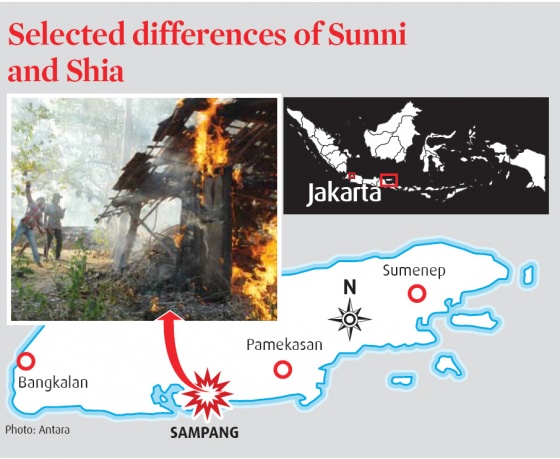
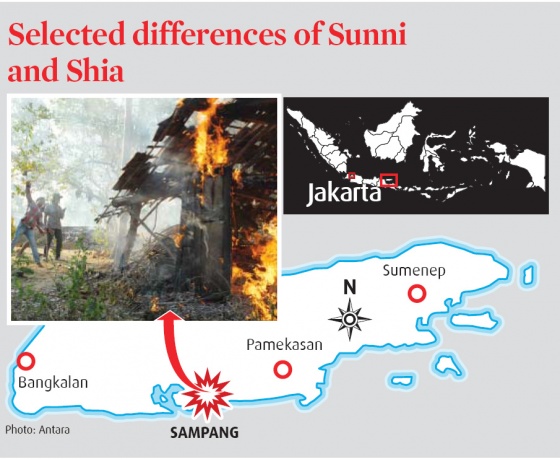
On the morning of Sunday, Aug. 26, a crowd descended on Shia minority villages in Sampang, Madura in East Java. Two died in the attacks and dozens of homes were razed. Until today dozens of families remain in a make-shift shelter, while authorities have offered to “relocate” them elsewhere. The Jakarta Post’s Prodita Sabarini reports from Sidoarjo, Pamekasan and Sampang, where the Shiites were also attacked last December. The local ulema have demanded a ban on the teaching of Shia.

Rumsiah stood in a tobacco field next to her burning house. She held her 3-year-old daughter tight to her chest. In front of her, the orange flames crackled as they burned the woven bamboo walls and the fire quickly ate them up. But for Rumsiah, the voices from the mushola (small mosque) speakers drowned other sounds.

“Muslimin and Muslimat, come out all of you!”

“Don’t be afraid!”

“Be unified!”

“Let’s face them together!”

“We will burn them and turn them into satay!”

Rumsiah, 30, ran to the tobacco field with her children and husband as a mob of over a thousand people came to Blu’uran and Karang Gayam villages in Sampang.

On Aug. 26, the day of the Lebaran Ketupat, the local Madurese custom marking the end of Ramadhan, families of the Shiite Muslims in both villages were preparing to send their children back to the Shiite Islamic boarding school (YAPI) in Bangil, East Java.

But local Sunni leaders in Blu’uran stopped the rented minibus and denied them entry to the rocky roads of the village, Ummu Kulsum, wife of imprisoned Shiite leader Tajul Muluk said.

Tension between Sunnis and Shiites has been high since the ulema in Sampang declared the Shiites, led by Tajul in Sampang, a deviant Islamic sect.

Last December, a mob burnt down three houses, including Tajul’s. Not long after, Tajul was sentenced to two years in prison for blasphemy.

“Come if you dare!” shrieked an incensed Shiite at his neighbors who had advanced toward their house. As the mob approached, Molotov cocktails were thrown exploded. “They [the Shiites] were prepared to fight,” Noer Tjahja, the Sampang regent said.

Blu’uran and Karang Gayam now have patches of charred ruins where houses used to stand. Chickens peck aimlessly around what was once a rice mill, and rifle-slinging Brimob officers stand guard. Too little, too late.

The mob razed 37 houses of Shia followers. Mohammad Khosim, or Hamama, 50, died in a carok (duel); hacked to death by Husein, 48, from the Sunni crowd, who later died himself in hospital from machete wounds. Hamama’s brother, Thohir, 46, a Shiite, is still in a critical condition.

Some eight people were injured, including the Omben precinct police chief.

***

A woman in an ochre prayer dress sits alone on the carpet of the Sampang indoor tennis court. She faces Mecca.

Behind her, children chase a ball or dance to the blaring songs played by volunteers from Tagana (the Social Affairs Ministry’s Disaster Response Team). The tennis court has become a makeshift refugee camp.

On her right a large banner separates two sides of the court. Over the separator are rolled mattresses, pillows and the personal belongings of refugees.

The 37 burnt houses belong to 64 families according to Kontras (the Commission for Missing Persons and Victims of Violence); around 270 people are staying at the camp.

There is not much to do here. The children play with the volunteers, but the adults just sit around and wait. They would return home, if it were safe.

But Noer says they can only return with the approval of the community there, when they “repent”. Tajul Muluk’s wife, Ummu Kulsum and his brother Iklil have become leaders of the refugees.

Kulsum carries a calm maternal air with her, silently enraged by what she calls Sampang regency’s  “incompetence”.

“If the regency could handle these differences properly, it would not be like this. They protect the guilty instead of the innocent. My husband is innocent and he is in prison,” she says flatly.

Most of the faces in the mob were strangers to Kulsum, but she could name her neighbors as leaders of the mob. Yet police have arrested only Tajul’s brother and arch-enemy Roisul Hukamah as the sole suspect. Kulsum said she did not see Rois, as he is popularly known, at the scene. But it was Rois, an official said, who summoned the people using text messages and phone calls.


Selected differences of Sunni and Shia

While both the Sunnis and the Shiites share most fundamental Islamic beliefs and theological laws, the distinctions between the two major denominations stem from historical political differences gradually transformed into a number of spiritual
dissimilarities.

• Successor
The Sunnis believed that the new leader of the Muslim nation after the death of the Prophet Muhammad was Muhammad’s close aide, Abu Bakr, who was appointed by the Prophet to become the first Caliph of the Islamic nation.

Meanwhile, the Shiites believe that the leadership remained within Muhammad’s family tree, which means that the Prophet’s cousin and son-in-law, Ali ibn Abu Talib, should be the leader instead.

• Religious leadership
While the Sunnis accepted that the first four Caliphs, Abu Bakr, Uthman ibn Affan, Umar ibn Al Khattab and Ali, were the rightful followers of Muhammad, they are not considered infallible.

Shiites, meanwhile, believe that imams were the descendants of the Prophet. Shiites often worship the imams as saints and perform pilgrimages to their tombs and temples to seek blessings.

• Religious practices
Shiites allegedly resented some of the companions of the Prophet Muhammad, such as Abu Bakr and Umar, who narrated the Prophet’s life and spiritual practices, and thus did not base religious practices on the testimony of those individuals.

• Marriage
The Shiites supposedly allow the nikah mut‘ah, or fixed-term temporary marriage, which is not tolerable within the Sunni community believing it as planned and agreed fornication.

• Rituals
When leveling their heads to the ground during prayers, Shiites place their forehead onto a piece of naturally occurring material, often a clay tablet said to be from Karbala, Iraq, the place where the son of Ali, Hussein ibn Ali (d. 680) was martyred, instead of directly onto a prayer rug.

In addition, some Shiites perform their prayers back to back, sometimes worshipping two times consecutively and thus praying five times a day but with a very small break in between the prayers.

From various sources (asa)


Prodita Sabarini, The Jakarta Post | Reportage | Tue, September 04 2012

In the land of ulema, the price of breaking with the past

The attacks and killings in Blu’uran and Karang Gayam villages did not only send tremors through Sampang, but have shaken Jakarta’s elites. President Susilo Bambang Yudhoyono held an impromptu meeting with aides and sent his top officials to Sampang. Jakarta blames poor intelligence for not detecting the seeds of conflict sooner.

In his office in Sampang, Rudy Setiadhi, the official in charge of local political security, showed rows of photographs, including those of meetings with the ulema in Madura, officials in Sampang and the cleric Tajul Muluk.

Rudy said Jakarta was mistaken. “I’ve been involved in mediation here since 2006,” he said. “This is proof that the Sampang government has tried its best to resolve the conflict.”

Rudy said that Tajul had offended the Madura ulema by bringing Shia teachings to Sampang. “Tajul is quite an arrogant person. He thinks that kampong clerics are nothing compared to him.”

Around March this year, Tajul’s brother and arch-enemy Roisul Hukamah, a convert to the Sunni denomination, distributed a recording of Tajul speaking to a follower on the phone to clerics in Madura.

In the transcript, shown to The Jakarta Post, Tajul blasts the Sampang regent for sucking up to the ulema for political gain.

He also said that in Sampang, uneducated clerics could become head of Islamic organizations. “Isn’t that showing disrespect to the ulema here?” Rudy asked.

Culture is important in Madura.There is a hierarchy of respect on the island. Both Rudy and Sampang regent Noer Tjahja say they adhere to this cultural convention: Buppa’ Babbu’ Guru Rato.

Buppa Babbu refers to parents, Guru to clerics and Rato to the government. Hence, the words of clerics hold higher value than those of the government.

A local cleric from Pamekasan says the informal education system of Islamic boarding schools is entrenched in Madura culture. Parents who can’t afford to send their children to public schools send them to Islamic boarding schools instead.

Alumni of Islamic boarding schools can be ulema in their villages, so each village has at least one ulema. Alumni continue their relationship with their teachers, their gurus, and make yearly visits to present donations to their them.

In 2004, Ali Kharrar, a revered local cleric, requested the help of the government to deal with the spread of Shia teachings by Tajul. The Sampang government, Rudy said, were more than happy to facilitate.

Tajul and Iklik meanwhile decried Kharrar’s sermonized warning about Shia as the beginning of their persecution.

Ulema rejection of Tajul was not merely a question of faith. Rudy said that Tajul disrupted the social order in Sampang with his ways.

Indeed, Tajul refused to accept envelopes filled with money from villagers. This was a break from the local customs, where people would give money to ulema for their preaching. A big name cleric can get a fee of Rp 2.5 million (US$262), while less prominent ulema can expect Rp 50,000 (US$5.24) to
Rp 100,000. Ulema also receive money from attendance at functions when villagers shake hands with them.

Tajul also said he stopped individual celebrations of the Prophet’s birth (Maulid), only holding a celebration at his home. In Madura, each house has a small prayer house, families hold feasts and invite a cleric to come and give a sermon.

“I changed the practice because I saw people there are under the poverty line … I gave them a solution so the cost of Maulid celebrations would not go through the roof.” Yet, this particular change reduces the popularity and, crucially, the income of local ulema.

***

A young cleric, Ahmad Muzakir quickly kisses the hand of Kyai Kharrar in front of his Islamic boarding house Daarut Tauhid in Proppo, Pamekasan, a neighboring town to Sampang. Wearing a white turban, Kharrar nods his head.

Kharrar wears his beard in a neat trim. A busy cleric, he excused himself to meet his wife in the female boarding house of his school. “Please excuse me, I will sin if I do not visit my wife. I have been out all day,” he said.

Kharrar had been out giving two sermons during the day and immediately led a sermon for his male students.

Kharrar is the brother-in-law of Tajul and Rois’ grandfather, Ahmad. Ahmad’s son, Makmun became a Shiite after reading books and bulletins about Shia after the Iranian revolution.

Ahmad cursed his son for converting to Shia to the day Makmun died, Kharrar said. Makmun, who was quite respected locally, did not teach Shia to other villagers. However, he sent his two teenage sons Tajul and Rois to YAPI.

“Kak [elder brother] Ahmad was against that and took them out from YAPI and sent the two to my boarding school,” Kharrar said.

“He [Tajul] bickered every day with the other santri because his thinking was already different”, Kharrar said. Tajul and Rois stayed at Daarut Tauhid for a mere three months and returned to YAPI.

Rudy said that in 1993, Tajul left for Saudi Arabia as a migrant worker. Kharrar however said that Tajul went to Iran and lied about Saudi Arabia. According to Kharrar, after his return to Sampang, Tajul started to teach Shiite beliefs to people in the village.

In 2005, Kharrar set up a meeting to convert Tajul back into Sunni teachings. He invited Sampang officials, police and clerics from the Sampang chapter of the Indonesian Ulema Council (MUI) and ulema from five cities in Madura.

“I told him, ‘Child, I am here not to debate but to ask you to return to the road our ancestors took.’”

Kharrar’s proselytizing toward Tajul and his warnings toward other ulema about Shia continued.

In 2006, Tajul finally relented and signed a statement saying that he was returning to Sunni teachings.

“But he is always wishy-washy. In a meeting with us, he would comply, but once he is back, he would return to his ways,” Kharrar said.

In 2006, hundreds of people intimidated Tajul and his followers into returning to Sunni teachings.

Till 2009, Rois was with Tajul as a Shiite, until Rois’ desire for a young woman, called Halimah, was disrupted by Tajul.

Halimah, 19 has a long oval face and big eyes. Her house was one of those burnt on the Aug. 26 attack. At the refugee camp, she said that Rois confessed his love to her when she was 15. “But I did not want to
marry him.”

According to Tajul, Kulsum and Rudy, Rois has a womanizing streak. Marrying women just to divorce them in a couple of months.

One day, a close follower of Tajul, Dul Azid, came to Tajul to intercede for him and ask Halimah’s parents for her hand in marriage.

Tajul then proposed to Halimah for Dul Azid and the parents accepted. Rois became enraged, Halimah said. He summoned her parents and Dul Azid’s parents to meet him. Tajul told them not to come lest Rois would judge them and hit them.

Rois was furious with Tajul. “If that is the case, it is as if you have taken my wife. From now on, I will use my bajing power against you,” Tajul recounted what Rois said. Bajing power in Madurese means every dirty way there is, Tajul said. When Rois defected to the other side, pressure against Tajul increased and in 2011, the Sampang government asked him to relocate to Malang for a year until the situation cooled off.

Tajul accepted Rp 50 million from the government for relocation costs. But he continued to visit Sampang, Rudy said. And it infuriated the people there.

Despite mediation through the National Commission of Human Rights in October 2011, a month later, a Sunni mob attacked Tajul’s family, burning down three houses.

Rois then reported Tajul to the police for blasphemy. The Sampang chapters of the largest Islamic organization, Nahdlatul Ulama, and Sampang’s chapter of MUI also released edicts that Tajul’s teachings were deviant. In July, Tajul was sentenced to two years in prison.

From prison, Tajul has said that he would like to return to Sampang after his release.

But Sampang regent Noer Tjahja, who will be running for reelection next year, ruled this out. “I am on the side of the ulema, that is clear. They are the ones who own Sampang. I don’t mind violating human rights, as long as I save the majority of my people”.

Prodita Sabarini, The Jakarta Post | Reportage | Tue, September 04 2012

Sampang regent ‘sides’ with the ulema

Sampang Regent Noer Tjahja is upset. A protracted disagreement over faith has turned deadly in his little town of less than 1 million people in Madura.

And worst yet, according to him, since the news of the attack against followers of the imprisoned Shia cleric Tajul Muluk surfaced, no one had got it right.

Some 300 meters across the road from where hundreds of Shiites take shelter at an indoor tennis stadium, Noer was sitting on the side of an outdoor tennis court.

Taking a break from his Saturday morning tennis, he met with The Jakarta Post. His brows furrowed, his deep big voice echoed across the court while he lambasted the media, the Jakarta political elites and human rights organizations for their comments.

Two people died in the Aug. 26 attack against Shiites in Blu’uran and Karang Gayam villages by a Sunni mob of over 1,000 people. The mob razed 37 houses in Blu’uran and Karang Gayam villages, displacing around 270 Shiites.

Since the attack, many had put in their two cents. President Susilo Bambang Yudhoyono blamed lack of police intelligence, poor early detection, and a solidarity alliance in Sampang accused Madura clerics and the regent of being behind the anti-Shia movement in Sampang.

Home Minister Gamawan Fauzi and Constitutional Court judge Mafud MD have said that the government would protect the rights of the Shia minority, promising to rebuild the houses of victims and guarantee their safety.

But Noer, elected in 2007, said any information about the conflict and its solution in Sampang from anyone other than him was wrong. He said he would like to meet the President to give his opinions on the conflict.

“I’ll tell him the true chronology, ‘If [Yudhoyono] receives information other than from me. It’s wrong. It’s wrong even if it’s from your aides. Don’t listen to it’,” he said.

“In all actuality we don’t have a Shia problem. The problem is about a family feud and a defiant sect — blasphemy…” Noer added.

The regent was referring to a feud between Tajul and his brother Roisul Hukamah, a convert to Sunni from Shia whose report on Tajul over blasphemy had brought the latter to court.

The court sentenced Tajul to two years in prison. Rois, as he is popularly known, is currently the sole suspect in the Sunday attacks.

“This is like a minority group is forcing their will on the majority. You shouldn’t turn it the other way around. Those in Jakarta are twisted. I have 900,000 residents. Of course I will prefer the dominant position,” he said.

Last Thursday, Iklil, Tajul’s brother, who has been staying with the rest of the refugees at the tennis stadium, walked across the street to the regent’s office. He has been wearing the same outfit for days, a white T-shirt and blue jeans. His house was among those burned by the mob.

That day, legislators from the House of Representatives visited Sampang from Jakarta to learn about the conflict. The members of Commission III had lunch with the regent and his staff at his office. Sampang ulema from Nahdlatul Ulama (NU) and The Sampang chapter of the Indonesian Muslim Council (MUI) were also present.

Iklil said that he was asked to come there.

“I walked to the pendopo [the regent’s office] but they were already finished. So, I walked back here,” he said.

Noer visited the refugee camp once, a day after the attack. But, until Saturday, he has been tight lipped on Sampang’s administration’s plan for the victims.

Sampang MUI and NU leaders, Bukhori Maksum and Syafi’uddin Wahid, who hold a lot of clout in Sampang politics, have stated that Shiites will not be accepted on their land.

As of writing, the refugees are still sleeping on mattresses inside the stadium.

“We want to return to our lands,” Iklil said. Rumors about relocation plans have been flying around. Iklil flatly refuses to be sent away. “It’s our homeland and we’re also worried that if we become banished people from our own land, how can we be sure that we would not face the same problem elsewhere?” he said.

From jail, Tajul echoes his brother’s statement. He also said he refuses “relocation” plans because it would give a bad image of Sampang people.

In a Sidoarjo jail, Tajul wears the orange T-shirt of prisoners. He has been transferred to Sidoarjo after the Aug. 26 attack in Sampang. Tajul and his lawyers deem that it would be safer for Tajul to not be in Sampang.

Tajul’s view is that the Sampang administration want to kick his followers out of Sampang, just like they did to him. In 2011, the Sampang administration made him move to Malang to appease the ulema in Sampang.

Ever since Tajul returned from the Middle East in 1999, and started to become a local cleric, teaching his Shia beliefs to the community in his village, local clerics have persistently pressurized Tajul to return to Sunni teachings and stop his clerical activities. The cleric who first attempted to make Tajul “repent” in 2005 was Ali Kharrar, Tajul’s
grandfather’s brother in-law.

Noer Tjahja refuses to call Tajul Muluk followers Shiites. Shia, a denomination in Islam, believes the leadership of Islam was to remain with the prophet Muhammad’s bloodline. Despite the differences with the mainstream Sunni teachings, the national MUI has never released an edict that Shia is deviant.

The Sampang court found Tajul guilty of blasphemy on the basis that he stated that the current holy Koran was not authentic. Noer believes that the refugees are adhering to a deviant teaching based on that court’s decision.

Noer also says that he follows the Sampang MUI and NU who have released edicts that Tajul’s teachings were deviant.

Noer says that unless Tajul followers “repent” and the community accept them back, rebuilding homes in the area is not an option. “If the houses were rebuilt, it’s like sending people to hot embers,” he said. Due to strong rejection of the Shia minority from the community, if the latter refused to leave, “lives are at stake here”, he said.

Tajul’s lawyer Abdullah Djoepriyono said that faith was a personal issue that the government could not force on anyone.

But, Noer said that he did not care if he violated human rights, as long as he saved the majority in Sampang.

To illustrate the community’s hostility toward the Shia group, Noer said that when the body of Muhammad Khosim or Hamama, 50, the Shiite who died of machete wounds, was taken back to his village, his neighbors refused to let him be buried in the public cemetary.

“The community rejects not only Tajul but the whole group,” he said.

The Blu’uran and Karang Gayam villages where Tajul’s followers come from are small farming communities. In the dry season, such as now, the produce from the fields is tobacco leaves. These fields turn into rice fields during the rainy season.

After the attack, three companies of Brimob officers were deployed to the area. Next to tobacco fields and village houses, officers holding rifles stand guard.

At Blu’uran villagers are sitting inside a bamboo gazebo. A man and a woman stack tobacco leaves into a pile. Others watch television. Mela, 30, a young mother feeds her toddler instant noodles.

“Yes I know that there are Shia people there,” she says. “I don’t know them though,” she added. The burned house of the Shiite family was separated by one house from the gazebo. She said she did not know anything about the attack.

Young men in sarongs standing in front of village houses also say they did not hear anything on Sunday.

According to a Brimob officer from Surabaya, the people in Blu’uran were very private and kept their distance from outsiders. He said that he had asked for days about what happened there, but all he got was “I don’t know”.

A Madurese Brimob officer, Junaidi, told the Post that people in these villages lived together and knew each other. Both Shia and Sunni people worked together in the fields.

He said that people became suspicious of Tajul when they saw how from three to four people coming to Tajul’s small mosque on Friday prayers, his congregation grew until the mosque could not contain the followers. “They overflow outside the mosque,” he said.

But, not all people were disturbed by the increasing popularity of the Shia group. Muhyin, a 21-year-old Shiite, said that a Sunni family hid him when the burning was going on.

According to Tajul, politics is at play in the persecution of Shiites in Sampang. He said that the pressure and eventual attack against Shiite groups happened because Noer continued to follow the wishes of local ulema there.

Noer acknowledges that. Running for election in December to secure his current position, he said he will do whatever the ulema wants.

“The ulema owns Sampang, I am merely a worker for them,” he said, adding that he follows the local customary convention in Madura in which holds the ulema in higher respect than the government.

For Noer, whatever the ulema say in Madura, is his command.

Wahyoe Boediwhardana contributed to the reporting.

Prodita Sabarini, The Jakarta Post, Sampang, East Java | National | Sun, September 09 2012

Paying alms can solve poverty: A big ‘if’

In Ramadhan, Muslims are reminded of their obligation to pay alms to the poor. The Jakarta Post’s Prodita Sabarini looks at the collection and management of alms, which are now regulated by law.

For many years, Indonesian Muslims have channeled their alms through mosques or by giving directly to the needy. But the rise of professionally managed alms agencies is changing the way Muslims help their brothers and sisters in need.

From online bank transfers and monthly direct debits, to alms through premium text messages, alms giving has made a leap from the traditional cash-in-hand distribution to the Web 2.0 era of online transactions.

The consequences of the change are enormous, according to leaders of Islamic charitable organizations in Indonesia. Utilizing the principle of crowd-sourcing funds, these alms organization are brimming with optimistic intent to solve the problem of poverty in Indonesia.

Data from the Central Statistic Agency (BPS) states that 31.9 million people or 13.3 percent of the population in Indonesia are poor, living on under Rp 233,740 (US$24.7) per month.

The National Alms Agency (BAZNAS) last year conducted a joint study with the Bogor Institute of Agriculture’s (IPB) school of economy and management, stating that Indonesia has the potential to collect Rp 217 trillion in zakat (Islamic mandatory alms). This estimate is more than twice the amount of
the national budget allocated by the Finance Ministry for poverty alleviation, which stands at Rp 99.2 trillion this year.

“If we collect Rp 217 trillion of zakat, we can say: that’s it. The problem of poverty can be managed by zakat,” BAZNAS executive director Teten Kustiawan said recently.

There is only one small problem with Teten’s confident contention: a very big “if”.

In reality, zakat collection in Indonesia is less than one percent of the amount that BAZNAS and IPB conjured up. In 2011, the national collection of zakat through BAZNAS, its provincial chapters and all registered private alms foundations was Rp 1.7 trillion, a mere 0.8 percent of the BAZNAS and IPB figure for zakat potential.

This figure excludes zakat collection from 7 of 19 national private alms agencies who failed to send reports to BAZNAS. The data also excludes zakat collected and distributed by mosques and private individuals.

This small percentage of realized zakat against zakat potential is not to say that alms agencies and foundations are not growing, far from it. Between 2002 and 2012, zakat collection through Islamic charities rose by more than 1,000 percent: an average 24 percent increase each year.

Five years ago in 2007, zakat collected by agencies and foundations stood at Rp 770 billion. Money collected by zakat agencies and foundations continues to rise even faster than the growth in the number of zakat foundations, said Teten.

Dompet Dhuafa Republika now collects as much as Rp 200 billion, according to executive director
Ahmad Juwaini. The funds collected have grown from a mere Rp 88 million in 1993, when Dompet Dhuafa, with the support of the Islamic-leaning newspaper Republika, pioneered professional alms management.

The Community Caring Justice Post (PKPU), established in 1999 to answer the social crisis during the sectarian conflict in Poso, managed to raise Rp 3.5 billion in their first round of fundraising. Last year, they collected Rp 80 billion, according to PKPU deputy CEO and head of the Forum Zakat (FOZ) Sri Adi Bramasetia.

Alms agencies have become much more visible, taking an aggressive marketing approach with advertisements in the media. This Ramadhan, the PKPU is running the campaign “Jangan ditahan” (Don’t resist it), playing with the concept of resisting temptation during the fasting month.

“People become curious. What is this ‘don’t resist’ thing? And then they get it — that you shouldn’t just keep your money. You should pay zakat,” Bramasetia said.

While charitable fund managers are certain that zakat money will be more beneficially distributed under their management, skeptics argue that channeling zakat through agencies will only waste zakat intended for the poor, as agencies skim off the money for operational and campaign costs.

Dompet Dhuafa, for example, uses soccer star Bambang Pamungkas in their media campaign. However, according to Islamic law, some 12.5 percent of the donated funds belong to the Amil (zakat collector and manager).

Ahmad’s response is that zakat agencies enable large amounts of funds to be collected and utilized in various aid programs for the poor. Dompet Dhuafa’s health program for the poor includes a free hospital and 34 free polyclinics across the country. Ahmad said that the hospital building and equipment alone costs Rp 60 billion and operational costs are around Rp 20 billion.

“Where will you find a community here willing and able to spend Rp 20 billion for a free hospital? Nobody could afford that. But if Dompet Dhuafa collects the money — not only Rp 20 billion, even Rp 50 billion, we’ll cover it.

“That’s the difference between paying zakat alone and collecting zakat together,” he said.

To manage and ensure accountability of alms agencies, last year the House of Representatives passed a new law on zakat management, replacing the 1999 law. BAZNAS became the official national zakat collector and coordinator of all alms foundations.

This is not the first time the state has become involved in zakat collection. In 1968, Soeharto appointed himself as the national Amil and BAZ Jakarta, which later became BAZIS Jakarta, was established. The self-appointment of Soeharto as Amil, however, did not change the traditional face of zakat. Lacking appropriate social welfare and empowerment programs, people deem zakat management as “a job lacking any prestige”, Ahmad said.

“There was no sense of pride. Zakat was managed on the side, at the end of Ramadhan, and channeled through mosques, then distributed to the poor in the area. That pattern was the norm for decades,” Ahmad said.

As alms agencies grow with clear and effective programs, along with transparent financial reports — most alms agencies publish their audited financial reports on their website; the 2011 law obliges agencies to audit their finances — the charity organizations are gaining people’s trust.

For PKPU, transparency in fund management is not enough. They also have to withstand allegations of partisanship. PKPU was founded by cadres of the Justice Party, which later became the Prosperous Justice Party (PKS).

Bramasetia said in answer allegations of partisanship, PKPU registered with the UN for a special consultative status with the UN Economic and Social Council. One prerequisite for any NGO to be granted consultative status was independence. In 2008, PKPU became the sixth Indonesian organization to receive such status.

Most of the alms agencies have five main program areas: economic empowerment, education, health, disaster response and religious development. Bramasetia said that most of zakat money goes on economic empowerment programs, which include grant money to set up micro-finance co-ops or capacity building programs.

Once, PKPU helped guava farmers transform fresh produce into extracts or puree. “When the harvest season comes, the price of guavas falls, but with our training, farmers are able to sell with added value as well as preserve their harvest in different forms,” he said.

Ahmad of Dompet Dhuafa questions people who give their zakat in the form of cash hand outs, in which people queue, sometimes for hours, to receive a mere Rp 50,000.

“Isn’t that torture? And how long does the food that they give last? How does that help with health and education?

“I say this is an egotistical form of worship. It’s merely ‘I’m happy that I can observe this ritual. The poor are happy to receive my help. He kisses my hand with his lips trembling with prayers for me while his tears flow’,” Ahmad said.

“Our pride is satisfied by that kind of ritual. But is that really what we’re looking for?”

Prodita Sabarini, The Jakarta Post | Reportage | Tue, August 21 2012

Despite limits, mosques remain popular way to channel alms

Come Ramadhan, mosques in Indonesia bustle with people donating and collecting alms, or zakat, for the fasting month.

On the porch of one mosque in Condet, East Jakarta, a banner read: “Accepting zakat, infaq, and sedekah”. At another mosque in West Jakarta, three youngsters were seen setting up a post to receive alms. In Central Jakarta, after tarawih, or Ramadhan evening prayers, an official of another mosque reviewed his logbook on alms collection.

Islamic law obliges Muslims who are able to give two types of zakat. The first is zakat fitrah, or donations of food (or of cash earmarked for food), given at the end of Ramadhan. In Indonesia, recipients of zakat fitrah typically take home about 3.5 liters of rice. The second type of alms, zakat maal, comprises at least 2.5 percent of a person’s earnings and assets. Infaq and sedekah, meanwhile, are voluntary donations.

Despite the rise of zakat agencies and foundations in Indonesia, mosques remain prominent in collecting and channeling alms. However, mosques have been better at managing donations geared for consumption, according to leaders of zakat agencies and foundations.

At Baitul Huda Mosque in Kebon Kacang, Central Jakarta, Karto Suwiryo, known better as Ato, stands among sacks of rice piled three or four high. The zakat fitrah distribution organizer ordered a ton of rice to be disbursed to the poor during Idul Fitri.

A local trader sent the sacks of rice the night before, Ato, 48, said. The mosque will pay for the rice after it receives the last zakat fitrah payment on the eve of Idul Fitri.

Ato said that the mosque intended to deliver alms to 800 people this year, about Rp 27,000 (about US$ 2.85) per person. At Masjid At-Taqwa, in Pal-merah, West Jakarta, the organizers rounded the zakat fitrah payment up to Rp 30,000 per person.

Besides receiving zakat fitrah payments from donors each year, the mosque, located in the streets behind the Grand Indonesia, Plaza Indonesia and EX shopping malls, has also attracted donations from its well-healed neighbors.

Ato said that one of the malls donated Rp 100 million to renovate the mosque. Baitul Huda mosque treasurer Rubby Mudraf added that anonymous donors often sent building materials, such as a truckload of sand or cement, when the mosque was renovated last year.

There are nearly 9,000 mosques in Jakarta, according to the Religious Affairs Ministry. With Muslims comprising 88 percent of the nation’s population of almost 240 million people, Indonesia has almost 240,000 mosques.

Ato said that neighborhood leaders would start listing poor people eligible for zakat fitrah donations a week before Idul Fitri. Included in the list would be children with single parents. He said in his area, which was full of boarding houses for people working around Jl. MH Thamrin, there were less than 100 poor families.

Mosque volunteers from Baitul Huda would then deliver the donations to their homes, he said.

“We make it our policy to not let anyone line up for donations,” Ato said. Helmi Ryansyah, 17, a volunteer at At Taqwa mosque also said that local teens would deliver the alms to the doorsteps of the poor.

Mosques have learned from past experiences, especially from the deadly stampede during Ramadhan in Pasuruan, East Java in 2008, in which 21 people were killed while lining up for cash handouts.

According to Forum Zakat (FOZ) head Sri Adi Bramasetia, zakat fitrah provides donation for consumption, targeting people who are extremely poor.

“The poor who are so poor that they could not be reached through economic empowerment programs … like it or not, [the alms] have to be for consumption,” he said.

National Alms Agency (BAZNAS) executive director Teten Kustiawan said that funneling zakat fitrah through mosques was appropriate, as local mosques had more direct knowledge of the people who were in need.

However, due to the nature of the donations and the limited resources, alms collected by mosques had little chance in lifting people out of poverty, according to alms foundation Dompet Dhuafa executive director Ahmad Juwaini.

— JP/Prodita Sabarini

The Jakarta Post | Reportage | Tue, August 21 2012

The debate on tax breaks for ‘zakat’

The law already lets those who pay zakat contribute less to the state’s coffers, although some advocates want there to be more deductions for Muslims who pay alms.

The 2011 Law on Zakat Management and tax laws provide for zakat deductions to reduce a person’s taxable income.

For example, people who earn Rp 15 million (US$1,575) and pay 2.5 percent (Rp 375,000) of their income as zakat can reduce the base figure by which their taxes are determined by attaching proof of zakat payment to an official alms agency.

This, however, would not do much to reduce an individual’s tax burden, according to advocates. Dompet Dhuafa executive director Ahmad Juwaini wrote an open blog posting to the Finance Minister Agus Martowardojo requesting that a specific tax deduction be created for zakat.

This would allow, for example, zakat donors who pay 5 percent of their income to the state coffers to offset their tax burden by 2.5 percent, making zakat virtually part of taxes.

The proposal has been around since the dawn of the Reform era. Advocates lobbied the House of Representatives during deliberations on the Zakat Management law in 2009 and again in 2011, when it was revised.

The head of Forum Zakat (FOZ), Sri Adi Bramasetia, said that the deduction was a good idea but more incentives were needed.

He said that Indonesians could donate up to Rp 217 trillion in zakat and that giving alms for tax deductions would not reduce the state coffers. He said that in countries such as Saudi Arabia, taxation and zakat affairs were managed under one department.

On preferential treatment of Muslims, Bramasetia said that other faiths could also follow Islamic-based charities and demand tax deductions for those who give alms.

— JP/Prodita Sabarini

The Jakarta Post | Reportage | Tue, August 21 2012

‘Zakat’ programs change the lives of beneficiaries

 (Antara/M. Risyal Hidayat)
(Antara/M. Risyal Hidayat)

Abdul Karim is the first in his family to go to college.

The father of the 22-year-old died when he was in junior high school; his mother farms a small plot in his hometown of Cirebon, West Java. His three older sisters only finished junior high school. Some are currently migrant workers.

Coming from a poor family, Karim was once uncertain about his future. At school, he was smart, getting top grades and even entering an international class for talented students in high school. “There were 25 students and we started at 6 a.m.,” Karim said.

One day, a fellow graduate of his high school told Karim to apply for the Etos scholarship given by alms agency Dompet Dhuafa.

With his friends in tow, Karim traveled to Dompet Dhuafa’s offices in Bandung, West Java, and applied. Now, he is in his seventh semester at the University of Indonesia. He studies geophysics and aspires to be a geothermal expert.

Stories such as Karim’s are not rare. Since the 1990s, Indonesia has seen a rise in the number of alms agencies and foundations that focus on economic empowerment, education, health, disaster response and religious development.

Sri Adi Bramasetia, the head of Forum Zakat and the deputy chief of another charitable group, the Community Caring Justice Post (PKPU), provided a breakdown on where zakat money goes. “Around 30 up to 40 percent goes to economic empowerment,” he said. Education and health each receive around 20 percent while the rest went to disaster response and religious development, he said.

Dompet Dhuafa executive director Ahmad Juwaini said that his organization focused on education and health, although it also was involved in education. “Everywhere I go, I meet recipients of Dompet Dhuafa scholarships. Once I was interviewed by a TV journalist. After the interview he said that he was a recipient of our scholarship”. The organization currently funds 400 students and can boast of having helped more than 2,000 graduates.

The PKPU meanwhile, focuses on economic empowerment programs designed to lift people from poverty, according to Bramasetia. Its programs include providing grant money to set up micro-finance co-ops or for capacity building programs.

Bramasetia said that they changed their performance measures in 2010. “We no longer set our targets based on the zakat we collect, but on the number of people we help”. The group set a target of helping 1.5 million people last year. This year, its target is 1.6 million people.

“Our goal is for the programs to reach as many people as possible”.

Prodita Sabarini, The Jakarta Post, Jakarta | National | Tue, August 21 2012

Shop and do good at the malls

To remind mall-rats that their money can serve other purposes than simply shopping, Islamic charity organizations have gone to the malls and opened for business.

Alms foundations, such as Dompet Dhuafa and the Community Caring Justice Post (PKPU), have set up counters in various malls and shopping centers. That way, whenever Muslims go to shop they are reminded that they also have a duty to give away some of their money to the less fortunate, particularly ahead of the highly consumptive Idul Fitri celebrations.

“We can’t just wait passively [to collect alms]. We have to, as the saying goes, ‘get on the ball’, and we see that potential zakat [alms] payers go to malls,” Dompet Dhuafa executive director Ahmad Juwaini said.

Zakat, mandatory alms, is one of the five pillars of Islam. Paying zakat through malls breaks from the tradition of channeling it through mosques or giving it directly to the needy.

Dompet Dhuafa, the private alms foundation that pioneered professional zakat management in Indonesia in 1993, first opened their counters in office buildings, such as the Jakarta Stock Exchange, according to Ahmad. Eventually, they spotted the potential of malls.

In Jakarta, its counters can be found at Senayan City and Plaza Senayan, as well as Blok M Plaza and Pejaten Village.

Handaka Santosa, head of the Indonesian Association of Shopping Centers (APPBI) said that shopping centers were commonly used as meeting points. “We can use them to create awareness of zakat and provide the facilities for that,” he said.

The emergence of Dompet Dhuafa has led to the establishment of 19 national private alms foundations in addition to the government-run National Alms Agency (BAZNAS) and its regional chapters. Zakat collection by these faith-based charitable organizations continues to rise with an average increase of 24 percent annually. Last year, the organizations collected Rp 1.7 trillion (US$178.5 million).

Ahmad said that while the majority of zakat donations come through online bank transfers, donations from zakat counters in malls can account for more than Rp 1 billion.

PKPU deputy CEO Sri Adi Bramasetia said that counters at malls were quite effective in collecting mandatory and voluntary donations. Last year, the counters collected Rp 1.8 billion in mandatory and
voluntary alms, he said.

In addition, Ahmad said, “because the owners and managers of other counters in the malls see us every day, we reach them as well.”

Prodita Sabarini, The Jakarta Post, Jakarta | Headlines | Tue, August 21 2012