By the way … Putting men in a tight spot

I propose that men be banned from wearing tight pants that leave little to the imagination. Those pants are often provocative and distracting. Let’s ban tight pants because they are — to use the words of our Religious Affairs Minister Suryadharma Ali — pornographic.

The minister heads the anti-porn task force and has to make a list of criteria of what is considered pornographic to effectively ban it.

Our Pornography Law doesn’t help him much as it has a sweeping definition on pornography: “Sexual materials made by people … that can arouse sexual desires and/or violate public moral values”.

So far, skirts that are worn above the knee have made it onto his list. By that logic, tight pants would be on that list, too. They are not only highly suggestive but also troubling.

Everyone, from punk rockers to corporate workers and men in uniform — whose tasks are, among others, to maintain public order — wear tight pants. It’s hard to do your job well when your derriere is the source of public curiosity.

See, I — and maybe some other women out there — get aroused by what those pants hide, or rather, emphasize. When those cops are waving their hands on the street, they think they’re helping the traffic to flow better. But we don’t! At least, I’m too busy checking out their cute butts.

For public decency and men’s own safety, no visible contours of a man’s behind in the streets should be available for public consumption. This is a matter of great importance.

Tights pants are so disturbing; they make me want to rape those beautiful men. Rape is bad. It’s awful. But it’s not entirely my fault to have such a desire to dominate and emasculate men when they dress so outrageously.

I’ll stop being a wisecrack and address some serious questions to my male compatriots. How did you feel about a sexual fantasy of raping you because of your “provocative” clothing? Do you find that normal and acceptable? Unless you’re into some dominatrix sex, it’s safe to say many of you will feel disgusted, offended, hated, objectified and violated.

Think about those feelings. Think about the shock, anger and shame that swells inside of you when you read my comments.

This is exactly how many women feel when they walk the street and get wolf-whistles, or when men in power try to control what women should wear in the pretext of protecting them women from rape.

Many of our male politicians seem to condone the hostile behavior of men toward women.

When a spate of sexual assaults on Jakarta’s public transportation system happened late last year, Governor Fauzi Bowo’s first reaction was to tell women not to wear miniskirts on buses.

When sexual assaults hit the House of Representatives, Speaker Marzuki Alie moved to ban mini-skirts in the legislature, adding an irresponsible comment along the way: “You know how men are.”

I beg to differ. Let’s suppose that not all men are weak-willed creatures who are helpless at keeping their sexual urges in check.

A man confident in his sexual behavior would never see a woman wearing a miniskirt as an invitation for rape. Real men would know how to appreciate beauty and to enchant a woman with his personality. A real man does not rape — he charms.

Only very frustrated men would object to seeing women wearing miniskirts. Their frustration stems from knowing they have no chance of wooing these women, either by virtue of their lack of confidence or by being in a committed relationship with another person.

Well, tough luck. As Mick Jagger sang to his then lover, “You can’t always get what you want”.

But, in a world where men have a sense of entitlement over women, it is difficult to get across to them that women are individuals and not sexual objects nor reproductive machines.

Sexual assault is a degrading crime. Humiliation comes when the offender takes away the victim’s control over his or her body, robbing them of their autonomy and dignity as free human beings.

The suffering of rape victims is horrendous enough without other people putting the blame on the victim for how they dress.

No one has the right to violate another person. There are no excuses. The danger is in the eye of the beholder, not in the object of beauty. The culprit is the rapist, not the victim’s torn clothes.

— Prodita Sabarini

The Jakarta Post | Headlines | Sun, April 22 2012
A bittersweet tale of Australia’s Black Capital

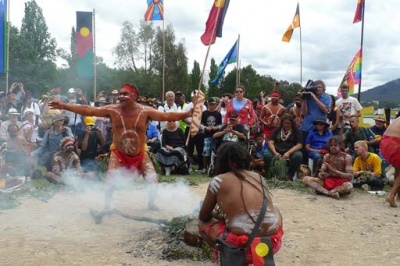
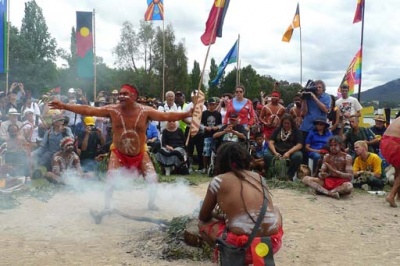
Sacred fire dance: Aboriginal men dance around a sacred fire at the 40th anniversary of Aboriginal Tent Embassy in Canberra.

In Sydney’s inner-city neighborhood of Redfern, there is a building with the city skyline as its background. Its whole side is painted with a yellow circle in the center, a block of black paint on top and red on the bottom. These are the colors and symbols of the Aboriginal Australian flag. The painting on the side of the building is apt for the area, as Redfern has for years been the heart of black Sydney.

It became a clear choice too for Sydney Festival organizers to select Redfern as the location for their Indigenous art program. The biggest cultural event in Sydney, the event is a summer-long citywide festival of music, film, visual and performing arts. This year, for the first time since its inception in 1977, the organizers dedicated a program, with the moniker “Black Capital”, for contemporary indigenous art. Carriageworks Gallery, the site for Black Capital is located in the old Eveleigh rail yards that drew thousands of indigenous people from rural areas to work there in the 1920s.

Redfern for Aboriginal communities in Australia has been the center for the indigenous peoples’ rights movement. The building with the Aboriginal flag painted on its side is located in an area of Redfern called “The Block”, nearly 8,000 square meters of land owned by the Aboriginal Housing Company. In 1972, at the start of Aboriginal land rights movement, activists won a grant to purchase the land for indigenous peoples, who at that time were under threat of eviction. Redfern is the birthplace of the first Aboriginal Legal Service and the first Aboriginal Medical Service. A few meters away from the “Aboriginal flag” building is a concrete wall that borders the bridge over the train tracks from Redfern Station. The wall is covered with murals depicting the story of the Eora nation, the land of Aboriginal tribes of Sydney.

Yet for the broader Sydney community, as drugs came in the area in the 1990s, Redfern became notorious for violence and crime. Many of Sydney residents’ in the 90s avoided going through Redfern, or if there was no alternative route, being vigilant about locking their car doors as they drove through it, lest they get mugged. Racial tensions between Aboriginal people in Redfern and the police escalated in 2004, when a riot broke out after the death of a teenage Aboriginal boy who crashed his bicycle into a fence and was impaled while fleeing the police.

Today’s Redfern has changed from the dark image of drugs and violence. Crime rates have dropped and property prices have increased. As places like “The Block” are scheduled for redevelopment, Redfern is slowly becoming gentrified, with little cafes, restaurants and small bars opening up. Meanwhile, its rich history as the center of the Aboriginal peoples’ rights movement in Sydney continues to be an inspiration for indigenous Australians and the city’s broader society.

The stories of Redfern became the soul of The Traveling Colony, the work of artist Brook Andrew for the Black Capital. The artist painted seven mobile homes with vibrant colors based on patterns from his mother’s indigenous tribe, the Wiradjuri. The trailers were parked along Macquarie Street on Jan. 7, the festival’s opening and were visited by thousands of Sydney residents. Since then, the mobile homes have been moved, and are now being showcased in the foyer of the Carriageworks Gallery until March 4.

Each mobile home has different interior settings, uniquely decorated from one another. The trailers offer different points of view both artistically and literally, as a video of a Redfern resident telling his or her story plays on a television set inside each unit.

The videos show people from different generations, from young Redfern artists such as Rarriwuy Hick and Corey “Little Nooky” Webster, to longtime Aboriginal rights activist Jenny Munro and Les Maleser. They answer the artist’s questions such as “What’s the most exciting thing that has happened in Redfern?”, “Have you imagined a different Redfern?” and “Who are your favorite stars?”

Andrew, who is based in Melbourne, explained in an email that the interviews reflected the personal ideas of the people in Redfern. “The work is personal,” he responded when asked whether “Traveling Colony” has any political intent. “As Aboriginal people, we have always been quite independent and made things happen for our people. I think this is reflected in their stories.”

Andrew said that the mobile homes were to house “the humble and powerful voices of the locals of Redfern and their personal stories. We are privileged to hear them speak. The trailer is like a holiday or a keeping place of culture. With my designs on them, they become a kind of special sacred place for sharing important stories,” he wrote.

What is personal in the stories is also deeply and radically political. Munro, slim with a short pixie haircut and a smoker’s lips, says in her video interview that she imagines a different Redfern. “Hell, I imagined a different Australia many times,” Munro says. “A black parliament, for example,” she added. “Yeah, I’ve imagined a different place, a different country many times.”

Munro dreams of a treaty being signed between the government and the Indigenous peoples. After the 1970s Aboriginal land rights movement, talk of a signing of a treaty was signaled by the Labor government in the 1980s. However, due to objections from the opposition, a “reconciliation process” was put forward instead. More than 30 years later, the process of reconciliation has yet to be finalized and indigenous Australians are still the most impoverished minority in the country. Indigenous peoples are over-represented in state prisons and have a 10- to 17-year gap in life expectancy compared to non-indigenous peoples. In the Northern Territory of Australia, Aboriginal people are subjected to welfare restrictions and bans on pornography and alcohol, a policy considered racist by the UN Special Rapporteur on the rights of indigenous peoples. The latest promise for reconciliation is a referendum to amend the Constitution by 2013 to recognize indigenous peoples as the first Australians.

Munro rejected the idea of constitutional reform. “The constitution is the basis of the racism. It’s the founding document of racism. Its intent is racist, its content is racist, its effect is racist,” she said. “Chuck the whole document out. Let’s talk about a treaty.

“Let’s sit around the table as equals, not this giving-us-crumbs-underneath-the-table situation. We are equal at the table and we decide as a group what’s contained in that treaty and it’s by consensus. It’s not by force — white is right or might is right,” she said.

Munro said that country has flourished for thousands of years before the 1788, the year the first fleet of British settlers arrived. “We’ve been sick since then and that’s because of the disease that came here, called racism,” she said.

“The constitution is the basis of the racism. It’s the founding document of racism. Its intent is racist.”

Munro moved to Redfern as a young woman in 1972, the year the protest for the Aboriginal land rights movement in Canberra started. She said that Redfern was a bastion of radicalism and she was actively part in it. She was on the board of the Aboriginal Housing Company for 20 years. Her radical spirit never waned over the years, and in the video interview, her grief shows through as she laments the growing conservatism among Aboriginal people.

Andrew said that his The Traveling Colony installation was a reflection of the rich cultural and social history of Redfern. “I think the work also reflects another side of Redfern that some people don’t understand, the passion and local,” he wrote. Listening to Munro’s voice in The Traveling Colony, one also glimpses the complexity of the reconciliation process.

There are mixed views on the issue of reconciliation among indigenous peoples in Australia. Munro is part of a more radical group that demands a treaty. On Jan. 26, she was among the thousand-strong march that rallied in Canberra, celebrating the 40th anniversary of the Aboriginal Tent Embassy, a movement that has grown to be a symbol of the struggle for sovereignty and self-determination for Aboriginal and Torres Strait islanders.

The Tent Embassy rally became rowdy as hundreds of protesters picketed a nearby restaurant where Prime Minister Julia Gillard and Opposition leader Tony Abbot were holding a function. The national leaders fled the scene under tight security and the mainstream Australian media portrayed the incident as a violent protest, disseminating a view that the group has a confrontational approach.

On the other hand, there are other groups of indigenous peoples, who sought a softer reconciliatory approach. Among them is a revered Aboriginal activist, Patrick Dodson, who co-chaired the expert panel that provided recommendations to the government for Constitutional changes in January. Dodson believes that there is a possibility of reconciliation through a referendum to recognize indigenous peoples in the constitution of Australia.

Dodson acknowledged the different ways Aboriginal groups assert their political rights. “I will always condemn bad manners and unnecessarily aggressive behavior by whomever. But, I will always defend people’s rights to assert their political position and try to look to the heart of why people feel so oppressed that they feel violent confrontation is the only recourse to the resolution of their position,” he said in a speech late last month at the University of New South Wales.

Amid the complexity of reconciliation, Sydney Festival’s Black Capital holds indigenous people’s contribution to Sydney’s art and cultural sphere in high regard, while addressing these challenging issues.

Sydney Festival director Lindy Hume said that Sydney has always been an important site for the indigenous peoples of Australia. Pre-dating the Aboriginal movement in Redfern, Aboriginal tribes in Sydney were the first to encounter the British fleet that would later colonize the land. “We wanted to try to celebrate that aspect of Sydney in some ways. The significance [of Black Capital] is to shine a light on a part of Sydney that is quite often thought of as problematic and complex — certainly not the kind of picture post card of Sydney that fits the tourist version of Sydney”.

Along with The Traveling Colony, Black Capital presents Wesley Enoch’s play I am Eora, a performance that explore the different archetypes in Aboriginal society. Prominent characters include the Aboriginal warrior and general Pemulwuy, who was decapitated by the British; the interpreter/reconciler Bennelong who was deemed by some Aboriginal people as a traitor; and the nurturer, Barangaroo, the wife of Bennelong. Black Capital also presents a concert by the Barefoot Divas and the exhibition and symposium of the history of black theater in Sydney.

The production of Black Capital is in its own way a reconciliatory process, as both indigenous and non-indigenous people worked together in producing artwork and performances that remind people of this special history. Andrew said that Black Capital was “a wonderful nod to the important history of Aboriginal people in Sydney”.

Black Capital was three years in the making, according to Hume. She said that the festival’s organizers consulted with Aboriginal communities in Sydney. She said that there is a sense of confidence and enthusiasm from the Aboriginal communities on Sydney Festival in a way that has never been shown before.

Hume also added that Black Capital brought contemporary indigenous art to a broader audience. “We were able to bring to the mainstream audience the work, the ideas and the imagination and the talent of particularly Aboriginal artists — a narrative of Sydney that hasn’t been understood very well by non-Aboriginal Sydney.”

Dodson said in his speech that the Aboriginal people of Australia and the colonizing people have been locked in an endless endeavor “to come to terms with each other’s place on this continent” since their first encounter in Botany Bay more than 200 years ago.

Whether this country will finally be able to heal the wounds of colonialism and close the gap between indigenous and non-indigenous people is yet to be seen. Andrew personally has mixed views on the government’s proposed reconciliation process. “I am not sure how we can reconcile on this vast issue when there are so many diverse Aboriginal nations in this country. It’s a long process that means different things to different people. Recognition and the revealing of the real history of this country needs to come and be acknowledged more thoroughly first”.

Prodita Sabarini, The Jakarta Post, Sydney | Feature | Thu, February 23 2012

Australian PM flees Aboriginal rights protesters on national day

Australian Prime Minister Julia Gillard and opposition leader Tony Abbott have escaped from a group of protesters rallying for Aboriginal peoples rights on Australia Day.

Gillard and Abbott had been presenting National Emergency Medals in a restaurant close to the nation’s parliament on Thursday, as part of official Australia Day celebrations.

Some 200 meters away, around 1,000 people had gathered in front of the former parliament house to celebrate the 40th anniversary of the Aboriginal “Tent Embassy”, a protest site symbolizing the Aboriginal people’s struggle for self-determination and sovereignty.

Knowing that the leaders were close by, some 200 protesters marched to the restaurant, chanting “shame” and “racist” in response to Abbott’s remarks, made earlier in the day in Sydney, regarding about the relevance of the Tent Embassy. Abbot was quoted by the AAP news agency as saying that he understood why the Tent Embassy was set up but “a lot has changed since then and I think it probably is time to move on from that”.

Police and security officers rushed the prime minister and the opposition leader out of the restaurant. Gillard reportedly tumbled and lost a shoe as she was dragged away by a bodyguard.

Four Aboriginal men — Michael Anderson, Billy Craigie, Bertie Williams and Tony Coorey — started the protest under a parasol in front of the then parliamentary building on Jan. 26, 1972, in response to government policy that rejected Aboriginal freehold land rights.

They named the site the “Aboriginal Embassy” as they felt that the policies made them foreigners in their own land. The Tent Embassy has grown to become a symbol of Aboriginal and Torres Strait Islanders peoples’ struggle for self-
determination rights.

The anniversary of the Tent Embassy falls on the Australia Day, a controversial date that some Indigenous Australians have dubbed “Invasion Day” as it marks the arrival of the first British fleet to Sydney.

Supporters of the Tent Embassy encircled a sacred fire and placed eucalyptus leaves to honor Aboriginal ancestors before speeches were conducted.

Aboriginal elder and activist Lyle Munroe told the gathering that when Captain Cook discovered Australia he found 500 different tribes and 800 different dialects.

“The high court has said that Captain Cook lied, virtually lied when he came out here. He said it was terra nullius, it was an empty land, only him and his ship crew were on the land and he came to the island and he claimed the island England.”

The Australian government is currently looking to change the country’s constitution to include recognition of the Indigenous people as the first Australians. An expert panel has submitted their recommendation for the constitutional reform last week. The government has promised a referendum to be held by the next election, which is expected in 2013.

However, some activists at Tent Embassy rejected the idea of constitutional reform and said the panel of experts did not represent the whole Aboriginal community.

Anderson, the only surviving member of the four Tent Embassy founders, said he did not want a constitutional reform.

“We want a treaty. We want to talk on an equal level, because we share sovereignty in this country,” he told The Jakarta Post, adding that activists were looking at lodging court cases with the European Court of Human Rights, the criminal courts and under United States tort law.

The Aboriginal people are the most impoverished minority of Australians, with a gap in life expectancy of 17 years compared to non-Indigenous Australians.

Prodita Sabarini, The Jakarta Post, Canberra | World | Fri, January 27 2012

Noam Chomsky: Remember the Santa Cruz massacre

American philosopher and linguist Noam Chomsky said justice was escaping human rights abuse victims, as he spoke of Indonesia’s dark period in East Timor (now Timor Leste) with the Santa Cruz Massacre 20 years ago, and the West’s complicity in that episode of violence.
Noam Chomsky: BloombergNoam Chomsky: Bloomberg

The prolific left-wing thinker gave his lecture on “Revolutionary Pacifism” in Sydney’s Town Hall recently as he received the Sydney Peace Prize awarded annually by the Sydney Peace Foundation.

“Another anniversary that should be in our minds today is of the massacre in the Santa Cruz graveyard in Dili just 20 years ago, the most publicized of a great many shocking atrocities during the Indonesian invasion and annexation of East Timor,” he said.

Twenty years ago on Nov. 12 in Dili, the military fired on civilians attending a memorial service of a resistance fighter, killing 270 people. Sixteen years earlier, with the backing of the US and Australia’s encouragement, Indonesia annexed East Timor.

Although the Indonesian government considers the chapter of its violent past in East Timor closed since it acknowledged a bilateral truth commission’s report that concluded — without naming individuals — that Indonesia committed gross human rights violations during East Timor’s 1999 break for Independence, Chomsky, citing the UN’s Declaration on the Protection of All Persons from Enforced Disappearance, considers it to be a continuing offense.

“The demands of justice can remain unfulfilled long after peace has been declared. The Santa Cruz massacre 20 years ago can serve as an illustration,” he said. “The fate of the disappeared is unknown, and the offenders have not been brought to justice, including those who continue to conceal the crimes of complicity and participation.”

Human rights organization Amnesty International recently urged the Indonesian government to reveal the details of the shooting in Santa Cruz.

Chomsky’s reminder of the impunity enjoyed by the perpetrators and those who were complicit in the violence carried out in East Timor was an illustration of his general theme of his lecture on “Revolutionary Pacifism”. He quoted American pacifist thinker and social activist A.J. Muste, who “disdained the search for peace without justice”. Chomsky quoted Muste’s warning 45 years ago: “The problem after a war is with the victor. He thinks he has just proved that war and violence pay. Who will teach him a lesson?”

In his lecture, Chomsky recalled Australia’s dismissive attitude on the invasion, quoting former Australian foreign minister Gareth Evans a couple of months before the Santa Cruz massacre as saying, “The world is a pretty unfair place … littered … with examples of acquisitions of force.” At the same time, Australia and Indonesia made a deal for East Timor’s oil.

The former foreign minister stood his ground that Australia had nothing to answer for morally in the annexation of East Timor by Indonesia. Chomsky said that this stance “can be adopted and even respected by those who emerge victorious”. He added, “In the US and Britain, the question is not even asked in polite society.”

Chomsky said that bringing the offenders and those who concealed and were complicit in the crime was the one indication of “how far we must go to rise to some respectable level of civilized behavior”.

The director of the Sydney Peace Foundation, Stuart Rees, as he introduced Chomsky to a standing ovation audience at Sydney Town Hall on Nov. 2, said that Chomsky was chosen for the peace prize as he had been committed to peace with global justice, to human rights and freedom of speech.

In the US, Chomsky has been criticized for his response on the assassination on Osama bin Laden. Chomsky reiterated his criticism on the invasion of Afghanistan and Iraq after 9/11 and the killing of Bin Laden in his lecture in Sydney. Chomsky said that the killing of Bin Laden abandoned the “doctrine of ‘presumption of innocence’”.

Chomsky joined Archbishop Desmond Tutu, Arundhati Roy, Sir William Deane and former secretary-general of Amnesty International Irene Khan as recipients of the Sydney Peace Prize.

Some 2,000 people attended his lecture at the historical building of Sydney Town Hall. In his soft-spoken manner, he mentioned that the public had the power to question the victors of war. In the case of East Timor, he said that in 1999, the pressure from the Australian public and media convinced former US president Bill Clinton to tell the Indonesian generals “that the game was over, at which point they immediately withdrew allowing an Australian-led peacekeeping force to enter.”

Chomsky said that there was a lesson for the public in that episode, as Clinton could have delivered the orders earlier, which would have prevented the massacre.

The social thinker read his lecture sentence by sentence in a calm and monotonous tone. His manner of speech did not boast any exemplary oratorical skill; however, the content was clear and his message was direct; and included in that message was that the strategy carried out by the US in the war on terror was destabilizing and radicalizing the Pakistan’s nuclear arsenal.

A professor of linguistics at MIT, Chomsky has long been criticizing American foreign policy.

According to The Guardian, he joins Marx, Shakespeare and the Bible as one of the 10 most-quoted sources in humanities and the only one among the writers who is still alive. With the Sydney Peace Prize, Chomsky won a A$50,000 (US$51,030) prize.

Prodita Sabarini, The Jakarta Post, Sydney | People | Fri, December 02 2011

Indefinite mandatory detention for asylum seekers harmful

A vignette of a short film started the night.

Two women, both who fled their home countries to avoid political persecution, were on the screen: a Chilean, Maria Fernanda Gonzales, who flew to Sydney in 1985, and an Iraqi, Zahoor Askari, who flew to the country a little over a decade later.

Maria stayed in the Villawood hostel in Sydney for refugees with her three boys and a baby on its way for seven months. The staff treated her kindly and she and her family were able to walk around outside the compound.

In Zahoor’s time, the place had turned into a detention center with two big wire fences surrounding the complex. “I woke up in the morning and thought to myself  ‘Where am I? I am in jail!’ I left Iraq because it was like a jail, only to be put in prison,” Zahoor said in the film.

The film started a public talk on Tuesday on Australia’s policy in the treatment of asylum seekers. Speaking at the talk, human rights advocate and lawyer Julian Burnside said Australia’s policy of indefinite mandatory detention was inhumane and unnecessary. Burnside also added that Australia’s tough measures on people smugglers was cutting the last chance of refugees
to seek escape.

Organized by State MP from the Greens Party Jamie Parker, the talk also featured a Hazara Afghan refugee and Francis Milne from the Uniting Balmain Church.

“Indefinite mandatory detention is completely unacceptable and it must end. This is an opportunity to begin a practical debate about the genuine alternatives,” Parker said.

In Australia, more than 4,000 asylum seekers are kept in detention centers. Since 1992 under the John Howard administration these incarcerations were mandatory and indefinite for people who came to Australia by boat without papers.

The detentions could last from six months to two years before the asylum seekers found out whether they would be granted protection visas or not.

Indefinite periods of detention have caused serious mental problems for detainees. The ABC Four Corners recent report showed that detainees harm themselves by cutting and many have attempted suicide. The frustration among asylum seekers being locked up for months have caused riots in detention centers on Christmas Island, with detainees setting ablaze the compound in March of this year. A month later, asylum seekers set fire to the Villawood detention center.

Burnside said that health and security checks should be limited to 30 days. Asylum seekers should be allowed in the community while immigration assessed their eligibility for protection visas.

Burnside said that asylum seekers who arrive by plane using tourist or student visas are allowed in the community through bridging visas. The percentage of people coming in by plane to be granted protection visas were a mere 20 percent, compared to 82 percent of the boat people who eventually receive asylum after spending time in detention. Hence, he questioned the need for indefinite periods of incarceration for people who are potentially granted refugee status as many end up having mental health problems after detention.

Burnside retold the story of Abdul Hamidi, an Iranian man who was detained at the Curtin detention center. He was granted asylum four years ago, but is now unable to work due to mental health problems. He was imprisoned in a small room and tortured in Iran. In Curtin, he tried to harm himself and attempted suicide. During times when Abdul has his bouts of frustration, detention center security guards place him in solitary confinement.

When the Labor government took power in 2008, the Immigration Department released seven new directives on detention centers. Among them were “detention in immigration detention centers is only to be used as a last resort and for the shortest practicable time” and “conditions of detention will ensure the inherent dignity of the human person.”

Burnside said if these directives were followed and more asylum seekers were allowed in the community awaiting their visas, the government would decrease their spending on detention centers and solve the problem of overcrowding in detention centers.

Burnside also commented on the government’s tough policies on people smuggling. Both leaders of the Liberal and Labor Parties have vilified people smugglers as evil people who make profits over the misfortune of others. In 2009 after a boat explosion that killed three asylum seekers, former Australian prime minister Kevin Rudd was quoted by ABC lambasting people smugglers as the “absolute scum of the Earth”. Burnside said that while Rudd lashed out at people smugglers, his own hero, German theologian Dietrich Bonhoeffer, was a people smuggler who evacuated German Jews to Switzerland. “Oscar Schindler is a people smuggler,” Burnside added, saying that he too did it as a business. And to make his point clear, Burnside said that the nuns in The Sound of Music, who helped evacuate the Von Trap family, were also people smugglers.

A recent report from ABC Radio National shows that the problem of fishermen-turn-people smugglers in Indonesia has a connection to Australia’s tough maritime border security. The Australian government burned some of the fishermen’s boats considered to be trespassing Australian waters. Having no means of livelihood, the fishermen who knew the way to Australia become people smugglers instead. Some are only teenagers.

For asylum seekers who ended up in Indonesia, their refugee granting process through the UNHCR might take 10 to 30 years. Burnside said he was sure that Australian leaders, if they were in the same position as the refugees, they would choose to go on a boat rather than languish for decades in uncertainty. Yet these leaders are cutting the refugees last chance to freedom by punishing people smugglers, he concluded.

Prodita Sabarini, The Jakarta Post, Sydney | Features | Thu, November 24 2011

A short dress is not a yes

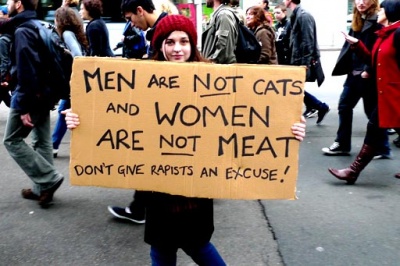
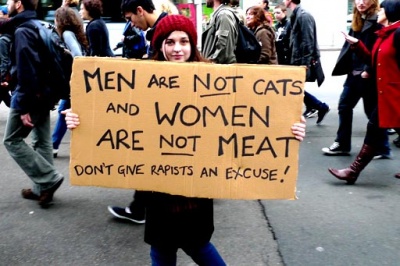
The message: Marchers take on the streets of Sydney with banners.

The rain was just starting to subside as hundreds of people — men and women alike — assembled at the Sydney Town Hall to march in an anti-rape rally dubbed SlutWalk, last Monday afternoon.

The SlutWalk has become a global movement since April — spreading across North America, Europe and Australia, and soon to New Delhi — after a police officer in Canada said women should avoid dressing like sluts if they don’t want to be victimized.

Melbourne was the first city in Australia to hold the march, with thousands of people taking to the streets there. The crowd in Sydney wasn’t as big, despite more than 7,500 people showing their support on the SlutWalk Sydney Facebook page.

The Sydney organizer Samadhi Arktoi told reporters at the rally that the rain had deterred many from attending.

Despite the gloomy weather, the participants marched from Town Hall to Harmony Square, shouting “Whatever we wear, wherever we go, yes means yes, and no means no!”

Most of the marchers wore winter jackets and coats. However, a few people who were brave enough to withstand the cold came in tank tops and slip dresses. One woman wore a black slip dress, with black feathered wings, while a man had a short black dress on, holding a sign “Yes means yes, and no means no”.

The ratio of men to women at the rally was equal. Mathew Lee, a 25-year-old student from Sydney, said the assumptions underpinning “slut-shaming” and “victim-blaming” were as hurtful to men as they were to women.

“They [victim-blamers] make certain assumptions about male behavior,” he said.

“It is assumed that if women dressed like sluts, men will be unable to control themselves; these assumptions assign us these kinds of instinct that men can’t help but rape women,” he said. “And I think that’s nonsense. I’m a man, I have never raped a woman. It’s just garbage. People use these kinds of excuses when it’s really about their own inability, their unwillingness to control themselves,” he said.

Lee said he joined the walk because it pushed a feminist agenda.

“I guess it falls under [the banner of] feminism, where you don’t have to be a woman to be a feminist. I’m quite proud to call myself a feminist,” he said.

Student Phillip Hall, 25, also joined the rally, donning red heart-shaped shades.

“I think there is a massive culture of victim blaming in this country and other countries, which is absolutely disgusting. The way the media portrays these cases and things enables that culture to thrive,” he said.

“I’m here because I think we need to stop blaming victims, stop blaming how they present themselves, what they do or what they don’t do, because the only person responsible for sexual assault is the person doing it,” he said.

The walk has sparked a debate here about whether the movement is really helping campaign for women’s rights or whether it’s a step back because of the campaign’s controversial name.

Mariana Amirudin, a Jakarta-based women’s rights activist and editor of feminist journal Jurnal Perempuan, is more concerned about another aspect of the walk.

While she acknowledged that campaigning for women’s rights over their bodies was an important cause, she was also concerned that women in the West still had to fight for their rights over their bodies.

“The campaign for women’s bodily rights in developed [Western] nations was supposed to be over, with radical feminists in the 1970s often campaigning about it,” she wrote in an email.

“I’m concerned because this means, even in Western countries, conservatism that rejects the freedom of individuals and is degrading to women is creeping up again,” she said.

Indeed, in many parts of the world, including in the West, which is considered more liberal and where modern women’s rights movement started, women are still seen as objects.

Sydney-based performing artist Emma Maye, who came to the rally dressed as former child star Betty Grumble, said that she experienced sexual harassment almost every day.

“It doesn’t matter what I’m wearing. I will get a wolf whistle, a snide remark,” she said.

Maye insisted it was important to understand why these things still happened in 2011.

Megan McKenzie, who also joined the rally dressed in a 1950s outfit, said that she had been “groped, grabbed all sort of things that are completely unwarranted and completely uninvited”.

They both joined the rally as independent individuals hoping to make a difference.

“I think it’s important for people to participate in these events, to start a conversation and bond with like-minded people,” Maye said.

McKenzie hopes the campaign will change people’s behaviors.

“Unwanted touching, unwanted sexual advances, unwanted comments are not acceptable. And the way someone dresses should not be seen as encouraging sexual assault. It’s [sexual assault] actually [driven by] something else inside the perpetrator,” she said.

Back in Indonesia, Titiana Adinda, a woman’s rights activist who has worked with victims of sexual assault at the Women’s Crisis Center at Cipto Mangunkusumo Hospital in Jakarta, said it was common for law enforcers to blame the victims in sexual assault cases, saying they had “asked for it”.

“They think victims invite violence by the way they dress or by being flirty,” she said.

Similar campaigns on women’s rights over their bodies have been carried out in Indonesia, Mariana said — albeit under a less controversial name. Mariana alluded to the thousands of people who took to the streets to protest the pornography bill between 2004 and 2006. However the bill was still passed.

According to her, Indonesia went through a period of enlightenment in women’s rights between 2004 and 2006, but that religious groups had since used religious symbols and moral claims to trump these campaigns.

The government, Mariana said, also paid more attention to radical religious groups than to women’s groups. Riding the wave of SlutWalk might be a good time for Indonesia to revive its own campaign.

Prodita Sabarini, The Jakarta Post, Sydney, australia | Life | Tue, June 21 2011

LGBT groups fight for their rights

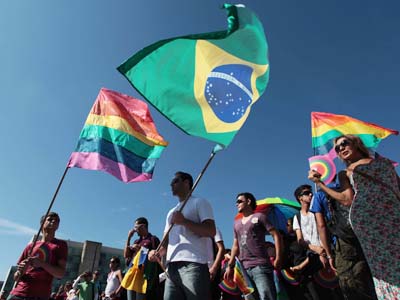
Come out: People wave gay movement flags (left and right) and the Brazilian flag during a march against homophobia in Brasilia, Brazil, on May 18. AP/Eraldo Peres

As people become more aware on LGBT issues, protests follow. Hartoyo, the secretary-general of LGBT rights organization OurVoice, said that was normal.

“As more [LGBT people] appear, rejection from certain groups will come too,” he said giving examples of groups such as the Islam Defenders Front (FPI) and the Muslim Forum (FUI). These groups protested an international LGBT event in Surabaya last year, intimidating the organizers to the point they canceled the event.

Hartoyo said he believed that Indonesian society was tolerant. “Hatred toward the LGBT group is based more on lack of non-judgmental media communication,” he said.

That is why his organization uses the Internet platform through writings on their website and videos on Youtube. “Through our website we try to express what we feel is happing inside of us,” he said. “OurVoice can be a media form where everyone has the right to disagree but they also have to listen to what LGBT people are going through,” he said.

He said the LGBT rights movement in Indonesia developed from being composed of patron type organizations — such as the transgendered women’s group that holds dance events to organizations that focus on the rights of LGBT people. In its third decade the advocacy movement has progressed far from the days of the 1980s when homosexual men and women and transgenders networked exclusively through the first and — at that time — the only gay magazine GAYa Nusantara.

Hartoyo’s organization OurVoice, and Arus Pelangi, Ardhanary Institute, are working more on the human rights issues concerning LGBT.

“After the reform era, organizations based more on human rights issues emerged and they hugely contribute to Indonesia’s LGBT discourse,” he said.

Eventually, Hartoyo said that the group aimed to gain political power that could ensure the state provides policies on LGBT rights.

Prodita Sabarini, The Jakarta Post, Jakarta | Feature | Sat, May 21 2011

Silver lining for gay and lesbians

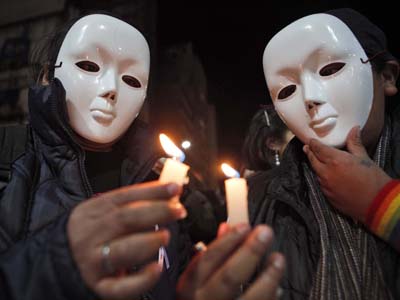
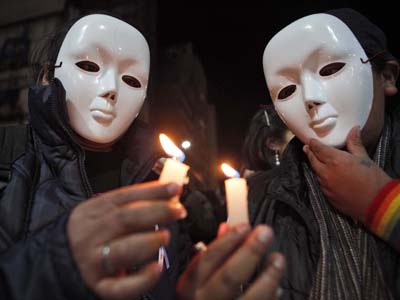
Seek the light: Activists wearing masks hold up candles during a demonstration marking International Day Against Homophobia in La Paz, Bolivia, on May 17. According to LGBT leaders, 24 people from the LGBT community have been murdered in the last 18 months in Honduras because of their sexual orientation. AP/Juan Karita

Fady, 29, limits his imagination to the future of his relationship with his boyfriend.

A closet homosexual, except to a few very close friends, he keeps his sexual orientation a secret.

“I have a lot of things to consider if I come out to people outside my [circle] of close friends. I don’t have enough energy and time to go through that,” he said.

For him and his boyfriend, what they have is the present. He said he would be happy enough if he could be with his partner for the next year.

“We don’t think about how it would be when we’re old and etc,” he said.

In the country’s strong heterosexist culture, LGBT (lesbian, gay, bisexual, transgender) people are either hidden or marginalized. Most LGBT people in Indonesia face rejection from families when they “come out” and are discriminated against by the system.

But, the country’s LGBT and liberal human rights groups are slowly working to fight the stigma of a lewd, mentally disordered lot attached to the LGBT community.

One of the country’s gay rights
organizations, OurVoice, is campaigning to fight homophobia in conjunction with the International Day of Anti-Homophobia that falls on May 17.

May 17 has been commemorated as the International Day Against Homophobia (IDAHO) since 1996, after a conference on gay rights in Montreal, Canada.

The date, May 17, was chosen as the symbolic day, as it was on this date the World Health Organization scrapped homosexuality from the list of mental disorders. The American Psychiatric Association stated in 1975 that homosexuality was not a mental disorder.

In 2006, the Yogyakarta Principle, a guideline of International
human rights law in relation to gender identity and sexual orientation was signed.

Despite that, persecution against LGBT people still takes place around the world. According to OurVoice, there are more than 70 countries that criminalize a person based on sexual orientation and gender identity.

In Indonesia, regional bylaws in South and West Sumatra criminalize homosexuals and the 2008 pornography law states that homosexuality is a deviant behavior despite the Health Ministry’s declaration in 1993 that homosexuality is no longer a mental disorder/disease in their Diagnostic Classification on Mental Disorder Guidelines (PPDGJ).

Fady said he did not know that such a day commemorating the rights for LGBT people existed. He said it was a good thing that a group of people in the world was concerned for LGBT people, although it didn’t affect him much, he added, as he kept his relationship with his partner a secret.

But for Ramy, a 20-year-old lesbian, that day is very important. While Fady keeps his sexual orientation and relationship a secret, not daring to imagine the future, Ramy said she would make sure to follow her own life path. “For the next couple of years, I will make sure I will have a relationship, like it or not,” she said. “I will be true to myself and not undermine my true self to please society,” she said.

Strong unity: Youths take part in a rally near the presidential house in Tegucigalpa on International Day Against Homophobia on May 17. Reuters/Edgard Garrido

Ramy, who chose not to disclose her last name, said her family learned of her attraction to the same sex in mid-2009. “My brother suspected that I liked women. I’m a tomboy, and he started to be suspicious. He followed me and found me with my girlfriend and took me home,” she said.

Her family interrogated her, asking why she couldn’t be “normal”. “I just told them that I was just following my heart; that I desired a woman,” she said.

Ramy said her family took her to an Islamic boarding school that treats “drug addicts and stressed out youth”, where she had to bathe in water mixed with seven kinds of flowers in an attempt to “cure” her.

After two months at the boarding school, Ramy, who lives with her mother, never brought her partner to her parent’s house again.

“My wish in the future is that my family can have an open mind and not be as rigid as now,” she said.

Ramy said that, among her friends and colleagues, she does not hide her homosexuality. “The first time they found out they were surprised, but later they said, ‘It’s her life,’” she said. “While my friends at work, luckily they are people who mind their own business,” she added.

When her colleagues found out, Ramy said that usually the first thing they would say was, “How did that happen? Since when?”

“My friends were surprised at first but later got used to it, while my colleagues at work mind their own business,” she said.


In urban areas, public knowledge, awareness and acceptance of homosexuality have increased compared to 10 years ago, general secretary of OurVoice, Hartoyo, said. Films with themes of homosexuality have been well-accepted, such as Nia Dinata’s Arisan! (Savings Gathering). A gay-themed film festival, Q Film Festival, also has been successfully running for almost 10 years.

“I think people are more accepting. Not that I’m saying they 100 percent accept [LGBT people], but information about LGBT is more open, which enables communication to happen,” Hartoyo said.

Hartoyo himself has experienced discrimination and abuse due to his sexual orientation, when in 2007 policemen in Aceh abused and tortured him for having homosexual relations.

Hartoyo said LGBT people gathering at places such as gay bars and clubs in big cities also indicated people were accepting.

Another example of how society is accepting — to a certain extent — towards LGBT people can be seen in Dino’s (not his real name) experience. Dino, a straight guy, pretended to be gay so he could live with two girls in a shared house without arousing suspicion and rejection from surrounding neighbors.

Dino said that to live in the house in South Jakarta, his housemates suggested that he pretend to be a stereotypical gay man by acting effeminate.

“I’d heard that some people protested when a guy lived in the house before I moved in,” he said. “When he moved out and I was about to replace him, my friends told me to act gay,” he said.

“My neighbors feel that their space needs to be protected,” he said.

Dino said that this could be an indication that LGBT people were more accepted, but he doubted that if an “outed” gay couple lived in the neighborhood, people would be as accepting.

For Hartoyo, it comes down to society’s perception of sex and the lack of sex education. “Sex is seen as sacred and on the other hand dirty.

“What is sacred is heterosexual relations under lawful marriage according to religious laws. Outside of that, sex is considered dirty, which means homosexual and lesbian sexual relations and heterosexual relations outside of marriage,” he said.

He said that there was a lack of sex education in the country. “Sex is always a taboo and feared. Sex education is something that is feared, with the assumption that by giving sex education people will have sex,” he said. “That’s not the case, and the state should not have a phobia of sex,” he said.

“When talking about reproductive health, safety, equality and justice, relationships do not have anything to do with halal (allowed by religious law), but mutual respect and understanding,” he said.

He said if a sexual relationship was based on equality between partners, it should not be considered a public matter. “Unless there is discrimination and violence, then what’s private can be a public matter,” he said.

Prodita Sabarini, The Jakarta Post, Jakarta | Life | Sat, May 21 2011

Dysfashional #6: The imagination that makes fashion

La Orfanelle, an installation by Antonio Marras, 2006.

Fashion is a paradox. Its skin-deep and transient nature makes one never take it too seriously. Yet good fashion is nothing but serious. It is art that stems from deep contemplation about aesthetics and self-identity.

The French Cultural Center (CCF) opened its Le Printemps Francais or art festival this month with “Dysfashional #6”.

“As a fashion exhibition which does not exhibit clothing, ‘dysfashional’ shows that fashion is beyond the objects that materialize it, an unstable state of sensibility,” says the event’s program booklet.

Some 15 art works curated by Italians Luca Marchetti and Emanuele Quinz, in the form of installations, videos and photography from European and Indonesian artists are exhibited at the National Gallery in Central Jakarta from May 8 to 15.

The Jakarta edition of this exhibition marks the first time “Dysfashional” is presented in an Asian country. The first edition was held in Luxembourg in 2007. Lausanne, Paris, Berlin and Moscow also hosted the exhibition in the following years.

Marchetti and Quinz approached designers and artists to participate in this exhibition on fashion that did not feature products such as clothing but “the imagination linked to fashion”.

CCF Jakarta director David Tursz said in the press briefing on Dysfashional #6 that the exhibition showed French culture from a more European perspective.

“To present France not alone, but really as part of this European state,” he said.

Turnz added the event also opened up opportunities for Indonesian artists to be involved in the festival.

Ruangrupa artist collective, Jay Subiakto with Stella Rissa, Davy Linggar, Deden Hendan, Oscar Lawalata, Dita Gambiro and Kiki Rizki with Erika Ernawan participated in the Jakarta edition of “Dysfashional”. Their works were exhibited alongside installations from European artists including Justin Morin with Billie Mertens, Antonio Marras, Hussein Chalayan and Michael Sontag.

The range of ideas and concept explored by artists in one simple theme of fashion is broad. The theme brought out contemplations on the body, urban lifestyle, fashion as protection of identity, and nothingness.

The first installation at the entrance of the gallery represents the different languages used to express the idea of fashion and beauty in Germany and France.

To visualize this, Parisian artist Justin Morin — who was in residence in Berlin in 2009 — and Belgian designer Billie Mertens observed how women in Berlin and Paris wore their hair, in a collaborative work titled Babylone.

The work features two columns, one with different shades of colorful wigs and the other column made of blonde and brown hair.

Morin when speaking at the National Gallery last week, said he had noticed many people with colorful hair in Germany. “Housewives, women between 50 and 70 years old with strange hair cuts and dyed hair,” he said.

As someone coming from Paris, he found this interesting. “It’s a cultural representation of traditional beauty. Like it’s very normal for them [Berliners] to have these very strange haircuts. I think maybe for them French women are very boring,” he said.

Morin explained he focused his attention on hair because he wanted to work beyond the ideas behind clothes. At the first and second edition of “Dysfashional” in Luxemburg and Lausane, he noticed “everyone was talking about the clothes but nobody was talking about the hair”.

In addition, Morin said hair was part of his personal story as his mother was once a hairdresser until he was five years old. “It’s an old souvenir for me,” he said.

British-Turkish designer Hussein Chalayan’s 2004 short film Anaesthetics can be seen on a big screen as visitors walk further into the gallery. The 11-chapter film shows how rituals and codes of behavior in fashion can work as anesthesia. “With aesthetics you can anesthetize the violence of life,” Quinz said on Chalayan’s video.

Photographer Davy Linggar revisited the 2005 work he created with Agus Suwage in Pinkswing Park (Adaptation), which ignited the furor of the Islamic Defenders Front (FPI) for the nudity it contained. The original Pinkswing Park described the life of Adam and Eve, with models Anjasmara and Isabel Yahya posing nude in the picture.

In the adaptation of his own work, Linggar created a black and white version of the park and left a blank spot where the models once stood. The picture was then placed above a dresser drawer with lit candles on top of it. “This represents the death of freedom of expression,” Davy said in the gallery. “Someone’s morality should not be judged by one’s nakedness,” he said.

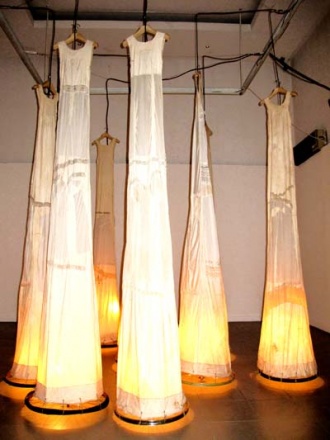
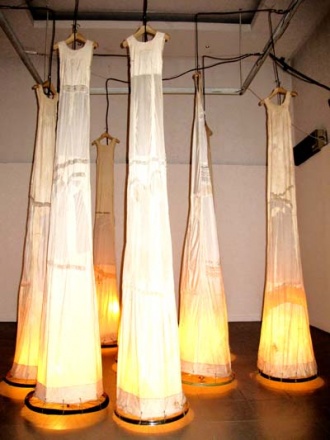
Antonio Marras’ Le Orfanelle is a poignant piece on the life of unwanted babies in Marras’ hometown Sardinia. His installations consist of white frocks hanging from the ceiling with dim lights shining from the bottom of the frocks. Quinz said the idea came from the Sardinian custom of leaving unwanted babies at the doorstep of monasteries and donning them in a white frock.

Marchetti noted the fresh perspective Indonesian artists brought to the exhibition. The Jakarta exhibition aroused a sense of exploration in him. In Europe, Marchetti and Quinz commissioned works from new artists for the exhibition. “Even if each piece of work, even if each new art work was new, we had more or less the feeling we would know what would come out,” he said.

According to Marchetti, there is a common aesthetic in Europe with some differences between countries. “There are common points, common aesthetics, and common ground,” he said.

“Arriving here we could feel the exhibition was really going to be an exploration or discovery,” he said.

Prodita Sabarini, The Jakarta Post, Jakarta | Features | Thu, May 12 2011

Tan Malaka: An opera of absence

up p21-a_177.img_assist_custom-400x267

Tan Malaka is a story of absence, mystery and, ultimately, about not knowing. The opera incorporates these themes into its very structure and communicates a subdued feeling of absence.

Throughout the work moments of silence — and the absence of the character for whom the work is named  — gave the audience a sense of incompleteness.

The opera, a collaboration between libretti Goenawan Mohamad and composer Tony Prabowo, was re-staged in Graha Bhakti Budaya (GBB) at the Taman Ismail Marzuki cultural center on April 23.

Tan Malaka was first performed for the public at the Salihara Theater in October. The performance commemorated both Goenawn’s 70th birthday and the 40th anniversary of Tempo, the magazine he co-founded.

The opera began in the pitch black. Then a line of red light traversed the stage from bottom to top. A man came out and stood on top of an ersatz wood platform waving a red flag depicting the hammer and sickle.

The opera tells the story of Tan Malaka, one of the country’s founding father and an international communist activist. He wrote about a potential Indonesian nation in his work Naar de Republiek-Indonesia in 1924 while in Canton, China — well before Sukarno and Mohammad Hatta voiced similar ideas.

Tan however was not present when Sukarno and Hatta proclaimed independence in 1945.

“People say he was in Jakarta those days. However, the young people prepared the proclamation of independence, and he was not there. Tan Malaka did not show even a couple of meters from Jl. Pegangsaan. He was unseen on the Aug. 17. Nobody told him,” Landung Simatupang, the opera’s narrator, said on the stage in the work’s third act.

Nearing the end of the opera, text flashed onto a screen behind the stage read: “Reportedly someone was shot dead. Reportedly Tan Malaka was shot dead. In the Kediri area”.

According to Harry A. Poeze, a historian who has traced Tan’s story for the last 30 years, Tan was shot in Selopanggung, Kediri, in 1949.

Goenawan described the performance as an essay opera — “a form that maybe has never existed before”. The opera does not follow the traditional storytelling conventions, such as a linear plot.

As Goenawan said in the opera’s program notes, the creators wanted to convey the idea that the stage did not represent an illusory reality.

“The stage is the place where reality is processed and the audience is involved in the process of freedom from illusion”.

There is no dialogue in the conventional sense. The actors are storytellers. Without a plot, however, the opera becomes demanding on viewers. It featured neither a crescendo nor resolution in the usual sense.

For some viewers, these muted currents allow for contemplation of the absence of Tan Malaka during the country’s most crucial moments and his mysterious death. For others, it’s a lovely (albeit inadvertent) lullaby.

Nyak Ina “Ubiet” Raseuki and Binu Doddy Sukaman beautifully performed the work’s arias. The sopranos sang short poems about Tan Malaka set to music performed by an orchestra conducted by Josefino Chino Toledo from the Philippines.

Goenawan incorporated into the work the Sumatran folk tale of Malin Kundang, which tells of a son who travels and returns home ungrateful.

Ubit and Binu each sang in turn: “Once there was a mother who heard her son say ‘I came to be seditious’,”. Malin Kundang symbolizes Tan Malaka as the antithesis of the status quo.

Landung replaced Adhi Kurdi who portrayed the narrator in the last version of the work. His strong presence on stage made the audience think of what happened during the time of Tan Malaka’s absence.

.Whani Darmawan played the person behind bars. He tells of the idea of struggle, a metaphor for continuing the revolution despite imprisonment.

The Paragita choir of the University of Indonesia, headed by Aning Katamsi, provided supporting vocals while Yudi Ahmad Tadjudin served as assistant director.

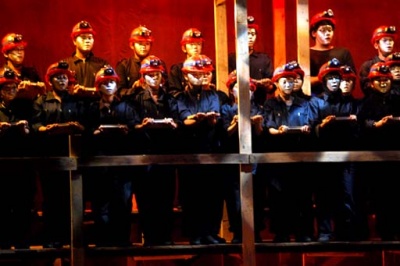
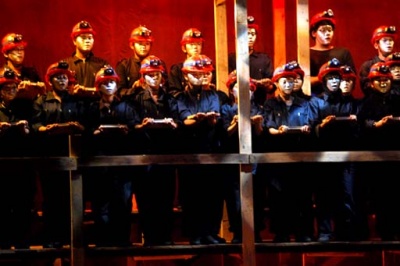
One of the most important elements of the opera was dance. Fitri Setyaningsih’s choreography was slow and silent to the point of meditation. About two dozen dancers from Surakarta represented the common people, miners and refugees, in the opera.

At one scene Fitri drew chalk circles on the stage, representing Tan Malaka’s continuous effort in writing and thus shaping history.

Goenawan and Tony’s opera revives memories of a revolutionary figure whose life ended tragically.

Tan Malaka is immortalized in the opera. As the narrator says:

“I disappear therefore I exist. I am present. Tan Malaka will not die in this story. Maybe that is what I need to say”.

Prodita Sabarini, The Jakarta Post, Jakarta | Feature | Sat, May 07 2011