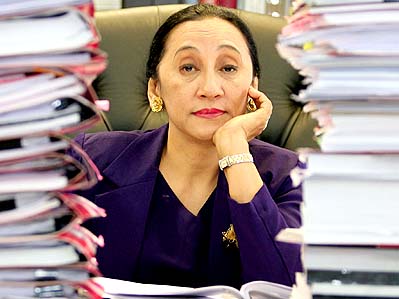
Louise Arbour: Woman of justice

Having worked as the chief prosecutor for two international criminal tribunals, as the United Nations high commissioner for human rights and now assuming the post of the president of the conflict prevention organization International Crisis Group, 63-year-old Canadian judge Louise Arbour says that conflict is part of human life.
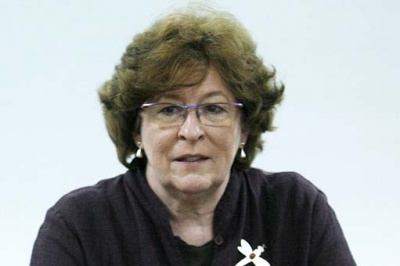
JP/R. Berto Wedhatama

“Conflict, I think, is part of human life. The real issue is conflict resolution; how to handle conflict. You cannot avoid conflict. The key is how you can respond to it; how you anticipate it; how you manage it; and how you resolve it,” she said recently.

Arbour who took up the position as president of the International Crisis Group (ICG) in July 2009 after ending her four-year term as the UN’s high commissioner for human rights a year before, was recently in Indonesia, one of ICG’s bases for Southeast Asia.

Arbour was in the region to meet with her colleagues and look at the situation in the region. Arbour last visited Indonesia in 2007 as high commissioner. On Indonesia, she said the country had established a point of leadership in the Association of Southeast Asian Nations (ASEAN). Domestically, the country has managed to achieve and maintain stability post-1998 reform era.

“Looking at the current situation in Indonesia, there is cause to be optimistic that Indonesia is much better equipped today to deal with these kinds of challenges than it has been in recent history,” she said.

Coming from her, the comment can be considered a compliment for the country. Arbour is famous for her frank — and for some, controversial — comments. In 2006, at the height of the Israel — Lebanon war she issued a statement that, “The scale of the killings in the region, and their predictability, could engage the personal criminal responsibility of those involved, particularly those in a position of command and control”. These words were seen by many as directed toward Israel, and were rejected by Israel’s ambassador to Canada.

Now, working in a civil society organization, Arbour said the organization had tremendous freedom to work, which was different to her work in the UN organization. International Crisis Group publishes more than 80 reports and briefing papers annually, as well as the monthly CrisisWatch bulletin assessing the current state of play in some 70 countries or areas of actual or potential conflict.

“There’s a very big difference in the scope and authority of the two positions. The high commissioner for human rights is a high-ranking official in the United Nations with a very large staff. But at the same time, inside the United Nations, as a UN official you are constrained by what member states are prepared to allow or not allow. The political framework of the United Nations is that the shareholders are the 192 states. At times, they are very much in conflict. At other times, they are firm in preventing a certain course of action. So, in a sense, it’s a role that has considerable influence, but not a lot of power,” she said.

She said as high commissioner her only mandate was human rights. “Not conflict resolution. Not political consideration. You just have to be an advocate for human rights protection and promotion,” she said.

Meanwhile, in ICG it was a little more complex, she said. “We’re still guided by human rights principles but we are driven by something that is also pragmatic, which is, at the end of the day, if you’re doing conflict management or conflict prevention or conflict resolution, you have to balance the purity of the principle and the likelihood of obtaining the right result. There is always tension between the desirable and the feasible,” she said.

She said the question was to find a point where there was a chance to achieve a result. “So it’s principles and pragmatism coming together,” she said.

“As a civil society organization, or a nongovernmental organization, we have tremendous freedom to work where we choose to work, assuming again we’re welcome by the government, we can’t impose our presence.

“I think over the years, the ICG has developed enough credibility that most governments understand that, even though we might not agree with everything they say we will always represent their point of view accurately. Even if we disagree with it, our analyses are not biased. We don’t work for anyone, we don’t represent any country,” she said.

Arbour’s first brush with human rights issues, she said, was as a lawyer in Canada. In 1992, Canada passed a new constitution that guaranteed all the fundamental human rights and civil liberties.

“To me, it profoundly changed the nature of Canadian society, of political discourse. My first interest was criminal law. But slowly I became more interested in human rights issues,” she said.

“My first opportunity internationally was sort of a mixture of the two,” she said. In 1996, then UN secretary-general Boutros Boutros-Ghali appointed her as chief prosecutor of war crimes before the International Criminal Tribunal for Rwanda and the former Yugoslavia in The Hague.

In 1999, she was appointed to the Supreme Court of Canada. She took the post as high commissioner in 2004.

Arbour said she believes strongly in the universality of human rights. She disagrees with the notion of cultural relativism of human rights, which was championed by Southeast Asian leaders in the 1990s, such as former Singapore prime minister Lee Kuan Yew and former Malaysia prime minister Mahathir Mohamad.

“I think in all the work I’ve done all my life, I’ve never met one single person on earth that, given the choice, would renounce any of the rights that are guaranteed, the right to life, to health, to freedom, to be free from torture. Everybody wants that,” she said.

Prodita Sabarini, The Jakarta Post, Jakarta | People | Tue, May 18 2010
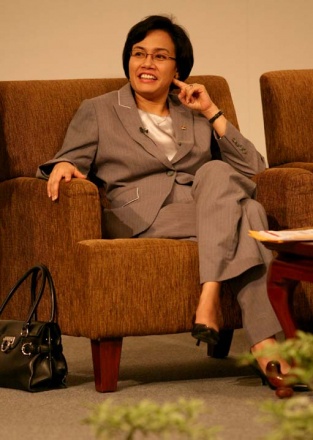
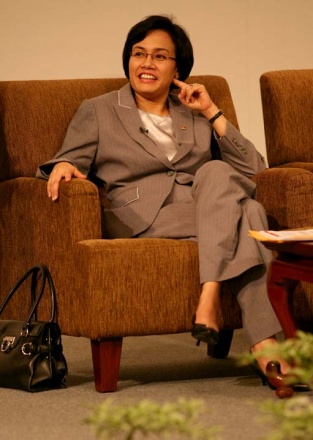
Sri Mulyani Indrawati: Woman of the century

“She could be the finance minister anywhere in the world,” says James Castle, founder of the consultancy Castle Asia. “She’s that good”.

JP/Arief Suhardiman
JP/Arief Suhardiman

Castle told that to Newsweek magazine last year on Indonesia’s outgoing finance minister Sri Mulyani Indrawati. She is stepping down from her post, which she had held since 2005, to join the top ranks of the  World Bank under its president Robert Zoellick.

President Susilo Bambang Yu-dhoyono approved of her resignation to work for the World Bank.

In a televised statement Yudho-yono on the departure of Mulyani, who was crowned as the best finance minister in Asia by Emerging Market Forum and finance minister of the year in the world by EuroMoney in 2006, said her departure was “a big loss”.

He said he would ensure however that her successor would carry on the financial and tax reforms she had initiated during her tenure.

Mulyani, 47, will start June 1 as one of the Washington-based bank’s three managing directors, the highest rank under Zoellick.

She will replace Juan Jose Daboub, former minister of El Salvador, who will complete his four-year term June 30, overseeing 74 nations in Latin America, the Caribbean, East Asia and the Pacific, the Middle East and North Africa, the World Bank said.

Analysts said this was a good exit for Mulyani, who with Vice President Boediono, was the target of an opposition campaign accusing them of abusing their authority during the Rp 6.7 trillion (US$716 million) bailout of Bank Century in 2008.

“The appointment is like a win-win solution,” said Purbaya Yudhi Sadewa, an economist at the Danareksa Research Institute in Jakarta. The new job can help Sri Mulyani save face. “She has been facing a lot of political pressure,” he said as quoted by Bloomberg.

Mulyani’s support for the decision to bail out Bank Century in 2008 in order to avert a wider systemic banking and financial crisis was the subject of a highly politicized parliamentary inquiry. The Corruption Eradication Commission is currently investigating the case and has questioned Mulyani on her policy decision.

Legislators had proposed to remove Mulyani from her official duties during any investigation or legal process. The government refused this proposal.

However, apart from the Century saga, her work in dismantling the structure of crony capitalism built during Soeharto’s authoritarian regime, slashing public and private debt, and spearheading sweeping reforms in customs and tax administration is testament to her outstanding achievements in the field of Indonesian economic reform.

During Mulyani’s time as finance minister, Southeast Asia’s largest economy has become a member of the group of 20 leading economies and one of the fastest growing in the region.

Fitch upgraded the country to “BB+”, a notch below investment grade, in January 2010 primarily in recognition of the improvements to sovereign credit-worthiness arising from improved fiscal policy discipline and falling debt ratios. Indonesia is expected to achieve the coveted investment grade within a couple of years to be on par with the emerging market elite of Brazil, Russia, India and China, known as the BRIC nations.

The World Bank said that Mulyani had navigated successfully in the midst of the global economic crisis.

“She has been an outstanding finance minister, with in-depth knowledge of both development issues and the role of the World Bank Group,” Zoellick stated in a press release.

Mulyani, born in 1962 in Tanjung Karang, Lampung, completed her doctorate in economics from the University of Illinois. She has been an avid fighter for Indonesia’s economic reform since the days following the 1997 Asian economic crisis. She was then the head of the University of Indonesia’s Institute for Economics and Social Research (LPEM UI).

Together with 13 other young economists, including Mari Elka Pangestu (now trade minister), Miranda S. Goeltom (former senior deputy governor of Bank Indonesia), and Anggito Abimanyu (now the Finance Ministry’s head of fiscal policy), they presented the Declaration for Saving Indonesia’s Economy.

Mulyani and Anggito later became the members of president Abdurrahman Wahid’s economic advisory team. Wahid’s presidency lasted less than a year and ended in July 2001 with the rise of president Megawati Soekarnoputri.

When rumors spread on Mul-yani’s candidacy in the new cabinet, she silenced them by heading to Atlanta in the US, to work as a consultant for the US Agency for International Development. In October 2002, she was appointed as the executive director of the International Monetary Fund to represent the Southeast Asian countries in its Washington, DC headquarters.

Indonesia’s next president, Susilo Bambang Yudhoyono, came to power in October 2004 and managed to lure her back as the state minister for national development planning.

A year later, in 2005, during a cabinet reshuffle, Mulyani was made the head of the Finance Ministry.

Mulyani in an interview said that as finance minister the goal of government economic policies was for people “to develop, be prosperous, get enough income, be able to meet all their needs from the day they were born until the day they die: education, food, health, recreation, all at affordable levels”.

Prodita Sabarini, The Jakarta Post, Jakarta | People | Thu, May 06 2010

Hans Kung: Encouraging interfaith dialogue

A proponent of religious dialogue, Swiss-theologian and Catholic priest Hans Küng is a highly respected ecumenical advocate and a controversial figure within the Catholic Church.

He established the global ethics project, a global peace movement that started in the early 1990s to find shared values between religions and humanistic beliefs despite “dogmatic” differences. Küng is also an outspoken critic of the Roman Catholic Church and the current pope, Benedict XVI.

The 82-year-old recently visited Jakarta and gave seminars on global ethics, dogmatism and religious fundamentalism. Sitting in a hotel meeting room in Central Jakarta, the silver-haired controversial
priest talked to The Jakarta Post about his views on Catholicism today, the role of religion in a more secularized society, his calling towards priesthood and his belief in the existence of god.

Born in 1928, Küng said his decision to become a priest came at a very young age — in his early teenage years. He studied theology and philosophy at the Pontifical Gregorian University in Rome and was ordained in 1954.

He has been a firm advocate for church reform most of his life, becoming the first major Catholic theologian to reject the doctrine of papal infallibility. In 1971, he released a book Infallible? An Inquiry, in which he maintained that papal authority was made not by God but by man and was therefore reversible. This prompted the Vatican to rescind his ecclesiastical teaching permission in 1979 as Küng refused to withdraw his challenge against papal authority. Küng however continued to serve as a tenured professor of ecumenical theology at the University of Tübingen, Germany, and was also director of the Institute for Ecumenical Research until his retirement in 1996.

Recently, in conjunction with the fifth anniversary of the election of Benedict XVI as pope, Küng wrote an open letter to the church bishops published in the Irish Times, motivated by “profound concern for our church, which now finds itself in the worst credibility crisis since the Reformation”. The Catholic Church has been under a spotlight after revelations of clerical abuse of children and adolescents, in the US, Ireland and Germany.

He appealed to the bishops to set about reform and call for a council, a conference of bishops.

Both Küng and Ratzinger, now Pope Benedict XVI, were in the second Vatican council (1962 to 1965), the latest ecumenical meeting of bishops, which dealt with the Church and its relation to the modern world.

The Vatican II resulted in liturgical reform, religious freedom, ecumenism and inter-religious dialogue.

Küng deemed that Benedict had yet to make the spirit of the Second Vatican Council “the compass for the whole Catholic Church, including the Vatican itself”.

He said the problems with the Catholic Church had to do with papal absolutism, the role of clericalism and the law of celibacy. Clericalism placed the priest above everybody as a holy man, he added. “They are not holy men, they are servants of the people,” he said.

With regards to the law of celibacy, introduced in the 11th century, Küng said it should be abolished and that women should be allowed into the ordination. Küng added that although sexual abuses also happened in other institutions such as families and schools, it was prevalent in the Catholic Church under celibate leadership. In the New Testament, he pointed out, Jesus and Paul practiced celibacy but allowed full freedom in this matter to each individual.

He also said that the rule of celibacy had prevented thousands of people from entering priesthood, causing a lack of new blood in the Catholic Church.

While he advocated reform within the Catholic Church, he voiced the need to put aside fundamental differences and build bridges

with the goal of attaining world peace through dialogue based on shared values.

In the seminar on Monday, Küng elaborated the four basic principles that all religions shared: “You shall not kill, murder, torture, rape. In positive terms, this means to have respect for life. You shall not steal, exploit, bribe or corrupt, which translates in positive terms as dealing honestly and fairly. You shall not lie, deceive, forge or manipulate.

“In other words, you must speak and act truthfully. You shall not commit sexual immorality, cheat, humiliate or dishonor. In positive terms, this means to respect and love one another”.

Küng’s opponents might find his dissenting opinions on the Catholic Church un-Catholic. But Küng responded they might not have read his books thoroughly. Küng has written prolifically — two memoirs, books about Christianity, the Catholic Church, Islam, science and religion, and global ethics.

Religion still plays a role in society, despite the process of secularization, he went on, which came about as a result of progress in science, democracy, philosophy and industrialization.

The world is an invitation to think about God, he noted, “not in a sense of rational proof but by credible reasons… It should be seen as a cosmic vision, which can run side by side with very serious science.”

Religion will still hold a place for people to find out about the meaning of life, about suffering and how humans can overcome it, and also to think about life after death, he said.

While he has always been inquisitive and critical, Küng has never doubted the existence of God.

“I doubted more the argument of his existence, than God himself. As a matter of fact, I never had the idea that God cannot exist. I would have found it irrational. To think that everything just comes out from nothing is not a rational position,” he said.

“But I do not accept rational proofs for God because that’s another dimension. This other dimension you can have reasons to believe, reasonable arguments for believing God, but not rational proofs.”

Prodita Sabarini, The Jakarta Post, Jakarta | People | Fri, April 30 2010

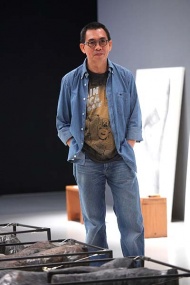
FX Harsono: Testimonies through art

Courtesy of FX Harsono

When prominent artist FX Harsono’s father sent his son away from Blitar to Yogyakarta in 1969 to pursue a higher education, he thought his son would study engineering.

Little did he know Harsono had other plans for his future: To paint.

“I lied to my father,” Harsono recalled. “He didn’t approve of me studying art,” he said.

Besides enrolling into a technology institute, Harsono was also accepted into then newly established art school STSRI ASRI. Having a huge urge to paint and learn about the arts, he entered both schools, but lasted only three months in the technology one.

“A year later, I finally told [my parents] and they had to willy-nilly accept my decision,” he said. “My father said: ‘Do as you wish, you’re an adult’.”

A brave decision to make, Harsono knew he was to endure a trying experience as a struggling artist. His determination, however, paid off.

Entering the fourth decade of his career as an artist, his paintings, installations and videos that delve into the issue of political repression, discrimination and identity, are acknowledged around the world.

Locally, he is deemed the person who helped develop contemporary art in Indonesia as the exponent of the 1970s new art movement.

Currently, the Singapore Art Museum is displaying his works from 1975 to the most recent 2009 exhibition, “The Erased Time”. The exhibition titled “Testimonies”, which opened on March 4 will run until May 9.

In his Tangerang house in Bintaro, the bespectacled 62-year-old reminisced on his early years as an artist. “It was very tough… very tough,” he said. “But I persisted to make a living from my art,” he said.

He founded the Gerakan Seni Rupa Baru or New Visual Art Movement with fellow young artists in 1975 as a response to what he viewed was a very Western-influenced art favoring decorative painting by an older generation of artists.

An Indonesian of Chinese descent, Harsono began using social and political themes in his art because he believed they represented the current Indonesian situation at that time.

In a discussion at the Dutch cultural center Erasmus Huis earlier this month, Harsono said that had he and his friends returned to tradition to create more Indonesian-themed art, it wouldn’t have been representative of the times they lived in.

One of his 1975 works, The Relaxed Chain, shows mattresses wrapped in chains, commenting on people being oppressed under Soeharto, including in the most intimate parts of their lives.

His 1994 work The Voices Controlled by the Powers is an eerie piece showing rows of wayang masks with their bottom half severed looking inward toward a pile of their cut jaws. The installation was a commentary on the banning of the progressive Tempo magazine.

“During Soeharto’s era, we can say that democracy was nonexistent. No one could talk freely, no one could criticize Soeharto,” he said. “People were oppressed and we depended on courageous people to voice criticism,” he said.

Harsono said he knew things needed to change. However, only a handful of people were brave enough to voice their dissent. “As an artist I also needed to voice my concern,” he said.

With the fall of Soeharto and the emergence of a fledgling democracy, Harsono shifted his focus from social political commentary to inward reflection.

He used art to search for his identity as a man of Indonesian-Chinese descent in early 2000. Three years later, he exhibited his works titled “Displaced”.

“‘Displaced’ showed I felt I was in a space that didn’t feel right. I felt uncomfortable, curious and restless, and started to question many things,” he said.

He used the image of a butterfly stabbed with a needle as a metaphor for the pain Indonesian-Chinese individuals endured in the country.

“I feel I had been constantly discriminated.

“I am not overpowered by it, but it is a constant injustice,” he said.

During Soeharto’s era, Chinese culture was repressed. Even writing in Chinese was forbidden and Harsono had to change his Chinese name, Oh Hong Boen.

He explored this concept at a deeper level in his 2009 exhibition, “The Erased Time”, in which he juxtaposed images of the mass killing of Chinese-Indonesians in Blitar — after Indonesia’s independence, and his personal experiences. His father, a photographer, was part of the exhuming team.

At one point after the reform era, Harsono thought of leaving the country. “I did think about it after the 1998 May riots. I thought we truly lived in a country where people of Chinese descent would always be victims during social change,” he said.

During the 1998 May riots, mobs attacked Indonesian-Chinese businesses. There were also reports of alleged rape of females of Indonesian-Chinese descent.

Harsono, however, stayed and channeled his frustration into art instead. A testimony of Indonesia’s ugly truth.

Prodita Sabarini, The Jakarta Post, Jakarta | People | Tue, April 27 2010

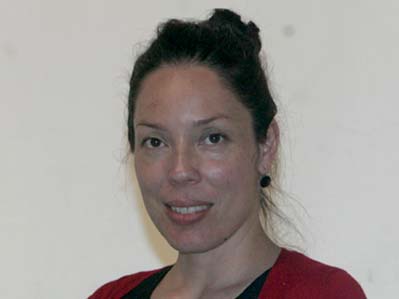
Hadassah Emmerich: Looking beyond identity

JP/R. Berto Werhdatama

The question of identity is an ever-present theme, which many artists like to explore as part of their self-discovery.

Berlin-based painter Hadassah Emmerich, who has a German-Dutch-Indonesian-Chinese background, however, said she had moved past trying to use art as a way to discover herself.

Her mixed-background prompted her to explore themes on different cultures, although she said she had abandoned using art to retrace her heritage background or reconnect with different cultures to find herself.

“I think now I’ve accepted more that you will never really know. It’s also up to you to be who you want to be,” she said. “I’m interested in artwork, not necessarily ‘me’ anymore,” she said.

The 36-year-old was in Indonesia recently for her latest exhibition at the Dutch cultural center Erasmus Huis, running from April 10 to May 4. Titled “Exopolis: Kembali ke Jakarta” (Return to Jakarta), she delves into exoticism in a playful manner. Her work in Exopolis consists of layers of different symbols taken from various cultures, times and settings, such as replicas of Paul Gauguin’s art.

Emmerich is the artist behind a noteworthy mural on the wall of the Dutch Embassy in Jakarta. Art commentator Carla Bianpoen likens the mural to “a maze of vibrant, exuberant, tropical colors evoking a sense of idiosyncratic yearning for a paradise lost”.

Having won several art prizes, Hadassah has exhibited her artwork since 1996, but it was her solo exhibition titled “With Love from Batik Babe” in 2005 that put her on the map.

Sitting in the Jakarta Arts Institute (IKJ) art department gallery after giving a lecture to students there, Emmerich talked to The Jakarta Post about how her heritage influenced her art, her search for identity and her journey as an artist.

“Without this background I may be searching within other sources, it’s hard to tell because you will never know how it would be otherwise,” she said.

“It makes me more curious on how cultures connect and where they connect. For example, I am attracted to universal stories, which are often love stories,” she said. “I’m also attracted to make collisions, to bring spirits together from different cultures that would never meet in real life. I figuratively take them from their graves and bring them back into one exhibition,” she said.

She recalling questioning her identity in her teenage years. Her Indonesian father moved to Holland when she was 6 years old. Her grandmother lived in the same house until Emmerich’s parents divorced. “Because my parents divorced, I lived with my mother and [our Indonesian culture] disappeared a little,” she said.

“Like every teenager, I asked ‘Who am I?’ and ‘What does this mean?’ ‘Is this exotic?’ and ‘How do people see me?’” she said. She even changed her name for five years until she was 17 from Hadassah to Marissa.

Hadassah is an uncommon name of Hebrew origin meaning myrtle tree. Emmerich said she did not have a Jewish background that she knew of and felt that her name did not suit her then.

She visited Indonesia in 1996 and studied art in Bandung. She came to Indonesia to answer three questions: Who am I? Do I have something in common with Indonesia? And, what is the art scene there?

“At that time it really was a big fantasy for me to come here, to explore,” she said.

However, her visit to Indonesia did not give her answers. “I came back with more questions and confusion,” she said.

Now, Emmerich said that she took on a more “mature” viewpoint. She said previously she used the questioning of her mixed-background identity or her femininity to drive her art but shifted to bigger themes after studying her Master’s of Arts in Fine Art in London. “I’m more interested in learning more about history and literature instead of questioning ‘who I am’.”

“The degree really helped me distance myself from what we call ‘navel looking’,” she said.

“In London, I learned even if I don’t have mixed blood, I can still come and take what I want. That’s the kind of attitude in London. It’s very rigorous, very cold. I was really surprised by that,” she said.

She said that she took her questions and gave them broader views. She added she was inspired by other artists “who had done the dirty work” to use as pawns in her stories. This she said was aimed to point to certain problematic themes.

Emmerich acknowledged that artists or art commentators of the older generation might not agree with her approach in playing with “exotic” styles, a theme she said people steered away from. She said people would consider it taboo to say Gauguin was good. “People are scared to take him on and are concerned about being politically correct,” she said. “Of course for the older generation, things have much more value and are untouchable,” she said.

But, she said that artists of her generation, who can apply many different references by connecting to the Internet, had more freedom in their art. Her approach, in taking different cultural symbols, gave her more freedom and she could be the “background”. “I’m a medium somehow,” she said.

Emmerich, who is expecting a baby, said that being a mother might also indirectly influence her work. “It makes me think of other things; maybe larger themes. I think it connects me to something very ancient, or universal. But how this will form, it’s difficult to say.”

Prodita Sabarini, The Jakarta Post, Jakarta | People | Sat, April 24 2010

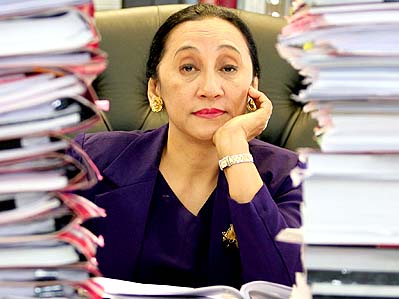
Maria Farida Indrati: Feminine voice of reason

JP/Nurhayati
JP/Nurhayati

Those quick to pass judgment may think that Maria Farida Indrati, the only woman in the Constitutional Court, was also the only judge out of the nine-member panel to doubt the necessity of the pornography law because of her gender.

But on closer inspection, it turns out her objection to the Court’s recent decision to uphold the pornography law did not specifically defend women, but Indonesia’s pluralistic social reality in general. Coincidentally, she happens to be a woman.

Sitting behind a spacious desk at her office on the 13th floor of the Constitutional Court building, this 61-year-old small-framed judge spoke to The Jakarta Post about her views on the pornography law and her role as the only female judge in the highest legal institution in the country.

Last month, the Constitutional Court headed by Mahfud M.D. turned down a judicial review filed against the pornography law on the basis that the law provided exceptions for the arts, literature, traditional customs, sports and culture.

The court ruling however failed to address the legislation’s divisive nature. The tourist haven island-province of Bali, whose people have been one of the most vocal opponents of the law, refused to comply with it. Since its inception, the pornography law has drawn a huge outcry from women and human rights activists as well as artists.

Wearing a violet suit adorned with a golden flower brooch, Farida, as she is popularly called, said the law would obviously affect women the most.

“Because people see women differently. People think it is impolite for women to expose their skin, while a man walking topless on the street doesn’t cause the slightest stir,” she said.

Her objections to the pornography law are fourfold: The law is open to too many interpretations, the definition of pornography is ambiguous, the law is divisive and bound to be difficult to implement.

“The formulation of the law has drained the country of its energy because of its many pros and cons.”

Farida said a panel of judges was created to reach a verdict. For the pornography law, she headed a panel of three judges.

“All of the judges in that panel disagreed [with the plaintiff] except myself,” she said. From there, a plenary session of judges was held. “In the plenary session, all the judges agreed to reject the request citing the law did not ran counter to the Constitution. But the moment I looked at the first clause, I was certain this [the law] could not work,” she said.

The first clause defines pornography as “pictures, sketches, illustrations, photographs, articles, sounds, voices, moving pictures, animations, cartoons, conversations, body movements or other forms of messages through various communication mediums and/or public displays that contain obscenity or sexual exploitation that violates community norms”.

Other judges nevertheless respected her dissenting opinion, she said, treating her equally irrespective of her gender.

However, Farida acknowledged that a feminine presence in the panel of judges does help cool down the heated atmosphere during plenary sessions. “All of them are bapak-bapak [older men] with loud voices. I can speak sternly too, but am calmer.”

“When all of the bapak-bapak raise their voices, I just sit calmly. They soon realize I have turned silent and they are being too loud,” she said, smiling.

Farida said that being a Constitutional Court judge changed some parts of her life. Previously she used to help the government draft legislation, now she reviews the drafts. Sometimes, she confessed, when reviewing (a flawed) legislation, she would become agitated and wished she could go back to her old job of writing the legislation. “Because I know how hard the process of drafting legislation is,” she said.

Being a judge has also taken its toll on her social life. An amiable and social person at heart, Farida said she used to enjoy lively interaction with government officials, friends from academia, and students before her job as a judge became so demanding on her time.

“People leave me alone, now. When I used to teach, many people would want to talk to me. I had many friends; I used to talk in forums; departments would invite me to talk. I was more available to my students,” she said. “That’s something I miss.”

However, she said she understood that as a judge she should be more independent.

Farida still makes a point of keeping in touch with the important people in her life, namely her elementary school teacher, who made her believe in herself despite her ailment.

Sister Monika C.B., 72, now a nun at Panti Rapih in Yogyakarta, “was the one who always guided me and made me believe in myself”. Sister Monika, who was visiting Jakarta, even caught up with Farida at her office during the time of the interview.

The eldest of eight children, Farida — now a professor of Law in University of Indonesia, said she had never dreamt she would become a judge. “I wanted to be a piano teacher.”

Her childhood dream wasn’t so much driven by a love of music, but by the desire to pursue a career that would suit her ailment.

“I suffered from polio when I was little. I used to walk to and from school and people would imitate how I walked. I learned to play the piano, and thought that teaching just a few students piano would be nice.”
But her father, who worked as a journalist for the state news agency Antara in Surakarta, did not approve of

her career plans. He believed the music industry in Indonesia at that time — circa 1969 — was still in
its infancy.

So she pursued her studies at the University of Indonesia, where she became the top student in campus, then in Netherlands and the United States.

Only after she became an assistant to Prof. Hamid Attamimi, the founder of the Indonesian Constitution Science, did she know law was her path in life.

“I realized that I was good at this, and this is the path God has shown to me,” she said.

Prodita Sabarini, The Jakarta Post, Jakarta | People | Fri, April 16 2010

Lesbians face double discrimination

Lesbian world: A woman reads a lesbian online magazine. Non-political lesbian movements have used the Internet as their media. JP/R. Berto Wedhatama

Families can do twisted things on learning their daughter or sibling is a lesbian.

A brother would force his butch lesbian sister to perform oral sex in an attempt to “educate her”. A mother would hire a gigolo so that her daughter would know the “pleasure” of men.

The sexologist her mother brought her would grope her, asking whether she felt any excitement. Families would force femme lesbians into marriages the latter did not want.

These examples are the stories that came to the LBT (Lesbian, Bisexual, Transgender) advocacy and research organization, the Ardhanary Institute, from women who have been abused because of their sexual orientation.

The director of Ardhanary Institute, RR. Sri Agustine, said recently at her office that violence toward the LBT individuals that came to Ardhanary’s crisis center was mostly carried out within the private sphere of the family home.

“At times, the home that is supposed to be the safest place becomes the most dangerous place. The most common type of violence is sexual abuse, especially toward butch females, by brothers, uncles, fathers who suspect the sexual orientation and wanted to ‘set them straight’,” she said.

“Femme lesbians would be forced into marriages because of the stigma of becoming an old spinster attached to unmarried woman,” she added. “A lesbian, who had been married for 13 years after being forced into it by her family, said she felt she had been raped for 13 years,” Agustine said.

The problem is compounded, she said, with the discrimination against LBT people by the state. The police force is yet to be sensitive toward crimes carried out on the basis of sexual orientation discrimination. Agustine said a police office, upon hearing that a rape victim was a lesbian, said: “No wonder you’ve been raped, you’re a lesbian”.

Victims of violence or sexual abuse would prefer to settle the problem without the help of the police. Or if they did report it to the police, did not say that the crime was related to their sexual orientation, Agustine said.

In Indonesia, entering the third decade of the gay movement, discrimination and oppression against homosexuals is still rife. Recently, intimidation from a hard-line religious group forced organizers of the International Lesbian and Gay Association (ILGA) Asia to cancel their conference in Surabaya, and the police did nothing to stop it.

For lesbian, bisexual and transgender women, their battle is twice that of their gay male counterparts. According to LGBT rights expert Baden Offord, Indonesian lesbians face double discrimination in terms of gender and sexual orientation.

“The Indonesian lesbian movement has a long way to go to bring about visibility and tolerance in the wider society,” he said through an email interview.

Compared to the transgender and gay movement, the lesbian movement in Indonesia is more discreet and less explicit. Agustine said this was due to the patriarchal culture in society.

“In the context of patriarchal culture, society teaches women to be passive and not active.

“There are more rules given to women. If a woman is yet to be married at a certain age, society labels her a spinster. This has made the LBT group more closed. If they came out, the family would be more ashamed,” she said.

“For gay men, society is more tolerant of them and of transvestites, because men have a place in public life. For lesbians, women have the traditional role of domestic life, to be a housewife and to be a ‘good woman’,” she said.

Agustine said she told lesbian women to claim their space.

“Be more educated, show society that we can contribute something,” she said.

Ardhanary works with different LBT groups across Indonesia, creating a vast network and support group.

In the Internet era, it is now easier for LBT individuals to find their community. Mailing lists, Internet forums and social networking sites such as Facebook have become an avenue for LBT people to meet and share stories.

Non-political lesbian movements have also used the Internet as their media. Online magazine sepocikopi.com is one example, in which the articles are written by and aimed at lesbians.

“SepociKopi is actually its own movement. We chose to ‘fight’ — not out — but in. How we view ourselves as humans and not conceptualize ourselves as marginalized,” Alex, SepociKopi editor-in-chief wrote in
an email.

“We believe in the power of words to light the path for lesbians when things seem dark and confusing. We’re not pushing lesbians to come out. We have a lot of articles that shows the pros and cons of coming out. But if they do want to, we push for them to do it in a positive way: to be a successful and high-achieving woman — who is coincidentally a lesbian,” she said.

Utari, a bisexual, said the sense of community did help her from being isolated and lonely. “No one around me that I know of is like me. It felt really lonely,” she said. Upon finding SepociKopi, Utari, 25, contributed to the website as well.

She has come out to her then boyfriend and later to a friend in the last year. “I think by coming out, I became more accepting of myself, because I could tell someone who accepted me as I am,” she said.

Agustine said the younger generation of lesbians was more open and educated. Sources of information are more readily available to them compared to the older generations of lesbians.

Since the reform era and the rise of the women’s movement in Indonesia, the lesbian movement in Indonesia, Agustine said, had become more inclusive, aligning themselves with the Indonesian women’s movement, such as Komnas Perempuan and Koalisi Perempuan Indonesia.

However, not all women’s groups were accepting of the lesbian movement, Agustine said.

Gay rights champion and founder of the first gay movement GAYa Nusantara Dede Oetomo said that, despite resistance, the incident of March 26, where the FPI harassed the ILGA organizers, showed that the LBT movement should join forces with any willing civil society elements

“Working with the women’s movement is clearly a logical choice even though there is resistance here and there. History in other countries and regions shows the same thing. However, the women’s movement is progressing, especially with the younger activists who are more open to sexual and reproductive rights discourses,” he said.

Lawmaker and human rights activist Nursyahbani Katjasungkana said up to now there had been no breakthroughs in legislation on the protection of the rights of sexual minorities.

She said she had fought for the rights of sexual minorities to be included in the legislation with legislator Eva Sundari during the drafting of the anti-racial discrimination bill and the citizens’ administration bill.

Both of the bills eventually passed into law witout including the rights of sexual minorities.

The anti-pornography law, in its definition section, states that being lesbian and gay, and sodomy,
were sexual deviations. And in Aceh, a bylaw, regulates that homosexuality can be punishable by stoning to death.

Nusyahbani said the discourse for the rights of sexual minorities had been pushed forward, but recent developments such as the anti-pornography law and the bylaw in Aceh had brought setbacks.

“LGBT groups are our social reality. They cannot be eliminated in the name of anything. Aren’t they God’s creatures as well?” she said

Prodita Sabarini, The Jakarta Post, Jakarta | Life | Sat, April 10 2010

Sweet wine for the young palate

People in Indonesia prefer wines that give an immediate taste in the mouth. Wines that sommelier Suyanto calls ghost busters.

“Something that’s rich and full-bodied; complex with a strong taste,” he said.

With a relatively young wine-drinking culture, Indonesia’s wine consumers are mostly at the entry level, with consumers preferring sweet wines, Vin+ wine shop marketing manager Yolanda Simorangkir said.

“They like sweet wine, because it’s easier to drink, but after they’ve trained their palate, they will appreciate more and understand more,” she said.

Suyanto said many people came to him saying they knew nothing about wine but were eager to learn. “For a sommelier, this is a challenge,” he said.

Suyanto said he would start by introducing different grape varieties. For red wine, he would start with the Merlot, because it has a rich taste. The next would be the Cabernet Sauvignon that has a fruitier taste, and the complex-tasting Shiraz would follow.

For white wine, Suyanto will start with Sauvignon Blanc and Chardonnay.

Wines from the so-called New World countries – Australia, Chile, and Argentina – are popular among Indonesians. “Mostly because they produce wine with a full-flavor character. Something that has an oaky and vanilla taste,” he said.

Yolanda and wine expert from Decanter Wine House Yohan Handoyo said despite Indonesia’s tropical weather, in which white wine served cold would suit better, Indonesians preferred full-bodied red wines.
At Vin+, the ratio between red and white wines purchases is 70-to-30, Yolanda said.

With many wine shops and wine-tasting events in Jakarta, people who have just starting to drink wine have many ways to learn about it.

One can also learn from the award-winning book Rahasia Wine (The Secrets of Wine), written by Yohan. The book was described as “wise, practical and deep in wine culture” when it won the prestigious Gourmand Award for wine education in 2008.

Suyanto said that, classically, a good bottle of wine has a balance between acidity, fruitiness and mineral. “A good wine is when you smell it for the first time, you can smell whether the scent is strawberry or raspberry, or whether it had been in an oak barrel or not,” he said.

Restaurateur Dieter Speers said that one of the reasons why more and more Indonesians are into wine was because: “Once you develop a taste, you won’t be able to stop. It’s just too awesome.”

“Ultimately, one would usually settle with a nice red wine from a classic country like France. Nothing beats wine from the Bordeaux area,” the German national said.

Prodita Sabarini, The Jakarta Post, Jakarta | Life | Thu, April 01 2010

Indonesia: Too dry for its own good?

Tempting: Wine connoisseurs and amateurs sample wines at a wine tasting event during the Jakarta Food and Fashion Festival in La Piazza, in Kelapa Gading, North Jakarta, on March 15, 2010. JP/P.J.LEO

“Wine comes in at the mouth/And love comes in at the eye;/That’s all we shall know for truth/ Before we grow old and die./I lift the glass to my mouth,/I look at you, and I sigh.”

W.B. Yeats wrote the poem A Drinking Song on wine and love more than a century ago as he pined for his unrequited love. In modern day Indonesia, where the culture of wine drinking has started to pick up in the last decade, wine lovers can relate to the words in Yeats poem, although they may be sighing for a different reason.

Recently, the Indonesian government announced their plan to revoke the luxury tax on alcoholic beverages; good news for wine lovers who have had to endure up to 400 percent taxes imposed on imported wine. But the euphoria was shattered two weeks later as the government plans to raise the excise by more than 200 percent, which would send liquor prices at least 40 percent higher.

Both plans will come into effect in April and the Indonesia Hotel and Restaurant Association (IHRA) are already saying the plan will hurt the country’s tourism sector, already lagging behind neighboring countries such as the – compared to Indonesia’s size – tiny city state Singapore and Malaysia.

Domestic consumption of wine will also be affected by the price increase, albeit in the short term, according to experts in Indonesia’s wine market.

The Four Seasons Hotel’s The Cellar Wine Shop sommelier Suyanto said the inevitable price increase would have an effect on wine sales. “In the first few months, people will wait and see or they will consume their personal stock first before shopping for new wines,” he said.

Nevertheless, Vin+ wine shop marketing manager Yolanda Simorangkir said the market had been growing 15 to 20 percent in the last four years, despite exorbitant prices. A US$5 wine in France is sold for around $45 in Indonesia. “It did go down for a moment during the [2008 global economic] crisis as people were more careful about spending money on wine,” she said.

A report on wine in Indonesia released recently by companiesandmarkets.com states that the market for wine in Indonesia increased at a compound annual growth rate of 5.1 percent between 2003 and 2008.

So what made Indonesians open their palates to the discerning taste of wine?

To the wine experts, the relaxing of regulations on wine distribution and the mushrooming of fine dining restaurants, wine shops, wine lounges, wine appreciation clubs as well as wine-related events such as wine tastings and workshops have contributed to the increasing interest of Indonesians in drinking wine.

In the 1990s, Suyanto, who worked in a formal restaurant at the Borobudur Hotel prior to working at the Cellar, said people would have to dine in a restaurant in a five-star hotel to enjoy wine. At that time, most wine consumers were foreigners. The barrier to purchasing wine was extreme, as the liquor was only available in duty-free shops.

But now, people can go to a wine shop and choose a bottle of Merlot or Cabernet Sauvignon from the “Old World” wine producers such as France and Spain or from “New World” producers such as Australia, Chile, Argentina or South Africa.

A group of friends can now wind down at Decanter or Cork and Screw, a restaurant and wine lounge.
“Basically, wine drinking is becoming a part of Indonesian culture. Because of its availability, people’s access to wine is increasing,” Yolanda said.

“Back in the day, wine was something that was extremely exclusive and it had yet to become as popular as now,” Yolanda.

Restaurateur Dieter Speers, who helped created the concept for Decanter, said after the 1998 riot, triggered by the Asian financial crisis, Jakarta saw a boom in “awesome” restaurants.

“After the riots, we saw a lot of entrepreneurial spirit; Indonesians opening restaurant, either Asian-based or Western-based ones,” he said. When these restaurants started competing, the service increased, he said. Wine also became available in wine shops.

The first to jump on the availability of wine was the expatriate community, Speers said.

Newcomers in Jakarta from wine-producing countries would always be startled by the overpriced wines marketed in Indonesia, he said. They would refrain from buying their native wine in Indonesia, saying: “This is crazy, I’m not buying”. “After three months, they’d start to scratch their heads, and after six months, they’d say OK”.

Speers said in Indonesia, wine distributor Reimer Simorangkir, the man behind Vin+ spearheaded the movement to introduce wine to Indonesian consumers.

In 1998, Reimer would hold wine evenings, inviting some 400 people to a four- or five-course dinner with seven or eight wines to taste for only Rp 400,000 ($44) to Rp 500,000.

These events, which were not aimed to generate profit but to cultivate Indonesian appreciation of wine, became a success. “A lot of Indonesians came and took the opportunity,” he said.

They did not have to spend Rp 800,000 on a bottle of wine they were not sure of, Speers said.

The idea was brilliant, as Indonesians saw no risk in trying out wine they did not understand on their own, he added.

“That was the beginning of a movement and since, more and more Indonesians have learned about wine. The other distributors didn’t want to be left behind, so they held wine events too,” he said.

The movement bore fruit. As currently, wine drinking has become a popular social pastime among young professionals. Speers said both Decanter and Cork and Screw owners tell him the majority of their customers are Indonesian women.

Despite the growing popularity of wine in Indonesia, the wine market value here is still far below its neighboring countries. According to a report compiled by the New Zealand Trade and Enterprise in 2008, the market value of wine in Indonesia was $27.9 million; Malaysia’s was $102.7 million, and Singapore $187.4 million.

Indonesia’s 90 percent Muslim population makes most of the people non-alcohol drinkers. Speers said this spurred the government to show some sensitivity in their policy on alcoholic drinks.

Wine-producing countries have been eyeing Southeast Asia, with its combined population of more than 450 million, as new markets for their products. It is reported that some wine-producing countries are in a state of overproduction. The EU reportedly has a surplus of 1.5 billion liters of wine, while Australia has an accumulated surplus of 100 million cases of wine.

Speer say Indonesia can learn from Singapore or Hong Kong, which are very lax in taxing liquor but generate a lot from value added tax. The tourism industry in Indonesia would be helped a lot by a cheaper and steadier supply of wine. Indonesia has faced wine and spirits shortages leading up to Christmas and New Year holidays, tourism peak times, in the past couple of years.

Speers says today, a good bottle of wine can be purchased for around $2 to $5 in its producing country. Of course, when it reaches the Jakarta shelves, the prices increase four- to fivefold.

Would anyone drink to that?

Prodita Sabarini, The Jakarta Post, Jakarta | Life | Thu, April 01 2010

Systematic deradicalization program needed: Expert

The war against terror is a war of ideologies. It can only be won by changing extremists’ belief in the use of violence, an expert in Indonesian extremism says.

Executive director of the Institute of International Peace Building, Noor Huda Ismail, believes terrorism can be rooted out of society, particularly in Indonesia, but the government and civil society should place more emphasis on “deradicalizing” extremists. The Institute is an organization that aims to rehabilitate former terrorists.

“[Terrorism can be rooted out] because the grievances are not real, unlike in Palestine, where people witness their mother being hurt; or have seen their friends or fathers suffer acts of violence,” he said recently.

“Here, there were no real grievances after Poso and Ambon,” he said, referring to the sectarian conflict between Muslims and Christians between 1999 and 2002.

Since the 2002 Bali bombings, the Indonesian government has implemented a deradicalization program, which consists in using former Jemaah Islamiyah (JI) militants such as Malaysian Nasir Abas to talk to terror suspects and convicts in prison. After their release from prison, former terror suspects receive economic assistance to start a business. Huda noted however that there was much room to improve the deradicalization program in Indonesia.

According to the International Crisis Group (ICG) 2007 report on deradicalization in Indonesian prisons, the program succeeded in making two dozens of former JI member cooperate with the police.
However, the police have arrested more than 450 terror suspects, Noor Huda said, and around 200 have been released after serving sentences, noting that these men were prone to becoming recidivists.

Some former militants who followed the deradicalization program have returned to JI combatant activities. Urwah, a JI member who served four years behind bars for his involvement in the 2004 Australian Embassy bombing, took part in the JW Marriott and Ritz-Carlton hotels in July last year after his release from prison.

The family or children of former combatants who were arrested or killed should also be included in the deradicalization program, as they were also prone to radicalism, Noor Huda added.

“Look for instance at [the case of] Muhammad Jibril, Abu Jibril’s son,” Huda said. Muhammad was arrested for allegedly helping finance the attacks on the JW Marriott and Ritz-Carlton hotels in July last year. His father, now a cleric in Pamulang, was a treasurer along with Hambali, a key Jemaah Islamiyah financier currently held in the US. Jibril spent three years in prison for being a hardliner in the early 1980s. He played a role in supporting sectarian conflicts in Poso, Central Sulawesi, until he was arrested by the Malaysian government, which held him from 2001 and 2004 under the country’s Internal Security Act for promoting radicalism.

Huda noted there had not been any systematic reprogramming or deradicalizing of convicts in the last few years. “The important thing is implementing a curative approach [rather than repressive methods]. From the moment terror suspects are arrested, they should be enrolled in the deradicalization program, and we have to know what they’re up to after their release,” he said.

The ICG noted in its report that deradicalization programs had largely been viewed in isolation from other developments.

“There has been little attempt, for example, to assess whether more people are leaving jihadi organizations than joining them; whether the men joining the program were already disposed to reject bombing as a tactic; or whether the initiative has created any backlash in jihadi ranks. There has been almost no public discussion about where the appropriate balance should be between leniency toward perpetrators, in an effort to prevent future attacks, and justice for victims,” the report stated.

Huda said the task of deradicalizing former combatants should not only rest with the police. In the report he co-authored with Carl Ungerer for the Australian Strategic Policy Institute (ASPI), he wrote that the best way to counter radical ideology might be “to empower militant leaders [who are no longer hardliners] whom the fringe group continues to trust, such as Afghanistan or Philippines veterans, and who are now lying low”.

He added that civil society such as the Muslim organization Nahdlatul Ulama and Muhammadiyah should be more active in countering radical ideologies.

Nahdlatul Ulama’s Hafidz Usman said the organization did not have a specific division in charge of approaching former terrorists, but worked with the government to support their program.

National Police deputy spokesman Brig, Gen. Sulistyo Ishaq concurred with Huda, saying the deradicalization process, in order to be effective, had to involve many parties. “The point is to give new understanding [perspective] to terrorist convicts and their families,” he said.

Prodita Sabarini, The Jakarta Post | Life | Fri, March 26 2010

Innocent victim: David Potter, a senior executive of PT Freeport Indonesia, is transferred to a hospital in Jakarta. Voices of the bombing victims are rarely heard in the media. JP/Nurhayati