Autistic children should be allowed to attend regular schools so they can learn how to interact with others, activists say.
Doctor Andreas Harry and actress Christine Hakim, who is active in campaigning for autism awareness, said Friday that it was better for autistic children to study in regular schools with children without autism than at special schools.
She said that studying in a regular school would allow autistic children to socially interact, while children who are not autistic will be able to learn more about autism and help to eliminate the stigma that surrounds it.
Andreas said many schools do not accept autistic children. Christine said rejecting a child enrolling at a school for being autistic was a violation of human rights, “because our principle is education for all,” she said.
“For children who do not have multiple syndromes, it’s possible for them to attend regular school,” she said, adding that children who had syndromes other than autism, like schizophrenia, would need different treatment.
Christine said at schools where autistic kids were part of the class, their social skills were more developed. Christine said children who were not autistic cared about their autistic friends and helped out the latter at school.
She cited the example of Global Mandiri School, which has 59 autistic students. “The students [who are not autistic] do not tease their autistic friends. They are caring and they help them out,” she said.
The award-winning actress, together with her foundation and Andreas, produced a documentary film on autistic children Love Me as I Am to commemorate world autism day today.
The 45-minute film, directed by Ricky Avenzora, will be taken on a road show and screened in schools in a bid to change people’s perceptions of autistic children. It features several autistic kids, including seven-year-old Michal Anthony, who has exceptional talents in classical piano. He is autistic and blind.
The research for the documentary began in January, Christine said. Andreas said the film was important in spreading awareness about autism in society. “There are more children born with autism than before,” he said. Andreas said that in 2008, from 1,000 births eight were born with autism. That figure is higher than 2000’s one in a thousand births.
Parents of autistic children said that some members of society perceive autistic children as having a mental disorder. “People will say, ‘Your child is crazy’,” Sri Astuti, who has a 23-year-old autistic son, said. Her son, Raditya Parasadi, did not speak until he was 10 years old. Now, he communicates with people freely and designs clothes.
Christine said that the aim of the film was to change that negative perception about autism and for society to accept people with autism and not isolate them. Christine aims to reach all members of society, including the government.
“We want to open people’s eyes. There should be no more children who are shackled, who are locked up or put away in a dorm even though their parents can look after them,” she said.
Autism is not a disease according to the medical community, Andreas said. He said it is a syndrome caused by a difference of anatomic structure in the brain. Andreas said symptoms of autism were difficulty in verbal and non-verbal communication, including difficulty in making eye-contact; unstable emotions; and having one repetitive single interest.
Andreas, whose child is autistic, said that autistic children have great potential in several fields. “My child is a doctor at 21,” he said.
Prodita Sabarini, The Jakarta Post, Jakarta | Features | Sat, April 02 2011
While Indonesians pride themselves on having a multicultural society with hundreds of ethnic groups and languages, a French sociology professor said his countrymen view the word multiculturalism as not politically correct.
“France is the only place in the world where multiculturalism is not politically correct. It’s a word the French don’t like to use,” Michel Wieviorka said.
The professor at the Ecole des Hautes Etudes en Sciences Sociales said he was one of the few social scientists to use the word.
Wieviorka, the former president of the International Sociological Association, was in Indonesia to give a series of lectures on democracy in universities across the country. His first lecture, held on March 11 at Salihara cultural center, centered on the French notion of laicité, or secularism, and diversity. His following lectures were at Gadjah Mada University in Yogyakarta, the University of Indonesia in Depok and Airlangga University in Surabaya.
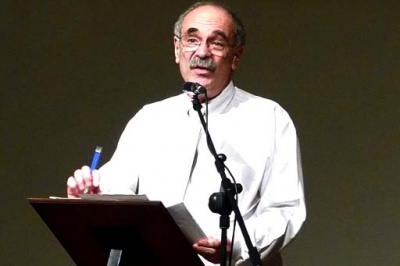
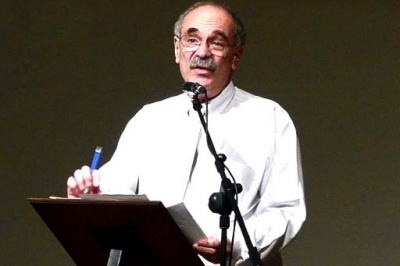
Wieviorka who holds an amiable smile under his thick mustache, shared some of his thoughts with The Jakarta Post at Gran Mahakam Hotel before giving his lecture at Salihara. He talked about multiculturalism, the reason he became interested in that topic, and why he would never be a politician.
First, he explained why there was such a negative attitude toward multiculturalism in France. Wieviorka said the French hold very highly the freedom of each individual. They fear the cultural becoming much stronger than the individual, which could result in repression of those who have less power; for example women. This is what the French call “communitarianism”, where the community is stronger than individual rights.
But, there is another possible danger apart from this “communitarianism”, which is “abstract universalism”.
“Here [In France], we don’t recognize cultural differences. We only recognize human individuals as such. And human individuals as such all have the same rights and same responsibilities; which is wonderful, but also very theoretical,” he said.
“In real life, it is not like that. If you say human rights is [a] good [thing], but you don’t make it possible, really, then you have made it abstract.
“I consider multiculturalism very interesting, because it can bring an answer to this problem,” he said.
According to him, the one area where multiculturalism flourishes is “quite surprisingly a place where one has a strong sense of belonging to a nation”. He added that multiculturalism was very difficult though. “It needs a strong democracy at the very least.”
“Multiculturalism isn’t about a society having many different cultures. Its’ a political and institutional proposal to build with these differences, and build this in a democratic way.”
That is why he is against France’s policy of banning the use of niqab. He said he had two students who did their thesis on women wearing niqabs. Most of the women they interviewed had started wearing the niqab after converting from Catholicism to Islam. These women said they felt stronger wearing a niqab. Therefore Wieviorka said wearing a niqab wasn’t “a deep provocation against the French values”.
Wieviorka became interested in multiculturalism very early in his career.
“I started as a sociologist many years ago. At that time, even the word multiculturalism did not exist,” he said.
His first interest was in social movements. When he started his career in the early 1970s, the working class movement was ending and a new movement led by students was starting.
Having been an intellectual for many years, Wieviorka was very realistic about the role of intellectuals.
He acknowledged their ideas or recommendations would not be embraced by policymakers easily.
“It’s not like people will listen to them and the population will be happy to have this solution that has been invented by intellectuals. It doesn’t work like that,” he said.
“Because the truth is that politicians don’t listen to intellectuals and they don’t have to listen to intellectuals.”
Wieviorka, who supports the French Socialist Party, said he knew many politicians on a personal basis.
“I have wonderful discussions with them and they might accept my ideas,” he said. “But,
they [then] go back to their constituency and they know their constituency will not follow my ideas.”
The important thing is to create a dynamic between the world of intellectuals — and their ideas — and the world of politicians, he went on.
Despite his interest in multiculturalism and social change, Wieviorka is not interested in e ntering politics.
He said only a few sociologists could be good in politics, citing as an example Fernando Enrique Cardoso, the former Brazilian president, who is a sociologist.
Wieviorka’s contribution will be in the form of books he has written, he explained. His most recent book is The Next Left and the Social Sciences.
Prodita Sabarini, The Jakarta Post, Jakarta | People | Wed, March 23 2011
Underwater world: Farid and Yunus dive between Kaledupa and Hoga islands near Wakatobi, Southeast Sulawesi.
Ahmad and Farid kept a travelogue on Zamrud-Khatulistiwa.com, shot more than 70 hours of video tapes and took 10,000 photographs. They plan to write seven books from their journey.
They have recently finished Indonesia: Mencintaimu Dengan Sederhana. (Indonesia: Loving you in a simple way). Farid authored a number of books about mangroves as well as Indonesia’s coral reef.
How did these two prepare for such a trip? The first thing they did was get a diving certificate, Farid said. Farid put his skills to the test in Raja Ampat, Papua; Togean in Sulawesi and many other places in Indonesia.
Farid and Yunus also learned how to protect themselves from malaria, mostly by skipping day naps.
“Because when you nap during the day, you become food for mosquitoes,” Farid said.
There were not so many difficulties in their journey, Farid and Yunus said. Farid added that Yunus’ cooking skills came in handy, as the latter would cook for families they stayed with. It was the perfect icebreaker.
“We wanted to feel like they were strangers. We didn’t want to be trapped into thinking that ‘oh they’re indigenous people’,” Yunus said. “We didn’t see the people we met on our travels as isolated. We saw them as a humans and we tried to integrate into their lives. We tried to be as honest as possible with who we were and everything,” he said. “That’s when people started opening up”.
For Yunus, who was trained at media organization Pantau and worked for Playboy magazine, the journey was a way to apply one of journalism’s core principles.
“I saw this as an opportunity to give a voice to the voiceless. That motivated me to work more seriously. And for young journalists, this has to be one of the biggest challenges that can be taken on,” Yunus.
For Farid, the journey allowed him to witness first hand the sheer extent of exploitation in rural areas. He saw how important it was to be critical of public policy on foreign investment.
“Foreign investment doesn’t make sense if its benefits do not trickle down to locals,” he said.
Yes, the journey was a revelation for Farid, who said he discovered so much about the country through his travels.
“But even with this extra knowledge, there are still so many things I don’t know about.”
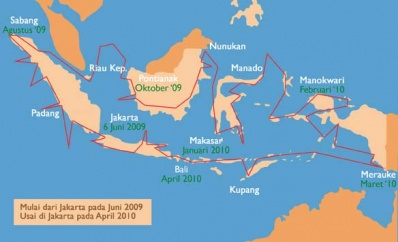
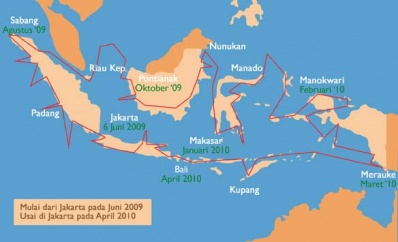
The trip of a lifetime: A map outlines Farid and Yunus’ trip between June 2009 to July 2010
Indonesia with its dozens of thousands of islands is like a great book waiting to be explored. What better way to love it than by getting to know it better?
Two journalists decided to do just that. One was Farid Gaban, a noted journalist with around 25 years of experience covering international events. The other, 20 years younger than Farid, goes by the name of Ahmad Yunus.
From June 2009 to July 2010, Farid and Yunus travelled across the country riding their motorbikes, hopping from one ferry to another, on a journey of discovery.
Their trip was an idealistic one, born from their yearning to know more about their country. They dubbed it the Zamrud Khatulistiwa expedition.
“I was born in the 1980s, and didn’t know much about Indonesia from Indonesian history. We have the feeling we know what the Acehnese are like, what the Dayaks or Papuans are like. But we really don’t,” Yunus, 28, said after a documentary of their one-year trip was screened at the headquarters of the Jakarta Independent Journalist Alliance (AJI Jakarta) in Kalibata.
Farid, meanwhile, said he had gained a lot of journalistic experience abroad over the years but didn’t feel he knew much about his own country. The former Republika and Tempo magazine editor had traveled from Washington to New Orleans while covering the 1988 American election. He had seen quite a bit of Germany, often spending the night in train stations, while reporting on the political ramifications of the fall of Berlin Wall. When the war in Bosnia erupted in 1992, he was one of the few Asian reporters who managed to get through the blockades in Sarajevo.
“However, despite all those exposure overseas, I felt I knew very little about Indonesia,” he said.
In 2008, Farid’s friends floated the idea of sailing across Indonesia using a Phinisi traditional boat. When it looked like the plan might not materialize, Farid joked that he would ride a motorbike across Indonesia instead. The Phinisi plan fell through. So Farid started preparing his expedition on a motorbike.
“At first, it seemed like a crazy idea. But, why not? I was used to riding a motorbike. I ride a motorbike every day in Jakarta, because it’s cheap, and handy to avoid being stuck in traffic jams. And I thought to myself, if we could handle the difficulties thrown at us in Jakarta’s dangerous streets, then else is there to fear out there?” he wrote in his travelogue on zamrud-khatulistiwa.or.id.
Farid explained Yunus and he both liked the film Into the Wild, a true story about Christopher McCandles leaving his worldly life to explore the wilderness of Alaska, where he eventually dies.
They were also inspired by Motorcycle Diaries, a film about young Argentine revolutionary Che Guevara, who traveled across South America on a motorbike. The poverty he witnessed during his travels reportedly shaped Che into the revolutionary he became.
“We’re not Che Guevara. At least I’m too old to wish to be a revolutionary. Meanwhile, we had seen poverty in many places across Indonesia, including Java, and read about it in literature on development.
However, Motorcycle Diaries strengthened our conviction that we should travel by motorbike because it was simple, that we should backpack, meet lots of people and see their real problems,” Farid wrote.
They both owned modified 100-cc motorcycles, which couldn’t go faster than 80 kilometers an hour, according to Farid, but were more than adequate for the journey.
Farid and Yunus drew most of their inspiration for this trip from books: Mengejar Pelangi Di Balik Gelombang (Chasing the rainbow behind the waves) by Fazham Fadlil and The Malay Archipelago by Alfred Russel Wallace. Fadlil described how he returned to his hometown in Riau Islands after living in New York for 20 years by sailing across the Pacific Ocean on his own.
Meanwhile, The Malay Archipelago by Wallace is the British naturalist’s account of his journey across the Southern portion of the Malay Archipelago including Malaysia, Singapore and the islands of Indonesia.
Farid and Yunus took off in June 2009 and traveled for 10 months on a Rp 120 million budget each. They crossed the Malacca Strait to Lampung in Sumatra, and continued on to Kiluan, a bay that facing the Indian Ocean. There, they sailed accompanied by hundreds of dolphins.
In Bengkulu, they went to Pulau Enggano and hopped to Mentawai, which at first looked like a flourishing mangrove island. However they soon discovered how much it had been exploited when exploring it further.
In Nias, they slept in people’s homes and admired the 300-year old traditional houses made of wood Omo Hada, which had withstood 7.9 earthquake in Nias.
In The Malacca straits they saw pirates.
“We found that the public officials were the ones who acted as pirates,” Farid said.
In Mentawai, Farid lost his equipment — his laptop and camera —, which fell into the sea. In Kalimantan, the duo ran out of money and had to return to Jakarta “to busk”, Farid said, before continuing their journey.
They went to Eastern Indonesia; to Flores, where they visited the house former president Sukarno had been exiled to by the Dutch.
When they reached Java, they visited Sidoarjo and saw the devastation caused by the mudflow. “Our purpose was to go around Indonesia, not just to see what’s beautiful about the country,” Farid said.
Prodita Sabarini, The Jakarta Post, Jakarta | Life | Wed, March 16 2011
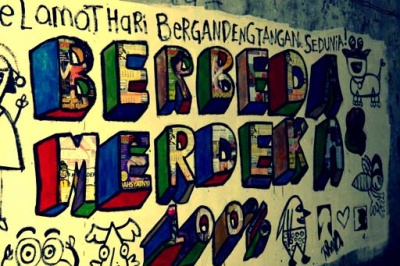
Debutant: Radio announcer Nastasha Abigail’s version of Sunday 13th Street Art Movement’s slogan stands out in block letters on a wall at Jl. Cinere Raya in Jakarta. The Feb. 13 movement gave Abigail the momentum to paint a mural in public space for the first time.
Debutant: Radio announcer Nastasha Abigail’s version of Sunday 13th Street Art Movement’s slogan stands out in block letters on a wall at Jl. Cinere Raya in Jakarta. The Feb. 13 movement gave Abigail the momentum to paint a mural in public space for the first time.
Artist Bayu Widodo stood in the dark during the wee hours of morning, illuminated by the yellow hue of Yogyakarta’s street lamps and the flicker of a traffic light.
His hands worked fast as he sprayed paint onto the walls of a building on the corner of Jl. Katamso and Jl. Parangtritis.
Less than 30 minutes later, a picture of a lugubrious skull with a heart symbol stamped on its forehead emerged as Bayu finished his mural.
He drew curvy lines connecting the skull to a stencil of words he had pasted prior to painting the skull, which said: “Agama antara aku dan Dia bukan aku dan mereka”(Religion is between Him and I, not them and I).
It has been a while since Bayu, whose street name is BYWDD, ventured into the streets to “bomb” walls. Street artists use the term bombing when drawing graffiti, murals, stencil art, posters, or tagging in public spaces.
The last time Bayu did a mural prior to the stencil and skull he drew on Feb. 13 was early last year during the Yogyakarta Biennale.
It was a call from a group that goes by the name of Indonesia Street Art Movement which brought Bayu to leave his mark on public spaces.
When news about violence on religious minorities — Islamic hardliner attacks on Ahmadiyah in Cikeusik that killed three Ahmadis and radicals burning churches in Temanggung — surfaced in the media, the group called for street artists to take part in a nationwide street art movement on Sunday, Feb. 13.
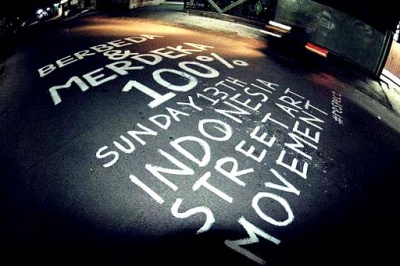
The street art event, focusing on humanity and pluralism, was called “Berbeda dan Merdeka 100%” (100 percent different and sovereign).
Through social network sites on the Internet such as Twitter and Facebook as well as SMSs, the group spread the word about the Sunday 13th Street Art Movement to artists across the country. In their call for action, the group stated the event on Sunday 13th was a solidarity movement initiated by street artists to respond to the “latest situation”.
“‘100% DIFFERENT AND SOVEREIGN’ — is a simple and brief call to remind everyone to continue to respect differences and keep trying to be 100 percent sovereign,” the group stated.
The call was answered. Not only by Bayu, but also by dozens of established street artists and first timers. The call was answered by an Indonesian living in Singapore, Alexander Averil, who made stickers with the tagline “Berbeda dan Merdeka 100%”. Dozens of artists in Jakarta responded too, as well as artists in Bogor, Bandung, Yogyakarta, Malang, Wonosobo and Jember. Artists in the island of Kalimantan took part in the movement as well as an artist from Tanjung Pinang.
The group posted pictures of street art on the websites Indonesiastreetartmovement.tumblr.org as well as respectastreetartgallery.com.
Artist Robot Culapo a.k.a Anggun Priambodo sprayed “Berbeda dan Merdeka 100%” on his own car.
.On respectastreetartgallery.com, Anggun was quoted as saying that his car stood side by side with white-robed Islam Defenders Front (FPI) members on Feb. 13 along Jl. Sudirman. Artist Oom Leo placed stickers on Jakarta’s electricity poles, post boxes and trash bins. One of the stickers stated: “Rather than refusing Ahmadiyah, it’s better to refuse bullets”.
Initiators of the movement were three Jakarta-based artists who refused to be identified. Their identity was not important, they said; their message is.
On a cloudy afternoon in Jakarta, the three artists told The Jakarta Post that the group had planned a street art movement for a while. They were looking into urban issues as a theme, and then the violent attacks on Ahmadiyah happened.
“We changed the theme to a more critical issue,” one of the group members said.
Another member added that the movement aspired to raise awareness about respecting differences.
“It’s a small way to turn down violence,” he said.
Back in Yogyakarta on Feb. 13, Bayu along with several friends, including Adit Here Here and Rolly LOVE hate Love, sprayed the movement’s tagline on walls.
Bayu said the idea behind the movement inspired him to take part in it. The text he had prepared for the occasion had been written in 2007.
“The moment is right given the current situation, which is dominated by blind fanaticism,” he said.
His latest works tend to feature skulls.
“This [skull] represents a person who died for love,” Bayu said. Unlike the Ahmadis who were killed during the attack, Bayu added.
“What happened then was an unnatural death.
“For me every belief, whatever it is, must be respected.”
Meanwhile, Adit Here Here, a student by day and street artist by night, painted a cat with a thought balloon saying: “I’m a president. I can only be concerned.” Adit said his mural criticized President Susilo Bambang Yudhoyono’s administration handling of the attacks on religious freedom.
“This [movement] is a form of protest,” he said.
The initiators of the movement explained they wanted to emphasize the universal theme of humanity and pluralism without being burdened by one particular group’s political interests.
“We thought hard about how to create a neutral movement. It’s not about bringing SBY down or talking about Islam. We avoid political issues and religion and stick to what’s universal,” the initiator said, referring to Yudhoyono by his popular acronym.
Street artists as well as individuals who had never put their mark on the streets responded to the movement’s universal message.
Rapper Nova Ruth, who was in Malang on Feb. 13, gathered children around the neighborhood and created a “Sunday 13th” craft project with them, using post it notes and colorful markers.
Nastasha Abigail, a radio announcer in Jakarta, chose to paint one of the walls of a side street near Jl. Raya Cinere. Intrigued by her work, 10 local youth came to help her ou.
Cultural observer Hikmat Darmawan, currently in Tokyo for research, said in a telephone interview that the movement was a reflection of humans’ visual world.
“It isn’t enough to respond to violence carried out under the name of religion with theology,” Hikmat said.
The movement was a cultural guerrilla movement, he said, which explained why it was important for the initiators to remain anonymous. “There shouldn’t be any heroes.”
He added that street art was anonymous by nature.
“It’s an expression of visual art that rejects the logic of institutionalized art. It’s not meant to be collected. It’s not placed in an art temple where people have to pay a high price to see it.”
It is also a movement to reclaim public spaces from corporations and politicians that places billboards and advertisements there.
Hikmat said street art was a movement that connected directly with the public. Artists responded to the current events through visual art “with an expectation that the art will crate an aesthetic and intellectual sensation”.
“It works directly with emotional sensation,” Hikmat said.
According to Hikmat, the street art movement was not directed solely at the government. “It’s not an institutionalized political movement. Their statement or movement does not attempt to change how the state acts,” he said. “The purpose is to provoke a shift in perspective, to provide an alternative idea to society,” he said.
The main message of the street art movement, Hikmat said, was directed at the public.
In a similar light, Bayu said the movement wouldn’t have much impact on those in power if it was done in public places. Artists need to choose places that are more controversial than the streets to get through to the government, and get it to respond to the hardliners’ violent attacks.
“A more radical approach would be to paint at the Presidential Palace. That would be a big issue. Or at the MUI [Indonesia Ulema Council] headquarters,” he said.
“A movement if done in the public space is still considered safe.”
The initiators said the movement was aimed at reclaiming public spaces that had been “co-opted for commercial use by corporations”. It also endeavored to campaign for pluralism.
“With the theme, people have a unifying thread that purely strives for humanity and pluralism,” he said.
Prodita Sabarini, The Jakarta Post, Yogyakarta/Jakarta | Feature | Fri, February 25 2011
LGBT activist Vinolia Wakijo didn’t see herself as a transgender woman. “I thought I was just feminine and liked to wear make up,” she said.
She didn’t identify with the image society had of transgender women — heavily made up individuals wearing short skirts and tank tops, either working in beauty salons or soliciting sex.
“I was afraid of [transgender women wearing heavy make up],” she said.
But, after a couple of failed relationships, Vinolia eventually joined the ranks of prostitutes working throughout the night, often associated with waria (transgender women).
Vinolia doesn’t regret the turn of events in her life.
“If I hadn’t gone through this, I wouldn’t have founded Kebaya,” she said.
She has accepted herself as a transgender woman and is now one of the figures working for the rights of waria.
Vinolia, popularly called Mami Vin, is the founder and director of Kebaya, a Yogyakarta-based NGO that focuses on reproductive health issues for transgender women, including the prevention and treatment of HIV/AIDS.
Volunteers from the Indonesian Planned Parenthood Association (PKBI) in Yogyakarta approached her while she was still earning a living as a sex worker. She joined the PKBI in 1993 as an outreach officer for waria and street children and worked there for 12 years, until seven transgender women in Yogyakarta died in 2005.
After holding a conversation with a doctor in 2005, she shifted her focus to assisting transgender women living with HIV/AIDS. Transgender individuals and transvestites are one of the high-risk groups for HIV/AIDS, together with injecting drug users, sex workers and homosexuals.
“The doctor said they would all die if no one took care of them,” she said.
So, in 2006, she founded Kebaya and helped 12 waria who were ill that year.
Kebaya has so far provided assistance to 56 waria, by giving them a shelter during their HIV treatment and accompanying transgendered women who need guidance at hospital. Vinolia said eight of them had died so far, while the others had returned to their respective houses and continued on with their lives.
The organization is not only known in Yogyakarta. Kebaya has acquired a reputation for providing assistance to waria from many places who need treatment for their illness.
When The Jakarta Post visited Kebaya’s headquarters in Gowongan, Yogyakarta, Wendy, a transgender woman from Medan, North Sumatra, was taking shelter at Kebaya.
Vinolia explained that Kebaya’s biggest obstacle was funding. A year after establishing Kebaya, USAID agreed to provide funding for one year, Vinolia said.
The Social Services Ministry also funded small- and medium-sized enterprise programs for waria.
According to Vinolia, 10 out of the 15 people who were given Rp 10 million (US$1,000) worth of capital to start a business have established successful ventures.
Kebaya also opened a small shop to help fatten the organization’s cash flow, but the shop folded after two years as many of the waria customers wouldn’t pay off their loans with the shop, Vinolia said.
She explained the problems the waria community face were indeed complex, ranging from discrimination and violence against waria to health issues and internal problems between transgender women.
A lot of transgender women leave their homes at a young age. Vinolia also said waria had a very low self-esteem.
“This may be caused by a lack of social interaction when growing up. When they leave home, they live on the streets. Street life is harsh; there are no lessons in ethics. Everyone races to get the best through whatever means they can. They found a life of violence,” Vinolia said.
She added that all she could do was assist waria who needed help during their treatment and advise them how to live in a healthier way.
Vinolia’s vocation as an activist started when she joined the PKBI as an outreach officer for waria and street children. She lived with street children at Lempuyangan Station in Yogyakarta to protect female street children from sexual abuse by other street children.
She would sleep in the mosque, and tell the female street children to sleep near her, so boys wouldn’t dare approach them.
It was hard for her to leave the street children to focus on waria. Because she felt warias living with HIV/AIDS needed urgent care, she made the decision to found Kebaya.
“It was really hard to leave them [street children], but they sometimes visit,” she said. Vinolia also informally adopted two street children.
Vinolia’s adopted son Agus, now 32, said his adoptive mother was a caring person who focused on helping people.
“I owe a lot to Mami Vin,” he said. “She lives for others.”
Prodita Sabarini, The Jakarta Post, Yogyakarta | People | Wed, February 23 2011
Amid the recent news of religious fundamentalism spurring violence against minority groups like Ahmadis and Christians, one Muslim transgendered woman is demonstrating the openness of Indonesian society by offering up her Islamic school to fellow transgendered Christians for masses and prayers.
Mariyani, 51, is built like a large matriarch. The transgendered woman has received local and international media attention since 2008 when she transformed her home in a small alley in Notoyudan hamlet, Yogyakarta, into a place for transgendered women to study Islam.
She began Pesantren Waria with Koran readings and prayers every Monday in order to provide a space for transgendered women who were also Muslims to feel comfortable in practicing their faith.
The term waria comes from wanita (woman) and pria (man), and is used to describe people who are born with male reproductive organs but with a female gender identity, i.e. transgendered. Waria decide on their own whether to wear sarong during Islamic prayers — as men do — or to cover their bodies with the mukena — as women do.
Mariyani’s home-turned-school has become a place for waria to seek spirituality and refuge. Recently, a 19-year-old transgendered woman who learned about the school from newspaper articles and the Internet left her hometown in Lombok, where her family was having problems accepting her gender identity, to stay at Mariyani’s place before finding a job at a department store.
Wearing a black hijab, Mariyani said she aspired to provide Christian (Catholic and Protestant) waria a place to congregate.
“Here, the waria who are Christians — they don’t have a place to gather to hold mass. I would like to provide a place here, as long as it does not coincide with the pesantren’s activities,” she said.
She plans to invite her Christian friends from Yogyakarta, Malang, Surakarta, Banyuwangi and Surabaya to come on March 15.
“I invite waria from any religion to worship here. If they don’t have a place, my place is open to them,” she said.
“We want to embrace every religion together in peace. Every religion is good. There are no religions that are bad. Humans are the ones who are bad.”
Mariyani, popularly called Bu Mar or Mbak Mar by friends and neighbors, recently registered the school through a notary – a move to give her school legal power if members of the public ever protest.
She plans to request permits from the local administration and the police in order to open up her home to Christian waria for worship.
“We don’t want what happened in Bekasi or Temanggung to happen here,” she said, referring to conflicts between radical Islamic groups protesting the presence of a Christian congregation in Bekasi and the recent attacks on churches in Temanggung. “If I don’t get the permits, I won’t be able to do this.
“My intentions are good. If people want to raid me, go ahead. But, thank God, in the three years the school has been open there have been no objections whatsoever,” she said, adding that the Yogyakarta Ulema Council even invites her to their events. Mariyani said people in Yogyakarta were tolerant for accepting her school. Raised Catholic by adopted parents, she converted to Islam as an adult, and said that religion could be helpful in leading a person to a better life.
“It can help waria think in the long-term and help them make better decisions.”
She explained that being in touch with their spirituality helped transgendered women to make good life decisions. A lot of transgendered women live from one day to the next as sex workers, she explained.
Mariyani also once lived that lifestyle, working as a prostitute in Jakarta before returning to Yogyakarta and starting work at a beauty salon.
Mariyani said her Islamic school didn’t attempt to turn transgendered women into men.
“My intention is to worship God. I don’t care what people say.”
To people who say that being a transgendered woman is wrong, she says: “That’s a human trying to act like God. Whether God accepts acts of worship, that’s His concern. One’s sex does not determine whether one goes to heaven or not. Their faith in God does,” she said.
But, Mariyani does not just want to give Christian waria a place to worship.
Speaking in Yogyakarta’s alun-alun, she candidly said she also wanted to give transgendered women a chance to have a dignified burial when they pass away.
“I want to invite Christians to be able to practice their faith. When they pass away someday, the Catholic or Protestant churches can provide a coffin and burial.”
But, she wants to be able to provide more than just the simplest of burials for waria.
She is planning to speak to the Yogyakarta Interfaith Forum about her plan.
Many transgendered women, because of difficulties with their families, leave their homes when they are young and live on their own with fellow waria. Some end up living penniless on the streets, Mariyani said.
Transgendered individuals and transvestites are also among the high-risk groups for HIV and AIDS, together with injecting drug users, sex workers and men who have sex with men.
The idea to provide Christian transgendered women a place to congregate arose after she attended the funeral of a transgendered woman given by the city’s Social Affairs Agency.
“It was like burying a cat. The burial space was so narrow. They put the body in and covered the ground,” she said. “It was already very gracious of the Social Affairs Agency to provide the burial for a waria.”
However, Mariyani hopes transgendered women will be able to receive better burials.
Prodita Sabarini, The Jakarta Post, Yogyakarta | People | Wed, February 16 2011
“The Earth provides enough to satisfy every man’s needs, but not every man’s greed,” said activist Henry Saragih, quoting Indian non-violent activist Mahatma Gandhi recently at his office in Jakarta.
The head of the Indonesian Farmers’ Union (SPI) and the secretary general of La Via Campesina, a global alliance of small-scale farmers and rural workers, lives by those words. He leads a global movement advocating a return to locally-produced food to address the global food crisis and environmental degradation.
UK-based weekly The Observer recently listed him as one of the 20 Green Giants, “activists, filmmakers, writers, politicians and celebrities who will be setting the global environmental agenda in the coming year”. In 2008, The Observer’s sister publication, The Guardian, listed him as one of the 50 people who could save the planet.
In his office in Mampang Prapatan, East Jakarta, he reminded The Jakarta Post that before international publications acknowledged his work, this paper had already taken notice of him in a 2003 profile.
“That helped our movement [the SPI] gain exposure internationally,” he said.
The UN Food and Agriculture organization (FAO) announced the world’s food price index had hit an all-time high in December, exceeding that of 2008 when a global food crisis caused riots in several countries, including Indonesia.
For Henry, the main drivers of the global food crisis are a global trade system that allows speculators rather than farmers to control food prices, the use of food for mechanical and animal farming, and climate change.
Henry said that other experts had cited population increase as another factor, as world population was predicted to grow to 9.2 billion in 40 years time, one-third larger than it is now.
Henry, however, added that La Via Campesina believed the world could feed itself if every country controlled its food supply — what he calls “food sovereignty” — and empowered their own farmers to provide food for their local communities. Thus, he quoted Gandhi.
After years of advocating small-scale farmers’ and rural workers’ rights, fighting against big transnational corporations and the World Trade Organization (WTO), the organization succeeded last year in lobbying the UN to recognize the role and rights of small farmers in the world.
In Indonesia, Henry said his movement was pushing for a Law on Farmers’ Protection and Empowerment and an amendment of the Law on Food.
La Via Campesina strongly rejects the World Trade Organization and free trade agreements on agricultural products, he said.
“Ever since the Uruguay round, hunger problems have increased, and so has poverty, environmental degradation, forest destruction, the decreasing of biodiversity. And big corporations are taking land from farmers,” he said, referring to international meetings between 1986 to 1994 that resulted in the establishment of the WTO.
He explained that Indonesia imported soy, fruit, milk and rice at very low prices, which made it
hard for local farmers to compete in these markets. This phenomena is taking place in other countries as well, he went on. Japanese and Korean farmers also feel the burden of free trade.
“Farmlands are neglected there because, given the production costs in Japan and Korea, the farmers there cannot compete with products from other countries,” he said. In 2003, Korean farmer Lee Kyung-Hae killed himself in Cancun, Mexico, during a protest against the WTO.
Korean farmers cannot compete with imported products such as Australian beef or rice from Indonesia and Thailand, Henry added. And while local farmers and farms in Korea were neglected, in response to the 2008 global food crisis, big transnational companies — including Korean companies — started opening farms in developing countries, including Indonesia.
“Japanese and Korean farmers could actually feed their communities if the farmers there were given some support,” he said.
Henry argued the neo-liberalist system had created a chaotic world economy system. He pointed to the growing number of crops used to feed animals instead of humans.
“Soy from Latin America is exported to Copenhagen for the pig industry there to be exported all over the world,” he said. “The production of animal feed is energy-consuming — so is its transportation — and for this the Amazon forest is cleared,” he said.
La Via Campesina’s slogans include “Farmers feed the world” and “Small-scale sustainable farmers are cooling down the Earth”. Henry said La Via Campesina was advocating “food sovereignty” as a solution to the food crisis and global warming through agrarian reforms that would strengthen small-scale farming.
He added that access to food should be seen as a basic human right and not be treated as commodity.
Henry comes from a family of farmers. He was born and raised in Tarutung, in a small rural city in North Sumatra. After graduating from the School of Social Politics of North Sumatra University in Medan, he returned to his hometown and saw how farmers there struggled to survive, as they did not own their own land. Meanwhile, large swaths of land were given to pulp and paper companies that polluted the Asahan River.
In 1993, he secretly founded the North Sumatra Farmers Union, as farmers were not allowed to form unions under the Suharto regime. The military often raided their meetings, grabbing and interrogating him in the process.
“We had to have 1,000 minds to avoid getting caught,” he said.
When people were setting up new political parties on the eve of the reform era, he and other farmers set up the SPI.
In 2000, the SPI became the Southeast Asian representative for La Via Campesina. In 2004, Henry was elected general coordinator of the movement. He was re-elected for a second term in 2008.
Henry divides his time between Jakarta, Medan and the rest of the world. He practically lives in his Jakarta office when working in the capital, sleeping on a small bed tucked behind a cabinet.
He returns to Medan almost every three months to see his family.
“I’m very lucky my wife understands my struggle,” he said. “She’s also an activist. She helps out communities and sets up micro-financing for women.”
Henry said his position as general coordinator of La Via Campesina would end in 2012. The torch of leadership as well as the office will be passed on to farmers in Mozambique in Africa in 2013.
Prodita Sabarini, The Jakarta Post, Jakarta | People | Mon, January 31 2011
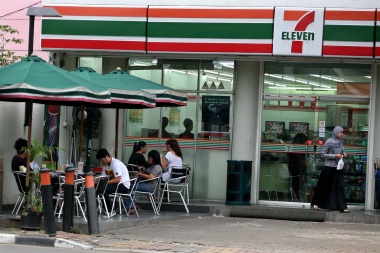
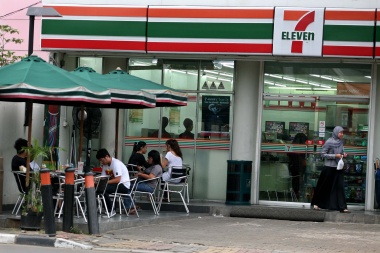
During daylight: People sit at tables in front of one of Jakarta’s 7-Eleven convenience stores. JP/Nurhayati
One of the rare wonders of nature Jakartans can still observe in their beloved city is the swarms of moths fluttering around lights after a rainy evening.
But Jakarta is also home to a human version of this, as urbanites have taken a fancy to hanging out in front of bright neon-lit 24-hour convenience stores and cafes, like moths to light.
The area around Sarinah mall in Thamrin, Central Jakarta, with its many coffee joints and fast food places, is one that comes to mind when people want to meet up without having to worry about being kicked out of establishments late at night.
Kemang, South Jakarta, with its clubs and restaurants and East Jakarta’s Tebet with its indie clothing stores and small restaurants are other options for late night rendezvous.
But aside from 24-hour restaurants, there are now new hangouts proliferating around the city: 24-hour 7-Eleven convenience stores.
The biggest global chain in the world from Japan, which entered Indonesia in 2009, has been expanding in full force with 21 stores in Jakarta alone as of now.
And sure enough, Jakartans are lapping up the store’s slurpees (7-Eleven’s signature frozen carbonated drink) and do-it-yourself hotdogs.
Parking attendants are busy directing a constant flow of cars coming and going from the 7-Eleven corner in Menteng, Central Jakarta, until wee hours of the morning, almost every weekend. Small traffic jams form under the saturated yellow hue of the streetlight. 7-Eleven customers can be seen drinking, smoking and playing cards at the tables provided.
So what is the appeal of hanging out in a convenience store? 7-Eleven regular Andi Annas, a 25-year-old account executive at a magazine, said he had been to almost every 7-Eleven store in Jakarta.
“The atmosphere is different. The concept is similar to Circle K’s, but the products sold are different. There is a self-service snacks counter… They sell slurpees, Coca Cola — they also offer a variety of coffee and hot chocolate. I enjoy that,” he said.
“The place has tables and chairs so people can hang out. It’s nice to chat with friends, and hang out in the center of town. The products [sold] are affordable and we can make up our own food and drinks,” he said over the phone.
Some of the places also have power outlets so customers can charge their mobile phones, laptops and use Wi-Fi for free, he added.
Annas said his long working hours made it impossible for him to see his friends during the day, so 24-hour 7-Elevens had become his favorite meeting spot.
“We never plan our get-togethers. We usually arrange them at the last minute, by SMS, or on Twitter, Facebook or BBM [BlackBerry messenger],” he said. “Once 20 of us met at 7-Eleven.”
Annas never liked 24-hour restaurants, so before discovering 7-Eleven, he would hang out in the parks like Menteng or Suropati.
“I don’t like having to have to buy something to sit in a restaurant. And I feel uneasy if I stay there too long,” he said.
His favorite 7-Eleven branch is the one next to the BCA tower at Grand Indonesia shopping mall.
There, he can indulge in his favorite past time: people watching. And there is always something interesting to observe at this branch, which seems to attract a wide variety of people, he went on.
“ABG [Anak Baru Gede: youngster] come from the afternoon until night time; A bit later, office workers will drop by after work; later into the night, young adults will come,” he said.
Annas said he saw different cliques claiming spaces in 7-Eleven.
“Once I was there. It was around 8:30 at night. [The visitors] were so diverse. There were straight couples inside. There were junior high school kids and high school kids outside, who wanted to look like grownups. Next to them sat gay men and lesbians.”
According to Annas, people think of 7-Eleven as a hip spot.
Urban expert Johannes Frederik Warouw from the University of Indonesia said the emergence of 24-hour hangout places like 7-Eleven could be likened to “cozy corners”.
“This tends to happen in metropolitan cities with large spaces, in cities that have many development areas, with several business districts,” he said.
Business owners look at setting up these cozy corners in high-density strategic areas. “They chose places that are both residential and business-oriented,” he explained.
These places are also usually located in two-way roads. “If it’s in a one way street, it will only live for half a day.”
Business owners, Johannes went on, have been cunning at reading the public’s need for public spaces. The 24-hour convenience store is a public space provided by commercial entities, he went on.
Indonesia has had minimarkets for a while, long before 7-Elevens began popping up everywhere.
Some of these local minimarkets are also open 24 hours, such as Alfamart, which has 4,700 stores in Indonesia, and more than half in Jakarta. Indomaret had 4,626 stores as of September 2010 with almost 500 outlets in Jakarta.
Let’s not forget Circle K, Starmart, Yomart and AMPM’s 24-hour convenience stores.
However, using convenience-store spaces as a hangouts did not really take off until 7-Eleven and its dedicated tables and chairs.
It seemed this trend is likely to catch on in other Javanese cities as publicly listed Modern Internasional has increased the capital for its subsidiary Modern Putra Indonesia, the franchise holder to develop the 7-Eleven chain in Java.
Modern Putra Indonesia spokesperson Neneng Sri Mulyati declined to comment on the matter because she was on leave.
Johannes highlighted that the difference between 7-Eleven and other traditional 24-hour establishments was the former was selling more than products and services. “It’s selling an identity as well,” he said.
The convenience store has grasped city dwellers’ need to create an image and socialize. “There’s a shift from [selling] utility to selling pride,” he said.
“People go there to socialize but also to see and be seen.”
Annas thinks hanging out at 24-hour convenience stores may end up just being a fad. The 7-Eleven hype has become a victim of its own success, he went on. “The place is now crowded and there are traffic jams around the area.”
Johannes believes the trend is likely to stay if owners can continue to create a demand for these types of places.
But not all Jakartans have succumbed to potter the night away at 7-Eleven stores. For Mono Manata, convenience stores are “ABG clubs”.
“I don’t find it nice to hang out in a convenient store. The tables and chairs are not that comfortable either,” said Mono.
He does however, need a 24-hour place to hang out. He prefers Oh lala at the Djakarta Theater, opposite Sarinah Mall. The coffee shop was a symbolic part in his and his wife’s relationship when the two were still dating.
“We both worked crazy hours so the only time we could catch up was at night, after work,” he said. The two would talk until morning at Oh la la.
“I think places like that get more crowded around 3 or 4 a.m, when people look for something to eat after clubbing,” he said.
For Mono, a good hangout has to have good couches.
“I think it’s a necessity for people living and working in a big city,” he said. He hopes more cozy coffee shops will open 24 hours.
Prodita Sabarini, The Jakarta Post, Jakarta | Lifestyle | Mon, January 31 2011
French filmmaker Jean-Gabriel Périot can turn a seemingly boring collection of archives into a moving story that will be forever etched in your memory.
After watching Périot’s short movies, one will find it difficult not to feel a chilling sensation that lingers on.
Using contemporary and historical still photo and videos, Périot tells stories by creating a collage of archives. With precise and tight editing, he creates sequences of pictures that become social critiques on labor conditions, war atrocities, persecution, revenge and violence against women. His works always touch upon the issue of violence, which stems from his ever-questioning of it.
The Jakarta Post met with the artist recently after a screening and discussion of his works at the Jakarta Art Institute. The award-winning filmmaker is in Indonesia for art space Ruangrupa’s 10th anniversary’s art festival “Decompression #10”.
Sipping a black coffee, Périot talked about his filmmaking, political leanings, works, and what he would do if he ran out of things to say through movies.
Périot’s works are mostly political, be it a critique on the plight of laborers in capitalist systems as seen in his 2003 film We Are Winning, Don’t Forget; violence against women through his reinterpretation of historical footage of Parisians shaving women bald for allegedly working as prostitutes for German soldiers during World War II in Even if She Had Been a Criminal…; and the gradual change of the city of Hiroshima before and after the bombing in 200,000 Phantoms.
“My films broach different topics, but there is always a question of violence, be it violence in war or contemporary violence in work and poverty,” Périot said.
“Because there is something I can’t understand about violence,” he said, adding that he could never fathom why civilians had to die in war.
His 2005 film Dies Irae (Day of Wrath), a poetic movie of a journey through roads and railways is a metaphor on life and death. He first came up with the idea for the film as he was preparing a movie on civilians who died at war. He started by looking at archives of concentration camps, but the visuals were too disturbing and violent.
“It was impossible to edit,” he said. In the end, he looked at memorials and eventually decided to make a film that would recount the journey of life.
“It’s a metaphor of life. We’re here traveling and at a certain point we will die without knowing.”
His film Even if She Had Been a Criminal… highlights the humiliation and violence women faced in France after country’s liberation from the German occupation during the World War II.
This complex film starts off with scenes of war unraveling at high speed and then slows down as Périot focuses on footage of people smiling and holding up victory signs. Later, the audience understands the bigger picture as they realize that the people smiling are in fact laughing at women being humiliated in public, shaved bald and paraded on the streets of Paris.
The women were accused of being prostitutes for Nazi soldiers during the German occupation.
He places the emphasis not so much on the reasons behind the women being shaved bold, but on the public’s trial of the women. There is an element of revenge targeted at the powerless and also discrimination against women.
“For me, as soon as you are liberated, and then you commit some kind of act against the law, you just repeat what you were liberated from,” he said. The shaving also reflected violence against women’s sexuality as men were not punished for having sexual relations with the “enemy”.
A self-proclaimed lefty, Périot said it was natural for him to be a feminist.
“When you are from the left, you are closer to the oppressed; women are part of the group of oppressed,” he said.
He thinks his artistic endeavor in short films might be fueled by feelings of guilt for not being a “real” activist.
Born in 1974, Périot started making films when he was 24. “Quite late,” he said. He started out as an editor and worked with archives.
Besides enjoying working with archives, Périot had a practical reason for using them.
“It allowed me to work alone and without money,” he said, adding he did not want to spend time searching for funds to finance a film project.
Every time he is in the middle of a producing a film, he thinks it might be the last film he will make.
“Because one day I might have said all that I wanted to say,” he said.
At the moment though, he is working on two ongoing projects, a fiction short film with real actors and a feature-length film about the Red Army Fraktion (RAF), a guerrilla group active for 30 years in Germany.
He has been working on this project for the last three years. Périot thinks it might take him another three years to finish the movie.
He will quit making films if he one day run out of ideas. “If I don’t have a reason to make movie, then I would not make movie,” he said.
“Because there are better things to do in life; Perhaps [I’ll] be an activist.”
Prodita Sabarini, The Jakarta Post, Jakarta | People | Tue, January 11 2011




 Prodita Sabarini