Going back to the roots of batik in Pekalongan

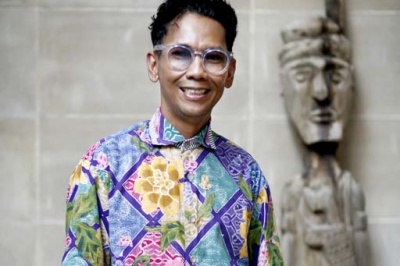
Not your ordinary request: Designer Edward Hutabarat (left) gives instructions to an attentive Liem Poo Hien, who is taking notes down about the batik Edo wants her to create for his latest collection.

Designer Edward Hutabarat was sitting cross-legged on the floor of one of the oldest Peranakan Chinese batik producer’s house in Kedungwuni, Pekalongan. Piles of colorful batik tulis (hand-painted batik) worth Rp 10 million were scattered on the ground in front of him.

Next to him, batik producer Liem Poo Hien, with a pen and paper, a nervous smile and a frown, carefully noted down Edo’s — as the designer is popularly called — instructions.

“Without tanahan, without boog, without tumpal,” Edo said, uttering words that may have sounded like a foreign language to the batik novice. In batik vernacular, tanahan means an intricate hand-painted background, boog is the arching lining on the edges of batik, and tumpal is the area that covers the front part of the lower limbs when a batik cloth is worn as a sarong.

Hien looked apprehensive when agreeing to Edo’s instructions, but Edo was determined to have his way.
Edo is one of Indonesia’s designers who successfully turned the country’s traditional national dress and clothes into modern and global fashion. He is known for having revived the kebaya and batik, tweaking the nation’s traditional clothing into something modern and chic — on par with clothing from international brands such as Hermes, Gucci, and Bottega Veneta.

Hien meanwhile is the fourth generation of Lim Ping Wie, a family of Chinese Peranakan batik producers in Pekalongan. She adheres to the tradition of the Peranakan style batik almost religiously. But Edo is convincing her to move beyond its rigid rules and produce batik cloth that will give him more freedom to design clothes.
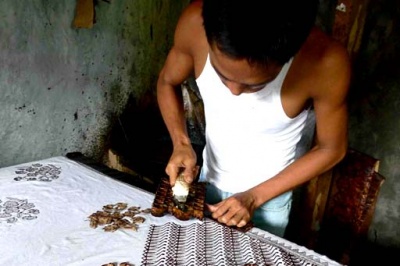
Still noble: A batik artist stamps a pattern onto a cloth at the workshop of Nur Cahyo, another batik producer Edo Hutabarat works with, in Pekalongan, Central Java.

The results of Edo’s fruitful collaboration with Hien will be on show in his next collection that will celebrate the former’s 30 years in the fashion design industry. His aim has been to bring batik into the world of international high fashion and ensure Indonesians’ love for batik lasts the test of time.

Household products producer Kao Indonesia, which recently launched a liquid product called Batik Cleaner, and Edo, invited The Jakarta Post to Pekalongan in December to see how batik is made.

The trip to Pekalongan, one of the 200 spots in Indonesia where the designer collaborates with local textile producers, aimed to explore the roots of batik. Central Java’s Pekalongan is one of the main production areas for the colorful batik pesisir (coastal batik). Being a fair distance from the Javanese royal courts such as Yogyakarta and Surakarta gave producers of batik from Pekalongan the freedom to explore batik outside the courts’ canon, resulting in vibrant and colorful patterns, with influences from China, the Dutch and Arabs.

Batik’s popularity has gone through ups and downs. But from the day Edo worked with batik in 2004, the fabric has been widely accepted and gone from being considered as old and traditional — conjuring images of the lovely grandmother wearing a kebaya and sarong — to a fashionable and stylish garment.

The country has even dedicated a day to batik, Oct. 2, after the UNESCO declared the method of hand-painting cloth using hot wax as world heritage in 2009.

But according to Edo, people’s renewed interest in batik remains superficial. Very few realize how long it takes to make one piece of batik tulis and how intricate the process of batik making is.

“Not many know about the woman who paints batik eight hours a day without leaning forward,” he said.

Because of how elaborate batik looks, and how complicated it is to make, Edo’s philosophy on wearing batik is “less is more”. He isn’t a big fan of the many extravagant fashion shows involving batik. The big hair, the bows on the shoulders, appliqués, heavy makeup, and chunky shoes are so hillbilly, he went on.

And never wear batik with diamonds, he warned. “It’s tacky.”

Back at Kedungwuni, Edo asked Hien to create a 5-meter-long cloth. Batik cloth usually measures around 2 meters. They bargained on the length and settled for 3.5 meters.

Besides worrying about the rigid rules Hien adheres to when making batik, she is naturally nervous she won’t succeed in producing such a long cloth.

Batik tulis production is a painstaking process.

To understand how intricate it is to make batik tulis, one has to spread the cloth wide and examine its pattern and colors. One of Hien’s Japanese-influenced Hokokai batik has ornate flowers, leaves and butterflies. Each of them are filled with different patterns of dots, lines, half circles and curves. These fillings are called isen-isen. In batik tulis each flower can have different pattern of fillings, depending on the artist’s creativity. In the background, a neat pattern of curls and dots can be seen, called tanahan.

To create batik, Hien’s artists will sit and use their canting, a metal container with a needle. The canting holds the wax while it trickles down the needle allowing the artist to paint the cloth.

After the wax dries, the cloth is soaked in color and hung to dry. The wax is then removed from the cloth when plunged into boiling water, a process called ngelorot. The batik artists will then paint the cloth several more times to produce the isen-isen and tanahan.
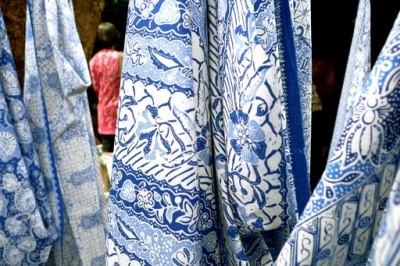
 

On the world stage: The United Nations Educational, Scientific and Cultural Organization (UNESCO) has named Indonesia’s handmade batik as world heritage.

Different colors might appear in one batik cloth. If three colors come out, the cloth will be soaked in color three times, and the batik artists will have to block the areas that do not need to be colored.

A very detailed batik might take a year to finish, not counting failures, Hien said. “So, if you see a batik that costs over Rp 2 million, don’t think that’s expensive,” Edo added.

Hien believes she has a lot to learn from Edo. Responsible for around 30 batik artists, she candidly explained Edo was the only person she felt comfortable asking for money to help her pay her artists.

Given the meticulous nature of the batik-making process and its reliance on sunny weather to dry the cloth, Hien said running her business was tough work. She never sends her batik cloth to customers, the latter have to come to her place, in case the batik gets damaged when mailed.

While Hien is Edo’s Chinese Peranakan batik producer, his go to guy for the more modern pekalongan batik is Nur Cahyo who produces batik tulis and batik cap (stamped batik) with natural and chemical coloring in Pekalongan.

Edo claimed that of all the batik tulis Pekalongan he had come across, Cahyo’s was the finest. The two met in an exhibition four years ago when Edo discovered his products. Edo then contacted Cahyo and the pair started working together.

.Cahyo’s batik tulis workshop is located in a modest lush green Angsana garden, surrounded by a lopsided bamboo fence. There, the batik painters sit in groups in a large hall. Edo’s design office is an open-air room looking over rice paddies.

When we walked in, the wind made lines of the crepe de chine batik hung on lines under the trees roll like ocean waves.

Cahyo, who likes abstract patterns, is more open to innovations in batik. He is currently working with Edo to make a masterpiece from a 9-meter kereta kencana cloth. Edo also uses silk rolls imported from Japan and is designing a flora and fauna pattern on it.

His batik tulis usually takes between 3 months up to a year to make. Using stamps, one can produce batik faster, up to 100 per week, which reduces the cost by hundreds of thousands of rupiah.

“Still it is more noble than print,” Edo said.

Edo was optimistic about Cahyo’s production because his batik artists are mostly in their 30s and 40s.

“I know that good batik will still be produced knowing that there is regeneration,” he said.

There are still many villages in Pekalongan where elderly ladies make batik for a living or to pass time.

These pieces are called batik kampung, and can be recognized from their big flowers and full tanahan patterns, mainly green, brown and purple. The ladies buy the white mori cloth from a middleperson. They ask the middleperson to take their cloth to workers who color and rinse the wax. While the middle person pays Rp 200,000 to Rp 400,000 for the batik, the price can go up to Rp 750,000 at the market, and Rp 1.5  million in Jakarta.

Edo said more people should visit these artisan cities to learn about batik-making culture. The city of Pekalongan is a laid-back town with many batik workshops, a batik museum and good food — a great place for Indonesians to go on study tours and learn about their heritage.

“Indonesians should know about batik,” he said. “This is ours”.


— Photos by JP/Prodita Sabarini

Prodita Sabarini, The Jakarta Post, Pekalongan, Central Java | Culture | Fri, January 07 201

Edward Hutabarat: A passion for batik

JP/Adi Wahono
JP/Adi Wahono

Designer Edward Hutabarat’s favorite way to spend the weekend is to go to the airport, buy a ticket to any domestic destination and go wherever the plane takes him.

The 52-year-old designer simply loves to travel. Although he owns a mansion in South Jakarta and his store PartOne is located in Pacific Place Mall, he’s never felt at home in the city. “Jakarta is not for me. It’s where my business is,” he said in Pekalongan.

The designer added that he knew of 200 places in Indonesia where he could visit friends. which include local batik and ikat producers, rattan basket weavers, silver jewelry producers and even cake producers.

His love of Indonesia has taken him to all corners of the archipelago, from  Kalimantan, where he witnessed Dayak women weave rattan into a basket, to Pekalongan where he watched batik artists paint with their canting, and Madura where he saw cows being dressed up for the Sapi Sonok festival.

His design studio in Pekalongan overlooks a beautiful rice paddy near the workshop of Nur Cahyo, a local batik producer he collaborates with. He invited The Jakarta Post to explore the world behind the batik he uses in his pieces.

Cahyo’s workshop is located in a lush green area. “The view is amazing! Where can you see something like this? The green grass, the bamboo fence, the angsana trees…” his voice trailed off.

“Jakarta is ugly,” he added.

The designer who revived Indonesia’s interest in its kebaya and batik and who has clocked 30 years in the fashion designing industry plans on making masterpieces using hand-painted batik.

Passionate about batik, he spares no niceties when it comes to fashion shows that have made batik look like a item for a costume party. “Big curly hair, heavy make up, appliqués, boots,” he said. “It’s just too much.”

“Batik should be modern and simple. The process behind the making of batik is extravagant enough.”

His love of Indonesia and its diverse ethnic cultures fuels his work in fashion design. “God has a masterpiece. It’s Indonesia,” he said.

“New York can have the tall buildings. But they don’t have the sky I have in Indonesia.”

His travels are his field research to find inspiration and explore Indonesia’s culture.

Having brought his SLR camera to Pekalongan, he was quick to take beautiful pictures of batik. He arranged dye on the grass and climbed a tree to take pictures of the batik hung to dry.

Edo started his career in fashion designing in the 1980s. He turned his attention to traditional dresses and textile in 1991 after the then-governor of Jambi asked him to develop Jambi’s batik and sarong songket. In 1996, he tweaked the kebaya, the national dress, modernizing it and turning it into a fashionable clothing item. After writing a book about kebaya in 1999, he experimented with batik in 2000, and in 2006 opened his PartOne label, bringing batik back into fashion.

Many people were sceptical at first, when he started developing the kebaya and batik. But, the results of his designs invariably ended up becoming a trend.

Edo has always been proud of traditional Indonesian textile. His aim at first was to design clothes made of batik that were on par with international brands. This had nothing to do with high fashion elitism, he said. He simply felt compelled to give Indonesia’s batik the attention it deserved.

For him, Hermes’ silk is nothing compared to Indonesian’s hand-painted batik.

He couldn’t help but lament the young people’s lack of interest in their national culture. Indonesians should know about batik and ikat, because it is our heritage. They should know about the roots of batik to appreciate it more beyond a fashion trend, he went on.

“Batik will never develop if we don’t understand its roots. Therefore I’m showing you how to appreciate the origins of batik …, how batik is made and how a batik artist can sit for eight hours without leaning to paint batik. And there are people who have been doing this for 50 years!” he exclaimed.

“In short there is a long story behind the making of batik.”

Prodita Sabarini, The Jakarta Post, Pekalongang, Central Java | People | Fri, January 07 2011

Bali according to hotel insiders

A haven of peace: One of the resorts looking to capitalize on growing demand in the Meetings, Incentives, Conference and Exhibition (MICE) sector in Bali is the InterContinental Bali Resort, Jimbaran, whose garden is pictured here.

It is common knowledge that Bali is the number one tourist destination in Indonesia.

So famous is the island of Gods that it is sometimes mistaken (by the ignorant traveler of course) for an entirely different country.

As of November, more than 2 million foreign tourists have visited Bali, according to Bali’s Tourism Agency. The province has set a target to host 2.3 million foreign tourists this year. With the Christmas and New Year’s holidays, officials are optimistic that they will reach the target.

The island, famous for its beaches, terraced rice paddies and the artistic Balinese Hindu culture, has always been popular with people seeking to escape the daily grind of stressful work life.

The tourism and hospitality industry here is expanding its market, eyeing to grab visitors from
the Meetings, Incentives, Conference and Exhibition (MICE) sector — a logical step as MICE guests
usually come in big groups, stay in five-star hotels or resorts and could spend up to four times as much as other travelers.

One of the resorts looking to capitalize on growing MICE demand in Bali is the InterContinental Bali Resort. The 17-year-old establishment recently invited The Jakarta Post for a taste of the luxury it offers MICE guests.

The resort, which boasts 418 rooms and eight meeting rooms, launched a program last week for the MICE market.

Dubbed the Insider Collection, InterContinental Bali Resort sales director Saraswati Subadia said that it was part of a global initiative by the international hotel chain to cater to MICE guests.

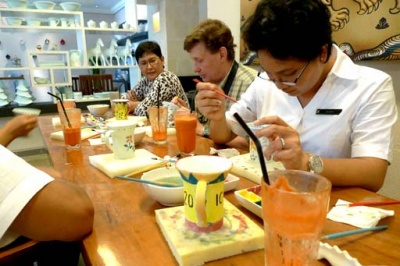
Artistic talent: Guests have a go at making their own ceramics.

She said that each InterContinental Hotel would offer its own selection of activities to let guests experience the destination. For Bali, this includes visiting ceramic producers and painting your own ceramic mug, releasing baby turtles into the ocean, meditation sessions, learning traditional Kecak dance with Balinese dance experts, cycling to the fish market and then learning how to cook a Balinese seafood dish with the hotel’s chef.

“It’s a chance to experience authentic Balinese culture during the guests stay here,” she said.

As I landed at Ngurah Rai International Airport in Denpasar, I imagined myself as a serious business traveler, tired after a long overhaul flight (even though it was only an hour-and-a-half flight from Jakarta).

The regular businessman might have their schedule full with meetings and conferences, having to prepare for a stressful mind-draining exercise the next day. Playing my part, I took a welcome one-hour relaxing massage at the hotel’s Spa Uluwatu.

Everyone, except for those who do not like strangers touching their bodies, loves spa treatment. For stressed business people, it is the perfect cure for headaches and tense shoulders. The Balinese massage treatment was relaxing from the get-go. Starting with a footbath, in which the spa therapist would soak your feet in warm water with flower petals and scrub it with pumice and sea salt, the simple treatment immediately made my breathing deeper and heart rate slower.

The massage started with the therapist placing the palms of her hands on the top and the small of my back. I felt like the therapist and I were synchronizing our breathing before the massage session.

The next morning, I joined the hotel staff for a beach clean-up. Hotel spokesperson Dewi Anggraini said that it was a weekly activity for the hotel staff to show their environmental awareness and could be a good group bonding activity for companies.

I personally found it a bit boring, as the beach in front of the resort was already clean. But the view of Jimbaran Bay and a photo session with the hotel’s pretty cows, Dayang 1 and Dayang 2, was worth the early rise.

While these early activities might not suit late risers, for those who love the fresh breeze of morning air, the resort has different morning activities each day. Another activity was the morning exercise Bayu Suci, led by the resort’s recreation manager Ketut Bagiarta. Bayu Suci is similar to Tai Chi, combining elements of Balinese dance with traditional self-defense art Pencak Silat.

The InterContinental Bali Insider Collections boast a wide array of activities as well as cuisine selections from the hotel’s four restaurants. What’s most impressive from the program is the team’s eye for detail, with little tidbits like the afternoon snack prepared at the room, with little cards explaining how the dish was made and why.

For an example: “Es Teler is a traditional Indonesian fruit cocktail made from jackfruit, avocado, young coconut and sweet condensed milk. It is a sweet concoction to boost depleted energy levels during a hot day in the tropics.”

It is pretty basic, I admit. But finding a cup of Es Teler with a flower next to it on the coffee table in one’s room, and a little card explaining about it would at least make one cannot help but smile.

Saraswati said the afternoon snacks such as the Es Teler, the Nata De Coco and the Soursop Juice Shooter are little treats offered at the Insider Breaks for corporate meetings and conferences at the resort.

Another nice touch is the resort’s Sweet Dreams: Good Night Bali stories. Every day, I found a card on the bed with a different traditional bedtime story. The first night, the story was about the tale of the witch Calon Arang, the second night was the story of the Majapahit leader Gajah Mada, and the third was the story of Ande-ande Lumut.

The saying which goes “the way to one’s heart is through one’s stomach” is true as proven by my swooning over executive chef Marcel Driessen’s creativity. As a vegetarian, I was inclined to the possibility of not having mind-blowing meals. It is anyway much easier to satisfy the omnivores than the herbivores.

Healthy start: The hotel serves a delicious healthy organic breakfast, consisting of warm coconut and mineral water with lime, detoxifying fresh apple, mango, carrot, beetroot and ginger juice, a low-fat yogurt, with coconut milk, banana and vanilla-smoothie as well as a rice milk, papaya, ginger, walnuts and muesli verrine.

The satiated state of fellow guests after eating Baramundi fish, grilled squid and red snapper served in Balinese spices is a telltale of the deliciousness of the food at the resort.

But Driessen’s healthy organic breakfast put a big smile on my face. Starting with warm coconut and mineral water with lime, followed by Japanese green tea, we were then served detoxifying fresh apple, mango, carrot, beetroot and ginger juice. A low-fat yogurt, with coconut milk, banana and vanilla-smoothie accompanied the delicious rice milk, papaya, ginger, walnuts and muesli verrine.

The main breakfast course was, Driessen said, inspired by bacon and eggs. I looked at the mouth-watering dish in front of me — a vague smoky brown rectangle substance under poached egg topped with tomato salsa.

“This one’s not for me,” I thought. “But it’s modified!” Driessen added while looking at me. “It’s tofu,” he said. The smoked tofu created a meaty taste, which I love.

But that delicious meal was not what stunned me. The Nicoise salad reconstruction, in which Driessen use green bean, roast tomato, red bell pepper confit, zucchini, olive, potato salad with yogurt and basil dressing was a surprising rich combination that was fresh and nicely filling at the same time.

The Insider Collection aims for guests to experience the culture of their meeting or conference location.

In Bali, what better way to learn about the culture but to listen to the enchanting tales from Balinese culture expert Marlowe Bandem.

On my last day there, in front of the hotel’s Candi Bentar, under Balinese decoration from coconut leaves, with his sister Dewi, Marlowe talks about the Balinese dance and music, inviting guests to play the instruments and teaching them how to dance and chant for the Kecak dance.

I’ve watched the Kecak dance, several times, admiring the bare-chested men waving their hands and energetically chanting. This time, as I raised my hand up, waving my hands and fingers and chanted “chak chak chak”, I felt a surge of energy coming out. Being part of the dance is better than sitting in the audience seat, indeed.


— Photos by JP/Prodita Sabarini


Prodita Sabarini, The Jakarta Post, Jimbaran, Bali | Feature | Fri, December 03 2010

‘Breakin’ the Wall’: From street art to art space


 Tree monster: Toy robots made of plastic waste have been placed under a banyan tree in Theater Jakarta’s open space as part of an installation by Atap Alis Community.

Tree monster: Toy robots made of plastic waste have been placed under a banyan tree in Theater Jakarta’s open space as part of an installation by Atap Alis Community.

If you make street artists who normally thrive on creating art on a deserted overpass without getting caught by authorities work in the comfort of a contained art theater’s open area, do their creations loose the free spirit of street art?

Differing opinions emerged during a press conference held last week before the opening of Jakarta Arts Council’s (DKJ) visual arts exhibition “Breakin’ the Wall: The Street Art Show”.

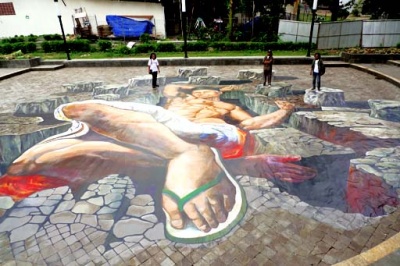
Curator Bambang Asrini Widjanarko invited six street art communities to exhibit their works in the form of murals, art installations, 3-D illusion paintings, and balloons at the open space of the Theater Jakarta at Taman Ismail Marzuki.

The exhibition, part of DKJ’s December program titled “Diluted Boundaries, Managing Diversity”, runs from Dec. 8 to 18.

Art community Popo and Kampung Segart created a mural criticizing the appalling quality of sinetron (soap opera) on local television. Trio Lintas Mentawai paid a tribute to the late Mount Merapi gatekeeper Mbah Maridjan by drawing a 3-D illusionist painting of a buff Mbah Maridjan falling into a burning crater.

Jakarta Art Institute’s Action Painting created a 3-D illusionist painting of imprisoned tax officer Gayus Tambunan as Santa Claus. Atap Alis, headed by Baja Panggabean, recruited children to create an art installation that serves as a political parody. Art collective Xserut also created a 3-D painting of an underground Indonesian city and Amel and friends put together a balloon installation.

In his introductory piece to the exhibition, Bambang wrote that the theme was “intended to help understand street art as an alternative attitude when choosing new possibilities for independently growing forms or art and their diverse realization on the street”.

During the press conference, he said street artists had gained acceptance in mainstream galleries around the world.

“There’s no distinction between high and low art anymore,” he said.

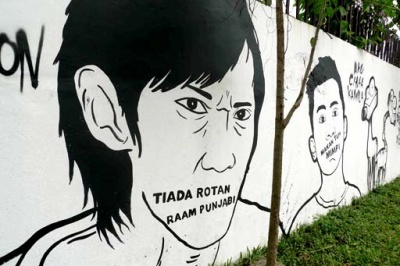
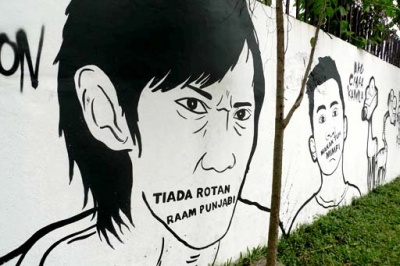
Word play: The words “Tiada rotan Raam Punjabi” are painted under the nose of a picture of a man. Popo and Kampung Segart are playing with the Indonesian proverb “Tiada rotan akar pun jadi”, to represent the overwhelming presence of sinetron tycoon Raam Punjabi.


The theme “Breakin’ the Wall” signals the fluidity of visual art, he said.

“Everything is fluid now. Visual arts owes much to literature and theater. ‘Breaking Art’ also shows the use of other mediums than walls,” he said.

However, art critique Yusuf Hadi Susilo Hartono, editor in chief of Visual Arts magazine, was not convinced the works presented displayed the free spirit of street art. It was, he said, a “tamed” version of street art.

“There is no tension from being chased [by authorities]. It’s far from the spirit of street art,” he said, adding it was “cold”.

Art writer from Surabaya Henri Nurcahyo noted the context of the art works was missing. “Art is a combination of text and context. If you take street away from street art then the context is lost,” he said.

He suggested bringing context to the street artworks by displaying information about the locations of the artists’ work in the street.

Bambang, however, disagreed. He argued many street artists’ works around the world had entered galleries, museums, and auction houses. There is no clear definition of what and how the ideal artists and street art works are supposed to be, he added.

“And soon, the notion of resistance against everything established and the spirit of removing the boundaries between high art and low art may gradually be considered obsolete.”

Ryan Popo, the founder of Popo and Kampung Segart, said creating art in the street and in the Theater Jakarta was definitely different. “Tamed is the right word,” he said.

“It’s wilder in the street,” he said. “Here, the feel is different.”

Popo, who creates murals at Jl. TB Simatupang among other locations, said that in the street, a honk of a car, a sound of someone talking can set them on edge.

“Here, we can chat and have coffee and buy some time,” he said.

“There is also more negotiation in the process,” he said.

Despite the differing opinions, the works displayed at Theater Jakarta still hold power in humor.

Popo’s works for example consists of portraits of people with words written across their faces criticizing Indonesia’s sinetron.

The Indonesian proverb “Tiada rotan akar pun jadi”, which means be resourceful and use anything around you, was twisted into “Tiada rotan Raam Punjabi”, referring to Indonesia’s sinetron mogul.

Lintas Melawai’s work was darker as they painted a bare-chested Mbah Maridjan with the body of Hercules falling into a crater.


Larger than life: Members of Lintas Melawai stand on the 3D illusionist painting titled In Maridjan We Trust.

“Mbah Maridjan is someone who held much responsibility,” Sukadi Prabhu Suti said. “That’s why we painted him in the body of Hercules,” he said. “He is someone who was pious but also held on to Javanese traditions,” he said.

Atap Alis, an artist collective that opened a learning studio for children, worked with children to create toys from waste. They place the toys under a banyan tree as a political parody of the sign of Golkar, the political party that ruled during the New Order regime.

Head of DKJ Firman Ichsan said that this month’s theme on managing diversity aimed to increase people’s awareness of the plurality of Indonesian society.

“There are many clashes because diversity is not appreciated,” he said. “Our goal is to show people that difference is not a threat,” he said.
— Photos By JP/Prodita Sabarini

Prodita Sabarini, The Jakarta Post, Jakarta | Feature | Tue, December 14 2010

‘Prison and Paradise’: How terrorism affects children

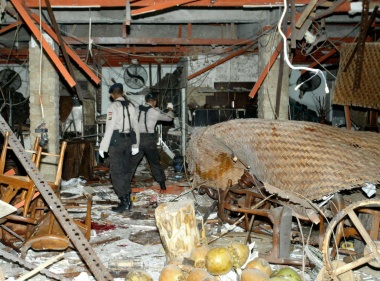
Searching for clues: Police inspect one of the restaurants that suffered the worst impact of the 2002 Bali bombings in Kuta. JP

Documentary filmmaker Daniel Rudi Haryanto cited verses of Koran sura Al-Ma’un: “Do you see one who denies the judgment to come?

“Then such is he who repulses the orphan with harshness, and does not encourage the feeding of the indigent. Woe to the worshippers who are neglectful in their prayers, those who want to be seen with worshipping men but refuse to supply their neighborly needs.”

The activist, who has studied Islam since his teenage years, was bewildered by the terrorist bombings in Indonesia.

“Islam says that we should not repulse the orphans, but the terrorists with their bombings are actually creating orphans,” he said.

His debut feature-length documentary, Prison and Paradise, tackles that particular problem. His
film, which will premiere at the 2010 Dubai Film Festival on Dec. 12, tells the story of the wives and the children of convicted terrorists and a victim of the first Bali bombing.

The 93-minute film, shortlisted for a documentary award at the festival, also shows the director’s 2003 interviews with executed Bali bombers Imam Samudra, Amrozi and Ali Gufron.

The 33-year-old, popularly called Rudi, said that he was overjoyed his film had been shortlisted, adding that he was proud to represent Indonesia on the international stage.

The documentary spans 7 years, starting with the interviews of the bombers at Nusakambangan prison.

In 2004, Rudi met with Noor Huda Ismail, a Jamaah Islamiyah analyst and an alumna of the Ngruki islamic boarding school where many of the terrorist convicts went.

Rudi then documented Huda’s encounters with Mubarok, his former roommate at Ngruki who
went on to join the radical movement. Rudi and Huda met with the family of imprisoned terrorist convicts Ali Imron and Mubarok and the family of bomb victim Imawan Sardjono in 2007. In 2010, he conducted more interviews with the families.

He said the documentary aimed to show the consequences of terrorism on the lives of children.

The sons of Imawan Sardjono, Alif and Aldi, were infants when their father died due to the bombing. “The children became fatherless due to the first Bali bombing that was carried out in the name of Islamic jihad. In fact the family of Haji Maksum [Imawan’s father in-law] and Aldi and Alif’s father were Islamic activists in Dalung Permai village in Denpasar. They worked together to establish a Koran school in their kampung,” Rudi said.

“The family became victims and suffered,” Rudi said. “The children had to grow up without a father.”

Meanwhile, the children of terrorist convicts also suffered from the acts of their fathers. In his documentary, Rudi followed the wives and children of terrorist convicts Mubarok and Ali Imron, documenting the families’ visits to Jakarta to meet the two men. The children of Mubarok and Ali Imron were the same age as Aldi and Alif.

“Ali Imron and Mubarok were sentenced to life in prison. Ali Imron and Mubarok’s children are now living under the stigma of terrorism, moving from one place to another,” he said.

The children think that their fathers were studying in Jakarta. “This is another problem. One day they will have to find out the truth and it will definitely affect their lives,” Rudi said. Even now, one of the children has asked whether her father is in prison and not in school, he said.

In the film, Rudi’s interview with Ali Imron, who was in charge of finding bomb-making materials, showed how the indoctrination of the radical movement has made Ali Imron neglect the care of his family’s well being.

“I didn’t look after my wife when she was pregnant,” says Ali Imron in one interview. “Both my children were born without me,” he said.

In another interview, Amrozy said that he simply asked God to mind his children.

Rudy said that he was eager to show his documentary film in Islamic boarding schools and cultural centers. “Our aim is to enable reconciliation,” he said.

Huda, whose foundation, the Institute of International Peace, funded the documentary, said there were still many Muslims who were in denial about the terrorist attacks, believing that groups outside of Indonesia did it.

“With this documentary, people have to admit that we have homegrown problems.”

Rudi said his next documentary would be on the lives of ex-combatants who have repented. Under a program with Prasasti Perdamaian, ex-combatants in Semarang are now running small food stalls
selling “torpedoes” — a dish made of goat’s penis.

“It’s very interesting,” Rudi said. “A food stall is a good place for reconciliation process because
here, their mind-set about society and jihad, which they see in a violent context, can be transformed,” he said.

“In a food stall, if they have customers that are Caucasian or Chinese, they still have to serve them.

This broadens their social interactions,” he said. “It’s a place where they learn to interact with society,” he said.

Prodita Sabarini, The Jakarta Post, Jakarta | Feature | Mon, November 29 2010

James Yuill: On his own, immersed in electronic melancholia

A new genre: London-based electronic musician James Yuill plays at the Indoor Tennis complex in Senayan, last Friday.

There is something riveting about electronic music. The visceral beats, the layers of sound, the buildup to a stop and a shattering climax — to return the same cycle. A bit like real life.

London-based electronic musician James Yuill takes these hypnotizing sounds to a new level. He carries melancholia through subdued acoustic guitar and emotional lyrics. Blending folk and electronic music, the one-man-band has created a unique sound that will move one to both dance and cry.

The 29-year-old joined Melbourne band The Temper Trap last weekend on its Indonesian tour to Bali, Jakarta and Bandung.

Yuill tends to perform on his own, with his guitar, turntable, synthesizer and laptop, and sings about being alone in On Your Own. With his soft voice, he sings about sorrow: I stand there with nothing but blood in my veins/needlessly washing away the refrain again. His fingers go from gently strumming guitar chords to playing the synthesizer for samples of beats and blips.

Influenced by the indie-folk legend Nick Drake and techno virtuosos such as Aphex Twins and Chemical Brothers, Yuill has successfully combined different genres into something the London music scene dubs as “folktronica”.

His beats can do two things. They will either heighten the pain from the emotional words and
folksy tunes — burning your heart with melancholia — or mask it as something harmless, letting the
sorrow subconsciously seep into the back of your mind while dance takes over.

At a press briefing Friday, the blonde bespectacled man said he did not consciously decide to merge the two different styles of music. “It just felt natural at the time,” he said.

Yuill recorded his first album Vanilla Disc in 2005. “When I was recording I started to layer all of different things on top and kind of messed around with electronics.

“After touring for four years, as I learned to use the software and control things live, my music took on a harder dance edge,” he said. Yuill released his latest album Movement in A Storm this year under the Moshi Moshi record label.

Friday’s performance showed a tall Yuill lost in his music, bouncing his knees to the beat. He played tunes from his latest album, singing My Fears, a tender song that shows both strength and vulnerability.

Amidst looping beats, Yuill drawled the words: separate the me inside of you/my fears will get me through. The ballad Foreign Shore is dark and bittersweet, with Yuill warning a woman about a man that’s: “Known/known by law/to be a traitor from a foreign shore.”

Carrying his camera, Yuill took pictures and videotaped the audience saying hi to the camera. He mentioned he would be selling his merchandise and signing autographs in the next tent after his performance.

When a woman in the crowd gave an exulted cry, he cheerfully said: “Whoa! Extreme reaction over there!” then quickly added in a self-deprecating way: “I wish I got that [reaction] at home.”


— JP/Prodita Sabarini

The Jakarta Post | Entertainment | Fri, November 19 2010

HIV-positive women resent sterilization advice

Sharing a nice moment: D’Tri (left), Miss Indonesia’s finalist from Jakarta, and Inka, another Miss Indonesia finalist from East Kalimantan, talk to Asti and Yuli, two women with HIV/AIDS who are undergoing treatment at the Darmais Hospital in Jakarta. JP/J.ADIGUNA

Her eyes welled up at the thought of her late husband who died four months ago. At 25, Cahaya is a single mother who runs a small store in front of her parent’s house in Jakarta.

She is uncertain about her future. She said she was not sure whether she would find another man in the future who would ease her lonely struggle.

The small-framed woman is HIV positive. But no one in her family knows she is, she said. “It was just between my husband and I. We used to be able to talk about it together.”

After giving birth to her second child two years ago, a doctor in a central hospital in Jakarta advised her to undergo a sterilization procedure because she is HIV positive. And so she did.

“The doctors said that I should be sterilized because my husband and I were both [HIV] positive,” Cahaya said, despite the existence of the PMTCT (Preventing Mother-to-Child Transmission) program that enables mothers to give birth to children without transmitting the virus to their child.

Cahaya, a homemaker before her husband died, contracted HIV from her husband. She did not know he was a former drug user when she married him. A month after they tied the knot, she fell pregnant. Nine months after the birth of her first child, the baby died of severe diarrhea. The doctor told her to get her blood tested. She found out she was HIV positive.

During her second pregnancy, Cahaya followed the PMTCT program, taking Anti Retrovirals (ARV) and undergoing a C-section, which was free under a government and National Aids Commission program. Her two-year-old daughter is healthy and HIV negative.

“We were concerned the hospital would make it hard for us to access the PMTCT program if we did not agree to the sterilization,” she said.

Two months ago, Cahaya met a fellow HIV-positive patient at the hospital when she was about to get her ARV.

The woman had just given birth to a baby and Cahaya asked whether she had been sterilized. “She said she hadn’t. I was so shocked. Why did the doctor tell me I had to be sterilized?” she said.

“I still have a long future ahead of me. If I meet someone, he will probably want to have children,” she said. “I am even thinking I might stay alone for the rest of my life and not remarry.”

Despite the implementation of PMTCT program some doctors in Indonesia are still advising HIV positive women to get sterilized. Oldri Shearli from the Indonesia Alliance of Positive Women (IPPI) said patients and doctors’ lack of awareness about women’s reproductive rights is the main problem.

There were 21,770 reported cases of HIV and AIDS in 2010, according to Health Ministry Data.

Around 25 percent of the people affected are women. More than 70 percent of HIV-positive women are in their reproductive age. The rate of mother-to-child transmission in 2010 is 2.9 percent.

The most common way HIV is transmitted is through sexual relations between heterosexuals (50 percent). HIV can also be transmitted by sharing needles or injection equipment with an injection drug user who is HIV-positive (40 percent), and 3.3 percent of HIV cases are transmitted through men having sex with each other.

Head of the National Aids Commission Nafsiah Mboi said doctors should no longer be advising HIV-patients to be sterilized.

Oldri said when HIV and AIDS had just entered Indonesia and the services for ARV treatment were not yet in place, doctors were advising HIV patients to get sterilized to prevent mother-to-child transmission of the disease. But with the publication of PMTCT guidelines from the World Health Organization, doctors should have stopped giving such advice by now.

Nafsiah said current studies have shown that normal delivery was recommended for HIV positive women who have undergone an ARV regime. “Unless there are signs the mother’s health is poor,” she added.

However doctors are still using their authority to advise HIV-positive women to be sterilized, not only in Jakarta, but also in Bandung and Bali.

In Bali, the Sprit Paramacitta Foundation, an organization focusing on HIV and AIDS issues, stumbled upon a woman whose pregnancy was terminated and who was sterilized.

At the time, the foundation was carrying out a survey on the PMTCT program in Bali. During a focus group discussion, a woman became emotional and told her story about her abortion and sterilization.

“Hani” was pregnant in 2007 and was distraught because her husband was having an affair with another woman while she was pregnant with his child.

The doctor suggested she abort her child and be sterilized, because she was HIV positive and already had two children.

“She was given a form to sign stating she agreed to be sterilized. She said she was so distraught at that time that she signed without really realizing what was happening,” Spirit Paramacitta director Putu Utami said.

The hospital representative told the foundation the doctors did so with the best intentions. “They said they wanted to prevent more children being born with HIV,” she said.

Her organization recommended the hospital inform its patients of all the choices available to them, and make sure their patients were in a stable emotional state when they made a decision.

Cahaya feels her rights as a woman to make informed choices about her body were violated. Instead of asking her opinion on getting sterilized, doctors talked to her husband.

“I was being examined and we were setting a date for the C-section.”

The doctor then called her husband to talk in private and told him Cahaya should be sterilized because they were both HIV positive.

Her husband was concerned they would face difficulties accessing the PMTCT help so he signed the consent form without her in the room.

“Later, I was summoned and they explained it to me,” she said. “My husband had already signed the papers.” While the doctor talked to Cahaya’s husband a week before the labor, “Diana”, in Bandung, said the doctors had only asked her husband to sign the consent form when she was about to give birth.

She said the doctors had suggested she should get an abortion at first. “The doctor said I had a moral obligation because I am HIV positive.”

Andi Yentriyani from the National Commission on Violence against Women (Komnas Perempuan) said the doctor’s advice to get sterilized could be considered as violence against women.

“This can be considered as violence when the information given is not complete and is conveyed in a way that scares people or makes them feel intimated, which in the end result in the loss of the feeling of safety,” she said.

“Everyone has the right to complete information so they can make an informed decision and be responsible for their decision. Every doctor should carry out that responsibility,” she said.

Nafsiah said doctors should be informed about PMTCT guidelines through the health ministry and professional associations.

The Health Ministry’s director general for disease control and environmental health, Tjandra Yoga Aditama, said there were no regulations stating doctors had to advise HIV positive women to be sterilized.

“The government guarantees that all programs related to HIV and AIDS are accessible for free,” he said.

Tjandra added that the government continued to inform the general public and doctors on how to handle HIV and AIDS cases.

“For example, there is a meeting today at Sulianti Saroso Hospital about HIV. Hundreds of doctors are attending. This is an effort to continuously inform doctors about the issue,” he said.

Cahaya hopes women in the future will never have to endure her ordeal. “Don’t force women to be sterilized. Women have the right to have a family, children and grand children,” she said with a quivering voice.

Prodita Sabarini, The Jakarta Post, Jakarta | Feature | Wed, November 10 2010

Tash Aw: Mapping invisible worlds

JP/Stanny Angga
JP/Stanny Angga

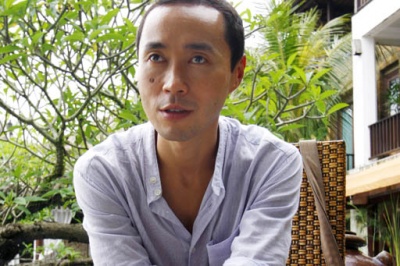
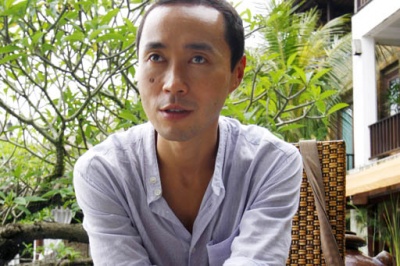
Malaysian author Tash Aw grew up knowing Indonesia was his country’s closest and most influential neighbor. But when he moved to England for college, he found there was little mention of Indonesia in the Western world.

“It was virtually invisible,” Aw said. This inspired him to title his second novel, set in 1960s Indonesia and Malaysia, Map of the Invisible World. “This was my way of drawing attention to Indonesia, of mapping it,” Aw wrote in an email recently.

Aw’s debut novel, The Harmony Silk Factory, won the Whitbread Award and the Commonwealth Writers’ Prize for Best First Novel in 2005, and was longlisted for the MAN Booker Prize. Set in 1940s Malaya, The Harmony Silk Factory has become an important voice in telling a Southeast Asian story to an English-speaking audience. With his 2009 Map of the Invisible World, Aw returns to Southeast Asia, this time further south to Indonesia.

Map of the Invisible World tells the story of two orphaned brothers. A wealthy Kuala Lumpur couple adopts the older brother, Johan, while the younger, Adam, is adopted by a Dutch-Indonesian man. The story begins on an island east of Bali, where Adam witnesses Karl, his adopted father, being arrested by the army during the time of Sukarno’s anti-imperialist rhetoric. Adam is an orphan once again, and journeys to Jakarta, meeting Karl’s former flame, Margaret, a university lecturer, and her assistant Din, who entices Adam to join in revolutionary struggle.

The title of the novel recalls the plight of its main characters, Aw says. “All the characters in the novel are physically present in one place, but their emotional lives are caught in another place, another time — in another world that has ceased to exist, or which may never have existed, a world that is now invisible,” he said.

Aw’s characters view home as an abstract and fragile thing. He may have drawn this from his own life experience, of finding a home in another country while continuing to view Malaysia as home. Aw writes about Adam’s view of home: “In those days he did not yet understand that Home was not necessarily where you were born, or even where you grew up, but something else entirely, something fragile that could exist anywhere in the world.”

Aw moved to England when he was 19, to study law at Warwick University and Cambridge University. He stayed in England, working as a lawyer for several years while working on his writing — a childhood ambition. Aw completed a degree in Creative Writing in 2002 at the University of East Anglia.

Asked where his home is, Aw’s reply was: “Home — that is the million dollar question for me!”
Aw says he owns an apartment in London, which makes London technically his home. “But I spend a lot of time in Kuala Lumpur and the rest of Southeast Asia. I think Malaysia will always be my point
of reference.”

Aw’s story of two brothers setting off on different paths is also a metaphor for how Aw views Indonesia and Malaysia.

“The two countries were often thought of as ‘brothers’ — with a shared language and religion and set apart from the other non-Muslim countries in Southeast Asia. We share music, TV and film. But it also struck me that in many fundamental ways the two countries could not be more different, both in terms of history and everyday contemporary life,” Aw says.

“So I decided to write a novel about two brothers and two countries, whose differences were most clearly highlighted in the 1960s during the time of Konfrontasi. The 1960s were a very turbulent time for Southeast Asian countries, most notably Indonesia, which is why it seemed the natural starting point for the novel.”

Aw has traveled extensively in Indonesia, including to Lombok. Last month, Aw took part in the Ubud Writers and Readers Festival in Bali.

Aw recognizes the love-hate relationship between Indonesia and Malaysia. The two countries have had bumpy relations, starting with Konfrontasi when Sukarno waged a war against Malaysia under the pretext that the latter was a neo-imperialist puppet.

In recent years, more spats have occurred because of misunderstandings about the use of traditional music and dance, or because of unclear borders. On the web one can gauge the strong animosity between the two countries, with harsh words and name calling on both sides.

Aw likens this to sibling rivalry.

“The animosity between Malaysia and Indonesia is, and always has been, a kind of sibling rivalry. I think it is the kind of tension that might arise if two children who shared much in common happened to have very different paths in life. Essentially I think it boils down to wealth, and how the two countries see themselves in relation to each other.”

Aw said Indonesia has had a much tougher time, particularly in the 20th century. “History has not been kind to Indonesia — Malaysia has had much more luck in this respect.”

Malaysia’s smaller size made its problems smaller in scale, he said. “We were able to become relatively prosperous and have more of a middle class earlier than Indonesia. But Indonesia has a much
older, richer and more varied history and culture — it is, after all, a far bigger country.

“I sometimes think Malaysia knows this and has a kind of inferiority complex that manifests itself in a kind of nouveau-riche arrogance,” he adds.

Despite the seeming animosity, Aw said ultimately there was more closeness between the countries than tension.

Prodita Sabarini, The Jakarta Post, Ubud, Bali | People | Thu, November 04 2010

Etgar Keret: Israel’s urban challenge

Israeli writer-director Etgar Keret, 43, said Jewish people usually gave their children names with meanings.

Keret’s first name means challenge. His last name means urban. “So my name means urban challenge,” he said.

He explained this in a prelude as to why his short stories are mostly based in urban settings. Keret is Israel’s best-selling short story writer who writes absurd and humorous tales of urban life in Israel. His works have been published in 30 languages and are included in Israel’s high school curriculum.

Having lived in Tel Aviv all his life, an urban life is the only one he knows, he says. “I think there’s something really urban about my mind… I love nature. But the most interesting thing for me is people. That’s why an urban setting is something that I like because you condense people together in small spaces. It heightens tension. It kind of pumps it out. So I like writing about urban life. And it’s also the only life I l know,” he said.

Keret was in Ubud, Bali, recently for the Ubud Writers and Readers Festival. When it was suggested he would find Jakarta interesting, he said that his visa for Indonesia
only allowed him to travel to Bali for the festival. Coming from a country that does not have a bilateral relationship with Indonesia, Keret jokingly says: “I was born with the wrong passport!”

He was almost could not attend the festival and had to wait five days in Bangkok for his pass, “But I’m really glad I made it,” he said. When he received the invitation to the festival, he said he was very excited. “Because [Indonesia] is a part of the world that I can’t travel to normally. I was very curious,” he said.

Sitting in an Ubud restaurant over a plate of Greek salad, Keret said that one of the purposes of his writing was to humanize Israel in the eyes of people. “Not to make us saints,” he points out “but to make us human.

“Regardless of all the trouble that I have in my country, we are people. Some of us are better, some of us are worse,” he said.

Keret, a son of a holocaust survivor, has for a long time been a spokesman for peace, writing witty and poignant criticism in his op-eds about the war. In a 2007 interview, he once said that his family was like a microcosm of Israel. Keret, the youngest of three siblings went into the arts. His stories do not show any political leanings, never putting things in black or white. His brother, currently living in Thailand, is a peace activist who founded the legalizing marijuana movement in
Israel. His sister became ultra-orthodox. Her 11 children are forbidden on religious grounds to read Keret’s graphic novels, which he dedicated to them.

Keret said his wish was to reach out to different communities. “Just so they have a glimpse of how [Israelis] live,” he said.

His short story collections have entered bookstores in Muslim countries. “I’m the only Israeli writer since the second intifada [whose works are] translated and published in Palestine,” he said. His books are published in Turkey as well.

Keret’s works have been translated in to 30 languages but the Indonesian language is yet to be one of them. “Nothing would make me happier to have an Indonesian one,” he said.

Reading Keret’s short stories, one sees the high-paced energy of urban life situations in his flowing sentences. But Keret’s surreal imaginations are what make his stories special.

During the festival opening, Keret read out his short story Fatso that tells of a man whose girlfriend morphs into a hairy man with no neck who wears a gold ring on his pinkie finger.

Fatso is a quirky love letter to Keret’s wife, Shira Geffen. They live in Tel Aviv with a 5-year-old son. Keret has co-directed the film Jellyfish with Geffen, based on a story that she wrote. The film went on to win best first feature at Cannes Film Festival.

Keret’s wild imagination in Fatso is only one example of how Keret’s mind explores the absurd. In Second Chance, he tells a story about a service that allows people to experience events and emotions that would occur if they had taken a different path in their lives simultaneously to the life they experience now. In Nimrod’s Flip Out, which also became the title of one of his short-story collections, he tells a story about how Nimrod’s suicide affected three friends who all experience mental episodes.

Keret said that writing had taught him to learn more about himself. Keret said he was an angry person when he was young. “I couldn’t articulate it but I had feelings that maybe I was being self-destructive. I just wanted to do something with my life. But I didn’t know how to do it. It was very frustrating,” he said.

Keret said the fact that he did not know what he wanted to be when he grew up “stoked deep fear in me”.

“Aggression usually comes from fear and incompetence. And I think writing taught me to be less afraid. And I became less angry. I know more about myself because of it.”

Keret has published his latest collection of short stories this year called Suddenly, A Knock on The Door.

He said that he would be traveling and has yet to think about his next project. “Between projects, I’m free falling. I don’t know what’s going on,” he said.

“There is something about writing. It’s like a gift. You can’t force people to give you a gift. If it comes, it comes,” he said.

Even now, Keret said, he felt uneasy about calling himself a “writer” on forms that ask his profession. “It’s what I do now. I don’t know if I will do it later. You know it’s like somebody who’s happy. They’re happy now. But who knows if they will be happy later.”

Prodita Sabarini, The Jakarta Post, Jakarta | People | Sat, October 30 2010

Teater Garasi: Embracing the in-between

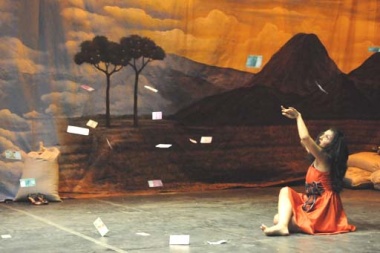
Drops of fortune: Actress Hanny Herlina looks up at money falling from the sky. Garasi actors impersonate Tarling-Dangdut performers, who in real life, receive money thrown or given to them by the audience. — Photo by courtesy of Festival Salihara

The sight of a big-eared red Teletubby with a Mohawk pushing dangdut singing women on a yellow makeshift boat into a crowd of amused art lovers is bound to create a surreal and absurd image.

So do women performing the traditional tari topeng (mask dance) using plastic masks of robot action heroes to the otherworldly sounds of blipping techno music.

But, these vignettes, part of experimental artist collective Teater Garasi’s latest play Tubuh Ketiga: Pada Perayaan yang Berada di Antara (The Third Body: On Embracing the In-Between), are not mere imaginary visions popping out from the minds of the Yogyakarta-based collective.

Directed by Yudi Ahmad Tajudin who collaborated with members of Teater Garasi, Tubuh Ketiga is an essay in the form of a visual art performance based on observations of Tarling-Dangdut art from the Indramayu community.

A coastal city near the border of Central and West Java, Indramayu is a crossing point between strong Sundanese and Javanese cultural centers; the urban life of Jakarta and sleepy rural village life; an industrial and agricultural area; and tradition and modernity.

Teater Garasi’s Tubuh Ketiga became a tribute to the people who live in the space in between, celebrating the latter’s relaxed openness to different cultures from virtually every direction.

The people from Indramayu have developed their own brand of art namely Tarling-Dangdut, a mixture of electric guitar, percussion, Sundanese flute with gamelan sensibility, combined with India-influenced Dangdut music and even techno sounds created from old chips.

By way of bricolage, Indramayu people take popular culture references and use them as their own. Beyond the tackiness of the performances, Teater Garasi sees a soupçon  of nonchalance in the meeting of different cultures — a refreshing attitude amid some of today’s fear-filled reactions toward change in the form of fundamentalism and chauvinism.

Teater Garasi presented Tubuh Ketiga on Oct. 11 and 12 at Salihara. Like a warm village reception, friends of Garasi formed a line and greeted the audience. Steamed bananas, peanuts and glasses of water were served to spectators, who took their places on the floor, the low-wooden platforms or stood at the back of the theater.

Guitar riffs accompanied poet Gunawan Maryanto, the night’s MC. His singsong voice kept on rolling word after word, until the white curtain located behind a metal bench adorned with fake flowers — and bearing the sign “Congratulations for a new life in the globalization era” — was torn down.

As the curtain fell, the audience saw a painting of the sun setting behind the mountain, rice paddies and factories on screens surrounding Salihara’s black box theater walls. The play about Tarling-Dangdut singer Shanti Revaldi began.

In the 70-minute performance, tari topeng maestro Wangi Indriya danced with Sri Qadariatin, and Hanny Herlina with Theodorus Christanto.

The play featured a varied selection of songs from Kucing Garong (Wild Cat), Mujaer Mundur (Backward Fish) to Bjork’s It’s not up to You.

The most profound moment of the play was Wangi’s singing of the song Rhizomatic while Hanny swayed her hips and mouthed the lyrics as if singing in slow motion. The two women sat on the makeshift boat, while the red Teletubby pushed the boat, slicing into the crowd of people.

Members of Teater Garasi started taking interest in Indramayu two years ago when they produced
Je.ja.lan, a play inspired by street life in Yogyakarta, Jakarta and Indramayu.

“We’re very interested in culture formed through the meeting of different cultures,” Yudi said.
Given Indramayu’s reputation as a crossing point, it was the logical place to go.

Garasi went to Indramayu in April after the harvest to observe the festivities.

“There was an extraordinary social phenomenon. Post-harvest, Indramayu turns into a center of festivals. Everywhere there are stage performances, in which Tarling-Dangdut becomes the main event,” Yudi said.

For Yudi, the people from Indramayu’s relaxed attitude toward different cultures surrounding them is valuable. “They arbitrarily take from here and there and recreate.”

In today’s interconnected world, an individual is no longer a construct of one single culture, which makes the question of identity becomes less important, Yudi added.

“The question is not about identity. The question is not ‘Who am I?’ but ‘What can we create?’” Yudi went on.

“In fact, many cultures construct the ‘I’. The traditional, the modern, the authentic, the alien — they all construct ‘I’, the subject.”

As in Garasi’s Je.ja.lan “dance-theater-cum-theater of images” production, the audience occupied almost the same space as the actors. Spectators were continually interacting with the actors, as the latter would use the entire theater as their stage.

“I place the audience and actors in the same space. The boundaries between stage, actor and audience become blurred,” Yudi said.

“Because, what is important for me in the two works is dialogue, interaction. It’s not the fiction or the art. I’m underlining communication rather than aesthetics. The play is merely a medium, my way to create dialogue on the issue of the idea that is being conveyed,” he said.

Tubuh Ketiga was indeed a fun dialogue.

Prodita Sabarini, The Jakarta Post, Jakarta | Art and Design | Mon, October 18 2010