On forgiveness, a response to GM and a call to action for Indonesia’s youth

A week after a groundbreaking national symposium on the 1965 tragedy, I received a message from my friend Febriana Firdaus. A journalist like myself, she lost her grandfather in the anticommunist violence in 1965-1966.

Febri and I are part of a new digital storytelling movement, Ingat65. We provide a medium for Indonesia’s younger generation to collectively remember the communist purges, a dark past that our nation for half a century has been forced to forget through propaganda and deliberate silence in official histories.

That morning, Febri forwarded to Ingat65’s Whatsapp group Goenawan Mohammad’s essay in Tempo magazine, entitled “Maaf” (Forgiveness). In his essay, GM, as the renowned essayist is commonly known, is not convinced President Joko “Jokowi” Widodo should apologize for the 1965 violence.

“For what? For a crime that’s not his, on behalf of a state that’s not his to represent?” Febri highlighted that part with a yellow marker. I see her point.

The symposium, the first official dialogue on the issue since the fall of Soeharto, who rose to power on the back of the 1965 violence, has sparked a discussion on truth and reconciliation. GM’s essay adds to this discussion. But his reasoning, I argue, is unsound.

A man of letters, he referred to many thinkers, including Marx, to reinforce his point that the crime of the “state” in 1965-1966 was not of the current “state” that Jokowi now leads.

“For me, Marx is more correct: The “state” can never be a place for anyone, at anytime. The “state” is always “particular”; it’s merely a tool for those in power in a certain time and certain space. It is not permanent,” he wrote.

The irony is lost on GM when he quotes Marx, whose methodology of socioeconomic analysis was banned in 1966 as part of the systematic destruction of the left.

The “state” that Jokowi leads, one that GM says is not the same with that of 1966, still maintains that ban.

Marx was right. The state is a tool for those in power in a certain time and certain space.

But GM is dreaming to suggest that in 2016 we have broken completely with the New Order.

Even though Jokowi was a mere toddler when the violence happened, he has nonetheless inherited a legacy of impunity that still operates in Indonesia’s politics.

But let’s talk about the subject of GM’s piece: forgiveness. An element for reconciliation, forgiveness is important in post-conflict resolution.

Letting go of resentment is crucial to restoring friendly relations between offenders — perpetrators, accomplices, bystanders — and victims.

GM talks about the kinds of forgiveness that he admires: the martyr-like “pure forgiveness” of Wolter Monginsidi, who forgave his wrongdoers ahead of the offending deed (his own execution), and the unconditional forgiveness of political prisoner Oey Hay Djoen.

According to GM, Hay Djoen, commenting on his peer Pramoedya Ananta Toer’s distrust in the apology issued by the former president and leader of Islamic organization Nahdlatul Ulama (NU) Abdurrahman Wahid, for NU’s involvement in the violence, wonders what moral right they have to deny forgiveness.

In Hay Djoen’s attitude to forgive unconditionally, GM sees something nobler than Pram’s rejection. Hay Djoen’s forgiveness, GM argues, defies Jacques Derrida’s fear of “conditional forgiveness” that placed “the victim” on a moral high ground.

However, GM failed to note that neither Hay Djoen nor Pram, nor other victims of the 1965 violence, were standing in a position of superiority.

Derrida’s warning that GM quoted on the dangers of “conditional forgiveness” being reduced as a tool for trade for national stability — as in the case of South Africa’s truth and reconciliation process — referred more to an amnesty and not necessarily genuine forgiveness.

Neither Hay Djoen nor Pram had such power to pardon. Unlike in South Africa, where the victims of apartheid went on to hold political power and started the process of truth and reconciliation, in Indonesia the offenders are still in power and have yet to cease their wrongful deeds.

Philosopher Charles Griswold, in his book Forgiveness: A Philosophical Exploration, notes that to gain true forgiveness from victims, there are several actions that the wrongdoer should do: acknowledge and repudiate the mistake, express regret, promise not to repeat the mistake, express sympathy and understanding for the suffering of the victim, and lastly, present an honest narrative that is not an excuse that can provide context as to why they carried out the offense.

Only then may the victim regain trust, let go of resentment and see the former enemy in a new light. These acts of apology should be made public on a national level to ensure an end to the injustice.

Forgiveness, on the other hand, Griswold notes, should be given on an individual level, lest what Derrida and GM feared might happen — forgiveness that doesn’t serve its genuine goal of renewal of bonds but acts as a form of forced peace-making.

How far are we from seeing these acts of apology in Indonesia? We don’t know yet.

The 1965 tragedy is still a deeply divisive issue. In an explanation about his essay on Wednesday, GM said he would like the state to apologize, if doing so brought about greater national harmony.

The 1965 symposium was an experiment to find out if we can start the process of reaching a national consensus that include all parties — victims and offenders — in the 1965 tragedy, according to one of the initiators, Agus Widjojo, the newly appointed National Resilience Institute chief, whose father was of one of the generals killed in the apparent abortive coup that rose the curtain on the violence.

In a way, in Ingat65, we are conducting an experiment too. We are opening a space for personal reflection to gauge how our generation feels about this issue and how we want our future to look.

Will we be a generation of bystanders (staying silent) or, worse, perpetrators (attacking gatherings of 1965 victims), and continue to perpetuate injustice? Our call now is not to Jokowi (just yet), but to our peers.

The voice of youth is crucial, especially now, when half of the country’s population is under the age of 30. We should find out what happened by talking to our elders.

We should read the many studies by academics and watch documentaries on 1965.

Let’s reflect on our history, decide what we want based on that reflection and together tell our leaders our desires for the future.

For too long, leaders of this country have been servants to themselves. Let’s peacefully bring power back into our hands and make GM’s dream come true.

Let’s make the state represent a new moral identity and really break away from the old guard, whose power came on the backs of extreme violence and the suffering of victims.

________________________________

The writer, an editor for The Conversation, is the initiator and chief editor of Ingat65. The views expressed are her own.

This article was published in thejakartapost.com on Friday, April 26, 2016 with the title “On forgiveness, a response to GM and a call to action for Indonesia’s youth”. Click to read: https://www.thejakartapost.com/news/2016/04/29/on-forgiveness-a-response-gm-and-a-call-action-indonesia-s-youth.html.
‘The Act of Killing’ doesn’t end

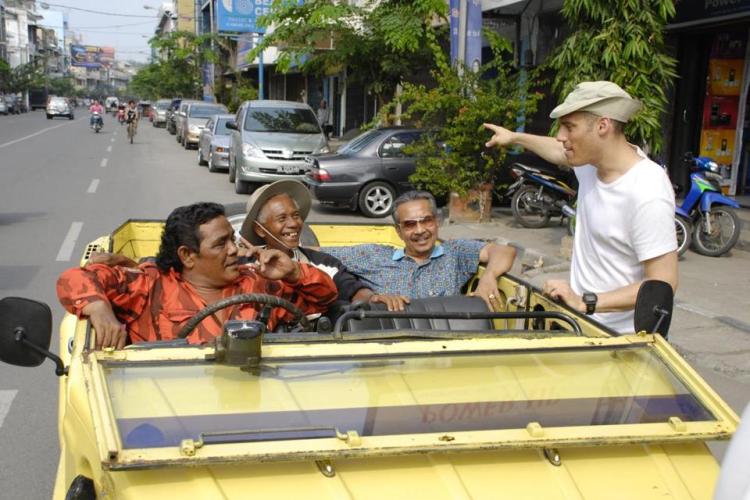
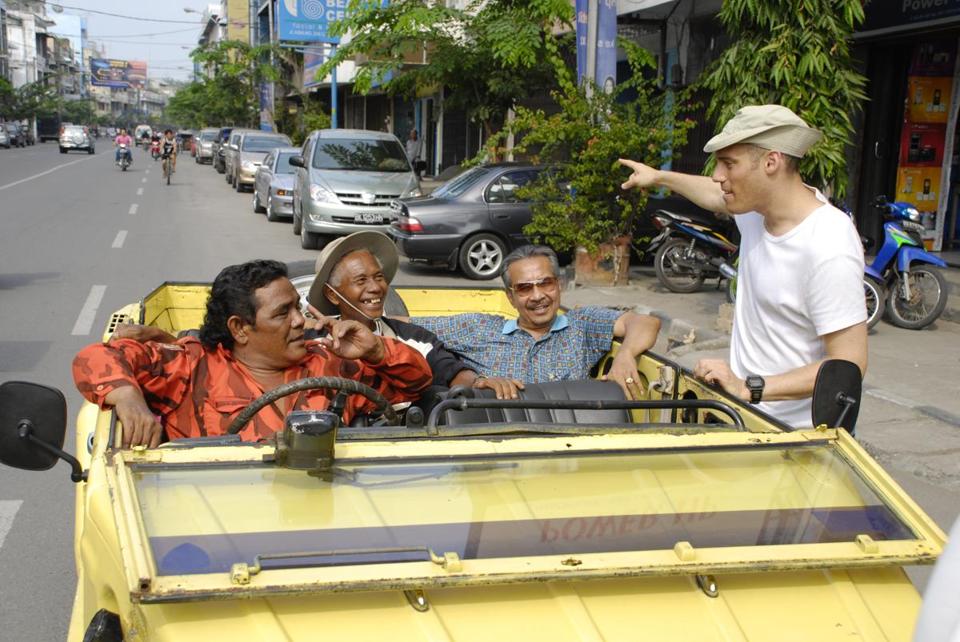
Safit Pardede (from left), Anwar Congo, Adi Zulkadry, and Joshua Oppenheimer behind the scenes in “The Act of Killing.” Drafthouse films

THE LIGHTS went off for the “The Act of Killing” when it lost the Oscar for Best Documentary Feature to a feel-good tribute to struggling backup singers.

It shouldn’t come as a surprise that with the dimming of publicity surrounding the documentary feature on death-squad leaders re-enacting their crimes in Indonesia’s anti-communist purge of 1965, the memory of victims and survivors would also fade. The murder of nearly a million people with the backing of the CIA had been ignored for 50 years until “The Act of Killing” shocked viewers with the open boastfulness of the killers. To its credit, Hollywood has boosted the profile of the film, and the bloodletting, in a way that no previous reports or studies on the massacre have achieved. But now that the curtains are drawn, will the film share the same fate as its disturbing subject matter?

The families of victims are still around and cry for justice. The Indonesian government justifies the massacre on national security grounds and has refused demands for a criminal inquiry. It sat on its hands last year when a group called Anti-Communist Forum of Indonesia attacked and threatened to kill survivors gathering for a discussion. And just last month its armed forces broke off a discussion on Tan Malaka, Indonesia’s former communist leader.

Anwar Congo, the main character in “The Act of Killing,” grew up selling black-market cinema tickets. Later, he acted out his deeds with the image of John Wayne in mind, playing the good guy fighting the communist villains. One reason that motivated Anwar was that the Indonesian communists hated American movies. By focusing on the killers who identify themselves with the cowboys of the West, Joshua Oppenheimer, the director of “The Act of Killing,” held a mirror to Americans suggesting that they may have more in common with the perpetrators than most like to think. What the film viewers saw was ugly, but it also shows the different paths the killers took to live with their guilt. At the end of the film, we see no redemption for Anwar Congo. As he slowly comes to realize that he’d done something terrible, his retching body does not give him release.

Oppenheimer and his fearless Indonesian crew dream bigger than the Oscar: They aim to bring justice for the survivors. As retaliation for an alleged communist coup, the Indonesian army, operating with the help of civilian death-squads, extinguished nearly the entire Indonesian left in a period of six months. They slaughtered union members, teachers, journalists, leftist artists, ethnic Chinese, and nearly all members of the communist party. The speed and scale of the killings are comparable to the worst recorded cases in modern history — six million Jews killed in eight years in German-occupied Europe and two million Khmers in Cambodia in four. But while the Nazis and Khmer Rouge have been defeated, and their atrocities universally condemned, the perpetrators of the Indonesian massacre have won and the Western world cheered on the bloodshed.

In a number of public screenings I attended — whether at Harvard or Columbia, an independent cinema in Brooklyn or at the Library of Congress — there was a sense of confusion and helplessness among the audience. They would often ask the director “but what can we do?” Oppenheimer would say they needn’t look as far as Indonesia for the answer but at their own neighborhood.

It’s no longer a secret that the West encouraged and supported the actions of the Indonesian army. The United States — at war in nearby Vietnam at that time — provided a list of people to be targeted for the Indonesian army and also equipment for their operations. At the height of the Cold War, America openly celebrated the annihilation of Indonesia’s Communist Party, the third-largest after the Soviet Union and China, over a mountain of corpses.

The word amok has passed into international vocabulary from the Indonesian amuk, describing a state of murderous frenzy. Perhaps Western intelligentsia could learn more about the real-life background behind the grammar. The lasting experience of amok is not over till we break the silence following the horror.

Joshua Oppenheimer has called for the United States to break the silence and admit the role it played in the massacre. At least one senator, Tom Udall of New Mexico, heard his call and raised the possibility of releasing a “Sense of the Senate” resolution on the issue. While this might be a glimmer of hope for survivors to get the recognition they deserve, American citizens could take advantage of this gesture and call on their senators to ensure the United States discloses its involvement and finally comes clean.

“The Act of Killing” is a re-enactment of a nation’s collective memory, a killer slowly comes to grip with the moral wrong of torturing and murdering hundreds of people. Neither Indonesia nor the United States has faced the truth so far. How long can we ignore what we know in our deepest hearts until we damage ourselves to a point of no redemption?

Prodita Sabarini, an Indonesian journalist, is the 2013-14 IWMF/Elizabeth Neuffer fellow.

Published in The Boston Globe  |    MARCH 29, 2014

Joshua Oppenheimer: Facing the monsters in the dark

Joshua Oppenheimer. Daniel Bergeron

Joshua Oppenheimer was walking down a glacier on Mount Karakoram in Pakistan when he had an epiphany.

It was the mid-1990s. He had been crying while sitting on the top of the glacier, remembering something about his childhood, said Oppenheimer.

When he walked down the black rocks, he realized that recording how humans imagined themselves could help people better understand reality.

He was spending a summer in India that year, working on a street theater project.

Around that time, Oppenheimer had changed his undergraduate major to philosophy from theoretical physics.

As a boy he was interested in the nature of reality and its relationship to consciousness. He said he was amazed as a high school student to learn that subatomic particles only show a fixed nature once we
observe them.

However, when he started at university, quantum physics were not as developed as the science is now and students were geared to become engineers, which Oppenheimer was not interested in.

However, after his moment of clarity on the glacier, he returned to Harvard and crammed three years of film studies in two.

Nearly 20 years after his epiphany, Oppenheimer, 39, has made a film, The Act of Killing, about former death-squad leaders as they re-enact the work during the mass killings following the purported attempted Communist coup in Indonesia in 1965.

The film is favored to win the Academy Award for Best Documentary, which will be handed out Monday morning, or Sunday night in Los Angeles.

The Copenhagen-based American was recently in New York after screening the film at the Library of Congress in Washington.

Beyond racking up a host of awards, The Act of Killing, eight years in the making, has achieved something that no other documents or reports on the genocide have.

It has broken the taboos on speaking about Indonesia’s dark past, stirring a national conversation that has been stifled for nearly 50 years by government propaganda and media self-censorship.

Internationally, the film has raised awareness about the killings and the collective role Western governments had in encouraging and ignoring one of the greatest massacres in history.

Oppenheimer himself has become a spokesperson about the genocide as the film gain prominence.

At both the Washington screening and when he accepted a British Academy of Film and Television Arts (BAFTA) award, Oppenheimer said that the Western world had not only ignored the killings: They encouraged it.

He called on the US and the UK to acknowledge their collective role in the genocide.  “I often talk about how The Act of Killing is a film about when killers win and take power.

“But the killers include the Americans, the killers include the CIA officers and the State department officials who gave a list of thousands of names to the Indonesian Army,” he said referring to the 5,000 names of public figures US officials gave to the government.

“It would be hypocritical for example for the US or for me to say the government of Indonesia should apologize without articulating equally forcefully [that] the US should apologize,” he said.

For Oppenheimer, the role of art is to show us “things that we already know but maybe had been too afraid to acknowledge or too afraid to remember”.

He chose nonfiction cinema to capture “the rainbow of stories that make up our factual reality”, which he said was made up of “almost innumerable number of fragmentary molecular interacting fantasies, stories, narratives, fictions”.

Non-fiction storytelling, he says, can “make visible the fiction” behind our perceptions.

“I think there’s a false and boring notion of nonfiction film that it’s a kind of window onto the world and you look into the window and you see the world,” he said.

Whenever people are filmed they “present” themselves, according to Oppenheimer. “We start acting out some of these invisible, second-hand, third rate, half-remembered script or stories that we have of ourselves that we identify
with — images that we have of ourselves that come from movies and culture and our parents and history.”

Oppenheimer said that filming people as they presented idealized images of themselves, as he did in the reenactments in The Act of Killing, gave a window into people’s deepest fears.

“What are they hiding? Why do they have to act like something that they’re not? Why do they have to act out an image of themselves. Which is pretend but very real?” he asks.

“Anytime you film anybody, you can see the fictions that people cling to so they can live comfortably withthemselves and you can glimpse behind that — who they really fear that they are.”

“There are events that we’re too afraid to inquire about,” Oppenheimer says. “But we know [they] lurk there like a kind of monster in the dark.”

Oppenheimer started his work in Indonesia in 2001, three years after the fall of Suharto, to examine the impact of globalization.

He filmed workers in a Belgian plantation in North Sumatra struggling to form a union. Many had family members who had been killed in 1965 or 1966.

When news of the project reached the authorities, the military intimidated the workers to keep silent.

At the suggestion of one of those who survived the genocide, Oppenheimer aimed his lens at the perpetrators.

To his horror, he encountered boastful men who would tell stories of how they killed — and reenact the deeds using their wives as subjects or in front of bored grandchildren.

Oppenheimer is now editing his next film, The Look of Silence, about a family of survivors of the 1965 violence confronting the killers.

“The Look of Silence is in some ways the film that I set out to make. But it’s not. It’s really different because making The Act of Killing changed everything and changed me in how I see what’s happening,” he said.

The second film Oppenheimer said has turned into “poem about silence that’s born out of fear and the necessity and trauma that comes out by breaking that silence”.

The Look of Silence will be Oppenheimer’s last film about the genocide in Indonesia. Conscious of the importance of acknowledging and the crimes of the past, Oppenheimer said that he could be a spokesman for the issue for as long as the film is in the spotlight.

He said there have been many activists and historians who have raised this issue, comparing the people to the truth-speaking child in the fairy tale “The Emperor’s New Clothes”.

“We’re trying to create a space where people can talk about and therefore to address their biggest and most frightening problems because if we don’t address them we’re doomed to continue living in the nightmare.”

Prodita Sabarini, Contributor, New York | People | Mon, March 03 2014, 12:40 PM

Published in The Jakarta Post

Director calls for US to acknowledge its role in 1965 killings

The killer: Former death-squad leader Anwar Congo (center) re-lives his savage past in The Act of Killing. (Dogwoof.com)


Oscar-nominated documentary filmmaker Joshua Oppenheimer on Tuesday called on the US to acknowledge its role in Indonesia’s communist purge after screening The Act of Killing, his film on 1965 death-squad leaders, for US Congress members and staff.

“Fifty years is a long time to not call a genocide a genocide,” he said. “If we want to have a constructive and an ethical relationship with Indonesia moving forward, we have to acknowledge the crimes of the past and we have to acknowledge our collective role in supporting those crimes, in participating in those crimes and ultimately in ignoring those crimes,” he said.

The Army, with the help of civilian death squads, killed 500,000 to 1 million people between 1965 and 1966 after the assassination of six army generals in an alleged communist coup attempt. The US government, which at the time was waging a war against Vietnamese communists, was reportedly pleased with the crushing of communism in Indonesia, and saw it as a success in their containment policy. Declassified CIA documents and investigative reports by journalist Kathy Kadane have showed that the US supported the communist purge by providing a list to the Army of around 5,000 people to be killed. The US then supported the Soeharto regime, responsible for orchestrating the massacres, as the new regime took over the country.

Despite the enormity of the crime, the International Criminal Court could not try the perpetrators of the 1965 genocide as it happened before the signing of the Rome Statute that founded the court. “What can happen is a special tribunal like the International Criminal Tribunal for the former Yugoslavia can be formed and that usually happens at the level of the UN Security council,” Oppenheimer said. “Before that can happen, probably the countries that were involved with supporting this, will actually have to say ‘Hey enough time has gone by for us to become comfortable with acknowledging what has happened here, in the name of addressing impunity and corruption in the fourth most populous country in the world’,” he said. “We need to pursue this because this was in fact a crime against humanity,” he said.

The Act of Killing was recently nominated for an Oscar Award in the Best Documentary category. The chilling film that follows death-squad leader Anwar Congo happily re-enacting the killings of 1965 has picked up awards in film festivals around the world. In Indonesia, the film has been shown in thousands of underground screenings across the country and as of Sept. 30 last year has been available for download in Indonesia. It has become a catalyst for national conversation on a topic that was largely buried under government propaganda during the Soeharto regime and self-censorship after reformasi (reformation).

“Bringing it here [Washington] is a new step in that journey for me,” Oppenheimer said. “I’m just pretty moved sitting here talking to you because it has been our hope that this would start a conversation everywhere about this past and about who we are as human beings in some deeper ways as well,” he said to the audience.

US Senator Tom Udall, who sits on the Senate Foreign Relations Committee, organized the Tuesday night screening. “When I heard about this film, I thought that this should be given an opportunity for members of congress and staff and everybody to see,” he said.

Some 60 people, mostly staffers of Senators, attended the screening held at the Library of Congress. The audience was silent for a couple of moments after the film ended before giving a somber applause. After watching the film, Udall called Oppenheimer an artist. “Artists sometimes tell us stories that we don’t want to hear, that we don’t want to face. They open a reality to us,” he said.

Udall said it was significant that the film was screened here. “This is our nation’s capital. This is the seat of government. As you heard from his [Oppenheimer’s] interview, we [the US] were involved. So it’s important that this space be created to have a discussion also,” he said.

Prodita Sabarini, Contributor, Washington, DC | Entertainment | Sun, February 16 2014, 11:25 AM

Published in The Jakarta Post