Henry Saragih: Farmers feed the world
JP/Prodita Sabarini
JP/Prodita Sabarini

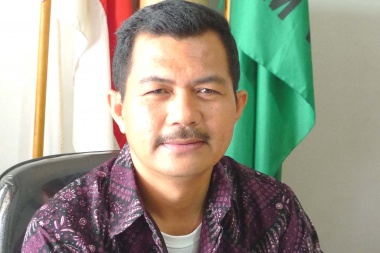
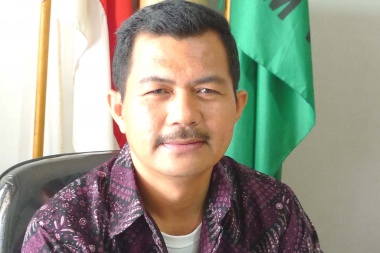
“The Earth provides enough to satisfy every man’s needs, but not every man’s greed,” said activist Henry Saragih, quoting Indian non-violent activist Mahatma Gandhi recently at his office in Jakarta.

The head of the Indonesian Farmers’ Union (SPI) and the secretary general of La Via Campesina, a global alliance of small-scale farmers and rural workers, lives by those words. He leads a global movement advocating a return to locally-produced food to address the global food crisis and environmental degradation.

UK-based weekly The Observer recently listed him as one of the 20 Green Giants, “activists, filmmakers, writers, politicians and celebrities who will be setting the global environmental agenda in the coming year”. In 2008, The Observer’s sister publication, The Guardian, listed him as one of the 50 people who could save the planet.

In his office in Mampang Prapatan, East Jakarta, he reminded The Jakarta Post that before international publications acknowledged his work, this paper had already taken notice of him in a 2003 profile.

“That helped our movement [the SPI] gain exposure internationally,” he said.

The UN Food and Agriculture organization (FAO) announced the world’s food price index had hit an all-time high in December, exceeding that of 2008 when a global food crisis caused riots in several countries, including Indonesia.

For Henry, the main drivers of the global food crisis are a global trade system that allows speculators rather than farmers to control food prices, the use of food for mechanical and animal farming, and climate change.

Henry said that other experts had cited population increase as another factor, as  world population was predicted to grow to 9.2 billion in 40 years time, one-third larger than it is now.

Henry, however, added that La Via Campesina believed the world could feed itself if every country controlled its food supply — what he calls “food sovereignty” — and empowered their own farmers to provide food for their local communities. Thus, he quoted Gandhi.

After years of advocating small-scale farmers’ and rural workers’ rights, fighting against big transnational corporations and the World Trade Organization (WTO), the organization succeeded last year in lobbying the UN to recognize the role and rights of small farmers in the world.

In Indonesia, Henry said his movement was pushing for a Law on Farmers’ Protection and Empowerment and an amendment of the Law on Food.

La Via Campesina strongly rejects the World Trade Organization and free trade agreements on agricultural products, he said.

“Ever since the Uruguay round, hunger problems have increased, and so has poverty, environmental degradation, forest destruction, the decreasing of biodiversity. And big corporations are taking land from farmers,” he said, referring to international meetings between 1986 to 1994 that resulted in the establishment of the WTO.

He explained that Indonesia imported soy, fruit, milk and rice at very low prices, which made it
hard for local farmers to compete in these markets. This phenomena is taking place in other countries as well, he went on. Japanese and Korean farmers also feel the burden of free trade.

“Farmlands are neglected there because, given the production costs in Japan and Korea, the farmers there cannot compete with products from other countries,” he said. In 2003, Korean farmer Lee Kyung-Hae killed himself in Cancun, Mexico, during a protest against the WTO.

Korean farmers cannot compete with imported products such as Australian beef or rice from Indonesia and Thailand, Henry added. And while local farmers and farms in Korea were neglected, in response to the 2008 global food crisis, big transnational companies — including Korean companies — started opening farms in developing countries, including Indonesia.

“Japanese and Korean farmers could actually feed their communities if the farmers there were given some support,” he said.

Henry argued the neo-liberalist system had created a chaotic world economy system. He pointed to the growing number of crops used to feed animals instead of humans.

“Soy from Latin America is exported to Copenhagen for the pig industry there to be exported all over the world,” he said. “The production of animal feed is energy-consuming — so is its transportation — and for this the Amazon forest is cleared,” he said.

La Via Campesina’s slogans include “Farmers feed the world” and “Small-scale sustainable farmers are cooling down the Earth”. Henry said La Via Campesina was advocating “food sovereignty” as a solution to the food crisis and global warming through agrarian reforms that would strengthen small-scale farming.

He added that access to food should be seen as a basic human right and not be treated as commodity.

Henry comes from a family of farmers. He was born and raised in Tarutung, in a small rural city in North Sumatra. After graduating from the School of Social Politics of North Sumatra University in Medan, he returned to his hometown and saw how farmers there struggled to survive, as they did not own their own land. Meanwhile, large swaths of land were given to pulp and paper companies that polluted the Asahan River.

In 1993, he secretly founded the North Sumatra Farmers Union, as farmers were not allowed to form unions under the Suharto regime. The military often raided their meetings, grabbing and interrogating him in the process.

“We had to have 1,000 minds to avoid getting caught,” he said.

When people were setting up new political parties on the eve of the reform era, he and other farmers set up the SPI.

In 2000, the SPI became the Southeast Asian representative for La Via Campesina. In 2004, Henry was elected general coordinator of the movement. He was re-elected for a second term in 2008.

Henry divides his time between Jakarta, Medan and the rest of the world. He practically lives in his Jakarta office when working in the capital, sleeping on a small bed tucked behind a cabinet.

He returns to Medan almost every three months to see his family.

“I’m very lucky my wife understands my struggle,” he said. “She’s also an activist. She helps out communities and sets up micro-financing for women.”

Henry said his position as general coordinator of La Via Campesina would end in 2012. The torch of leadership as well as the office will be passed on to farmers in Mozambique in Africa in 2013.

Prodita Sabarini, The Jakarta Post, Jakarta | People | Mon, January 31 2011
Papua series: Papua development program aims to lure the young back to farming

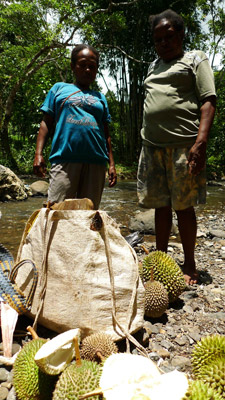
Durian feast: Two women stand over durian by the river in Serui, Yapen Islands. February is durian season and villagers in Serui can collect ripe durian from the ground and take them to market. (JP/ Prodita Sabarini)

As with many areas in Indonesia and around the world, people in Papua move from rural areas to the city.  However, having lived close to their land for thousands of years their competitive streak in setting up small businesses lags behind that of migrants who have for generations had the skills to run businesses, according to Rio Pangemanan, Oxfam program manager on the Papua Enterprise Development Program.

In no corner of the town of Wamena will one see a shop that is owned or run by indigenous Papuans. Indigenous women with their noken (traditional Papuan woven bags) hanging from their heads to their backs sell sweet potatoes or vegetables on a cloth in the street markets. Young strong-limbed Papuan men push rickshaws, some even in bare feet. Others  wander around  the markets, intoxicated from glue-sniffing.

UK based international development organization Oxfam is currently the only international NGO that is allowed to operate in the heavily policed province. Working with local partners, Oxfam has been supporting local farmers in five regencies in Papua in developing their farms and markets.

Oxfam supports the farmers according to the local needs and potential. For example, in Yapen Island, Oxfam has supported the Wamanuam Be Kitabono Yawa (WMY) Cooperative in cultivating vanilla beans. In Jayawijaya regency, the NGO has supported the Independent Business Foundation (Yapum) in cultivating and distributing sweet potatoes. Meanwhile in Paniai and Nabire Oxfam has supported their local partners in helping coffee farmers and in Jayapura, cacao farmers.

Oxfam’s contract ends next year, but Rio hopes that the NGO will get an extension for its programs. Rio said of the vanilla program in Serui that vanilla vines needed three years to produce beans, so new farmers would only have their first harvest in 2014. Rio said that by the end of 2014, he hoped the cooperative would be able to run independently.

Meanwhile in Wamena, Rio estimates that it will take two years for their partners to be independent in terms of management. He said that if the local government could take part in transportation and distribution of the produce, Oxfam’s partners, such as Yapum, would be able to operate independently once their management capacity had been strengthened.

In his office in Serui, Apolos Mora, the head of WMY cooperative said that for years vanilla trees grew in the wild in forests in Yapen. The Dutch brought the seeds when they opened coffee and chocolate farms on the island in the 1950s. “Before they [the Dutch] could teach the local people to cultivate vanilla, there was the transfer of power to Indonesia,” Apolos said.

One day in 2008, Apolos was reading about vanilla in the bookstore and an “Aha!” moment hit him as he realized that these plants were the ones that grew wild in the forest. When Madagascar, the largest vanilla pod producer in the world, had poor harvests, the price of vanilla pods skyrocketed to Rp 3 million (US$309) per kilogram, Apolos said. Apolos then decided to cultivate vanilla vines and trained the farmers joining his cooperative to plant vanilla too. He sells the pods to Manado, where they are exported to Europe, the US, Australia and New Zealand.  Recently, the price for dried vanilla pods was Rp 115,000 per kilogram.

PDEP manager, Rio Pangemanan, said that Oxfam supported programs according to the characteristics of the area. The island and coastal areas are more developed than the mountain areas due to ease of access to other islands in Indonesia. The mountain areas meanwhile are more isolated. This results in a different variety of crops that can be profitable to produce. While farmers in Serui can sell their crops in Manado, in Wamena farmers can only sell locally.

In Jayawijaya, Oxfam supports farmers revitalizing their sweet potato farms. Partnering with Yapum, they have developed 20 sweet potato collecting points in Jayawijaya that will distribute the crops to the markets in Wamena. Rio said that these collecting points had become a place for farmer’s advocacy and education to motivate the community to return to their farms instead of leaving for the city.

Local NGOs such as Yapum and WMY cooperative say that it is not always easy advocating for farmers to cultivate vanilla beans or sweet potatoes. Farmers’ programs in Papua are often project-based, in which farmers are given money to open rice paddies or fishponds. Once the funds dry up, the projects become neglected.

Eli Tabuni, the secretary of one of the sweet potato collecting points was one of the farmers who questioned the program. “This [sweet potato farming] is our culture, why are you making a project out of this?” he asked Yapum and Oxfam during their visit there. He said that many of the programs were only temporary and were not really helpful.

Kiloner Wenda, Oxfam Sweet Potato project officer in Jayawijaya, answered Eli in the Lani language with another question. “Where are the young people now who will work on the farms?” he said. “If we don’t start now, then our culture will slowly disappear,” he said.

Rio said that the projects aimed to support indigenous Papuan farmers in developing their business sense and opening their access to markets. In Wamena, women carrying their sweet potatoes from their villages to the market have to pay for transportation to the market for their heavy bags.

Yapum encourages them to sell the potatoes for Rp 5,000 per kilogram, and they only need to drop their crops at the collecting points. This way, the women did not have to travel far to the markets and could save on transportation, Rio said.

In Serui, the program has managed to attract young farmers, but in Wamena, whether the program will succeed in bringing the young back to the farms is yet to be seen. For the kids that like to play in the farm, their dreams are to be pilots and teachers, they say. But they will always love eating sweet potatoes.

— JP/Prodita Sabarini, Yapen, Serui

Prodita Sabarini, The Jakarta Post | Reportage | Wed, March 27 2013

Papua series: Laboring mamas, chopped fingers

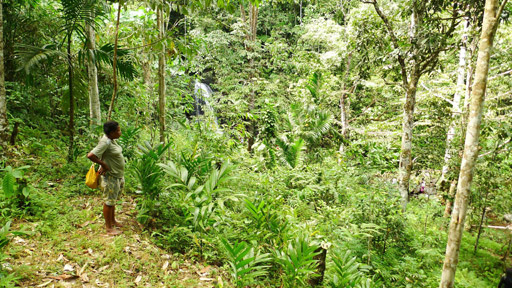
Taking a breather: Weldemina Mora looks at a waterfall in Serui, Yapen Islands regency. In Serui, some Papua vanilla vineyards are located on customary land belonging to the Yawaunat people. (JP/ Prodita Sabarini)

A mama walks barefoot under the skin-burning sun in a hamlet in Piramid district, Jayawijaya regency. With their traditional woven bags (noken) dangling from their heads, Papuan women, lovingly called mama-mama, dig into the earth to harvest sweet potatoes.

Orina, 30, is one of the mama-mama. Last week was harvest time in her village, Yonggime. Carrying her 3-year-old-son Samuel to the field on her shoulder, she steadies the weight of her noken on her head.

“It’s hard work,” she says. “We sweat a lot and we dig using shovels,” she said. The shovels that the women use are made from thin long metal with flat tips. Most tiring, she said, was that they had to carry their noken and their babies or toddlers with them to the field. Sometimes women carry three bags on their head, one for their offspring and the others for collecting the harvest.

The bulk of the work on farms in Papua falls to women. Most indigenous Papuans in the mountainous highlands such as in Jayawijaya regency live from farming. Families grow sweet potatoes for their daily meals, as well as for their pigs. The rest, they sell in the markets. Women are usually the ones who travel to the markets carrying heavy loads on their heads. The sweet potatoes, or hipere in the local language, can grow as big as a newborn baby, weighing around 5 to 10 kilograms each.

“Men open the fields, build the fences and dig irrigation channels, but that’s it. The people who tend the fields, plant and toil, harvest and feed the cattle, are the women,” Patricio Wetipo from the organization, Humi Inane (Women’s Voice) Foundation, said in Wamena recently.

In Indonesia’s easternmost province, indigenous women are marginalized and often become victims of violence both from outside and inside their communities. The security approach in the restive province has seen many women suffer sexual violence at the hands of Indonesian Military (TNI) personnel, as documented in a 2009 study by the National Commission on Violence Against Women (Komnas Perempuan).

Women are also second to men within their communities. Besides having a heavier workload, they were not included in decision-making in tribal communities, Patricio said. Polygamy and adultery was rife, he added, and with Papua being the Indonesian province with the highest rate of HIV/AIDS, a lot of women contract the virus from their husbands. Patricio said that his organization had documented 370 reports of violence against women in Jayawijaya alone.

One can see the stark difference between men and women with the grieving customs of communities in the central mountains. Women in those tribes cut off the phalange of a finger as a sign of grief when a member of their family passes a way. The men, meanwhile, make only a tiny slice in the tip of their ears. The government has banned this particular practice, but one can still see many women with short, stumpy fingers, including younger women.

But conditions for women are changing — albeit slowly; development programs that incorporate gender equality are opening up access for women to become community leaders.

In Wamena, Sarlota Itlay, 42, stands out as the head of a farmers’ group in Musaima village, a position that she’s proud to hold. The single mother of four describes her position as “one that’s rare in Papuan custom”. When development NGO Oxfam started a Papua Enterprise Development Program (PEDP) in Wamena in 2009, the single mother joined the group of 55 farmers that opened 10 hectares for sweet potato cultivation.

She was the only woman that spoke a lot during discussions with Oxfam and the Independent Business Foundation (Yapum), Oxfam’s local partner, she said. In 2010, she was appointed head of the farmers’ group. Her leadership caught the eye of the local Hubikiak district administration and she was appointed as the village secretary, giving her a role in the day-to-day administrative affairs.

Rio Pangemanan, Oxfam’s PEDP manager, said that when devising programs to support entrepreneurship within indigenous Papuan communities, they ensure that women’s ideas and roles are clear. They separate discussions between women, men and community leaders to ensure that women’s aspirations are heard before planning the program.

Patricio also uses this technique in his awareness-raising campaigns.

“We talk with the women in the communities about women and men’s positions in customary law, whether there is violence or not and, if so, what forms of violence they experience,” he said. Patricio then talks with the men on the same topics. In the end, the men and women gather for a dialogue about women’s roles and violence against women in their community.

Change was slow, he said, but women were becoming more confident and courageous in expressing their objections about things they felt were unfair.

In Wamena, religious institutions are also playing a role in empowering women. In a Catholic boarding house for girls in Wamena, some 30 girls sit on a carpeted floor and discuss their rights as women. Led by Deacon John Jonga, a Catholic priest and human rights activist, the girls, who are in junior high and high school, shared their stories of how they felt having a lower status compared to their brothers. They also said they had to work harder on the farms during their school breaks compared with their brothers.

Deacon John had the girls laughing when he cracked a few jokes about how hard it must be for them having been born girls. But he was very serious when he asked them what they wanted when they grew up.

“Do you want to be the young wife of an old tribal leader?” he asked. “I know a woman who used her savings to pay the dowry for her husband’s new wife. Would you like that?” he asked. The girls giggled and shook their heads. Marcela Logo, 17, said that if her future husband treated her badly and had another woman, she would leave him.

“You are worth it, you’re equal to men, and you deserve to be free from violence,” Deacon John said. The girls’ eyes grew wider, and an optimistic glint showed in their smiles.

— JP/Prodita Sabarini, Wamena, Jayawijaya

Prodita Sabarini, The Jakarta Post | Reportage | Wed, March 27 2013


Papua series: Money in the farms

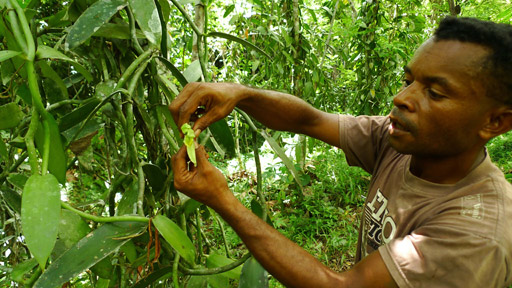
Gentle handling: A vanilla farmer pinches vanilla pods to help pollination. Farmers in Serui, Yapen Islands regency, Papua, are starting to cultivate vanilla for export to Europe and the US. (JP/ Prodita Sabarini)

Returning to the land may be one way to improve food security and welfare in Papua. The Jakarta Post’s Prodita Sabarini was recently among a group of journalists invited by the Britsh NGO Oxfam to examine a few of their programs in Serui and Jayawijaya regencies in Papua. Below is her report.

Seth Jenggo Mora sits under vanilla vines in Serui, a town in Yapen Island off the northern coast of Papua that resembles a bird’s neck. He sings a Yawaunat tribe song about the perils of leaving one’s home. “If I leave and return to my village/what will I have there?” he sings. “If we go abroad, when will we become a man?”

His red lips and teeth, reddened from chewing betel nuts for more than half a century, formed a smile as he finished his song. From Yapen where Serui lie to hamlets in the central mountains of Jayawijaya, traditional songs hold a deep meaning in Papuan culture. When reporters and NGO workers visited a village in Piramid district of Jayawijaya regency, Papuan men greeted visitors with tearful alments expressing their gratefulness of having guests from faraway places.

The song that Seth sung has relevance in today’s Papua, where urbanization has taken some of the young away from the rural areas to the big cities, leaving the traditional farms neglected.

As indigenous Papuans trail behind in education and economic power compared to migrants from Sulawesi, Java, or Sumatra, some young people who live in the cities end up turning to petty crimes or prostitution.

A large number of residents have contracted HIV, sending the number of infected people to the roof. According to the Health Ministry, Papua has the highest number of HIV infections in Indonesia, recording 7,572 cases between 1987 and 2012.

The Central Statistics Agency (BPS) said that urbanization in Papua has increased by 3.76 percent between 2000 and 2010, when 25.96 percent of the population, or 735,629 people, lived in cities, compared to 22.2 percent a decade before.

In Papua, more than 70 percent of the people live from farming. Taking extractive industries out of the equation, agriculture contributed 25.74 percent to Papua’s gross domestic regional product (GDRP) in 2012.

The mining industry in the resource-rich province contributed 46.52 percent to Papua’s GDRP in 2012, but absorption of local workers has been low. In 2010, only 26,747 people, mostly migrants, worked in extractive industries. In Timika, more than 70 percent of the population are migrants, according to the 2010 census.

As agriculture holds an important role in the lives of indigenous Papuans, developing the local economy by empowering farmers might help realize their basic rights for sustainable livelihood, according to Rio Pangemanan from Oxfam, which has a number of programs involving farmers in Papua.

Farmers and NGO workers in Papua report that a change of eating habits, with the introduction of rice as staple food from Java and with the government programs of rice for the poor, has jeopardized the self subsistence of villages and the livelihoods of young people in Papua.

Jayawijaya Agriculture Agency head Paulus Sarira said that five years ago, 94 percent of the population consumed sweet potatoes as their main staple. “Now only around 16 percent of the people consume sweet potatoes. Some have turned to eating rice,” he told a seminar on food security in Wamena early this month.

Chris Manuputty, the special assistant to the Jayawijaya regent for governance and social welfare, said that the unchecked change of eating habits from sweet potatoes to rice might lead to a food crisis in Wamena in the coming years.

Petrus Wenda, 70, a farmer from Yonggime, a hamlet in Piramid district in Jayawijaya, is one of the local farmers who mourn the loss of young people from his village. In his sweet potato farm in the Baliem Valley of Jayawijaya, Petrus told visiting reporters that sweet potatoes were part of his culture. Small framed, Petrus became animated in telling the story of the benefits of sweet potatoes, or hipere in the local language.

He stepped back and jumped over an irrigation ditch to better express his feelings. His voice became louder and his movements became more animated. “See my right arm? I can defeat five men with this,” he said while stretching his right arm. “See my left arm? I can defeat five more with this,” he said, reaching out his hand. Petrus then stretched his right leg and said “I can kick with this”, displaying how hipere made him strong and healthy. “Rice tastes good but it makes your stomach ill,” he said.

There is a reason why Petrus is so passionate about sweet potatoes. According to him and other elders, the introduction of rice has made young people leave the villages for the city to earn money so they can buy rice instead of preparing their land for the women to grow sweet potatoes.

“A lot of young people go to the city and become robbers. They live there [in cities] and they end up dead,” Petrus said. “Now young people don’t want to plant sweet potatoes. All of them think they can make money in the city. In fact, the money is here,” Petrus said.

The Jakarta Post | Reportage | Wed, March 27 2013

Paper Edition | Page: 8