Silver lining for gay and lesbians
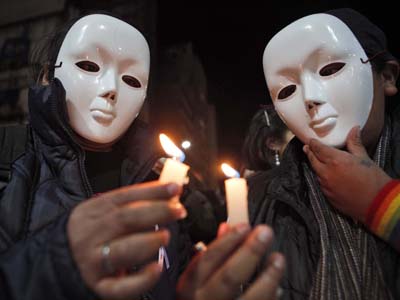
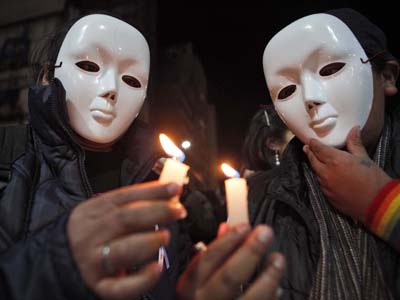
Seek the light: Activists wearing masks hold up candles during a demonstration marking International Day Against Homophobia in La Paz, Bolivia, on May 17. According to LGBT leaders, 24 people from the LGBT community have been murdered in the last 18 months in Honduras because of their sexual orientation. AP/Juan Karita

Fady, 29, limits his imagination to the future of his relationship with his boyfriend.

A closet homosexual, except to a few very close friends, he keeps his sexual orientation a secret.

“I have a lot of things to consider if I come out to people outside my [circle] of close friends. I don’t have enough energy and time to go through that,” he said.

For him and his boyfriend, what they have is the present. He said he would be happy enough if he could be with his partner for the next year.

“We don’t think about how it would be when we’re old and etc,” he said.

In the country’s strong heterosexist culture, LGBT (lesbian, gay, bisexual, transgender) people are either hidden or marginalized. Most LGBT people in Indonesia face rejection from families when they “come out” and are discriminated against by the system.

But, the country’s LGBT and liberal human rights groups are slowly working to fight the stigma of a lewd, mentally disordered lot attached to the LGBT community.

One of the country’s gay rights
organizations, OurVoice, is campaigning to fight homophobia in conjunction with the International Day of Anti-Homophobia that falls on May 17.

May 17 has been commemorated as the International Day Against Homophobia (IDAHO) since 1996, after a conference on gay rights in Montreal, Canada.

The date, May 17, was chosen as the symbolic day, as it was on this date the World Health Organization scrapped homosexuality from the list of mental disorders. The American Psychiatric Association stated in 1975 that homosexuality was not a mental disorder.

In 2006, the Yogyakarta Principle, a guideline of International
human rights law in relation to gender identity and sexual orientation was signed.

Despite that, persecution against LGBT people still takes place around the world. According to OurVoice, there are more than 70 countries that criminalize a person based on sexual orientation and gender identity.

In Indonesia, regional bylaws in South and West Sumatra criminalize homosexuals and the 2008 pornography law states that homosexuality is a deviant behavior despite the Health Ministry’s declaration in 1993 that homosexuality is no longer a mental disorder/disease in their Diagnostic Classification on Mental Disorder Guidelines (PPDGJ).

Fady said he did not know that such a day commemorating the rights for LGBT people existed. He said it was a good thing that a group of people in the world was concerned for LGBT people, although it didn’t affect him much, he added, as he kept his relationship with his partner a secret.

But for Ramy, a 20-year-old lesbian, that day is very important. While Fady keeps his sexual orientation and relationship a secret, not daring to imagine the future, Ramy said she would make sure to follow her own life path. “For the next couple of years, I will make sure I will have a relationship, like it or not,” she said. “I will be true to myself and not undermine my true self to please society,” she said.

Strong unity: Youths take part in a rally near the presidential house in Tegucigalpa on International Day Against Homophobia on May 17. Reuters/Edgard Garrido

Ramy, who chose not to disclose her last name, said her family learned of her attraction to the same sex in mid-2009. “My brother suspected that I liked women. I’m a tomboy, and he started to be suspicious. He followed me and found me with my girlfriend and took me home,” she said.

Her family interrogated her, asking why she couldn’t be “normal”. “I just told them that I was just following my heart; that I desired a woman,” she said.

Ramy said her family took her to an Islamic boarding school that treats “drug addicts and stressed out youth”, where she had to bathe in water mixed with seven kinds of flowers in an attempt to “cure” her.

After two months at the boarding school, Ramy, who lives with her mother, never brought her partner to her parent’s house again.

“My wish in the future is that my family can have an open mind and not be as rigid as now,” she said.

Ramy said that, among her friends and colleagues, she does not hide her homosexuality. “The first time they found out they were surprised, but later they said, ‘It’s her life,’” she said. “While my friends at work, luckily they are people who mind their own business,” she added.

When her colleagues found out, Ramy said that usually the first thing they would say was, “How did that happen? Since when?”

“My friends were surprised at first but later got used to it, while my colleagues at work mind their own business,” she said.


In urban areas, public knowledge, awareness and acceptance of homosexuality have increased compared to 10 years ago, general secretary of OurVoice, Hartoyo, said. Films with themes of homosexuality have been well-accepted, such as Nia Dinata’s Arisan! (Savings Gathering). A gay-themed film festival, Q Film Festival, also has been successfully running for almost 10 years.

“I think people are more accepting. Not that I’m saying they 100 percent accept [LGBT people], but information about LGBT is more open, which enables communication to happen,” Hartoyo said.

Hartoyo himself has experienced discrimination and abuse due to his sexual orientation, when in 2007 policemen in Aceh abused and tortured him for having homosexual relations.

Hartoyo said LGBT people gathering at places such as gay bars and clubs in big cities also indicated people were accepting.

Another example of how society is accepting — to a certain extent — towards LGBT people can be seen in Dino’s (not his real name) experience. Dino, a straight guy, pretended to be gay so he could live with two girls in a shared house without arousing suspicion and rejection from surrounding neighbors.

Dino said that to live in the house in South Jakarta, his housemates suggested that he pretend to be a stereotypical gay man by acting effeminate.

“I’d heard that some people protested when a guy lived in the house before I moved in,” he said. “When he moved out and I was about to replace him, my friends told me to act gay,” he said.

“My neighbors feel that their space needs to be protected,” he said.

Dino said that this could be an indication that LGBT people were more accepted, but he doubted that if an “outed” gay couple lived in the neighborhood, people would be as accepting.

For Hartoyo, it comes down to society’s perception of sex and the lack of sex education. “Sex is seen as sacred and on the other hand dirty.

“What is sacred is heterosexual relations under lawful marriage according to religious laws. Outside of that, sex is considered dirty, which means homosexual and lesbian sexual relations and heterosexual relations outside of marriage,” he said.

He said that there was a lack of sex education in the country. “Sex is always a taboo and feared. Sex education is something that is feared, with the assumption that by giving sex education people will have sex,” he said. “That’s not the case, and the state should not have a phobia of sex,” he said.

“When talking about reproductive health, safety, equality and justice, relationships do not have anything to do with halal (allowed by religious law), but mutual respect and understanding,” he said.

He said if a sexual relationship was based on equality between partners, it should not be considered a public matter. “Unless there is discrimination and violence, then what’s private can be a public matter,” he said.

Prodita Sabarini, The Jakarta Post, Jakarta | Life | Sat, May 21 2011
A beautiful mind

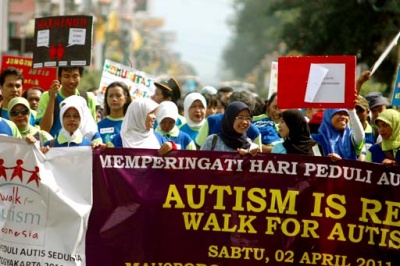
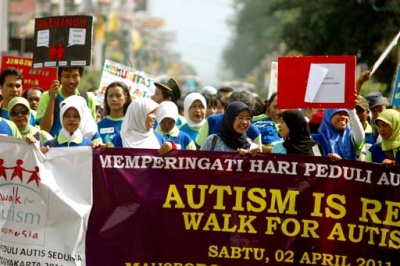
Showing solidarity: Participants to the World Autism Day held on April 2 walk down the streets of Yogyakarta. Antara/Wahyu Putro

For the first 10 years of her son’s life, Sri Astuti never heard him utter a word.

Her son Raditya Parasadi is autistic. When he was growing up, information on autism was hard to come across, Sri explained.

Now, 13 years later, Raditya communicates freely. He can hold conversations on various topics from religion to marriage. He also has a penchant for designing clothes.

While he has now blossomed into a talented young man, Sri said raising an autistic child wasn’t easy, mainly because society perceives autistic children or people as strange and freakish.

Raditya once worked in a hotel, Sri said, but when his old boss moved on, Raditya was laid off because his new superior wasn’t open to having an autistic employee.

Actress-cum-activist Christine Hakim recently launched a campaign to eliminate the negative stigma surrounding autism, which was accompanied by a documentary film on autistic children.

Christine, through her foundation Christine Hakim Feature, aims to educate the public about autism.

“People say the [autistic] children looks crazy, while in fact they [children] are not. We have to approach them to understand them,” Christine said during the launch of the documentary.

For her campaign, Christine is working with neurologist Andreas Harry as a producer and advisor, and Ricky Avenzora, a lecturer in child recreation and disabilities, as a documentary film director.

Sri said that meeting with Christine, Andreas and Ricky was like a miracle.

“I don’t shed tears anymore. I’ve cried too much already,” she said.

“I say stop the tears. Don’t be sad. It’s a miracle from god. Our child is a gift we should care for. Give as much love as you can,” Sri said.

Autistic children and their parents gathered recently in a restaurant in a central Jakarta office tower for lunch. They came to share their stories and watch an extract of the documentary film on austistic children Love Me as I am.

Christine, award-winning actress who has produced documentaries on Indonesian heritage, started doing research for the documentary on autism in January this year. The film’s launch on April 1 was meant to coincide with Autism Day on April 2. Christine plans to screen the documentary film in schools, to change the perception that autistic children should not attend regular public schools.

Studying in a regular school allows autistic children to interact with other children who aren’t autistic, she went on. Children who aren’t autistic also benefit because they get to know about autism, and stop stigmatizing it.

Documenting the lives of autistic children and their families has been both painful and inspiring for Christine. She said she wanted to educate people about what autism was really about.

Autism is not a disease, according to the medical community, Andreas said. It is a syndrome caused by a different anatomic structure in the brain, Andreas explained. Difficulties in verbal and non-verbal communication, including difficulties making eye-contact; unstable emotions and having one repetitive single interest were the general symptoms of autism.

According to Andreas, the film plays an important role raising awareness about autism among society.
“There are more children born with autism than before,” he said.

In 2008, eight out of 1,000 babies were born with autism, compared to one in 1,000 in 2000, Andreas stated.

Andreas, whose child is autistic, said autistic children had great potential in several fields. “My child is a doctor at 21,” he said.

He added that researchers in the UK claimed Einstein might have been autistic. He has symptoms of Asperger’s syndrome, which is a form of autism.

The documentary recounts the stories of autistic children with exceptional talents. One of the talented children is 7-year-old Michael Anthony. He is autistic and blind.

The sound of his fingers dancing on the piano keys comes out like that of an adult maestro playing classical music. Christine said that listening to Michael play brought tears to her eyes.

Michael can play around 100 songs, including sonnets from Mozart, Bach and Beethoven. His mother said he first listened to his brother playing the piano, and then started to play around with the piano himself.

Andreas said that at his age, Michael could still be exposed to different areas of interest. Music might just be one of many areas Michael possesses talent in, he said.

“He might have more than one talent,” he said.

Emilio, another autistic child, does paintings with vivid colors. One of his paintings could have sold for US$5,000, but Emilio and his family declined to sell it.

Christine said it was important for the government and the public to get rid of any misconception about autistic children. The latter should be allowed to study in public schools and interact with non-autistic children, she said. Denying them a place in regular schools was a violation of human rights.

“Because our principle is education for all,” she said.

Irma, a mother of two children, said her autistic son had learned to interact socially with his younger sister, who isn’t autistic.

Christine explained that autistic children improved their social skills when studying alongside other children in regular schools. Children who are not autistic care more for their autistic friends and help the latter at school.

She cited as an example Global Mandiri School, which has 59 autistic students.

“The students [who are not autistic] do not tease their autistic friends. They are caring and they help them out,” Christine said.

Andreas added that autistic people could have an independent and meaningful life.

“In the end they are able to fall in love and form families. We want to go to that direction,” he said.

Prodita Sabarini, The Jakarta Post, Jakarta | Life | Wed, April 13 201

The love life of transsexuals

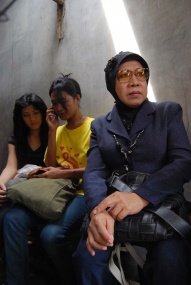
Caring souls: (From left to right): Adel, Shanti and Nency sit in a waiting room at Cipto Mangunkusumo Hospital, in Salemba, Jakarta, after fellow transsexual and AIDS activist Shakira was shot by unidentified assailants at Taman Lawang in Central Jakarta at dawn last month. JP/Wendra Ajistyatama

For many transgendered women, loving a man means letting him go. Only few dare to wish for an everlasting romantic partnership.

Yuli Rettoblaut, Mariyani and Rully all share the same story: They were in long-term relationships where they eventually told their partners to leave them and marry a “real” woman.

“I feel I’m destined to not have a partner,” Rully said in Yogyakarta.

Rully said she had been in a 7-year relationship with a man. Being a devout Muslim, Rully encouraged him to find a wife. “Whenever we talked about children and other stuff, we came to a dead end. I suggested he end this [relationship] and marry [another woman],” she said.

In the beginning, her partner refused to leave her but eventually agreed to end the relationship.

“I’ve concluded that it’s enough to feel love in our hearts; we don’t need to have it written down because there is controversy [in the issue of same sex or transgendered marriages], and we might not have the courage to always be known as something that defies long-held rules in society’s norms,” she said.

Those who do marry often come to loggerheads with Indonesian law. Recently, Fransiska Anastasya Oktaviany, also known as Icha and Rahmat Sulistyo, 19, was arrested for alleged identity fraud. Icha had been married for six months to Muhammad Umar, 32. Umar said he did not know Icha was a transgendered woman.

Hartoyo, director of LGBT rights organization Ourvoice, said in a press statement that Icha’s gender identity and sexual orientation was Icha’s and Umar’s private concern. “However, Icha has a different gender role and sexual conduct so she had to forge her identity card. The problem of why Icha forged her identity should be highlighted by the State… Many transgendered people do the same thing, and some of them are permitted by local authorities to change their sex on their ID card,” Hartoyo said.

Despite the fact that the State, through the Ministry of Health in 1993, has stated that homosexuality, bisexuality and transsexuality are not diseases or mental illness, the 2006 Demographic Administration Law has not accommodated transgendered people as a separate identity and still designates gender identity according to physical anatomy, Hartoyo said.

Mariyani, who runs an Islamic School for transgendered women, once encouraged her partner to leave her and marry another woman. But, after that relationship, she found someone new and was married under religious law.

“A female religious leader married me off,” she said. Her husband apparently already had a wife and children, so Mariyani and her husband separated. Mariyani adopted a child and decided to live on her own with her daughter.

Lulukaszyura Surahman (Luluk), 28, said until a couple of years ago, she wouldn’t admit she was a transgendered woman. “I felt I was a woman and I was very against telling people that I’m a waria [transgendered],” she said.

Men would court her, and she would be responsive. Eventually, she would ask her friend to tell the man courting her that she was a transgendered woman. “They usually disappeared after that,” she said.

Now she tells people from the start that she is a transgendered woman.

“So, he would know from the start,” she said. Luluk added that she would not want to stay single the rest of her life.

“It doesn’t feel good to be alone all the time,” she said. “Every person wants to love and be loved,” she said.

— JP/Prodita Sabarini

Prodita Sabarini, The Jakarta Post | Feature | Mon, April 11 2011

Life as a (special) woman

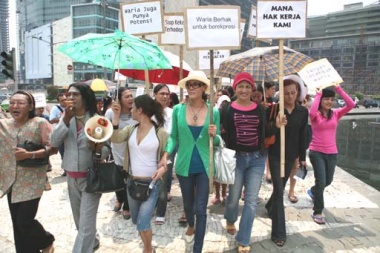
Action time: Dozens of waria who are members of a solidarity network gather for a protest at Hotel Indonesia’s traffic circle. JP/Arief Suhardiman

What makes a woman a woman? What makes a man a man?

For Lulukazyura Surahman (Luluk), 28, being a woman is a question of identity. It is all in the mind and in the way one behaves. It has little to do with one’s sexual organs.

“I’m a woman even though I have a penis,” she said. “I’m a woman, but I’m special.”

And a beautiful one she is. With long black hair, curly lashes and a big easy smile, she said people often did not realize she was transgendered.

Luluk struggled with questions of identity while growing up, from forcing herself to act manly to questioning God. But, despite her struggles to accept herself, Luluk is one of the lucky ones. Her family, with a moderate Muslim Nahdlatul Ulama background, never rejected her for being transgendered and made sure she completed her education until university level. She got her undergraduate degree in sociology and worked as an activist at Srikandi Sejati, an organization that works with LGBT issues.

Other transgendered women have not been so lucky while undergoing the soul-searching process of accepting their gender identity. Often they embrace their identity at the expense of rejection from family and society.

Once they have established their gender identity and found peace with who they are, issues of societal acceptance like teasing and barriers in the workplace continue to haunt their lives.

Many transgendered women end up on the streets and disconnected from their families, while at the same time isolated from mainstream society. Living in exclusive transgendered communities, they busk on the street or solicit sex for money or to find sexual partners.

Vinolia Wakijo, 51, the founder and director of the Yogyakarta Transgendered Women’s Organization (Kebaya) said a lot of transgendered women lived a life steeped in violence.

“They lack social experience since they leave their families at a young age. Life on the street is harsh, especially in the [transgendered] community. Where do they learn ethics? They race to get the best in whatever way. In the end, they live a harsh life,” she told The Jakarta Post at Kebaya’s headquarters in Yogyakarta.

In Jakarta, the transgendered women’s community hangs out at Taman Lawang park. That is where Faizal “Shakira” Harahap was shot earlier this month. Shakira, a transgendered woman, was killed and two other transgendered women, Agus “Venus” Yuliaman and Tantang “Astrid” Stianugraha, were injured. The police are still investigating the case.

In Aceh, Cut Yanti Asmara, a transgendered woman who worked at a moving beauty salon, was killed last week. The suspect, Fuadi, is now in police custody. He allegedly called Cut Yanti “bencong” which loosely translates as “tranny”. Yanti became enraged and came at him with a knife and was reaching for a shovel when the latter allegedly hit her with a crowbar.

In 2008, the Central Jakarta Public Order Agency was accused of violence that led to the death of a transgendered woman in Taman Lawang. The transgendered woman died after leaping into the Ciliwung River while fleeing a hail of stones thrown by public order officers.

Transgendered women in Indonesia are prone to becoming victims of violence, starting from the rejection of their families to cheating customers and bigoted strangers.

For Lenny Sugiharto from Srikandi Sejati, transgendered women have to be emotionally stronger in dealing with mocking and teasing from people.

“When one has chosen to live their life as a waria they have to be ready for the consequences,” she said. She added, “don’t let the teasing get to you.”

Discrimination against transgendered women in the workplace is also a huge problem. Up to now, Indonesian society accepts transgendered women only in specific areas, such as beauty salons and the entertainment industry.

Rully, 50, had to give up being a teacher in a school in a remote area in West Sumba. Raised in Makassar, South Sulawesi, Rully, who has dressed as a woman since she was a child, defied the education system in the early 1980s and presented herself in class as a transgendered woman.

Rully explained to her students from the beginning that she was a transgendered woman. “So they don’t develop the wrong understanding about waria,” she said,

She taught third to sixth graders. “Almost all the students respected me. [There were] only one or two cases, for example a student once said ‘trannies like to suck d*cks’. They didn’t know that I am a devout Muslim. In the early struggle this really hit me hard,” she said.

In the end, Rully felt pressured by the education agency. The head of the provincial education agency called her in. “I was summoned because I’m a waria,” she said.

In the one year that Rully taught, she concluded that mentally she was not ready to “go public” as a transgendered woman. “Almost every day I waste my energy with conflicting thoughts,” she said.

She resigned from being a civil servant. Rully now works with Vinolia in Kebaya as coordinator for support for transgendered women.

While, Luluk and Rully are transgendered women who received family support early in their childhood and completed their higher education without having to run away from home, Vinolia experienced the “dark side” of being a transgendered woman — working as a sex worker.

Mariyani, the founder of an Islamic school for transgendered women in Yogyakarta, led a similar path, living the life of a sex worker before settling down and setting up a beauty salon and in 2006 an Islamic school.

From her work at night, Vinolia was exposed to the outreach activities of Yogyakarta PKBI (Indonesian Planned Parenthood Association) and became a volunteer herself.

Vinolia said many transgendered women are not confident interacting in the community. Constant rejection and mocking from society causes them to have low self-esteem. Vinolia said transgendered women should push themselves and talk to their neighbors and be social. Both Vinolia and Mariyani joined an arisan (savings gathering) with women in their respective neighborhoods in order to be social and accepted in the areas they live in.

But, even among transgendered women their gender identity can be different from one another. Luluk believes she is a woman, and is open to the possibility of a sex change. Meanwhile, Rully, Mariyani and Vinolia believe they are waria (transgendered women).

“We’re women at heart, male physically. These two things together build what is man and women,” she said.

“We are transgendered physically and mentally,” she said.

“I will not have an operation,” Mariyani said. “I don’t want to defy God’s laws.”

She said that as long as she still feels it is a sin, she will never undergo a sex-change operation.

“I’m satisfied like this, I feel pleasure like this, I’m comfortable like this,” she said.

Prodita Sabarini, The Jakarta Post, Yogyakarta/Jakarta | Life | Mon, April 11 2011

Vinolia Wakijo: Living for others

up p28-a_205.img_assist_custom-400x267

LGBT activist Vinolia Wakijo didn’t see herself as a transgender woman. “I thought I was just feminine and liked to wear make up,” she said.

She didn’t identify with the image society had of transgender women — heavily made up individuals wearing short skirts and tank tops, either working in beauty salons or soliciting sex.

“I was afraid of [transgender women wearing heavy make up],” she said.

But, after a couple of failed relationships, Vinolia eventually joined the ranks of prostitutes working throughout the night, often associated with waria (transgender women).

Vinolia doesn’t regret the turn of events in her life.

“If I hadn’t gone through this, I wouldn’t have founded Kebaya,” she said.

She has accepted herself as a transgender woman and is now one of the figures working for the rights of waria.

Vinolia, popularly called Mami Vin, is the founder and director of Kebaya, a Yogyakarta-based NGO that focuses on reproductive health issues for transgender women, including the prevention and treatment of HIV/AIDS.

Volunteers from the Indonesian Planned Parenthood Association (PKBI) in Yogyakarta approached her while she was still earning a living as a sex worker. She joined the PKBI in 1993 as an outreach officer for waria and street children and worked there for 12 years, until  seven transgender women in Yogyakarta died in 2005.

After holding a conversation with a doctor in 2005, she shifted her focus to assisting transgender women living with HIV/AIDS. Transgender individuals and transvestites are one of the high-risk groups for HIV/AIDS, together with injecting drug users, sex workers and homosexuals.

“The doctor said they would all die if no one took care of them,” she said.

So, in 2006, she founded Kebaya and helped 12 waria who were ill that year.

Kebaya has so far provided assistance to 56 waria, by giving them a shelter during their HIV treatment and accompanying transgendered women who need guidance at hospital. Vinolia said eight of them had died so far, while the others had returned to their respective houses and continued on with their lives.

The organization is not only known in Yogyakarta. Kebaya has acquired a reputation for providing assistance to waria from many places who need treatment for their illness.

When The Jakarta Post visited Kebaya’s headquarters in Gowongan, Yogyakarta, Wendy, a transgender woman from Medan, North Sumatra, was taking shelter at Kebaya.

Vinolia explained that Kebaya’s biggest obstacle was funding. A year after establishing Kebaya, USAID agreed to provide funding for one year, Vinolia said.

The Social Services Ministry also funded small- and medium-sized enterprise programs for waria.

According to Vinolia, 10 out of the 15 people who were given Rp 10 million (US$1,000) worth of capital to start a business have established successful ventures.

Kebaya also opened a small shop to help fatten the organization’s cash flow, but the shop folded after two years as many of the waria customers wouldn’t pay off their loans with the shop, Vinolia said.

She explained the problems the waria community face were indeed complex, ranging from discrimination and violence against waria to health issues and internal problems between transgender women.

A lot of transgender women leave their homes at a young age. Vinolia also said waria had a very low self-esteem.

“This may be caused by a lack of social interaction when growing up. When they leave home, they live on the streets. Street life is harsh; there are no lessons in ethics. Everyone races to get the best through whatever means they can. They found a life of violence,” Vinolia said.

She added that all she could do was assist waria who needed help during their treatment and advise them how to live in a healthier way.

Vinolia’s vocation as an activist started when she joined the PKBI as an outreach officer for waria and street children. She lived with street children at Lempuyangan Station in Yogyakarta to protect female street children from sexual abuse by other street children.

She would sleep in the mosque, and tell the female street children to sleep near her, so boys wouldn’t dare approach them.

It was hard for her to leave the street children to focus on waria. Because she felt warias living with HIV/AIDS needed urgent care, she made the decision to found Kebaya.

“It was really hard to leave them [street children], but they sometimes visit,” she said. Vinolia also informally adopted two street children.

Vinolia’s adopted son Agus, now 32, said his adoptive mother was a caring person who focused on helping people.

“I owe a lot to Mami Vin,” he said. “She lives for others.”

Prodita Sabarini, The Jakarta Post, Yogyakarta | People | Wed, February 23 2011

Mariyani: Religious differences not a problem for ‘waria’

P28-A2_0.main story

Amid the recent news of religious fundamentalism spurring violence against minority groups like Ahmadis and Christians, one Muslim transgendered woman is demonstrating the openness of Indonesian society by offering up her Islamic school to fellow transgendered Christians for masses and prayers.

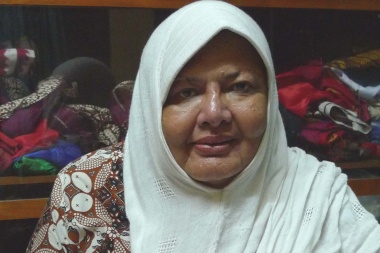
Mariyani, 51, is built like a large matriarch. The transgendered woman has received local and international media attention since 2008 when she transformed her home in a small alley in Notoyudan hamlet, Yogyakarta, into a place for transgendered women to study Islam.

She began Pesantren Waria with Koran readings and prayers every Monday in order to provide a space for transgendered women who were also Muslims to feel comfortable in practicing their faith.

The term waria comes from wanita (woman) and pria (man), and is used to describe people who are born with male reproductive organs but with a female gender identity, i.e. transgendered. Waria decide on their own whether to wear sarong during Islamic prayers — as men do — or to cover their bodies with the mukena — as women do.

Mariyani’s home-turned-school has become a place for waria to seek spirituality and refuge. Recently, a 19-year-old transgendered woman who learned about the school from newspaper articles and the Internet left her hometown in Lombok, where her family was having problems accepting her gender identity, to stay at Mariyani’s place before finding a job at a department store.

Wearing a black hijab, Mariyani said she aspired to provide Christian (Catholic and Protestant) waria a place to congregate.

“Here, the waria who are Christians — they don’t have a place to gather to hold mass. I would like to provide a place here, as long as it does not coincide with the pesantren’s activities,” she said.

She plans to invite her Christian friends from Yogyakarta, Malang, Surakarta, Banyuwangi and Surabaya to come on March 15.

“I invite waria from any religion to worship here. If they don’t have a place, my place is open to them,” she said.

“We want to embrace every religion together in peace. Every religion is good. There are no religions that are bad. Humans are the ones who are bad.”

Mariyani, popularly called Bu Mar or Mbak Mar by friends and neighbors, recently registered the school through a notary – a move to give her school legal power if members of the public ever protest.

She plans to request permits from the local administration and the police in order to open up her home to Christian waria for worship.

“We don’t want what happened in Bekasi or Temanggung to happen here,” she said, referring to conflicts between radical Islamic groups protesting the presence of a Christian congregation in Bekasi and the recent attacks on churches in Temanggung. “If I don’t get the permits, I won’t be able to do this.

“My intentions are good. If people want to raid me, go ahead. But, thank God, in the three years the school has been open there have been no objections whatsoever,” she said, adding that the Yogyakarta Ulema Council even invites her to their events.  Mariyani said people in Yogyakarta were tolerant for accepting her school. Raised Catholic by adopted parents, she converted to Islam as an adult, and said that religion could be helpful in leading a person to a better life.

“It can help waria think in the long-term and help them make better decisions.”

She explained that being in touch with their spirituality helped transgendered women to make good life decisions. A lot of transgendered women live from one day to the next as sex workers, she explained.

Mariyani also once lived that lifestyle, working as a prostitute in Jakarta before returning to Yogyakarta and starting work at a beauty salon.

Mariyani said her Islamic school didn’t attempt to turn transgendered women into men.
“My intention is to worship God. I don’t care what people say.”

To people who say that being a transgendered woman is wrong, she says: “That’s a human trying to act like God. Whether God accepts acts of worship, that’s His concern. One’s sex does not determine whether one goes to heaven or not. Their faith in God does,” she said.

But, Mariyani does not just want to give Christian waria a place to worship.

Speaking in Yogyakarta’s alun-alun, she candidly said she also wanted to give transgendered women a chance to have a dignified burial when they pass away.

“I want to invite Christians to be able to practice their faith. When they pass away someday, the Catholic or Protestant churches can provide a coffin and burial.”

But, she wants to be able to provide more than just the simplest of burials for waria.

She is planning to speak to the Yogyakarta Interfaith Forum about her plan.

Many transgendered women, because of difficulties with their families, leave their homes when they are young and live on their own with fellow waria. Some end up living penniless on the streets, Mariyani said.

Transgendered individuals and transvestites are also among the high-risk groups for HIV and AIDS, together with injecting drug users, sex workers and men who have sex with men.

The idea to provide Christian transgendered women a place to congregate arose after she attended the funeral of a transgendered woman given by the city’s Social Affairs Agency.

“It was like burying a cat. The burial space was so narrow. They put the body in and covered the ground,” she said. “It was already very gracious of the Social Affairs Agency to provide the burial for a waria.”

However, Mariyani hopes transgendered women will be able to receive better burials.

Prodita Sabarini, The Jakarta Post, Yogyakarta | People | Wed, February 16 2011

HIV-positive women resent sterilization advice

Sharing a nice moment: D’Tri (left), Miss Indonesia’s finalist from Jakarta, and Inka, another Miss Indonesia finalist from East Kalimantan, talk to Asti and Yuli, two women with HIV/AIDS who are undergoing treatment at the Darmais Hospital in Jakarta. JP/J.ADIGUNA

Her eyes welled up at the thought of her late husband who died four months ago. At 25, Cahaya is a single mother who runs a small store in front of her parent’s house in Jakarta.

She is uncertain about her future. She said she was not sure whether she would find another man in the future who would ease her lonely struggle.

The small-framed woman is HIV positive. But no one in her family knows she is, she said. “It was just between my husband and I. We used to be able to talk about it together.”

After giving birth to her second child two years ago, a doctor in a central hospital in Jakarta advised her to undergo a sterilization procedure because she is HIV positive. And so she did.

“The doctors said that I should be sterilized because my husband and I were both [HIV] positive,” Cahaya said, despite the existence of the PMTCT (Preventing Mother-to-Child Transmission) program that enables mothers to give birth to children without transmitting the virus to their child.

Cahaya, a homemaker before her husband died, contracted HIV from her husband. She did not know he was a former drug user when she married him. A month after they tied the knot, she fell pregnant. Nine months after the birth of her first child, the baby died of severe diarrhea. The doctor told her to get her blood tested. She found out she was HIV positive.

During her second pregnancy, Cahaya followed the PMTCT program, taking Anti Retrovirals (ARV) and undergoing a C-section, which was free under a government and National Aids Commission program. Her two-year-old daughter is healthy and HIV negative.

“We were concerned the hospital would make it hard for us to access the PMTCT program if we did not agree to the sterilization,” she said.

Two months ago, Cahaya met a fellow HIV-positive patient at the hospital when she was about to get her ARV.

The woman had just given birth to a baby and Cahaya asked whether she had been sterilized. “She said she hadn’t. I was so shocked. Why did the doctor tell me I had to be sterilized?” she said.

“I still have a long future ahead of me. If I meet someone, he will probably want to have children,” she said. “I am even thinking I might stay alone for the rest of my life and not remarry.”

Despite the implementation of PMTCT program some doctors in Indonesia are still advising HIV positive women to get sterilized. Oldri Shearli from the Indonesia Alliance of Positive Women (IPPI) said patients and doctors’ lack of awareness about women’s reproductive rights is the main problem.

There were 21,770 reported cases of HIV and AIDS in 2010, according to Health Ministry Data.

Around 25 percent of the people affected are women. More than 70 percent of HIV-positive women are in their reproductive age. The rate of mother-to-child transmission in 2010 is 2.9 percent.

The most common way HIV is transmitted is through sexual relations between heterosexuals (50 percent). HIV can also be transmitted by sharing needles or injection equipment with an injection drug user who is HIV-positive (40 percent), and 3.3 percent of HIV cases are transmitted through men having sex with each other.

Head of the National Aids Commission Nafsiah Mboi said doctors should no longer be advising HIV-patients to be sterilized.

Oldri said when HIV and AIDS had just entered Indonesia and the services for ARV treatment were not yet in place, doctors were advising HIV patients to get sterilized to prevent mother-to-child transmission of the disease. But with the publication of PMTCT guidelines from the World Health Organization, doctors should have stopped giving such advice by now.

Nafsiah said current studies have shown that normal delivery was recommended for HIV positive women who have undergone an ARV regime. “Unless there are signs the mother’s health is poor,” she added.

However doctors are still using their authority to advise HIV-positive women to be sterilized, not only in Jakarta, but also in Bandung and Bali.

In Bali, the Sprit Paramacitta Foundation, an organization focusing on HIV and AIDS issues, stumbled upon a woman whose pregnancy was terminated and who was sterilized.

At the time, the foundation was carrying out a survey on the PMTCT program in Bali. During a focus group discussion, a woman became emotional and told her story about her abortion and sterilization.

“Hani” was pregnant in 2007 and was distraught because her husband was having an affair with another woman while she was pregnant with his child.

The doctor suggested she abort her child and be sterilized, because she was HIV positive and already had two children.

“She was given a form to sign stating she agreed to be sterilized. She said she was so distraught at that time that she signed without really realizing what was happening,” Spirit Paramacitta director Putu Utami said.

The hospital representative told the foundation the doctors did so with the best intentions. “They said they wanted to prevent more children being born with HIV,” she said.

Her organization recommended the hospital inform its patients of all the choices available to them, and make sure their patients were in a stable emotional state when they made a decision.

Cahaya feels her rights as a woman to make informed choices about her body were violated. Instead of asking her opinion on getting sterilized, doctors talked to her husband.

“I was being examined and we were setting a date for the C-section.”

The doctor then called her husband to talk in private and told him Cahaya should be sterilized because they were both HIV positive.

Her husband was concerned they would face difficulties accessing the PMTCT help so he signed the consent form without her in the room.

“Later, I was summoned and they explained it to me,” she said. “My husband had already signed the papers.” While the doctor talked to Cahaya’s husband a week before the labor, “Diana”, in Bandung, said the doctors had only asked her husband to sign the consent form when she was about to give birth.

She said the doctors had suggested she should get an abortion at first. “The doctor said I had a moral obligation because I am HIV positive.”

Andi Yentriyani from the National Commission on Violence against Women (Komnas Perempuan) said the doctor’s advice to get sterilized could be considered as violence against women.

“This can be considered as violence when the information given is not complete and is conveyed in a way that scares people or makes them feel intimated, which in the end result in the loss of the feeling of safety,” she said.

“Everyone has the right to complete information so they can make an informed decision and be responsible for their decision. Every doctor should carry out that responsibility,” she said.

Nafsiah said doctors should be informed about PMTCT guidelines through the health ministry and professional associations.

The Health Ministry’s director general for disease control and environmental health, Tjandra Yoga Aditama, said there were no regulations stating doctors had to advise HIV positive women to be sterilized.

“The government guarantees that all programs related to HIV and AIDS are accessible for free,” he said.

Tjandra added that the government continued to inform the general public and doctors on how to handle HIV and AIDS cases.

“For example, there is a meeting today at Sulianti Saroso Hospital about HIV. Hundreds of doctors are attending. This is an effort to continuously inform doctors about the issue,” he said.

Cahaya hopes women in the future will never have to endure her ordeal. “Don’t force women to be sterilized. Women have the right to have a family, children and grand children,” she said with a quivering voice.

Prodita Sabarini, The Jakarta Post, Jakarta | Feature | Wed, November 10 2010

Ma Jian: A note to remember

JP/Stanny
JP/Stanny

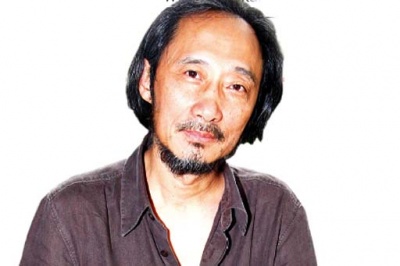
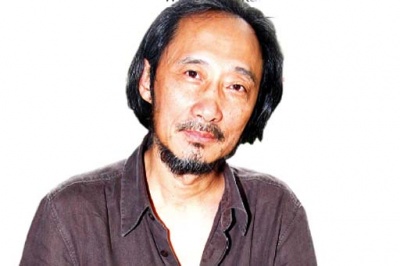
Chinese writer Ma Jian, 57, whose works are banned in his home country, never tires of reminding people of the Tiananmen Square massacre in Beijing, which took place more than 20 years ago.

His latest book, Beijing Coma, recounts the story of a young student activist who falls into a coma after being shot during the Tiananmen protests. Through Ma’s protagonist Dai Wei, the reader finds out what it must have been like to grow up under communist rule.

For Ma Jian, who was present during the 1989 protests, his protagonist’s comatose state is a metaphor for the Chinese people, who after 20 years have either forgotten or ignored the death of the thousands of unarmed citizens on June 4.

“This is a problem in Asia as well as China. As long as people’s living standards improve and they live a comfortable life, they don’t care so much about abuses of human rights,” Ma Jian said recently in Ubud, Bali, as translated by his wife Flora Drew. He noted that many East Asian countries had grown economically but remained undemocratic.

Ma said he wrote Beijing Coma “not only to remind the young people [of China] about this history they may not know about but to also tell them about the idealism and optimism of young people 20 years ago”.

But given Ma’s books are banned in China, youth there is not able to access his books freely. Ma, who lives in London, said he knew more about what was happening in China than the people living there because of the government’s tight policy on information dissemination. He also has more freedom to express his views compared to his friends who live in China.

“Some writers in China perhaps feel they have freedom of expression – that things have improved but they are fooling themselves,” he said.

“Young Chinese writers have grown up in this culture. They are somehow able to circumvent it through the Internet but they can’t use sensitive words, otherwise access to their content will be blocked,” he said.

Ma hopes the Internet will help Chinese youth read his works.

Ma and Drew attended the Ubud Writers and Readers festival. The day Ma talked to The Jakarta Post, the Norwegian Nobel Committee announced imprisoned Chinese and human rights activist and writer Liu Xiaobo had won the Nobel Peace Prize.

“These things indicate the West is putting pressure on China to respect freedom of speech,” Ma said.
Ma moved from Beijing to Hong Kong in 1987 shortly before his books were banned there. He now lives in London with Drew and their four children. Every time he came back to China, he was under constant monitoring, he said. In 1989, he joined the student protests, but a few days before the day of the massacre, Ma returned to his hometown in Qingdao as his brother fell into a coma after an accident.

Ma said that had he stayed in China, one of two things would have happened. “One, I would have remained a writer and would be in jail. Or, I would have given up writing altogether because if I cannot write freely, I would prefer not to write.”

Ma met Drew in 1997 on the night Hong Kong was handed over to China. Drew, who had studied Chinese in London, was at that time making a documentary for an American television station. She read Ma’s books, which he showed to her, and was convinced they needed to be translated into English.

After Ma moved to London, Drew translated his memoir Red Dust for almost two years while he was writing. The book about Ma’s precarious three years of traveling in China in his early 30s, at a time where travel permits were required to travel anywhere inside China, went on to win the Thomas Cook Travel Book Award.

Red Dust was published in China under a pseudonym, but only after half of the content was censored, Ma said.

Ma set off on the journey because he wanted to see China through his own eyes. He was a state journalist before and explained everything that was shown to him was pre-arranged to paint a rosy picture. When he reached Tibet, he penned his findings in his first book Stick Out Your Tongue, about Tibet’s underbelly.

China is still Ma’s spiritual homeland, which he will continue to stay connected to. He said living away from China helped him see the country more clearly, like looking at a mountain from afar.

Prodita Sabarini, The Jakarta Post, Ubud, Bali | People | Thu, October 21 2010

Paving the way for sexual rights

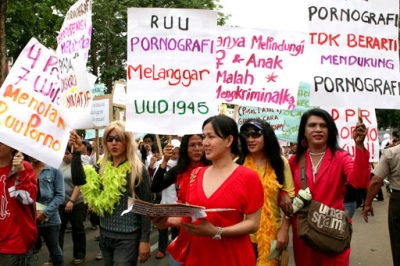
Sexual rights: Transsexuals join a rally to protest against the Pornography Law in Jakarta. JP/Arief Suhardiman

In a Semarang court in Central Java, a prosecutor groped a transgender woman charged with running away as well as having sex with a teenage girl, and said: “You have breasts, you’re a woman”.

Before the trial, the teenage girl’s family had beaten the transgender woman.

The court sentenced her to five years in prison. Soka Handinah Katjasungkana from the Indonesian Women’s Association for Justice (LBH APIK) Semarang, who advised her in her last trial, said that despite the transgender woman’s obvious violation of the children’s protection law, she had been discriminated against because of her sexual orientation.

In the country’s rural areas, parents continue to encourage their teenage daughters to marry young. But, because the charged person had defied cultural and religious norms by having same-sex relations, she was reported to the police by the girl’s parents. “Compare that to teenage girls being wed off to middle-aged men as their second or third wives,” Handinah said.

In Indonesia, where heterosexual relationships are considered the norm, discrimination and violence against people with different sexual orientations and gender identities is widespread.

However, a movement to bring equal rights irrespective of sexual orientation and gender identity by researchers and activists in Asia is gaining ground.

Handinah presented the convicted transgender’s case study at an International Policy Dialogue on sexuality last week in Yogyakarta. The three-day workshop, held at Gadjah Mada University’s Center for Population and Policy Studies (CPPS), and attended by 45 researchers and activists from India, Brazil, Bangladesh, the Netherlands, Syria, Egypt, and the Philippines, discussed issues under the theme “Bridging the gap between sexuality research and advocacy for sexual rights”.

Organized by an Asian research network for women/gender studies, Kartini Asia, and the Amsterdam-based SEPHIS (The South-South exchange program for research on the history of development), it was the first international meeting to discuss sexuality, including the rights of Lesbian, Gay, Transgender and Bisexual (LGBT) individuals, after the failed International Gay and Lesbian Association conference held in March in Surabaya that was stopped by hard-line religious groups.

In the opening speech, Muhadjir Darwin, the head of CPPS, set the tone for the rest of the conference: “[Human] sexuality is not a dichotomy, either black or white, male or female. It’s created. God created diversity. It is against humanity, against human rights, and against god’s will to discriminate against people on the basis of their sexual orientation and gender identity,” he said.

Muhadjir’s statement was still a far cry from the mainstream view in Indonesian society, Asia and around the world. According to a 2010 ILGA study, it is a crime to be gay in 76 countries.

Last year, Indonesia’s westernmost province Aceh released a bylaw criminalizing homosexuality and stipulating adulterers should be stoned to death. The controversial pornography law also criminalizes homosexuality.

But while intimidation and discrimination against LGBT still exists in Indonesia, it is also the place where the first international principles on the application of International Human Rights Law in relation to sexual orientation and gender identity, the Yogyakarta principles, were signed.

Outlined in Yogyakarta, the principles were drawn up at a meeting between the International Commission of Jurists and human rights experts from around the world at Gadjah Mada University in November 2006. The first principle states: “All human beings are born free and equal in dignity and rights. Human beings of all sexual orientations and gender identities are entitled to the full enjoyment of all human rights.”

In its third decade, Indonesia’s LGBT advocacy movement has come a long way since the 1980s when gay men, transgender and lesbian women networked exclusively through the first and — at that time — only gay magazine, GAYa Nusantara. Since then, more LGBT rights groups have emerged — such as Arus Pelangi and Ardhanary Institute — and fought for the right of sexual orientation to be acknowledged as part of Indonesia’s universal human rights.

But as the LGBT movement seeks more space in the public arena, hard-line minority groups are showing resistance through violence and intimidation, instilling public fear, said Soe Tjen Marching, the founder of two publications on sexuality.

Legal practitioners advocating sexual rights have warned that LGBT groups’ increasing advocacy work might end up being counterproductive for the LGBT movement, suggesting they should focus on winning people’s hearts first.

Ratna Batara Munti, who headed the Network of the Pro-Women’s National Legislation Program (JKP3) — an association of various NGOs, including the Women’s Health Foundation (YKP) and LBH Apik — explained that while the association was fighting for universal access to reproductive health care in the revised Health Law, a book titled Indahnya Perkawinan Sesama Jenis (The Beauty of Same Sex Marriage) was released.

Legislators shocked by the contents of the book felt compelled to push through Article 72 in the revised Health Law, stating that “Everyone has the right to a healthy and safe reproductive and sexual life, free from force and/or violence, with his or her lawful spouse”. In other words, the Health Law they passed only protects legally married couples, according to Ratna.

“Legal advocacy runs the risk of being counterproductive. There should be more advocacy work at the socio-cultural level. [Starting with] the space they [LGBT] have, in which they can work, socialize, and in some cases have relationships without being harassed — let these spaces be wider first,” Handinah said.

To address this gap at the socio-cultural level — and widen the public’s openness to different sexual orientations and gender identities, Soe Tjen runs two publications: Bhineka, a free magazine on pluralism issues and Jurnal Gandrung, a journal on critical sexuality studies.

Jurnal Gandrung, the first journal on sexuality in Indonesia, launched its first edition in June. The journal’s first essay, written by progressive Islam scholar Siti Musdah Mulia, focuses on Islam and homosexuality, calling for a reinterpretation of Islam’s understanding of homosexuality.

Kartini Asia coordinator and human rights activist Nursyahbani Katjasungkana also pointed out that the issue of sexual rights was not limited to discrimination against LGBTs. The problems with violence against women stems from the issue of sexuality as well, she said.

There is a need to link research findings and activism, Nursyahbani went on. Many studies on sexuality can be used by advocacy groups, but the problems disseminating research findings to advocacy groups hamper the exchange.

For example, bringing together researchers from different countries could create an exchange and dialogue on sexual rights issues in their respective countries.

Prodita Sabarini, The Jakarta Post, Jakarta | Feature | Wed, August 25 2010

Tesa Casal de Vela: A fine line

JP/Prodita Sabarini
JP/Prodita Sabarini

As Theresa “Tesa” Casal de Vela and her daughter joined a rally organized for Manila’s gay pride two years ago, they heard Christian fundamentalists shout at marchers that they were going to burn in hell and needed to repent.

Casal de Vela, a Filipino feminist scholar and activist, recalled her then five-year-old daughter asking: “Why are they shouting at us mama? Why are they angry with us?”

“I said ‘You know, because they think that God does not like us and that’s not true because God loves everybody’,” she went on. So when the fundamentalist groups yelled at them, her and her daughter shouted back: “God is Love”. Later on, her daughter started singing the Barney I love you song, which goes: “I love you / You love me / We’re a happy family.”

It wasn’t the last time Casal de Vela witnessed rejection from religious fundamentalist groups toward Lesbian Gay Transexual and Bisexual (LGBT) individuals. The former director of Isis International Manila — an organization that promotes women’s human rights by facilitating networking as well as information sharing between women’s movements — attended the International Lesbian and Gay Alliance (ILGA) conference in Surabaya earlier this year, which was cut short by radical groups’ disruptive behavior.

She joined ILGA in 2005 as part of Isis, one of the feminist organizations that became a member of ILGA. Her aim since 2005 has been to foster what she calls “intermovement” or collaboration between the feminist and LGBT movements. She was about to promote her message at the failed ILGA conference in March, themed “Moving Forward”. “But, in fact we weren’t allowed to move at all,” she said.

She was recently in Indonesia for an International Policy Dialogue on gender and sexuality in Yogyakarta, which ran from Aug. 9 to 11. Casal de Vela talked to The Jakarta Post about LGBT rights in the Philippines, discovering her sexuality, and the need for several levels of activism for sexual rights.

According to the 41-year-old senior lecturer at the International, Humanitarian, and Development Studies of Miriam College in the Philippines, one could argue her home country has a strong LGBT movement, with LGBTs in academia and prominent jobs in public office.

“This [state of affairs] — co-exists with a situation where we can’t get an antidiscrimination against LGBT bill passed. We have Christian fundamentalist groups protesting against a gay pride march,” she continued. There are incidences of police raiding gay bars to extort money from bail. “And if you don’t know your rights, you will let them arrest you.”

She recalled her journey in discovering her sexuality as “strange”. A heterosexual until college, Casal de Vela explored her sexuality after she became involved in feminist movements. After college, she was in a relationship with a woman and told her parents she was a lesbian. They were shocked by the news — but only for a couple of hours.

Once her family and community accepted her sexuality, she fell in love with … a man. “So I had to tell my family again. And they were like ‘Wait, we already accepted you as a lesbian’.”

So she explained to her family that she was in love with the man. “I still like women, but I fall in love with a person’s soul. You know whatever that outer part that person looks like is not my main concern.”

She eventually married the man and gave birth to her daughter. The marriage then dissolved. Casal de Vela said that she had been with her current female partner for seven years.

In the research she is currently carrying out on sexuality, preliminary findings show discrimination against Lesbian, Bisexual and Transgender (LBT) women differs depending on the group or particular identity. A bisexual woman who looks “straight” or heterosexual, will experience less discrimination in the workplace compared to “butch” or “masculine-looking” lesbians and transgender women, she added.

“For instance, my partner and I are both feminine [looking] and teachers in a school. And we’re OK. I think it’s because we’re ‘feminine-looking’ lesbians, so people can also accept that easily,” she said.

“Two feminine women with a baby, [will stimulate this kind of thought:]‘ Isn’t that nice; that’s so sweet; that’s so cute’. But people have a problem when they see the butch [looking woman] and a femme.

“It’s worse for transgender individuals,” She explained, especially for those entering the workforce.

“It’s easier to get work if you can pass as a straight person,” she said. For her research, she interviewed transgender women with PhDs who could not find jobs. “Because the only work available is in entertainment, or hairdressing, you know that kind of thing. But, they have PhDs in psychology.”

When advocating the rights of women and LGBTs, she said there should be several levels of activism, campaigning for matters which may be seen as trivial, such as the use of female public toilets for all women, including “butch-looking” lesbians and transsexuals, to promoting the involvement of LGBT individuals in political organizations.

Prodita Sabarini, The Jakarta Post, Jakarta | People | Thu, August 19 2010