‘Jurnal Perempuan’: Facing off against fundamentalism
The stronger sex: Jurnal Perempuan is currently one of the leading publications on gender, women’s rights issues and feminism in Indonesia.

The Jurnal Perempuan Foundation (JPF), which launched the country’s first feminist journal Jurnal Perempuan, has come a long way from distributing photocopied newsletters on feminism writing as complementary material at university.

Entering its 15th year, Jurnal Perempuan has significantly contributed to the development of women and gender thought in Indonesia. It is now reaching a larger audience, as the JPF is producing work in more media forms — radio, TV documentaries and a youth magazine.

At the same time, the journal is facing a new challenge in its pursuit of enlightenment and equality: The rise of religious fundamentalism.

In her public lecture on July 30, Gadis Arivia, a feminist scholar and the founder of Jurnal Perempuan, said the idea of publishing the journal, which germinated 15 years ago, generated two types of responses.

“Some people assumed Jurnal Perempuan was a magazine about cooking. So bookstores offered to place the journal in the cooking book section. Others, such as magazine vendors in the Senen area, assumed it was a magazine that published pictures of women in provocative poses,” she said.

“It’s difficult to explain [what] a feminist magazine [is about] when the spectrum on offer is either food or erotica.”

When Jurnal Perempuan first hit bookstores, around 500 to 1,000 copies were sold, said JPF director Mariana Amirudin. Today, the journal has 6,000 subscribers and sells 5,000 copies in bookstores.

The foundation then branched out to produce radio shows to reach a larger audience, partnering with 191 radio stations in Indonesia. “The journal’s content was analysis and in-depth writing about various women issues. It has become very intellectual and now caters to the academic world,” she said.

“We chose radio programs as the medium of choice in 1996. Radio can be a means to reach people in the lower-middle class bracket who do not necessarily read, but listen.”

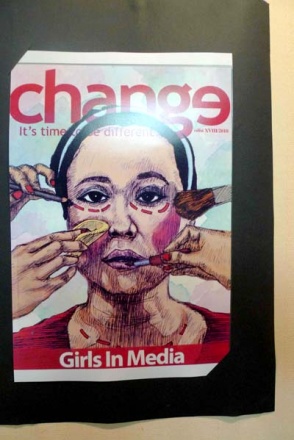
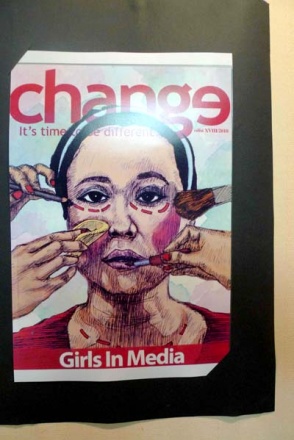
The JPF also produces documentaries and has a website. In 2008, the foundation launched a youth magazine called Change.

Women studies expert Sulistyowati Irianto said the journal helped deconstruct the rigid image people have of women and their role in society. It grew alongside the development of women’s movements and feminist thought after the reform era.

“Indonesian women had their own movement but the New Order controlled and silenced it,” she said.

Under the New Order regime of president Soeharto, the women’s place in society was institutionalized through the marriage law, which defines the role of the husband as the head of the household, and the wife as a homemaker.

In her lecture, Gadis said the image of women broadcast by the state and the state-controlled media during the New Order was that of Dharma Wanita — a group of wives of officials who spent their time organizing many charity — not empowerment programs.

Gadis explained the Ibu-ibu (motherly woman) image prevalent during the New Order was not without a design or ideology. “It was ideal to erase from the public’s memory the image of a more radical, empowered woman active in civil movements.”

The Indonesian Women’s Movement (Gerwani), the largest women’s organization before the New Order, had played a big role in women’s empowerment during the Old Order regime. It was also one of the organizations that helped build Indonesia, Gadis said.

“Gerwani had a clear ideological line and was affiliated to the communist party. When the pogrom
of the communist party took place, and people sympathized with the communists, Gerwani was also annihilated especially as its members were accused of killing the generals,” Gadis said.

The journal aims to deconstruct the image of women having limited roles in society. Mariana said the road to equality between genders was a change of mindset, which is what the JPF attempts to nurture.

Sulistyowati said Jurnal Perempuan’s continuity contributed significantly to the development of women’s thought and movement. “The issues discussed are those women talk about. The [Jurnal Perempuan] writers know their fields and understand feminist perspectives,” Sulistyo said.

“Their contribution is huge because many other journals don’t survive,” she said. “Jurnal Perempuan has succeeded in maintaining its presence in print media. The people behind Jurnal Perempuan have done a very good job [of maintaining this presence].”

But it is not without difficulties, Mariana went on. In the first years, Gadis had to sell her car to cover the cost of publishing the journal.

She said Jurnal Perempuan measured its success against the number of people subscribing to the journal. “That’s a few steps to what we call enlightenment and equality in society.

“It will take a long time to produce an enlightened society.”

Jurnal Perempuan changed Mariana’s life. A former Islamic fundamentalist, Mariana joined Jurnal Perempuan in 2003, after studying women’s studies. She used to be a member of the NII, a group advocating the creation of an Indonesian Islamic state.

“I read the journal and began going through books written by Nawal El Saadawi,” she said, referring to the Egyptian feminist. Mariana enrolled in women studies at the University of Indonesia. “My mindset changed radically,” she said.

She became a feminist because she put a critical thinking cap on and used common sense. “I knew I still had a brain and I could tell something didn’t make sense,” she said. “I was very uncomfortable with
my past. By learning about feminism, human rights and social science, I regained confidence in myself.”
Gadis’ lecture at the Antara building in Thamrin was the first of what Jurnal Perempuan hopes will be a long tradition of yearly lectures.

Attending the lecture was Constitutional Court judge Maria Farida Indrati, the only woman in the court and the only judge voicing doubts about the necessity of the Pornography Law, as well as gay rights activist Hartoyo.

Gadis’ lecture, titled “Media, State and Sex” is a timely issue. At a time when the state and the media cannot differentiate between the public and private domain, and view women’s sexuality as a moral threat, Gadis’ lecture delved into the issue of how the media depicted women in rigid, limited roles, how the state was controlling women by defining their roles and even their sexuality in the form of various legislations — such as the Marriage Law that states a husband is the head of household and the wife a housewife, the “vague” Pornography Law and the revised Health Law controlling women’s reproductive rights.

Jurnal Perempuan grew in the freedom experienced during the reform era, Mariana said. “We were the agent of change that was partying with the freedom we had.”

The challenges the journal are facing today, Mariana added, was the political standoff between the progressive liberals and the religious fundamentalists.

“There are many setbacks in our society, be it the state of democracy and the rise of fundamentalist groups that hate women,” she said.

Gadis ended her lecture by asking how to improve the state’s attitude toward sex. “A state smart about sex will create a smart society as well.”

“It’s proven that ignorance in sex education has brought ineffective policies, creating a society
that has a phobia of women’s bodies, has ensured children misunderstand [what] sex [is about] and provided an environment for violent, scary and radical groups that can only create harm.”

Prodita Sabarini, The Jakarta Post, Jakarta | Feature | Fri, August 13 2010
Nursyahbani Katjasungkana: A new perspective on sex

JP/Prodita Sabarini
JP/Prodita Sabarini

Sex remains a taboo subject in Indonesia, causing discomfort and a sense of panic when discussed in the public domain.

Lawyer and human rights activist Nursyahbani Katjasungkana is dead set on changing this state of affairs by carrying out research and policy advocacy.

In Yogyakarta last week, the former house member from the National Awakening Party (PKB) talked to The Jakarta Post on her way to Gadjah Mada University where she was scheduled to speak at the International Policy Dialogue on gender and sexuality.

The dialogue, organized by women’s/gender studies research network Kartini Asia and Amsterdam-base SEPHIS (South-South Exchange Programme for Research on the History of Development), was part of Nursyahbani’s endeavor to build a movement on sexual rights in Indonesia. It brought together Indonesian and international researchers as well as activists in the field of sexuality to find better strategies when carrying out advocacy work.

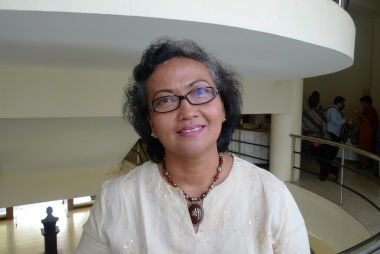
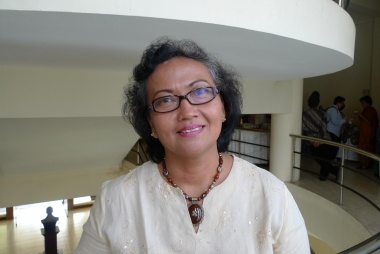
Soft-spoken, with intelligent and warm eyes behind her black-rimmed glasses, Nursyahbani explained why examining sexuality was crucial when defending human rights.

“Sexuality is not only about having sex. It controls human’s behaviors when they interact with each other. It encompasses people’s sexual orientation. Homosexuals, heterosexuals and bisexuals are within a continuum line in which the pendulum can lean either to the left or right,” she said. The control over women’s bodies in a patriarchal society also stems from a fear of women’s sexuality.”

In 2003, she co-founded Kartini Asia, a research network focusing on women and gender studies in Asia that aims to create synergies between women’s/gender studies and feminist activism in the region.

In 1990, she said, she had the harrowing experience of putting her six-month-old daughter under the knife for the Islamic tradition of female genital mutilation.

“The first time I saw clearly how female sexuality was oppressed was in the case of my own daughter. I knew that female circumcision was not compulsory – that it was a means to control women’s bodies and their sexuality. I read several hadith – which might be weak – that it [female circumcision] existed to control women so they would not be promiscuous, and have affairs.”

Nursyahbani and her sisters also underwent female genital mutilation as babies, she recalled.

“My mother, through my sister, kept pressuring me into continuing this practice. Both would always ask whether my daughter had been circumcised yet. I gave in after six months.”

Her mother who comes from a traditional Betawi community said it would be a sin not to carry out the circumcision.

“Finally, after six months, I brought my daughter to the doctor. I remember I had goose bumps walking into the hospital. My daughter was taken by the midwife and nurse inside, and I heard her screaming. When she came out, her diaper was covered in blood.”

Medical practitioners in big cities like Jakarta carried out the procedure until the mid 1990s. Nursyahbani said a doctor had performed the procedure on the baby of one of her fellow feminist scholars when she came to give birth in a prominent hospital in Jakarta, without obtaining her consent. Only in 2006 did the Health Ministry release a circular to end the practice of female genital mutilation.

Nursyahbani said she deeply regretted agreeing to her daughter having her female genitalia cut. As her daughter reached maturity, Nursyahbani told her about the genital mutilation and her own experience.

“That was my first experience — of seeing female sexuality shaped by a social construct and women perceived merely as sexual creatures. The regional bylaws on obscenity depicting women as obscene humans and the cause of rape stem from that way of thinking,” she said.

Her work as defending female workers and pregnant teenagers finally strengthened her conviction that sexuality and sexual rights had to be addressed as human rights issues.

She added that researchers and activists needed to keep collaborating to work on policy advocacy. Changing society’s perception on sexuality issues and eventually behavior will take a long time, Nursyahbani went on.

Nursyahbani, a renowned advocate for legal justice and the protection of human rights for Indonesian women, co-founded the Indonesian Women Association for Justice and became the first secretary general for Indonesia Women’s Coalition for Justice and Democracy.

“It took us seven years to pass the Domestic Violence Law,” she said. “Seven years,” she repeated in a whisper.

“Change does not come easily.”

Prodita Sabarini, The Jakarta Post, Jakarta | People | Mon, August 16 2010

Activists say fundamentalists stoke public fears

International researchers and activists gathered in Yogyakarta to network and develop better strategies to advocate sexual rights.

The International Policy Dialogue was held from Monday to Wednesday and carried the theme “Bridging the Gap Between Sexuality Research and Advocacy for Sexual Rights”.

The dialogue was the first international meeting to discuss issues in gender and sexuality after the International Lesbian and Gay Alliance Conference in Surabaya was abruptly cancelled in March due to intimidation from a radical Islamic group.

Participants discussed the sexual rights of women and lesbians, homosexuals, bisexuals and transgendered (LGBT) people.

Sexual rights activist Soe Tjen Marching — who edits the Surabaya-based Bhinneka, a magazine which focuses on pluralism, and Jurnal Gandrung, a newly launched journal on sexuality — said in her presentation that intimidation and acts of violence by fundamentalist groups, such as the Islam Defenders front (FPI), have created a public fear, which is the dominant factor in determining people’s behaviors and decisions.

“Public fear can indeed work to the favor of fundamentalist groups. It can be their biggest ally,” she said.

“The fundamentalists don’t have to do a single thing sometimes. The public already responds on their behalf,” she added.

For example, two universities in Surabaya refused to accept Bhinneka and Jurnal Gandrung because they did not want to be seen as supporting or facilitating discussions of sexuality due to fear of the religious fundamentalists, Soe Tjen said.

Human rights activist Nursyahbani Katjasungkana said that the cancellation of the Surabaya conference was example of discrimination against LGBT rights. Radical groups base their arguments on morality, culture and religion, she said.

Gadjah Mada University’s policy studies center head Muhadjir Darwin said the public believes that sexual orientations that differ from heterosexuality are immoral.

“They just have a different sexual orientation from the dominant group,” he said.

Nursyahbani, who is also the coordinator of the Kartini Asia Network, said organizers chose Yogyakarta to host the workshop to commemorate the Yogyakarta Principles.

In 2006, international human rights activists in Yogyakarta defined universal principles for international human rights law in relation to sexual orientation and gender identity.

The Yogyakarta principles say: “All human beings are born free and equal in dignity and rights.
Human beings of all sexual orientations and gender identities are entitled to the full enjoyment of all human rights”.

The Policy Dialogue was organized by Kartini and SEPHIS (South-South Exchange Program for Research on the History of Development) with the collaboration of Center for Population and Policy Studies of Gadjah Mada University.

Hartoyo — an activist who was once tortured and humiliated by police in Nanggroe Aceh Darussalam due to his sexual orientation — said he was lonely in his struggle for rights and has yet to see many LGBT people fight for their rights due to discrimination.

Nursyahbani said the workshop aimed to bridge the gap between research on sexuality and advocacy at the grassroots level.

Several scholars have said that research on sexuality is a long process, which sometimes do not meet the need of fast action in the part of advocacy groups.

Researchers and activists agreed that research on sexuality is an important for advocacy groups.

Prodita Sabarini, The Jakarta Post, Yogyakarta | National | Thu, August 12 2010

Terrorist shootings: One down, comes a thousand

Early this month, the Indonesian audience was once again presented with images of police killing high profile terror suspects.

This time, the gruesome image the public was left with was the lopsided and open-mouthed head of alleged bomb-maker Dulmatin, shot by the police in an internet café in Pamulang, South Tangerang.
The Counterterrorism Police Detachment 88 squad also killed two men, believed to be Dulmatin’s bodyguards, as they tried to escape on a motorcycle in a separate raid in Pamulang.

The Indonesian police hunt for terror suspects has gained much praise as counterterrorism agents continue to successfully locate leaders of Jemaah Islamiyah (JI) — a militant group responsible for several bombings in Indonesia, killing master bombers Azahari in 2005 and Noordin M. Top last year.

However, critics say the killings might not be beneficial in eradicating terrorism in the long run, as the assassinations might instead give JI sympathizers a reason to turn into active JI combatants, and valuable information on terror networks that could have been extracted from the combatants has been lost.

Police might also be held accountable for human rights abuse or extra judicial killings if ever the political climate changed and religious-based parties gained more power, Indonesian extremism expert Noor Huda Ismail said. “That’s really not good for the police [agents] who have worked hard to address terrorism at its roots,” he said.

According to local newspaper Tempo, a witness in Pamulang saw that the two men killed had
not opened fire on the police although they had physically resisted the arrest.

“The police should immobilize [the suspects] but shouldn’t necessarily have to kill them,” said Huda recently, who is also the executive director of the Institute of International Peace Building.

“The police — in their capacity as law enforcers — do not have the right to punish. They have the right to investigate. Taking a life away can be categorized as extra judicial killing,” he said.

Indonesian Police Watch chairman Neta S. Pane suggested the police was using terror raids as a diversion from political issues, like the Bank Century bailout case. “Every time there is a big issue, they use the raids to divert attention from the case,” he said.

“The raids are always dramatic and suspects always shot to death,” he said. “If we let this be, it will
have a negative impact on police performance in the future. Besides capturing terror suspects, they [police agents] become executors under the pretence that the suspect resisted arrest.”

Neta added that under Dai Bachtiar’s leadership, national police agents rarely shot dead terror suspects — unlike now, as witnessed by the police’s Detachment 88 counterterrorism unit recent terrorist shootings.

The police was able to capture Bali bombers Amrozi, Mukhlas and Imam Samudra alive in 2002. The three were tried and executed in 2008.

National Police deputy spokesman Brig. Gen. Sulistyo Ishaq said the police always aimed to arrest suspects alive, but “if we [police agents] are under threat, we will resort to force that can be accounted for in the eyes of the law”.

International Crisis Group expert Sidney Jones said that all police actions should be guided by human rights and respect for the law, but there were times when it is perfectly legitimate to use force, when the threat confronted by law enforcement officers requires it.

“But anytime anyone is killed in the course of a police operation, it is appropriate to ask questions about whether non-lethal tactics could have been used and whether the deaths in question could have been avoided.”

She also agreed it would be far more beneficial to capture suspects alive, because of all the information they could provide about terror networks.

Huda said killing suspects might cause the police to lose crucial intelligence information.

“We do not know when exactly Dulmatin returned; what he was doing here; who was helping him,” he said.

The police however recently revealed that Dulmatin, one of the masterminds of the 2002 Bali bombings, had left his hideout under the radical Philippines Abu Sayyaf group to help open up a new training camp — different from the usual JI camp — in Aceh.

Dulmatin and colleagues Umar Patek and Heru Kuncoro, who are still at large, had extensive knowledge of setting up camps in the middle of the jungle, gained from their experience helping Abu Sayyaf rebels in Mindanao, South Philippines.

Police killed two terror suspects in Aceh and arrested 31 people. They also seized several weapons from the suspects, including three M16 and two AK-47 automatic rifles, a handgun, 25 ammunition magazines and hundreds of rounds of ammunition. Three police officers were killed and eleven wounded in the raid.

“I think the fact that three police were killed and 11 wounded this time indicates they were facing a serious threat,” Jones said. “That said, I also think the police at all levels could benefit from more training in confronting ‘active shooters’.”

The National Police chief Gen. Bambang Hendarso Danuri explained that suspected terrorists had changed tactics from suicide bombing to armed warfare, as indicated by the actions of the group reportedly involved recently in a training camp in Aceh.

Huda believes counterterrorism activities should be carried out as one “whole package” or all encompassing, and include “deradicalization” — the process of persuading extremists to abandon violence. Without this, he said, terrorism will continue to be a problem.

The killings of high profile terror suspects by the police runs the risk of converting JI sympathizers into combatants, he added.

“There has been an internal raft in JI since the first Bali bombings in 2002. The majority does not condone the use of violence, but a small group does,” he said.

The passive majority of JI supports the small violent group. “In a sense, they will never tip off the police about the small group’s movement,” he said.

Repressive methods used by the police — such as the use of force and killing suspects — might trigger some of the passive supporters to join the movement to show solidarity.

“And this should be avoided,” he said.

Prodita Sabarini, The Jakarta Post, Jakarta | Life | Fri, March 26 2010

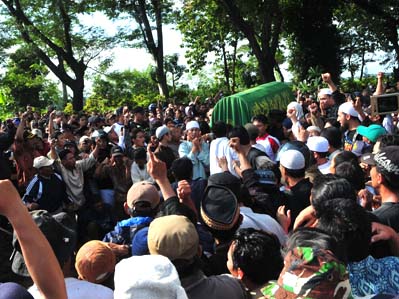
Addressing the real problem: Supporters shout “God is Great” as they carry the body of militant Dulmatin in Petarukan village, Central Java. Besides gun downing the alleged terrorists, the government should consider implementing a deradicalization program involving former terrorist prisoners. JP/TARKO SUDIARNO

Fear of the religious starts early

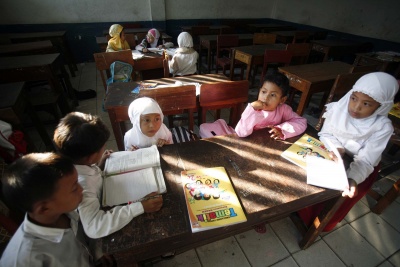
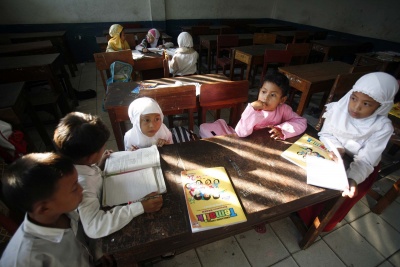
From the beginning: Children study in groups at an elementary school in Jakarta. Proselytizing in Indonesia’s public schools is on the rise, recent studies have shown. JP/J. Adiguna

Although Indonesia has long been a melting pot of religious and ethnic groups, differences in faith still breed curiosity, fear and even animosity.

When Kelik Wicaksono opened the door of his house to two leaders of his neighborhood one Saturday morning, he didn’t expect to hear the kind of news the two men brought him.

Kelik and his wife, both Christians, had been giving English lessons to children in their neighborhood in Pondok Cabe, South Jakarta, every Saturday afternoon.

“It was a very sad moment. The men came to tell us that two local ulemas from another village had voiced their concerns about the content of our class,” Kelik said.

“They were afraid because my faith is different from theirs. And they were worried I was teaching [the children] something else,” he said.

In fact, ulemas and neighborhood leaders were so concerned they held a meeting about the class at the sub-district level.

“What I don’t understand is why didn’t they come to me personally instead of talking behind my back and having a meeting about it?” he said.

The class, Kelik said, teaches children English in a fun way. Sometimes the 15 to 30 children, who are all Muslims, learn to sing and dance, other times they make origami artwork.

When the news of the day was the conflict between the National Police and the Corruption Eradication Commission (KPK), students took part in discussions on that topic. When asked what the duties of the police were, one of the girls in the classroom answered with certainty: “to catch the KPK”.

“Our class is very secular,” he said. “What we can see from it [the class], is that children are now more courageous and confident… because our class is very laid back,” he said.

Kelik and his wife are still holding the class and will meet with the neighborhood leaders to discuss how to address their concerns.

A few children have stopped coming to the class after their parents forbade them to do so.

“The children said, ‘They say you’re teaching us Christian sholat’,” Kelik said. Sholat is the Muslim prayer ritual.

Religious minorities are still persecuted in parts of the country, with certain groups more prone to having their freedom of worship violated.

While permission to build a mosque, the place of worship for Muslims, is easily attained, given the majority of people in Indonesia are Muslim, Christians at times find it more difficult to build their own places of worship.

Last March, Depok mayor Nur Mahmudi Ismail revoked the building permit for a Batak Protestant church in Limo, Depok. Last month, a mob burned down two Protestant churches and the home of a pastor in North Sumatra.

Kelik said he had talked to people around his neighborhood and found they were afraid of Christianization.

When it comes to Islamization however, people remain tightlipped and the state will rarely take any action to stop it, said Jajat Burhanudin, the head of the Center for Islamic and Society Studies (PPIM) at Syarif Hidayatullah State Islamic University in Jakarta.

According to Jajat, some public schools and universities are becoming hotbeds for radical Islamic thinking, with student religious groups preaching intolerant behavior towards people from different religions.

Jajat added that compartmentalized religious education in public schools and the conservative attitude of religious studies teachers contributed to religious intolerance in Indonesian schools.

In 2008, PPIM did a survey involving 500 Islamic studies teachers in Java and found that most teachers were opposed to pluralism, tending toward radicalism and conservatism. The worrying results speak for themselves.

The study shows 62 percent of the surveyed Islamic teachers, including those from Nahdlatul Ulama and Muhammadiyah – the country’s two largest Muslim organizations – rejected the notion of having non-Muslim leaders.

Almost 70 percent of the respondents were opposed to non-Muslims becoming their school principle and close to 35 percent were against having non-Muslim teachers at their schools.

Around 75 percent of the teachers didn’t want followers of other religions to build their houses of worship in their neighborhoods, the survey found.

Eighty five percent of teachers prohibit their students from celebrating big events perceived as Western traditions, while 87 percent tell their students not to learn about other religions.

In addition, 48 percent of the teachers would prefer female and male students to be separated into different classrooms.

The survey also shows 75 percent of the respondents had asked their students to call on non-Muslim teachers to convert to Islam, while 61 percent reject new Islamic sects.

In line with their strict beliefs, 67 percent said they felt more Muslim than Indonesian.

The majority of respondents also supported the adoption of sharia law in the country to help fight crime.

According to the survey, almost 60 percent of the respondents were in favor of rajam (stoning) as a punishment for all kinds of crimes and almost 50 percent said the punishment for theft should be having one hand cut off, while 21 percent want the death sentence for those who converted from Islam.

Only 3 percent of the 500 surveyed Islamic studies teachers said they felt it was their duty to produce tolerant students.

Jajat said the state had failed to take measures to contain a growing radicalization of Islam in public schools.
“The seeds of conservatism start early and educational institutions have always been the place to spread a certain ideology,” he said.

Islam-based political parties are actively collaborating with high schools to create “integrated” schools, he added. “It is part of a deliberate strategy to Islamize public schools,” he said.

While religious groups should not be stopped from opening day schools or boarding schools – even if those end up spreading their ideology, Jajat said, the situation becomes a worry when proselytizing happens in public schools.

“It shouldn’t happen in public schools. The government funds public schools with tax payers’ money. All religions should be treated equally,” he said.

He said democracy and universal values should be taught at school, while “the strengthening of primordial religious identity be avoided”.

Children should be exposed to different faiths as early as possible so they become accustomed to differences in society, Jajat said.

They should also be encouraged to have interfaith dialogues or join activities with people from different faiths.
“It can be something completely unrelated to religion, like how to tackle the problem of garbage,” he said.

The Indonesian religious education system, in which students are given religious studies based on the faith they adhere to, is very compartmentalized and does not stimulate tolerance and understanding between different faiths, Jajat lamented.
“At the same time, there is no effort to make the students see beyond religious symbols,” he said.

Recently a Facebook page titled “Replace religious education in high school with studies about ethics, humanity and basic philosophy” was created. The page now has 400 fans.

When asked about the page, Jajat said he fully agreed with the message.
“Basically, we should hold on to universal values,” he said.

One of the group’s fan, Karl Karnadi, an Indonesian atheist who lives in Germany, said he supported the group because he believed the current religious education system did not promote pluralism.

“In my opinion, intolerance tends to arise when a person is only taught about one religion all of his/her life without having been given the chance to know about other religions and their followers,” he said.

“Why not use religious studies for that? Teach people about more than one religion. Teach them at least about Indonesia’s six ‘official religions’. Give children a chance to get to know different religions outside the ones they adhere to. And in a descriptive way [like Wikipedia] rather than by indoctrinating them [like at church or with Koran readings],” he said.
“That’s an interesting idea, don’t you think?” Karl mused.

Prodita Sabarini, The Jakarta Post, Jakarta | Life | Wed, February 17 2010

Religious TV jeopardizing pluralism

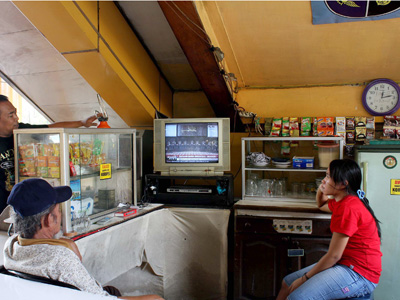
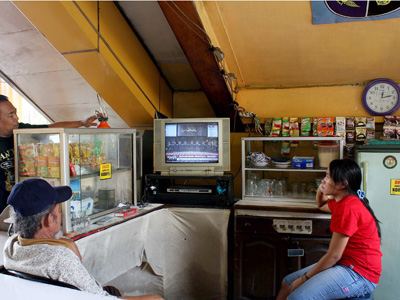
Pervasive medium: Three people watch a television program in a shop at a railway station in Jakarta. Activists argue that many religious TV programs play a symbolic rather than a substantial role in religion, and tend to marginalize minority groups. JP/Nurhayati

A recent episode of an Islamic religious program aired on a private TV station broached the topic of tattoos, questioning whether they were haram (prohibited) or halal (allowed).

The TV show presenter then pointed his microphone to people with tattoos, asking if they knew the marks on their skin were prohibited under Islamic law.

The episode in itself begs the following questions: Was singling out people with tattoos in a religious program right or wrong?

How about other minorities whose lifestyles are not in line with certain religious teachings, such as gay men and lesbians, or people who drink alcohol?

How would broadcasting a strict right or wrong label on people affect the pluralist nature of our society?

Religious programs, which have been around since the early days of TV — when the country only had one public television station, TVRI – usually take the form of sermons delivered by ulemas, priests or Buddhist monks.

In recent years, producers of religious programs have been experimenting with reality-TV types of shows. While some shows focus on one particular topic, such as debating whether something is halal or haram and then interviewing people about the matter, others are a blend of reality shows and religious programs, with family members attempting to get their relative who has strayed from religion to return to it.

Through religious programs, TVs are bringing into everyone’s living rooms strict interpretations of religious teachings in a modern context, which could jeopardize pluralism and religious tolerance.

The head of the Indonesian Broadcasting Commission (KPI), Sasa Juarsa Sendjaja, said Indonesian media was generally doing a good job promoting pluralism.

“However, there are attempts, here and there, from the majority to dominate the minority,” he said.

The majority of people in Indonesia are Muslims. The Indonesian Ulema Council (MUI) has often stipulated divisive edicts or fatwa. In 2005, the MUI released an edict stating that pluralism, liberalism and religious secularism were haram.

Since then, a number of fatwas have been released, including a ban on smoking, women riding on the back motorcycles, hair straightening, hair-dyeing and on taking pre-wedding pictures.

Artist and politician Guruh Soekarnoputra said TV programs promoting intolerance reflected the changes permeating Indonesian society.

“We’re not a Pancasila country anymore,” he said, referring to the country’s principles. The country has a motto, Bhinneka Tunggal Ika or Unity in Diversity that represents Indonesia’s pluralistic society.
KPI, Sasa said, regulates what can and cannot be broadcasted on TV.

“And one requirement is that television stations should respect pluralism. Minority groups like gay men and lesbians, not just people from different religions, should also be respected,” he said.

After all, the KPI – through the Press Board (Dewan Pers) – monitors news, entertainment or infotainment programs to ensure they adhere to a code of journalism ethics.

“For talk shows or regular television programs, we do the monitoring ourselves,” he said. “There are programs that could be construed as fuelling intolerance. But we have to see to what extent,” he said.
Director of the Jakarta-based International Center for Islam and Pluralism (ICIP), M. Syafi’i Anwar, said many religious programs on television acted more as symbols than anything else.

“Television makes sure religious programs are merely entertainment,” he said.

“The programs are artificial and symbolic. Therefore we see a lot of people go to haj but corruption is still rife; many mosques are being built while many people are still homeless,” he said.

Because programming on TV channels is driven by ratings and profits, much of the preaching or dakwah on TV is not educational, Syafi’I went on.

“Sometimes, the programs even contradict religious teachings.”

Syafi’i said dakwah should not be judgmental. “It [the preaching] should be persuasive instead.”

“Dakwah should be carried out with wisdom… meaning we should not be judgmental,” he said.

Even if religion disagrees with certain activities or attitudes, one should not be judged by them, he added.

“The only good way to preach is by highlighting role models, or leading by example, not by being judgmental.”

Islam spread across Indonesia through persuasion and dialogue, Syafi’i said. The nine wali or saints who spread Islam in Java in the 15th century used local arts and culture influenced by Hindu and Buddhist culture.

“That’s why Islam in Java has rituals such as sekaten… because of the mix of culture,” he said of the ritual welcoming the Islamic New Year.

Television is a very important media to promote pluralism, Syafi’I said. Religious leaders in TV programs should use a persuasive method that will give religion a friendly face.

Progressive Islamic scholar Maman Imanulhaq Faqieh who leads the Islamic boarding school Al-Mizan in Yogyakarta said intolerance stemmed from religious leaders applying religious teachings out of context.

“Some religious leaders lack wisdom when examining the problems plaguing society,” he said.

“Religion is supposed to be the energy that can bring change and promote messages to humanity.”

However many religious programs in Indonesia are still very shallow and do not touch the substance of complex problems in society, he said, as they have misunderstood how to apply religion to modern life.

“Therefore, [religious] TV programs now are merely judging and blaming people for society’s ills.
They do not try to delve into the problem, and in the end it alienates religion from society,” he said.

Maman said the current religious programs on television reflected a more Arabic interpretation of Islam, with preachers wearing long robes and sermonizing about strict interpretations of the religion.

When preaching religion, Ma-man said, religious leaders should focus on the liberating and emancipating aspects of the religion, and address human rights violations and other social problems in the community.

“It is time for religious leaders to tackle societal problems seriously. There should be a dialogue between religious leaders and the community, in which both parties respect and appreciate each other,” he said.

Prodita Sabarini, The Jakarta Post, Jakarta | Life | Wed, February 10 2010

Papua series: Laboring mamas, chopped fingers

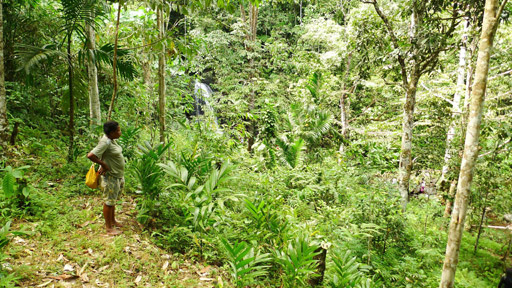
Taking a breather: Weldemina Mora looks at a waterfall in Serui, Yapen Islands regency. In Serui, some Papua vanilla vineyards are located on customary land belonging to the Yawaunat people. (JP/ Prodita Sabarini)

A mama walks barefoot under the skin-burning sun in a hamlet in Piramid district, Jayawijaya regency. With their traditional woven bags (noken) dangling from their heads, Papuan women, lovingly called mama-mama, dig into the earth to harvest sweet potatoes.

Orina, 30, is one of the mama-mama. Last week was harvest time in her village, Yonggime. Carrying her 3-year-old-son Samuel to the field on her shoulder, she steadies the weight of her noken on her head.

“It’s hard work,” she says. “We sweat a lot and we dig using shovels,” she said. The shovels that the women use are made from thin long metal with flat tips. Most tiring, she said, was that they had to carry their noken and their babies or toddlers with them to the field. Sometimes women carry three bags on their head, one for their offspring and the others for collecting the harvest.

The bulk of the work on farms in Papua falls to women. Most indigenous Papuans in the mountainous highlands such as in Jayawijaya regency live from farming. Families grow sweet potatoes for their daily meals, as well as for their pigs. The rest, they sell in the markets. Women are usually the ones who travel to the markets carrying heavy loads on their heads. The sweet potatoes, or hipere in the local language, can grow as big as a newborn baby, weighing around 5 to 10 kilograms each.

“Men open the fields, build the fences and dig irrigation channels, but that’s it. The people who tend the fields, plant and toil, harvest and feed the cattle, are the women,” Patricio Wetipo from the organization, Humi Inane (Women’s Voice) Foundation, said in Wamena recently.

In Indonesia’s easternmost province, indigenous women are marginalized and often become victims of violence both from outside and inside their communities. The security approach in the restive province has seen many women suffer sexual violence at the hands of Indonesian Military (TNI) personnel, as documented in a 2009 study by the National Commission on Violence Against Women (Komnas Perempuan).

Women are also second to men within their communities. Besides having a heavier workload, they were not included in decision-making in tribal communities, Patricio said. Polygamy and adultery was rife, he added, and with Papua being the Indonesian province with the highest rate of HIV/AIDS, a lot of women contract the virus from their husbands. Patricio said that his organization had documented 370 reports of violence against women in Jayawijaya alone.

One can see the stark difference between men and women with the grieving customs of communities in the central mountains. Women in those tribes cut off the phalange of a finger as a sign of grief when a member of their family passes a way. The men, meanwhile, make only a tiny slice in the tip of their ears. The government has banned this particular practice, but one can still see many women with short, stumpy fingers, including younger women.

But conditions for women are changing — albeit slowly; development programs that incorporate gender equality are opening up access for women to become community leaders.

In Wamena, Sarlota Itlay, 42, stands out as the head of a farmers’ group in Musaima village, a position that she’s proud to hold. The single mother of four describes her position as “one that’s rare in Papuan custom”. When development NGO Oxfam started a Papua Enterprise Development Program (PEDP) in Wamena in 2009, the single mother joined the group of 55 farmers that opened 10 hectares for sweet potato cultivation.

She was the only woman that spoke a lot during discussions with Oxfam and the Independent Business Foundation (Yapum), Oxfam’s local partner, she said. In 2010, she was appointed head of the farmers’ group. Her leadership caught the eye of the local Hubikiak district administration and she was appointed as the village secretary, giving her a role in the day-to-day administrative affairs.

Rio Pangemanan, Oxfam’s PEDP manager, said that when devising programs to support entrepreneurship within indigenous Papuan communities, they ensure that women’s ideas and roles are clear. They separate discussions between women, men and community leaders to ensure that women’s aspirations are heard before planning the program.

Patricio also uses this technique in his awareness-raising campaigns.

“We talk with the women in the communities about women and men’s positions in customary law, whether there is violence or not and, if so, what forms of violence they experience,” he said. Patricio then talks with the men on the same topics. In the end, the men and women gather for a dialogue about women’s roles and violence against women in their community.

Change was slow, he said, but women were becoming more confident and courageous in expressing their objections about things they felt were unfair.

In Wamena, religious institutions are also playing a role in empowering women. In a Catholic boarding house for girls in Wamena, some 30 girls sit on a carpeted floor and discuss their rights as women. Led by Deacon John Jonga, a Catholic priest and human rights activist, the girls, who are in junior high and high school, shared their stories of how they felt having a lower status compared to their brothers. They also said they had to work harder on the farms during their school breaks compared with their brothers.

Deacon John had the girls laughing when he cracked a few jokes about how hard it must be for them having been born girls. But he was very serious when he asked them what they wanted when they grew up.

“Do you want to be the young wife of an old tribal leader?” he asked. “I know a woman who used her savings to pay the dowry for her husband’s new wife. Would you like that?” he asked. The girls giggled and shook their heads. Marcela Logo, 17, said that if her future husband treated her badly and had another woman, she would leave him.

“You are worth it, you’re equal to men, and you deserve to be free from violence,” Deacon John said. The girls’ eyes grew wider, and an optimistic glint showed in their smiles.

— JP/Prodita Sabarini, Wamena, Jayawijaya

Prodita Sabarini, The Jakarta Post | Reportage | Wed, March 27 2013


Reports from Papua

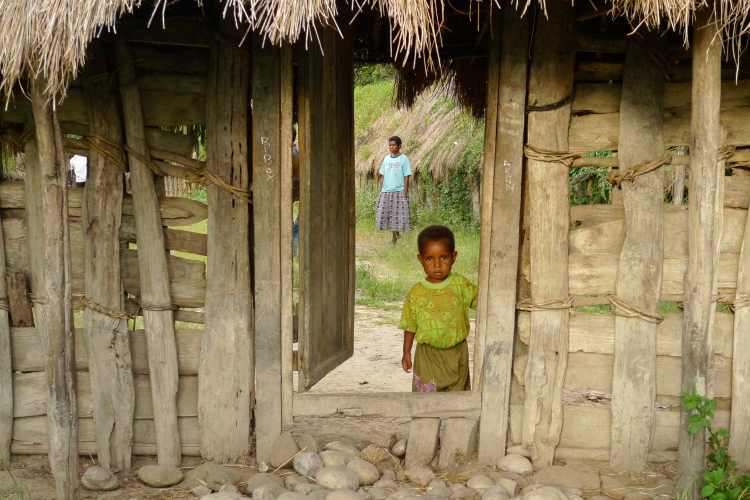
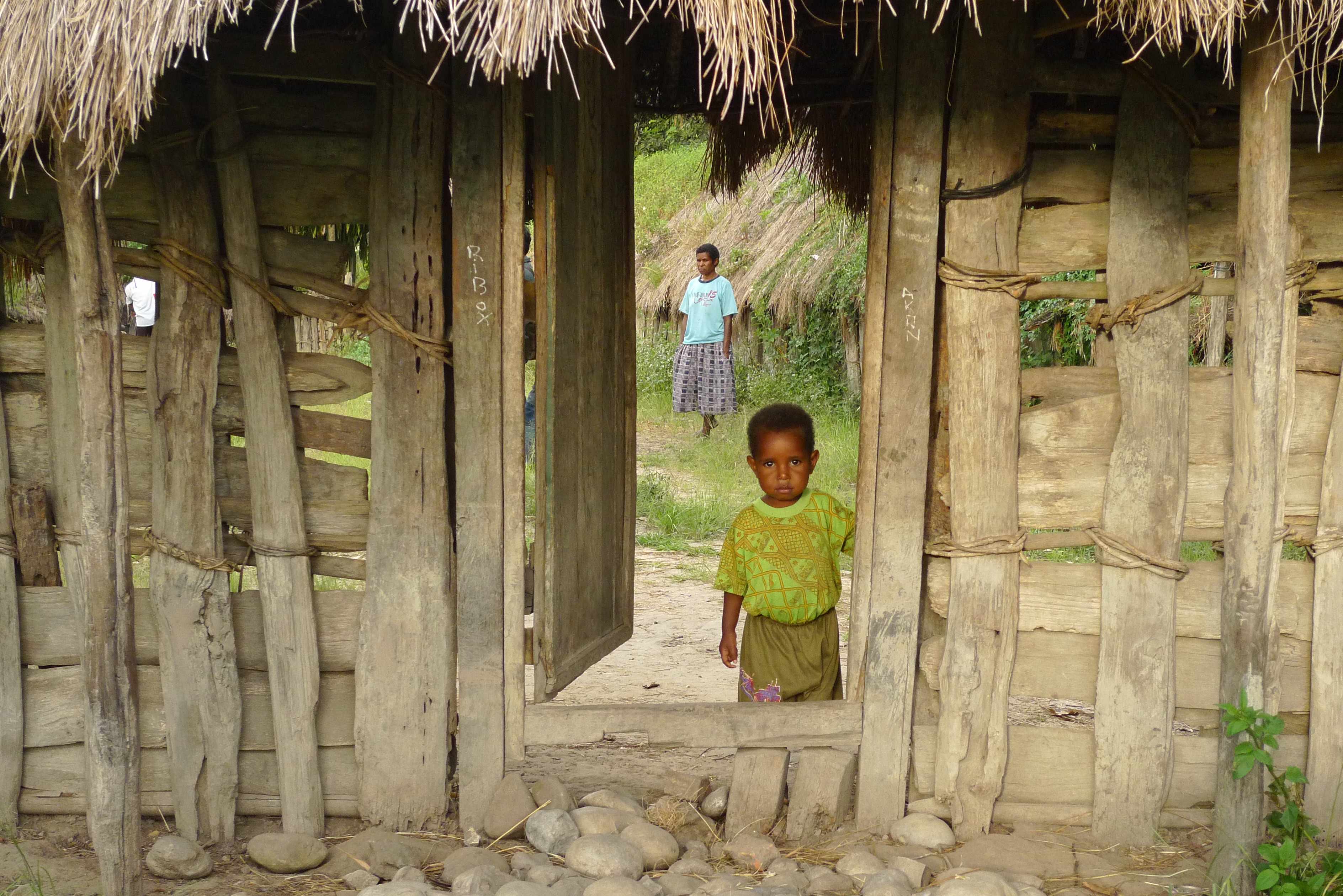
A little boy looks out from the gate of his house in Jiwika, Jayawijaya Papua. Photo by Prodita Sabarini

I’ve always wanted to go to Papua, ever since I read an opinion piece in The Guardian by exile Papuan independence leader Benny Wenda two years ago. It’s such a faraway place from where I grew up and the tales that have been told to me is also so far from the reality there. When I finally set my foot to Papua, the land that people call a piece of heaven on Earth, I was mesmerized by its beauty. The layers and layers of undulating hills and valleys covered in mist was like out of this world. But, it’s a sad place too, the people witness and suffers from violence from the military and injustice from the Indonesian government. I’m Indonesian, Javanese, but when I traveled to Papua, I question the insistence of the government for a unified Indonesia, when it takes away the right to self-determination of peoples. How come an imaginary line be so important as to keep people in chains? Going to Papua, I felt like traveling to time and space, to Java in Colonial times, when all the people despised the Dutch Colonial power and yearned for freedom. But then, it all makes sense why they want to keep that imaginary line, to be able to take away what they wouldn’t be able to take if the line disappears.

Click here for the links

https://proditasabarini.com/2013/04/11/papua-series-papuas-politics-a-case-of-homo-homini-lupus/

https://proditasabarini.com/2013/04/11/papua-series-traditional-voting-system-may-create-conflict-customary-leaders/

https://proditasabarini.com/2013/04/11/papua-series-collective-grief-leads-to-dream-of-freedom/

Papua series: ‘Collective grief’ leads to dream of freedom

For Papuans, their graves are a reminder of the grief that besieges their land.

In front of the Justice and Human Rights Advocacy Network office in Wamena is the grave of Opinus Tabuni, a member of the Papuan Indigenous Council, killed in a military crackdown on World Indigenous Peoples’ Day in August 2008.

Human rights activist Theo Hesegem sat just a few feet from the grave. He recently said that the government’s attitude to the complex social and political problems in Papua would not end the violence.

In 2011, UP4B was established to accelerate development and growth in the most impoverished region in Indonesia. The hope was to improve the welfare of indigenous Papuans and quell their discontents.

But the source of discontent is not about having food on their plates. Theo said that Papuans’ main problem “is not eating and drinking. It’s not about welfare. We don’t know how many children, how many families, how many people have been shot or killed — that’s the problem”, Theo said.

Researchers at the Indonesian Institute of Sciences (LIPI) believe that decades of political violence has led Papua to a collective memory of grief, or memoria passionis.

While the government attempts to speed up development in the region, it retains a military approach. In 2009, security forces killed Free Papua Movement (OPM) leader Kelly Kwalik, and despite of his death, sporadic attacks from the OPM continue. According to the National Intelligence Agency (BIN), last month’s ambush was partly due to rebel fighters unhappy with a new military district command (Kodim) in Puncak Jaya.

“People can’t assume that the issue of Papua is finished. It’s about ideology. You can’t shoot a person and say his ideology is dead. There are other people. That person has children who will continue to think that ‘my father was shot because of Papua’,” Theo said.

Melianus Wantik, 29, member of the National Committee for West Papua (KNPB) which campaign for secession from Indonesia, said that the grave of They H. Eluay, the assassinated leader of the independence movement the Papua Presidium Council, was an important place for KNPB.

Young activists in Papua established KNPB after Theys was killed. During the founding of KNPB Melianus said they camped at Theys.

KNPB members themselves are now on the police wanted list, accused of shootings and bombings. KNPB leader Victor Yeimo reports that 22 KNPB members were killed last year, including the KNPB leader Mako Tabuni.

For Papuan Indigenous Council (DAP) Baliem area head, Yulianus Hisage, the killings no longer have a shock effect on him. “Killing people, shooting people in Papua: It’s normal. For us, the indigenous community, it’s normal because it’s not the first time we’ve seen it,” he said.

Yulianus, who is part of the Jakarta-based conflict resolution NGO, the Titian Perdamaian Institute and often travels outside of Papua, does not feel safe in his own land. “When I leave Papua, for Yogya I feel safe. Back in Papua, I worry when I will be killed,” he said.

From various sources

From various sources

Prodita Sabarini, The Jakarta Post | Reportage | Thu, March 28 2013

Paper Edition | Page: 21

Papua series: Traditional voting system may create conflict: Customary leaders

Look who I voted for: A woman in Woma district, Jayawijaya regency, holds her ballot up before placing it in a noken (traditional Papuan woven bag) in the January gubernatorial elections. (Antara/Rico)

Papuans have been allowed to reject secrecy as one of the principles of general elections. The open-ballot system is permitted there, but customary leaders say the open election system as it stands in Papua today has no roots in tradition and could easily cause conflicts in the already restive province.

The heavily militarized province held its gubernatorial election on Jan. 29 using open ballots. Known as the noken system, its name is taken from the traditional woven bag that replaces the ballot box. During the election that saw Lukas Enembe and Klemen Tinal victorious, voters in Papua placed their ballots in one of several noken. The number of bags corresponds to the number of candidates. The bags are hung in the open for all to see.

“It’s a dangerous system,” Damianus Wetipo, a polling station official in Asolokobal, Jayawijaya said. He said that lack of secrecy meant that village or customary leaders were able to pressurize their people to vote according to his choice, and if there was any defiance, people could end up fighting each other.

The Constitutional Court (MK) recently rejected a lawsuit against Papua General Elections Commissions (KPUD) by five campaigns in the Papua gubernatorial race. They claimed that fraud had been widespread in the election and that the noken system was undemocratic.

Under the 2007 Law on General Elections, the principle of secrecy is part of elections, along with elections being direct, public, and free.  However, MK judges ruled that the noken system was not a violation, stating that it was part of the Papuan culture.

Traditionally decision-making in Papua has been a collective consensus, in which the tribal head can be a proxy for his tribe. The noken system was invented to translate this to modern election practice, where every citizen has suffrage. Each citizen is expected to place the ballot themselves.

The Papuan Indigenous Council (DAP) Baliem region head, Yulianus Hisage, said that the noken system was unknown to their tradition.

Damianus said that the noken itself was part of their culture but having people choose a bag to place a vote, to and thereby choose their leader, was not.

Damianus said that Papuans, many in rural and isolated areas, have been used to the ballot box in elections for a very long time. He recalls that the noken system was first used during the first free presidential election in 1999 after the New Order authoritarian era, but he was unsure of the reason for the change of system.

The village officials said that the system holds a huge potential for inciting conflict. In regency elections, Papuans can become fanatical and very belligerent in their support of their candidates.

Indeed, it is not just in the regency elections that violence can flare up. During the gubernatorial election the system took its toll. Tolikara regency councilor Husia Yosia Karoba from the Golkar Party was beaten to death by Democratic Party supporters, the winners of the election. Husia reportedly urged people to vote for the Golkar candidate.

The open system is not the only problem with Papua elections. The Democracy for Papua Alliance (ALDP) reported electoral fraud in the handling of leftover ballots. The fixed voter’s list was, they claim, higher than the actual number of voters. This challenge was echoed by five candidate pairs and went all the way to the Constitutional Court. The court explained that the number of eligible voters was based on a census by the Papua Population and Transmigration Office.

ALDP reported that in Hesatum village the number of ballots was around 300, while the actual village population was 138.

The village officials then confirmed the inflation of the voter list. Damianus knows all the people living in his village, but the names in the list included people from a neighboring village and those who had passed away. “Rocks and trees were given a name and put on the list,” he said jokingly.

The unused ballots were placed in Lukas and Klemen’s noken, who eventually won.

Village heads say they were pressurized to cheat as the regency has power over their positions. Moreover, defying the directives runs the risk of having their children unable to get jobs in government. Most educated indigenous Papuans look for jobs in the public service, which creates a dependency on the whims of political elites.

Prodita Sabarini, The Jakarta Post | Reportage | Thu, March 28 2013