Religious minorities unite for freedom

Iron: Pondok Gede sub-precinct head Comr. Dedy Tabrani speaks to an Ahmadi behind the locked gate of the Al Misbah Mosque in Bekasi on April 5. (Antara/Widodo S. Jusuf)

Next to a sealed Ahmadi mosque in Bekasi is a plot of land with leafy trees and damp earth. To get in one has to squeeze through a gap between a tall iron gate and the wall of a residence on the other side.

From this bit of land, Ahmadiyah members send food over the gate to the 19 Ahmadis staying inside the mosque, which was sealed in early April by Bekasi public order officers.

When the officers put up the corrugated iron fence to seal the Al Misbah Mosque, about 40 people were inside, including women and children. The women and children have since been taken out.

The remaining 19 stayed behind, giving away their freedom for an indefinite time as a symbol, an
act of protest, toward the Bekasi municipality and the central government for meddling with their freedom to worship.

The lot became a gathering place on Saturday night for Sobat KBB, a solidarity group of victims of religious intolerance and violence, a collective of minority groups — Christians, Shia Muslims, Ahmadis and those of other beliefs — that have experienced discrimination and persecution. Sobat translates as friend in English.

The national coordinator of Sobat KBB is Palti Panjaitan, the Filadelfia Batak Christian Protestant Church pastor whose church in Bekasi was also sealed by the Bekasi city administration.

Palti said about 10 people came to the gathering. Liberal Islam activist Mohammad Guntur Romli, who in a pluralism rally that turned violent in 2008 had his nose and cheekbone fractured by blows from members of the Islam Defenders Front (FPI), and Nong Darol Mahmada were among the attendees.

Over grilled fish, the group shared their thoughts about the state of religious minorities in Indonesia.

Rahmat Rahmadijaya, an Ahmadiyah cleric who remains inside the shuttered mosque, joined the discussion through a small opening in the mosque’s black iron door.

Ahmadiyah spokesperson Firdaus Mubarik said they wanted to bring Palti into their campaign because they saw the creative ways the Filadelfia church had promoted their cause, such as holding mass in front of the presidential palace.

Firdaus said the Ahmadis collaborated with Filadelfia for the Saturday night gathering — aimed at becoming a regular meeting — to continue to voice their cause.

“We don’t want the people remaining in the mosque to be forgotten,” he said.

Palti, meanwhile, said they might make the gathering more regular, not only in the lot next to Al Misbah but in other places where religious minorities are persecuted.

The group was established in February after a workshop by the Setara Institute, a human rights organization that monitors religious freedom across the country, and is also open to agnostics and atheists, the priest said.

“Sobat KBB is open to any victims [of persecution] including atheists. We fight for all victims who have been victimized or discriminated against in the name of religion, either those who adhere to religion or those who do not. We will fight hand in hand, to support each other,” Palti said.

Local and international organizations have criticized Susilo Bambang Yudhoyono’s administration for the increasing religious intolerance and violence in the country, even as he recently received the World Statesman Award from the US-based Appeal of Conscience Foundation. The award has been deemed a publicity stunt by rights groups who say the president does not deserve the award because of his track record in dealing with religious minorities.

Setara has documented 264 cases of violent attacks against religious minorities, up from 244 cases in 211 and 216 cases in 2010. Meanwhile, non-believers are criminalized, as in the case of atheist Alexander Aa, who broadcast his thoughts about the non-existence of God and was put behind bars in 2012.

“We want to enlighten people that religion should not be used to judge other religions or beliefs,” Palti said of Sobat KBB.
Struggling: Nineteen Ahmadis are staying inside the Al Misbah Mosque in Bekasi, which was sealed by Bekasi public order officers in April. (JP/Prodita Sabarini)Struggling: Nineteen Ahmadis are staying inside the Al Misbah Mosque in Bekasi, which was sealed by Bekasi public order officers in April. (JP/Prodita Sabarini)
In the case of Ahmadiyah, a 2008 joint ministerial decree banned the sect from proselytizing and the decree became the base for the regional government to ban Ahmadiyah outright. The West Java administration banned Ahmadiyah activities in 2011, the same year the Bekasi mayoralty announced its ban.

From across the corrugated iron fence, Rahmat, 33, who has been living on the grounds of the mosque for a decade, said Islamic hardliners from the FPI started to intimidate and harass Ahmadis at Friday prayers after Bekasi mayor Rahmat Effendi announced the ban.

“They threatened us, roaring their motorcycle engines, disturbing our prayers,” he said.

Except for Rahmat and a resident living next to the mosque, the neighbors of the mosque are not Ahmadis.

Ahmadis from other parts of Bekasi come and pray there on Fridays. But a resident living nearby said people were nonplussed with them. “For us here, to each their own”.

Rahmat said the Bekasi administration’s sealing of the mosque was the latter’s idea to protect the Ahmadis from religious hardliners. “But they did it without consulting us first, there was no dialogue,” he said.

The mosque is now guarded by three police officers, who take shelter from boredom in the house in front of the mosque where they can watch television when nothing is happening. The police presence ensures no-one enters the mosque, either Ahmadis or hardliners. A number of times after the mosque was sealed hardliners have arrived, but were cordoned off by the police.

“We feel shackled, it’s tough being here,” Rahmat said. The young cleric is living separately from his wife and two children. The youngest was born in February.

His days are used to pray, he said. They also entertain themselves with badminton and ping pong.

Rahmat said they have sent letters of protest to the president and the mayor. The Ahmadis are also taking their case against the Bekasi administration to the administrative court.

Even though the government is not keeping the Ahmadis inside the mosque, Rahmat said he would stay locked inside until the government reopened it.

“Forever, we will stay here forever,” he said.

But, he doesn’t wish for that. Rahmat is instead hoping for divine intervention to help the embattled Ahmadis win their case.
Prodita Sabarini, The Jakarta Post, Bekasi | Feature | Fri, May 24 2013, 2:48 PM

Female candidates rush to learn campaign strategies

Female candidates running for next year’s legislative election are feeling the pressure to learn the ropes of campaigning fast, while fighting the stigma that their presence in parties’ candidate lists are mere formalities.

All 12 parties contesting the 2014 general election have fulfilled the 30-percent-quota for female legislative candidates, according to the General Elections Commission (KPU). But as parties have complained about the difficulty in finding high quality female candidates to reach the quota, many still view female candidates as unworthy contenders, Democratic Party legislative candidate Umi Farida said.

Umi, 35, a former NGO worker whose work focuses on women, labor and minority rights, is a first time candidate for the House of Representatives, contesting in the Central Kalimantan electoral district (dapil).

Following the Constitutional Court ruling early this year that upheld the 30 percent quota requirement for women, party leaders, such as United Development Party chairman (PPP) and Religious Affairs Minister Suryadharma Ali complained about the difficulties in reaching the quota. Syarif from the Great Indonesia Movement (Gerindra) Party also commented that while the party can guarantee quantity, it could not guarantee the quality of many first time female candidates.

Female candidates say that many of their male counterparts have more experience and are more confident in campaigning, while the women still need support in campaign strategies.

The Democratic Party, in collaboration with the University of Indonesia, supported its female candidates by holding a course for them, Umi said. She said the program introduced female candidates to strategies such as mapping out voters and issues specific to voter’s needs; as well as fund raising and campaign budgeting.

Binny Buchori, a Golkar candidate focusing on universal health care access, said her party also had training for female candidates. Golkar focuses on legislation processes and development issues such as the Millenium Development Goals. Binny will run in the East Java VII electoral district, covering Ponorogo, Pacitan, Trenggalek and Tulungagung.

Meanwhile, Tunggal Pawestri, an activist running for the Yogyakarta Council with the Indonesian Democratic Party of Struggle (PDI-P), said female candidates had discussed the need for specific training that covered constituent outreach and voter targets.

“Male candidates may be more familiar with election strategies, but women need training,” she said. For example, they need to know how many votes are needed to win a seat based on the number of voters in an electoral district. For example in her electoral district in Kulonprogo, Tunggul would need at least 25,000 votes to secure a seat in the Yogyakarta Council.

Nihayatul Wafiroh, 33, from the National Awakening Party (PKB), who will run in East Java III — Situbondo, Bondowoso, Banyuwangi — said that some very qualified women had been assigned the numbers one to three on the candidate list. She was listed as number two, which matches the PKB’s number on the party list. Despite an open-proportional system, which means those who win the most votes will enter regardless of the rank, Nihayatul said the top numbers still had a psychological effect on voters.

“Many of the voters are still party-oriented and not figure-oriented, so they would choose the top numbers on the list,” she said.

Similarly, Tunggal is listed as number four on the list, the same as the PDI-P, which she hopes would help her campaign. Umi from the Democratic Party meanwhile is at the bottom of the list due to it being her first time.

An anonymous source running for the House, from one of the winning parties in the 2009 election, said that competition is rife between candidates from other parties and within the parties themselves. Back-door deals between candidates, in which underdog candidates are asked to donate their won votes, occur often.

“So women just fill the quota and are not considered ‘real contestants’ in the race, and other candidates will ask them to give their votes to them,” the source said.

— JP/Prodita Sabarini

The Jakarta Post | Reportage | Tue, May 14 2013, 11:32 AM

Few voters research legislative candidates

ELECTION-2.img_assist_custom-520x749

Life is all about choices and Indonesians will have a chance to decide in next year’s legislative election on who should make rules for them.

In the last elections for representatives in the local and provincial councils as well as the national parliament, many voters made questionable choices, judging from the track record of the country’s lawmakers.

The Constitutional Court has received many judicial reviews for flawed laws. Elected councilors have also produced hundreds of discriminative bylaws that have been blamed, among other things, on councilors’ legal incompetence.

Meanwhile, the Home Ministry reported that some 3,000 legislative councilors and House of Representatives members were implicated in legal cases, around 1,000 of them in graft cases.

Indonesian Parliament Watch (Formappi) head Sebastian Salang said that it was difficult to rely on voters to do research and pick the right candidate.

To push people to take care about who represents them is hard as they don’t feel any benefit from having legislators, he said.

Sebastian says the General Election Commission (KPU) shares the blame, as they list candidates without any explanation. “In the end [voters] tend to choose people that they’re familiar with such as celebrities, who they have seen on television,” he said.

But Priska Siagian from the Send Books Movement (GKB), a civil movement that sends books to legislators as a critique to use common sense and better references in their work, said she believes that there are smart voters out there, who want smart representatives.

Priska herself says she seeks potential representatives with a similar vision to hers. “Because for five years after they are sworn into office all our political and legal matters will be represented by these legislators,” she said.

Priska said that the Internet helps her track the record of prospective candidates in her electoral district. After checking their track record she would scrutinize the candidate list. “The good thing is in this digital era, [we can] find information on people, especially legislative candidates.”

Ika Karlina Idris, a Jakarta-based-voter, said she was guilty of not doing research for the last legislative election. She said she only found out the names of the candidates when she opened the ballot paper in the voting booth. But this year, Ika said she wanted to scrutinize each candidate in her election commentary blog gosippemilu.org.

The Election Commission has posted on their website kpu.go.id the prospective legislative candidate list (DCS) from the 12 parties contesting the elections. The website also has the maps of each province’s electoral district. There will be 77 electoral districts (dapil) for the 2014 election. Some Regional Election Commissions (KPUD), such as the West Java KPUD, have posted the DCS for the provincial and regional councils.

Voters can check which dapil they should vote in according to their residence, listed on their ID card. For example, those with an ID based in Bandung would vote in dapil West Java I. Those living in East Jakarta would vote in Jakarta I. A Surabaya resident would vote in East Java III.

After finding one’s dapil, a voter can start checking the nominated legislative candidates for the respective regency or municipality, provincial councils and the House of Representatives.

For example, the choices for residents of West and North Jakarta, as well as the Seribu Islands ( DKI III), will include current House speaker Marzuki Alie from the Democratic Party, who suggested women in the House to be banned from wearing miniskirts to save them from sexual harassment; retired policeman Adang Daradjatun of the Prosperous Justice Party (PKS), who failed in his bid for Jakarta governor in 2007 and whose wife has been implicated in a graft case; the son of business tycoon and Great Indonesia Movement (Gerindra) Party Hashim Djojohadikusumo, Aryo P.S. Djojohadikusumo, also the nephew of the party’s presidential candidate, former Special Forces (Kopassus) chief Prabowo Subianto; former athlete and newsman Richard Sambera from the Indonesia Democratic Party of Struggle (PDI-P), incumbent legislator and former TV presenter Tantowi Yahya from Golkar, and the secretary general of a hardline religious group Islamic Peoples Forum (FUI) Muhammad Alkhathkhath, from the Crescent Star Party (PBB).

— JP/ Prodita Sabarini

The Jakarta Post | Reportage | Tue, May 14 2013, 11:26 AM

Tried, tested strategies: Incumbents, dynasties and celebrities


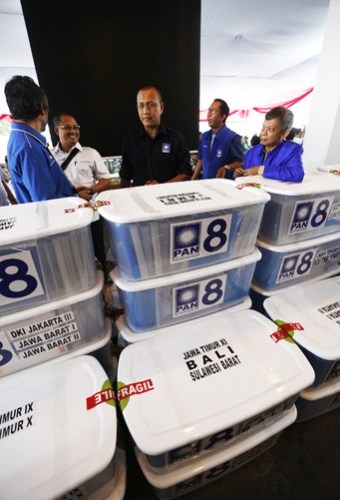
The National Mandate Party (PAN) was one of 12 political parties that submitted lists of proposed candidates for the 2014 legislative elections to the General Elections Commission on April 22. The commission will vet the lists to determine a final list of candidates to run for the 560 seats in the House of Representatives. JP/Jerry Adiguna

The General Elections Commission (KPU) posted on its website the provisional legislative nominees list from the 12 political parties eligible to contest the 2014 legislative elections. The parties can still make changes to their lists until May 22 while the KPU finalizes the list for Aug. 22. The Jakarta Post’s Prodita Sabarini looks at how the parties compiled their lists for the House of Representatives and related issues, in the following report. 

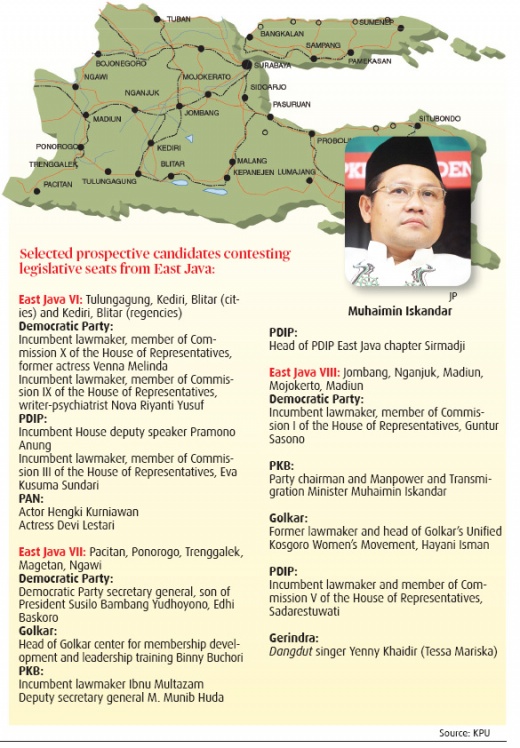
For the electoral district of East Java VI, once the winning ground of former Democratic Party chairman Anas Urbaningrum when he ran for parliament in 2009, the number one spot on the Democrat’s prospective legislator candidates list (DCS) is held by a former soap-star — lawmaker Venna Melinda.

Next on the list — for the electorate district comprising Tulungagung, Kediri and Blitar — is incumbent lawmaker writer-psychiatrist Nova Riyanti Yusuf, who ran for Jakarta II district in 2009.

In the same electorate district (dapil) as Venna and Nova, the Democratic Party of Struggle (PDI-P) has current House deputy speaker and the former party secretary general Pramono Anung. The vocal lawmaker Eva Kusuma Sundari is also running in the same dapil.

With the 2014 legislative elections looming, political parties are preparing their strategies to win the most seats in the House of Representatives, the local and provincial councils. Using old faces and reshuffling dapil for some incumbent lawmakers appears to be the strategy of choice for the Democratic Party. Besides Nova, incumbent Ramadhan Pohan and Ruhut Sitompul were also moved to different electorate districts, and are now running in the same dapil in North Sumatra I.

President Susilo Bambang Yudhoyono’s party won the most seats in the 2009 election, garnering 150 from the 560 available. But it is currently facing a plunge in popularity after a series of graft cases involving its party officials.

After the scramble of political parties to submit their candidate list on April 22, the General Election Commission (KPU) finished verifying the nominee paperwork on Tuesday. The political parties now have 14 days to revise their list; the final candidate lists are scheduled for August 22, following input from the public.

Political parties are setting optimistic targets, especially those ahead in the opinion polls. The PDI-P was most popular according to a survey in March by the National Survey Institute (LSN). According to Idham Samawi, PDI-P head of recruitment, the party aims to win the election nationally by winning in at least 17 provinces.

At the last election, the PDI-P won in five provinces and came third after the Democratic Party and Golkar. Idham attributed this to the party being without representatives in seven provinces.

Golkar set a confident 30 percent target, or 168 of the House’s 560 seats, higher than 2009 when it won 107 seats, and higher than the Democratic Party’s current 150 seats.

Firman Subagyo, head of Golkar’s election team for Java, said their target would be at least 17 seats each in East and Central Java and at least two seats in Yogyakarta. At the last election, East Java had 87 seats from 11 electoral districts up for grabs, Central Java had 77 seats from 10 dapil and Yogyakarta had eight seats.

Also in the March LSN Survey, the Great Indonesia Movement Party (Gerindra) was ranked the third most popular party, after Golkar. Gerindra deputy chairman Fadli Zon said that they would target at least 20 percent of total votes in 2014. The party won 4.5 percent of the vote last election and secured only 26 seats.

With a lower number of incumbents compared to the winning parties of the 2009 last election, Gerindra is relying on celebrities. These include television culinary personality Bondan Winarno, racing driver Moreno Suprapto and dangdut singer Yenny Khaidir, popularly called Tessa Mariska.

“We can’t have someone who’s popular but disliked by many,” Fadli reflected.

The Prosperous Justice Party (PKS), all too aware that its image has been sullied by the beef graft case that implicated former chairman Luthfi Hassan, set the “moderate” target of at least 15 percent of the vote. In 2009 the PKS won 7.9 percent of the vote

“The leadership [of the PKS] was quickly addressed and it was not like the Democratic Party who let their case linger,” PKS party spokesperson Mardani Ali Sera said, referring to the Democratic Party’s leadership uncertainty after Anas was removed from his post as party chairman. The party eventually elected Yudhoyono as chairman, a controversial issue as he already holds a high position in the party.

“With the appointment of Anis [Matta, as chairman] low morale in regional areas can be prevented,” Mardani said, referring to the former PKS secretary general, adding that even after the graft case the PKS won the gubernatorial elections in West Java and Medan.

Similar patterns can be seen across many of the parties; most have renominated their incumbents, encouraged a “passing of the baton” within political dynasties and the nomination of celebrities.

The strategies taken by Islamic parties are interesting and sometimes controversial. The PKS, an Islamic party, nominated non-Muslims in the eastern provinces. The Crescent Star Party (PBB) nominated a graft convict, former chief detective Susno Duadji, despite the KPU ruling that convicted individuals were disqualified from running. Susno recently surrendered to the police, leaving the PBB to prepare a replacement.

The National Mandate Party (PAN) is, for the second time, nominating Eurico Guiterres, its East Nusa Tenggara chapter party head and a former pro-Indonesia militia leader during Timor Leste’s independence fighting in 1999.

Indonesian Parliament Watch (Formappi) said recently that 90.5 percent of incumbent lawmakers from nine major political parties had been nominated for reelection, including those implicated in graft cases. One example is Democratic Party deputy executive chairman Max Sopacua, who was questioned by the Corruption Eradication Commission (KPK) after former party treasurer Muhammad Nazaruddin, a lawmaker until his graft conviction, alleged that Max accepted funds embezzled from a state-funded construction project.

Other names tarred by graft scandals are Setya Novanto and Kahar Muzakir, from Golkar, both of whom were implicated in the National Games (PON) project case.

Like the dynasties of bigger parties, Gerindra has similarly signs of cultivating a “keep it in the family” culture. The offspring of Hashim Djojohadikusumo — brother of Gerindra’s presidential candidate and party chief patron Prabowo Subianto — 29-year-old businessman Aryo P.S. Djojohadikusumo and 26-year-old actress, presenter and philanthropist Rahayu Saraswati Djojohadikusumo, have been nominated.

For the PDI-P, the Sukarno clan nominees are chairwoman Megawati Soekarnoputri’s daughter Puan Maharani, Puan’s uncle Guruh Sukarnoputra, and cousin Puti Guntur Sukarnoputri. In the Democratic Party, there are 15 names related to Yudhoyono— including son Edhi Baskoro Yudhoyono; cousin Sartomo Hutomo; in-laws Hartanto Edhi Wibowo and Agus Hermanto; Agus’ daughter Lintang Pramesti; and niece Putri Permatasari.

The candidates of 2014’s newcomer, the National Democrats (NasDem), founded by news channel Metro TV owner Surya Paloh, include noted journalists and presenters. Desi Fitriani, renown for her coverage of Aceh, will run in Aceh I and Virgie Baker in North Sulawesi. NasDem has also listed actress Jane Shalimar, model Noni Chirilda Kelling and actor Doni Damara.

Next year’s election uses an open and proportional system, meaning candidates who win the most votes will enter the House. In the last election the parties ranked their candidates by number, thus, those of a higher rank were prioritized though another candidate from the same party might have received more votes — a source of frustration for the losers. But following a ruling by the Constitutional Court those with the most votes will secure legislative seats.

“The parties still determine the ranking on the list — but now the effect is merely psychological”, Fadli of Gerindra said.

The result is that candidates now have to really put themselves out there so their constituents are familiar with them, PDI-P’s Idham said.

The Jakarta Post | Reportage | Tue, May 14 2013, 11:16 AM

Mixing prayer and Maroon 5: Students dare to face the odds

“God Forbid, Toli-Toli high school students make fun of Islamic prayer!” shouts the title of a YouTube video. I clicked the link and was amazed.

I saw five teenage girls, bangs, long hair and all, one of them in a headscarf. They wore track suits and were in a classroom, lined up like a group of dancers.

Their arms, folded in front of their solar plexus’ were in poses just like salat (daily Islamic prayers). A girl chants Arabic at a beautiful pitch until American band Maroon 5’s poppy tune “One More Night” begins. Then the group breaks into a dance.

I find the video amazing and with 500,000 clicks and counting, it seems like many others do too. But the reasons for this interest differ. While Islamic vigilantes say: “How dare they?!”, pressuring the school principal to expel them and call for them to be jailed for blasphemy, I say: “How daring!”

Challenging authority, especially when that said authority rules heaven and earth, is not for the faint hearted.

The girls’ dance, switching turns between mimicking Islamic prayer and dancing to a song about “making love for one more night”, has a mischievous quality in it and they would be lying to themselves if they say it did not.

Juxtaposing the sacred and the profane is sacrilegious. However, they most probably did not intend to provoke.

Perhaps it was just for the laughs and the thrill, like when the class clown mimics the most feared teacher. They are testing the boundaries, knocking down the door that is the exit of innocence. What is it like on the other side?

They have shown incredible guts, unknowingly practicing a Nietzschean rejection of religious authority. Some, if not most of us have done it before: playing tag between girls and boys in the mosque before prayer, slipping in funny words in our Koran recitation, stealing sleep during the priest’s sermon or secretly bringing an iPod to mass. We know it is wrong, but we cannot help it. We are only human after all.

The difference between the girls’ mischief and the mischief of others lies in a smartphone, Internet connection and a lack of sensible judgment about posting it online.

The dance we see on YouTube shows two things. First, it shows a performance that reflects the lives of Indonesian Muslim teenage girls in a globalized world.

The girls took two things that are close to the lives: their daily religious rituals and pop music, and created their own version of art. Media studies majors might say they are practicing bricolage, creating something from various elements of their lives.

Second, it shows a lack of understanding of Indonesia’s youth about the power of the Internet. In Indonesia, with conservative, moralistic laws in place such as the Anti-Pornography Law, Internet Transaction Law and the Blasphemy Law, uploading information to the Internet can change someone’s life.

It is unwise to store incriminating materials on your hardrive. Unless one plans on making a political statement like Pussy Riot, then it is best to keep it to yourself.

The uproar from Islamic hard-liners as the video went viral did not come as a surprise.

This is Indonesia after all, a country where cops are on friendly terms with Islamic vigilantes, where Sunni mobs can chase away Shia minorities by burning their houses and get away with it, and where people have to hold their mass on the street because the majority does not allow the minority a place for worship.

But should the girls be sacrificed because their dance offends some people? Should these individuals, who are supposed to be preparing for their national exams, pay with their futures for the silly mistake of putting their mischievous dance on YouTube? Do the pious seriously consider dancing girls so dangerous to have them imprisoned?

The Blasphemy Law, once unsuccessfully challenged by activists at the Constitutional Court, has notoriously impinged on the rights of our religious minorities.

Now, it is going to be used to crush the futures of these young girls. The Central Sulawesi office of the Indonesian Ulema Council (MUI) wisely said that the girls should not be expelled and sent to prison, but the girls’ school principal said he felt forced to expel them because the Muslim community was angry.

We cannot dismiss the role of parents and teachers in this conundrum. The reason why the students got into this mess in the first place is due to poor education.

Whether you view that teachers have not taught the students proper religious morals or whether they failed to teach the girls the consequences of posting stuff on the Internet, adults have a part in the mishap.

Instead of taking responsibility for his students’ future, the principal has stepped aside and allowed these girls to swim into a predatory ocean. It seems the principal lost his guts amid the uproar, but he could learn something about courage from the young girls he was supposed to educate and mentor.

Prodita Sabarini, Jakarta | Opinion | Mon, April 29 2013

‘Bakar batu’: A gestaltist dance

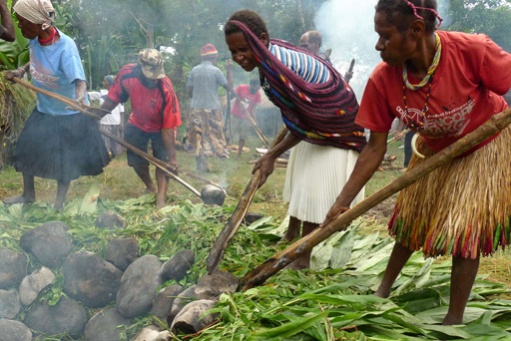
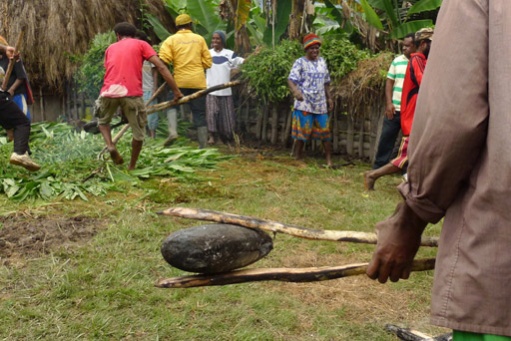
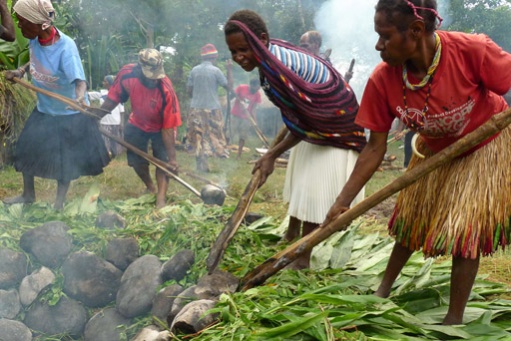
A crackling fire heats a pile of rocks in a village in Baliem Valley under the Jayawijaya mountain range. The Lani people in Yonggime village are getting ready for a feast.

Bakar batu (rock burning) is an age old ritual in Papuan tribes. The indigenous Papuans perform the ritual on various occasions: the harvest, after a conflict resolution, a funeral, to name a few. It’s an earthy cooking method where vegetables (and sometimes game) are cooked with the heat of hot rocks placed in a hole in the ground covered by leaves and grass.

In Yonggime village in Jayawijaya’s Baliem Valley, the atmosphere is festive. They are performing the rock burning ritual to celebrate the sweet potato harvest.

The people work with amazing efficiency. They shout to each other in their melodic Lani language.

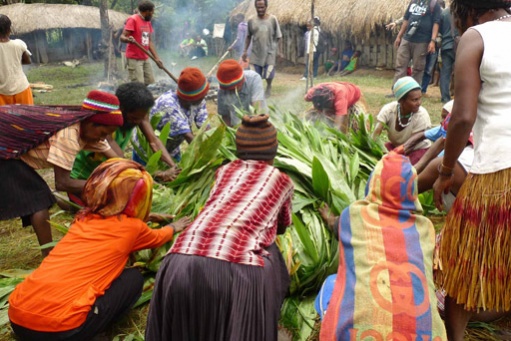
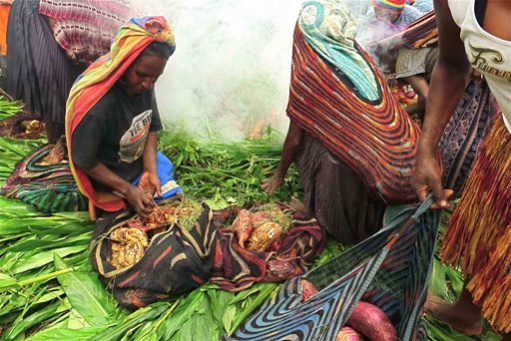
The ritual looks like a dance that requires cooperation and trust. Everyone moves fluidly. The men dig a hole in the ground and heat the rocks on a wooden platform. The women bring in the sweet potatoes in their traditional woven noken bags. When the hole is ready, the men and some women move the hot rocks with a forked stick.

Amazingly, no one bumped into each other or got burned. The village is more than just a group of people. In this dance, they are a gestalt.


p21-gbakar.img_assist_custom-512x341

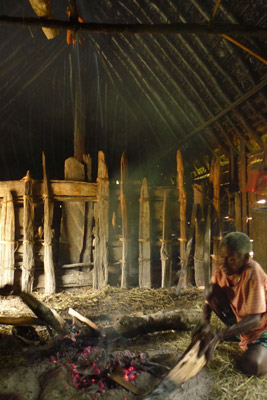
Keeping warm: An old Papuan lady tends to a fire inside a traditional Papuan house.


Smoking: Women arrange sweet potatoes in the cooking pit. Under the grass and leaves are hot stones.


Rolling the stones: Yonggime village women and men place hot stones on a pit covered by grass and leaves to prepare their earth oven.


Baggage off: A woman opens her noken, a traditional Papuan woven bag, filled with sweet potatoes next to the cooking pit, while other women bring their noken closer to the pit.
Don’t leave any behind: A man arranges stones above a wooden platform while another man squats to pick up stones. The stones will be heated up by setting the logs on fire. Keeping warm: An old Papuan lady tends to a fire inside a traditional Papuan house.
Don’t leave any behind: A man arranges stones above a wooden platform while another man squats to pick up stones. The stones will be heated up by setting the logs on fire.
Keeping warm: An old Papuan lady tends to a fire inside a traditional Papuan house.

— Text and photos by Prodita Sabarini

The Jakarta Post | Culture | Sat, March 23 2013

Govt calls HRW ‘naive’ for report on growing intolerance

Presidential spokesperson Julian Adrian Pasha is calling Human Rights Watch (HRW) “naive” for its report released on Thursday highlighting abuses against religious minorities in Indonesia.

“They should see Indonesia in its entirety, with its diversity and pluralism,” Julian said. “Even in a homogenous country there is friction between groups,” he said.

The 107-page report released by the New York-based group, titled In Religion’s Name: Abuses Against Religious Minorities in Indonesia, said that President Susilo Yudhoyono’s has been inconsistent in defending religious freedom.

The report also said that the government had been complicit in the persecution of religious minorities by failing to enforce laws and issuing regulations that breached minority rights.

Phelim Kine, the deputy director of the Asia Division of Human Rights Watch, said on Thursday that Yudhoyono was “failing to sanction those members of his government, his government’s officials and members of the police and security forces who have been passively or actively complicit in acts of religious intolerance and violence”.

Religious hard-liners have carried out hundreds of attacks local religious minorities such as the Ahmadis, Shia, Christians and Bahai.

The intimidation and attacks have been part of a growing trend of religious intolerance in Indonesia, according to HRW. Setara, a local organization monitoring religious freedom in Indonesia, documented 264 cases of violent attacks against religious minorities in 2012, up from 244 cases in 2011 and 216 cases in 2010.

In August, for example, one man was killed as a mob of 1,000 Sunni Muslims razed 37 homes belonging to Shia Muslims in Madura, East Java, while in February 2011, three Ahmadis were killed as 1,500 Islamist militants attacked an Ahmadi community in Cikeusik, Banten.

The report said that the perpetrators have mostly come from militant Sunni groups that were “at times acting with the tacit, or occasionally open, support of government officials and police”.

The central government has also not prioritized the investigation of incidents of religious intolerance and violence for police and security forces, the report said.

The HRW also reported the so-called Coordinating Board for Monitoring Mystical Beliefs in Society (Bakorpakem) for inhibiting religious freedom, saying that Bakorpakem, which is under the Attorney’s General’s Office, had been influential in pressing the decision to ban religious communities.

The report said that under Yudhoyono, Bakorpakem has had an active role in prosecuting people espousing views it deemed blasphemous to Islam, such as imprisoned Shia leader Tajul Muluk and the Alexander Aan in West Sumatra, who was imprisoned for posting pro-athiest statements on Facebook.

While Human Rights Watch also said that a 2008 joint ministerial decree that banned Ahmadis from propagating their beliefs was a license to violate the rights of religious minorities, Julian said that the extra-judicial attacks against Ahmadis in 2011 resulted from their non-compliance with the decree.

Julian also denied that the police did not have a clear direction under Yudhoyono.

“When they [police] are faced with a clash that involves a violation of the law, it’s very difficult for the police to protect others — that doesn’t mean that they do not protect the right to live and human rights.”

Prodita Sabarini, The Jakarta Post, Jakarta | National | Fri, March 01 2013

Report with 107 pages:
In Religion’s Name: Abuses against Religious Minorities in Indonesia
http://www.hrw.org/reports/2013/02/28/religion-s-name

Slide Show with 18 photos: Rising Violence against Religious Minorities
http://www.hrw.org/features/indonesia-rising-violence-against-religious-minorities


New province will attract newcomers

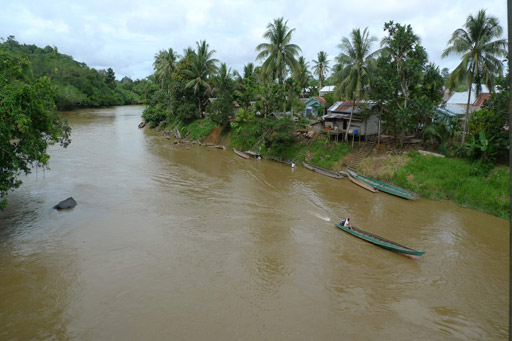
Waterways: A long boat glides along the Sekatak River in Bulungan regency. River passage is the main transportation choice in North Kalimantan, as the new province still lacks good roads. JP/Prodita Sabarini

People move far and wide to find their fortunes. In Indonesian; there’s even a word for it: merantau. Jakarta has long been the destination for migrants looking for social mobility. Now, a new province, 1,500 kilometers away across the Java Sea, offers fortune seekers a new destination.

North Kalimantan, around 70,000 square kilometers of forests and large winding rivers carved from the northern part of East Kalimantan, holds a host of business and work opportunities, according to leaders here.

Bulungan Regent Budiman Arifin said that the creation of the province would increase the region’s annual economic growth rate, tipped at 5.63 percent in 2010, by 2 percent.

Officials are not the only ones excited. Liliek Krisnamurti, a migrant from Surakarta, Central Java, says that he has found his place in North Kalimantan and is optimistic that others would feel the same.

It was earlier this month when Liliek was traveling for business from Malinau regency to Tanjung Selor, the new provincial capital. It was a bumpy four-hour journey in a rental car. Infrastructure is meager and affordable public transportation is rare in North Kalimanatan, Demand is growing, however, resulting in, for example, the emergence of several rental car businesses.

Liliek runs an up-and-coming printing business, supplying a host of customers, from lumber mills seeking invoices to schools seeking textbooks. He moved to Samarinda in 1998 after finding that there was nothing for him in Java. At the time, he was an itinerant street singer. “I’ve tried Solo, Yogyakarta and Bali,” he said.

He then tried his luck in Kalimantan, starting off as a janitor at a print shop, where he learned the trade and soon was offered a better job. Four years ago, he moved north, to Malinau, then the largest — and poorest — regency in East Kalimantan.

Liliek said he was optimistic on the new province’s prospects. “I think it’s really good that North Kalimantan is its own province. This region has a lot of potential,” he said.

He said that Malinau, the regency he now calls home, will attract a lot of investors.

Three major coal companies currently operate in Malinau — Bara Dinamika Muda Sukses, Mitra Bara Adi Perdana and Kayan Putra Utama Coal — that produced a total of 1.89 million tons of coal valued at US$133.92 million in 2010, according to the Malinau administration.

Liliek, however, said that business and work opportunities would develop outside the extractive industries. He declined to reveal how profitable his business has been, saying that over the last four years he has been able to build a house by a river that cost him more than half a billion rupiah.

Budiman said that not long after the formation of the new province was announced, automobile dealers arrived looking for land to build showrooms in Tanjung Selor.

The regent said that North Kalimantan would definitely attract new migrants from other parts of Indonesia.

Agus Tantomo, a former East Kalimantan councilor however is skeptical that North Kalimantan regions would be better off as its own province. He said that regions in North Kalimantan would lose their share of dividends from the East Kalimantan’s southern regions extractive industries.

According to law, the central government receives 70 percent of share of income from oil and 30 percent goes to the producing region. For gas, from the 30 percent, six percent goes to regencies and cities within the producing province. Meanwhile for oil, regencies and cities from the producing province receives 3 percent of
the income.

As the regencies and the city in the new North Kalimantan produce less than East Kalimantan’s southern regions, their budget would be smaller, Agus said.

Budiman however is optimistic and claims that the province has plenty of natural resources. The Bulungan Mining Agency has issued 87 mining permits (IUPs) covering 400,000 hectares between November 2009 and February 2011, to the ilk of environmental activist. Only one of the companies is in the producing stage, the rest are still exploring.

Budiman said that officials had required companies to follow environmental standards.

“If companies don’t comply then we send warning. We can even rescind their permits.”

The regent said that he was focusing on agriculture and working with the central government to open 50,000 hectares of farmland in the Delta Kayan Food Estate. He said that 50 percent of the farmers would be local residents of North Kalimantan and the rest migrants from Java, Lampung and West Nusa Tenggara.

“They are given 2 hectares of land and an 18 month living allowance. School and health facilities are available too,” he said.

The number of migrant farmers was capped to ensure that original residents of the area were not marginalized, he added.

Meanwhile, in Jakarta, Ichsan Malik, the head of the Peace-Building Institute, said that the prospects for peace in North Kalimantan were good, despite the ethnic conflicts that have emerged in other regions where migrants have settled down far from home.

“The people are heterogeneous and the economic gap between different ethnic groups is not that wide. There is no problem with injustice,” he said.

The dominant ethnic groups in the region are national-majority Javanese, Bugis and Dayak. Ichsan, known for his peace-building work during the communal conflicts in Maluku, said that the Dayaks in the province still faced challenges. In 2010, riots between ethnic Tidung and Bugis ethnic groups erupted in Tarakan.

As a new province, the government, from its beginning, should pay more attention to the Dayak people,” he said adding that an affirmative-action was required to ensure their rights.

Meanwhile, some of those who lived in the province before its inception say that the formation of North Kalimantan will be a good thing only as far as it affects their lives for the better.

Yohanes, the village leader of Sekatak, Bulungan said many young local Dayaks have not received
the same work opportunities compared to migrants, while the land they live off has been given away for mining or timber concessions. These companies, however, have not been recruiting young Dayaks for good jobs, Yohanes said. “They take Dayaks to be security guards but not as staff.”

In the long run, with more migrants coming in, Ichsan warns that these discontents should be addressed to prevent future conflicts.

Prodita Sabarini and Nurni Sulaiman, The Jakarta Post, Bulungan | Reportage | Mon, January 28 2013

Three years ahead of Governor race, possible candidates already surface

Bumpy ride: A truck drives along a dirt track in Bulungan regency. The new North Kalimantan province is hoping to speed up development in regions that lack infrastructure. JP/Prodita Sabarini

The election of the governor of North Kalimantan province is still three years away, but names are already being bounced around for the first elected leader of the new province.

Golkar party chief in Nunukan regency Ngatidjan Ahmadi said on Wednesday that his party had three names that they saw as strong candidates to support. “Jusuf SK, former mayor of Tarakan; Martin Bila****, former regent of Malinau and Anang Dahlan, former regent of Bulungan,” he said.

Jusuf Serang Kasim, a doctor who ran the Tarakan hospital before becoming mayor of Tarakan, is one of the driving forces behind North Kalimantan earning its provincial status. He founded Gerakan Kaltara Bersatu (the United North Kalimantan Movement) to intensify lobbying for North Kalimantan at the House of Representatives. Local North Kalimantan political observer from Borneo University, Yahya Ahmad Zein, says that while the initiative to form a new province came from university students of North Kalimantan origin, Jusuf SK was the man who organized and unified the movement.

“He took over, so after he finished his term as mayor he started to strengthen the movement,” he said. Yahya said that people had been sporadically advocating provincial status for North Kalimantan. “There was the KNPI (Indonesian Youth Committee) and other organizations but after he took over, the campaign for North Kalimantan was more intense and organized,” he said.

Yahya says that due to Jusuf’s work in lobbying for North Kalimantan, he is currently very popular in the region. Another potential candidate, Martin Bila, a former Malinau regent, is known for his conservation activities as Malinau mayor. In 2007, he received the Kalpataru award from President Susilo Bambang Yudhoyono for his work in preserving the environment in Malinau. Jusuf SK also received the Kalpataru award in 2006 for preserving mangroves in Tarakan.

Ngatidjan added that the incumbent Bulungan regent Budiman Arifin might be a strong contender with the backing of the Democratic Party. Budiman however declined to comment on the gubernatorial election.

The law that endorsed the establishment of North Kalimantan as a new autonomous province mandated the Home Affairs Ministry to appoint an acting governor by July 2013 at the latest. The acting governor would then prepare for the 2014 legislative election while the gubernatorial election is scheduled for 2015, three years after the passing of the law.

Jusuf, with the Gerakan Kaltara Bersatu, and politicians that sit in the East Kalimantan council representing regions that are now part of North Kalimantan territory, plans to challenge the law that leaves the new province without a local council for a year and prolongs the time until the province has an autonomous administration to three years.

“By law North Kalimantan exists, but in reality it doens’t,” Yahya said regarding the North Kalimantan administrative arrangement. In fact voters in the regions of North Kalimantan are still included on the electoral roll for the East Kalimantan gubernatorial election in 2013.

Constitutional Court expert Ni’matul Huda said that each of the prospective challengers had a chance at winning, as quoted by radartarakan.co.id. She also questioned the accountability of the acting governor in managing the budget.

Ngatidjan said that the three-year hiatus could cause the political map to change ahead of the election.

Yahya also said that it was too early to predict the candidates that would run for governor.

Prodita Sabarini and Nurni Sulaiman, The Jakarta Post, Bulungan | Reportage | Mon, January 28 2013

A new province is born

Waterways: A long boat glides along the Sekatak River in Bulungan regency. River passage is the main transportation choice in North Kalimantan, as the new province still lacks good roads. JP/Prodita Sabarini

Indonesia’s newest province is North Kalimantan, carved out of one of the nation’s richest provinces, East Kalimantan. The Jakarta Post’s Prodita Sabarini and Nurni Sulaiman report from Bulungan regency, the home of its future capital. 

To the north of East Kalimantan, bordering the Malaysian states of Sabah and Sarawak, a new province — Indonesia’s 34th — is in the making.

North Kalimantan was born after the gavel was pounded at a plenary meeting of the House of Representatives in Jakarta in October.

A little over two months later, across the sea around 1,500 kilometers from the capital, there are few signs of the province’s existence. In Tanjung Selor, the capital of Bulungan and the proposed provincial capital, a sign in front of the old regent’s office reads: “Preparations for the North Kalimantan Gubernatorial Office”. The office is a simple low-rise yellow building.

The House bill that authorized the creation of North Kalimantan mandated the home minister to prepare governmental infrastructure and to appoint an acting governor within nine months.

Bulungan Regent Budiman Arifin said that the acting governor would have their office in the yellow building, which sits on about 1.6 hectares in the city. “It will be up to the new governor if they want like to renovate it,” he said.

North Kalimantan’s establishment came as a surprise: A government issued moratorium on the formation of new autonomous regions in 2009 was effectively flouted by the House. The last province to be established before North Kalimantan was West Sulawesi in 2004, but new regencies continued to be created. The government wanted to halt the creation of new provinces and regencies as the process had been prone to conflict. In 2009, for example, angry protesters barged into the North Sumatra Legislative Council’s chambers, demanding that the body approve the formation of the province of Tapanuli. The council speaker’s Abdul Aziz Angkat, died of a heart attack out of shock.

North Kalimantan comprises four regencies — Bulungan, Nunukan, Malinau and Tana Tidung — and Tarakan city.

In early January, the regents and the mayor visited Samarinda for events marking the 56th anniversary of East Kalimantan. Budiman, who was at the event, said he was wistful and relieved at the same time. “This will be our last time going to Samarinda for the anniversary. Next year, we will be celebrating our own.”

Tarakan mayor Udin Hianggio says the history of North Kalimantan began 12 years ago, when a group of university students hailing from the northern part of East Kalimantan, who were studying in Malang, East Java, launched an initiative to separate from East Kalimantan.

Back then, oil-rich Berau regency, which also includes the popular tourist destination of Derawan, was to have been the cornerstone of the new province. Berau was eventually kept within East Kalimantan.

Regional leaders and civil society groups met regularly to prepare their request to establish a new autonomous region. They established an association of regional leaders and a lobbying group headed by former Tarakan mayor Jusuf SK.

“This has been a long struggle,” mayor Udin said, “Praise God, [the new province] is now passed as law.”

The House mandated that a budget for North Kalimantan’s operations and elections be allocated by the East Kalimantan provincial administration and the four affected regency administrations. East Kalimantan has been pegged to provide Rp 300 billion for the new province; Bulungan regency, Rp 50 billion.

The rationale behind the creation of a new province, Budiman said, was administrative ease. East Kalimantan was previously the nation’s second-largest province in terms of area after Papua. Officials in the northern part of East Kalimantan had to take boats, planes and a bumpy day’s car ride to Samarinda, East Kalimnatan’s provincial seat.

Budiman said that having the provincial capital in the north would speed administration, speed progress and speed the elimination of poverty. The regions in the north were the poorest in resource-rich East Kalimantan, lacking infrastructure while featuring double-digit poverty rates. Malinau was the worst off, recording a poverty rate of 15.31 percent in 2010, according to the East Kalimantan Statistics Agency.

Another reason to form a new province was to better secure Indonesian territory that borders Malaysia. In 2002, Indonesia lost a legal battle with its neighbor to keep Sipadan and Ligitan Islands in the Makassar Strait. Lawmaker Agun Gunandjar Sudarsa of House Commission II on regional autonomy said that the establishment of North Kalimantan would secure the loyalties of Indonesians living on the Malaysian border.

“We saw the history of how our country lost Sipadan-Ligitan [islands,” Udin said. “That’s an example [of the effect] of an area which is too vast.”

However, critics say that establishment of new autonomous regions has been costly, claiming that a lack of capacity has meant that new regions have failed to improve the people’s welfare.

According to the Home Ministry, 57 of 205 autonomous regions established between 1999 and 2004 have failed to increase welfare or public service. The Home Ministry now regularly evaluates these new provinces, regencies and municipalities, which it can order to be reintegrated with their original regions if found wanting.

Budiman, however, is certain that North Kalimantan will be able to serve its people. “Many of the new regions that resulted from decentralization in East Kalimantan have succeeded, starting from Tarakan, Malinau regency, Nunukan, West Kutai, East Kutai, Bontang, Penajam, and Tana Tidung regency,” he said.

All the regions in North Kalimantan were once a vastly larger Bulungan regency. Tarakan, Malinau. Nunukan, Tana Tidung were part of Bulungan until they became autonomous.

He said that the human resources to staff the new province were available in Bulungan and the other regencies.

The staff and acting governor of North Kalimantan are currently staffed by appointments from the ministry. “The acting governor will not open all the [provincial] agencies yet, only the vital ones, such as those for public works, health agency, etc….,” Budiman said.

To anticipate the flow of migrants coming to Bulungan as Tanjung Selor becomes the provincial capital, access to clean water and other services would be increased, Budiman said. He added that he would work with the state electricity company PLN to increase the power supply in the region.

“More people will come here as we become a new province. We have to be ready for that,” he said.

The Jakarta Post | Reportage | Mon, January 28 2013