Few voters research legislative candidates
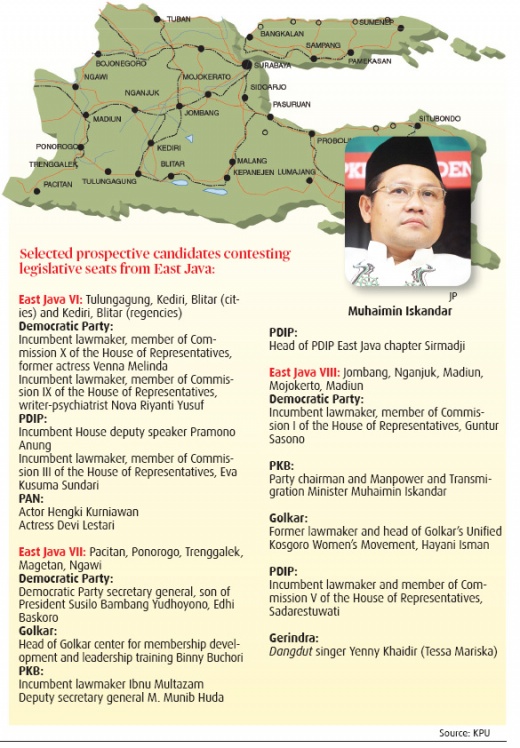
ELECTION-2.img_assist_custom-520x749

Life is all about choices and Indonesians will have a chance to decide in next year’s legislative election on who should make rules for them.

In the last elections for representatives in the local and provincial councils as well as the national parliament, many voters made questionable choices, judging from the track record of the country’s lawmakers.

The Constitutional Court has received many judicial reviews for flawed laws. Elected councilors have also produced hundreds of discriminative bylaws that have been blamed, among other things, on councilors’ legal incompetence.

Meanwhile, the Home Ministry reported that some 3,000 legislative councilors and House of Representatives members were implicated in legal cases, around 1,000 of them in graft cases.

Indonesian Parliament Watch (Formappi) head Sebastian Salang said that it was difficult to rely on voters to do research and pick the right candidate.

To push people to take care about who represents them is hard as they don’t feel any benefit from having legislators, he said.

Sebastian says the General Election Commission (KPU) shares the blame, as they list candidates without any explanation. “In the end [voters] tend to choose people that they’re familiar with such as celebrities, who they have seen on television,” he said.

But Priska Siagian from the Send Books Movement (GKB), a civil movement that sends books to legislators as a critique to use common sense and better references in their work, said she believes that there are smart voters out there, who want smart representatives.

Priska herself says she seeks potential representatives with a similar vision to hers. “Because for five years after they are sworn into office all our political and legal matters will be represented by these legislators,” she said.

Priska said that the Internet helps her track the record of prospective candidates in her electoral district. After checking their track record she would scrutinize the candidate list. “The good thing is in this digital era, [we can] find information on people, especially legislative candidates.”

Ika Karlina Idris, a Jakarta-based-voter, said she was guilty of not doing research for the last legislative election. She said she only found out the names of the candidates when she opened the ballot paper in the voting booth. But this year, Ika said she wanted to scrutinize each candidate in her election commentary blog gosippemilu.org.

The Election Commission has posted on their website kpu.go.id the prospective legislative candidate list (DCS) from the 12 parties contesting the elections. The website also has the maps of each province’s electoral district. There will be 77 electoral districts (dapil) for the 2014 election. Some Regional Election Commissions (KPUD), such as the West Java KPUD, have posted the DCS for the provincial and regional councils.

Voters can check which dapil they should vote in according to their residence, listed on their ID card. For example, those with an ID based in Bandung would vote in dapil West Java I. Those living in East Jakarta would vote in Jakarta I. A Surabaya resident would vote in East Java III.

After finding one’s dapil, a voter can start checking the nominated legislative candidates for the respective regency or municipality, provincial councils and the House of Representatives.

For example, the choices for residents of West and North Jakarta, as well as the Seribu Islands ( DKI III), will include current House speaker Marzuki Alie from the Democratic Party, who suggested women in the House to be banned from wearing miniskirts to save them from sexual harassment; retired policeman Adang Daradjatun of the Prosperous Justice Party (PKS), who failed in his bid for Jakarta governor in 2007 and whose wife has been implicated in a graft case; the son of business tycoon and Great Indonesia Movement (Gerindra) Party Hashim Djojohadikusumo, Aryo P.S. Djojohadikusumo, also the nephew of the party’s presidential candidate, former Special Forces (Kopassus) chief Prabowo Subianto; former athlete and newsman Richard Sambera from the Indonesia Democratic Party of Struggle (PDI-P), incumbent legislator and former TV presenter Tantowi Yahya from Golkar, and the secretary general of a hardline religious group Islamic Peoples Forum (FUI) Muhammad Alkhathkhath, from the Crescent Star Party (PBB).

— JP/ Prodita Sabarini

The Jakarta Post | Reportage | Tue, May 14 2013, 11:26 AM

Tried, tested strategies: Incumbents, dynasties and celebrities


The National Mandate Party (PAN) was one of 12 political parties that submitted lists of proposed candidates for the 2014 legislative elections to the General Elections Commission on April 22. The commission will vet the lists to determine a final list of candidates to run for the 560 seats in the House of Representatives. JP/Jerry Adiguna

The General Elections Commission (KPU) posted on its website the provisional legislative nominees list from the 12 political parties eligible to contest the 2014 legislative elections. The parties can still make changes to their lists until May 22 while the KPU finalizes the list for Aug. 22. The Jakarta Post’s Prodita Sabarini looks at how the parties compiled their lists for the House of Representatives and related issues, in the following report. 

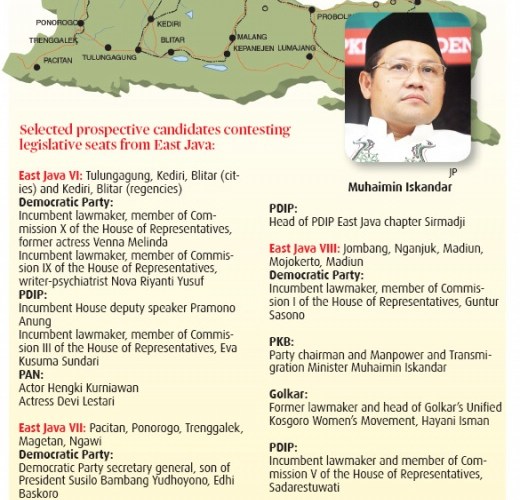
For the electoral district of East Java VI, once the winning ground of former Democratic Party chairman Anas Urbaningrum when he ran for parliament in 2009, the number one spot on the Democrat’s prospective legislator candidates list (DCS) is held by a former soap-star — lawmaker Venna Melinda.

Next on the list — for the electorate district comprising Tulungagung, Kediri and Blitar — is incumbent lawmaker writer-psychiatrist Nova Riyanti Yusuf, who ran for Jakarta II district in 2009.

In the same electorate district (dapil) as Venna and Nova, the Democratic Party of Struggle (PDI-P) has current House deputy speaker and the former party secretary general Pramono Anung. The vocal lawmaker Eva Kusuma Sundari is also running in the same dapil.

With the 2014 legislative elections looming, political parties are preparing their strategies to win the most seats in the House of Representatives, the local and provincial councils. Using old faces and reshuffling dapil for some incumbent lawmakers appears to be the strategy of choice for the Democratic Party. Besides Nova, incumbent Ramadhan Pohan and Ruhut Sitompul were also moved to different electorate districts, and are now running in the same dapil in North Sumatra I.

President Susilo Bambang Yudhoyono’s party won the most seats in the 2009 election, garnering 150 from the 560 available. But it is currently facing a plunge in popularity after a series of graft cases involving its party officials.

After the scramble of political parties to submit their candidate list on April 22, the General Election Commission (KPU) finished verifying the nominee paperwork on Tuesday. The political parties now have 14 days to revise their list; the final candidate lists are scheduled for August 22, following input from the public.

Political parties are setting optimistic targets, especially those ahead in the opinion polls. The PDI-P was most popular according to a survey in March by the National Survey Institute (LSN). According to Idham Samawi, PDI-P head of recruitment, the party aims to win the election nationally by winning in at least 17 provinces.

At the last election, the PDI-P won in five provinces and came third after the Democratic Party and Golkar. Idham attributed this to the party being without representatives in seven provinces.

Golkar set a confident 30 percent target, or 168 of the House’s 560 seats, higher than 2009 when it won 107 seats, and higher than the Democratic Party’s current 150 seats.

Firman Subagyo, head of Golkar’s election team for Java, said their target would be at least 17 seats each in East and Central Java and at least two seats in Yogyakarta. At the last election, East Java had 87 seats from 11 electoral districts up for grabs, Central Java had 77 seats from 10 dapil and Yogyakarta had eight seats.

Also in the March LSN Survey, the Great Indonesia Movement Party (Gerindra) was ranked the third most popular party, after Golkar. Gerindra deputy chairman Fadli Zon said that they would target at least 20 percent of total votes in 2014. The party won 4.5 percent of the vote last election and secured only 26 seats.

With a lower number of incumbents compared to the winning parties of the 2009 last election, Gerindra is relying on celebrities. These include television culinary personality Bondan Winarno, racing driver Moreno Suprapto and dangdut singer Yenny Khaidir, popularly called Tessa Mariska.

“We can’t have someone who’s popular but disliked by many,” Fadli reflected.

The Prosperous Justice Party (PKS), all too aware that its image has been sullied by the beef graft case that implicated former chairman Luthfi Hassan, set the “moderate” target of at least 15 percent of the vote. In 2009 the PKS won 7.9 percent of the vote

“The leadership [of the PKS] was quickly addressed and it was not like the Democratic Party who let their case linger,” PKS party spokesperson Mardani Ali Sera said, referring to the Democratic Party’s leadership uncertainty after Anas was removed from his post as party chairman. The party eventually elected Yudhoyono as chairman, a controversial issue as he already holds a high position in the party.

“With the appointment of Anis [Matta, as chairman] low morale in regional areas can be prevented,” Mardani said, referring to the former PKS secretary general, adding that even after the graft case the PKS won the gubernatorial elections in West Java and Medan.

Similar patterns can be seen across many of the parties; most have renominated their incumbents, encouraged a “passing of the baton” within political dynasties and the nomination of celebrities.

The strategies taken by Islamic parties are interesting and sometimes controversial. The PKS, an Islamic party, nominated non-Muslims in the eastern provinces. The Crescent Star Party (PBB) nominated a graft convict, former chief detective Susno Duadji, despite the KPU ruling that convicted individuals were disqualified from running. Susno recently surrendered to the police, leaving the PBB to prepare a replacement.

The National Mandate Party (PAN) is, for the second time, nominating Eurico Guiterres, its East Nusa Tenggara chapter party head and a former pro-Indonesia militia leader during Timor Leste’s independence fighting in 1999.

Indonesian Parliament Watch (Formappi) said recently that 90.5 percent of incumbent lawmakers from nine major political parties had been nominated for reelection, including those implicated in graft cases. One example is Democratic Party deputy executive chairman Max Sopacua, who was questioned by the Corruption Eradication Commission (KPK) after former party treasurer Muhammad Nazaruddin, a lawmaker until his graft conviction, alleged that Max accepted funds embezzled from a state-funded construction project.

Other names tarred by graft scandals are Setya Novanto and Kahar Muzakir, from Golkar, both of whom were implicated in the National Games (PON) project case.

Like the dynasties of bigger parties, Gerindra has similarly signs of cultivating a “keep it in the family” culture. The offspring of Hashim Djojohadikusumo — brother of Gerindra’s presidential candidate and party chief patron Prabowo Subianto — 29-year-old businessman Aryo P.S. Djojohadikusumo and 26-year-old actress, presenter and philanthropist Rahayu Saraswati Djojohadikusumo, have been nominated.

For the PDI-P, the Sukarno clan nominees are chairwoman Megawati Soekarnoputri’s daughter Puan Maharani, Puan’s uncle Guruh Sukarnoputra, and cousin Puti Guntur Sukarnoputri. In the Democratic Party, there are 15 names related to Yudhoyono— including son Edhi Baskoro Yudhoyono; cousin Sartomo Hutomo; in-laws Hartanto Edhi Wibowo and Agus Hermanto; Agus’ daughter Lintang Pramesti; and niece Putri Permatasari.

The candidates of 2014’s newcomer, the National Democrats (NasDem), founded by news channel Metro TV owner Surya Paloh, include noted journalists and presenters. Desi Fitriani, renown for her coverage of Aceh, will run in Aceh I and Virgie Baker in North Sulawesi. NasDem has also listed actress Jane Shalimar, model Noni Chirilda Kelling and actor Doni Damara.

Next year’s election uses an open and proportional system, meaning candidates who win the most votes will enter the House. In the last election the parties ranked their candidates by number, thus, those of a higher rank were prioritized though another candidate from the same party might have received more votes — a source of frustration for the losers. But following a ruling by the Constitutional Court those with the most votes will secure legislative seats.

“The parties still determine the ranking on the list — but now the effect is merely psychological”, Fadli of Gerindra said.

The result is that candidates now have to really put themselves out there so their constituents are familiar with them, PDI-P’s Idham said.

The Jakarta Post | Reportage | Tue, May 14 2013, 11:16 AM

‘Bakar batu’: A gestaltist dance

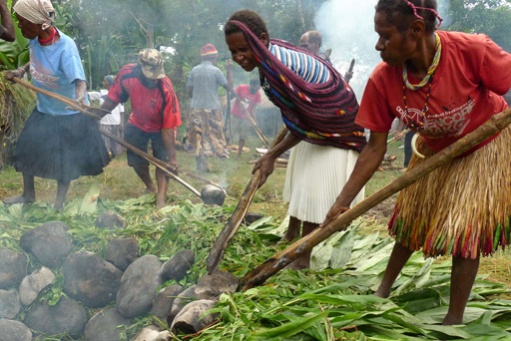
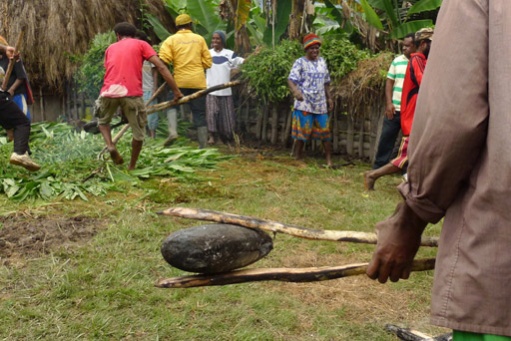
A crackling fire heats a pile of rocks in a village in Baliem Valley under the Jayawijaya mountain range. The Lani people in Yonggime village are getting ready for a feast.

Bakar batu (rock burning) is an age old ritual in Papuan tribes. The indigenous Papuans perform the ritual on various occasions: the harvest, after a conflict resolution, a funeral, to name a few. It’s an earthy cooking method where vegetables (and sometimes game) are cooked with the heat of hot rocks placed in a hole in the ground covered by leaves and grass.

In Yonggime village in Jayawijaya’s Baliem Valley, the atmosphere is festive. They are performing the rock burning ritual to celebrate the sweet potato harvest.

The people work with amazing efficiency. They shout to each other in their melodic Lani language.

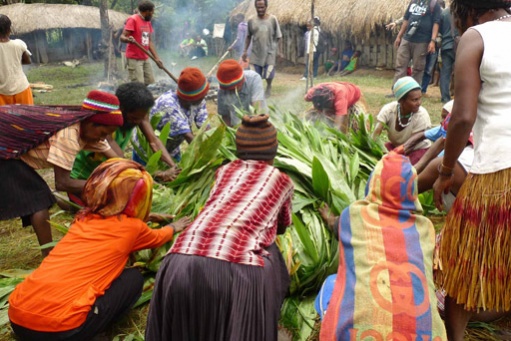
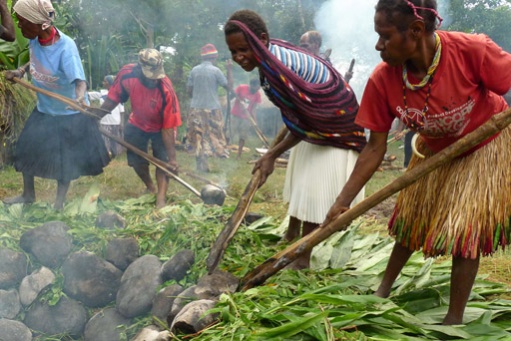
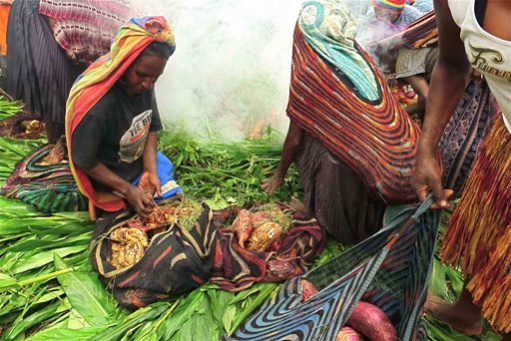
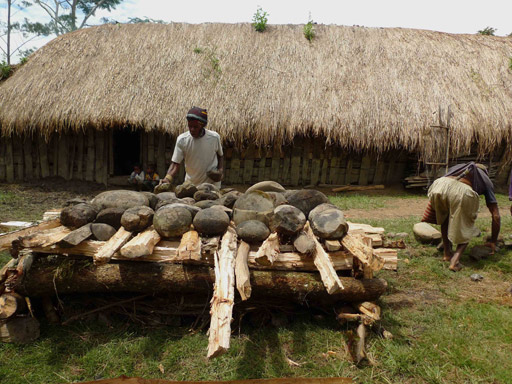
The ritual looks like a dance that requires cooperation and trust. Everyone moves fluidly. The men dig a hole in the ground and heat the rocks on a wooden platform. The women bring in the sweet potatoes in their traditional woven noken bags. When the hole is ready, the men and some women move the hot rocks with a forked stick.

Amazingly, no one bumped into each other or got burned. The village is more than just a group of people. In this dance, they are a gestalt.


p21-gbakar.img_assist_custom-512x341

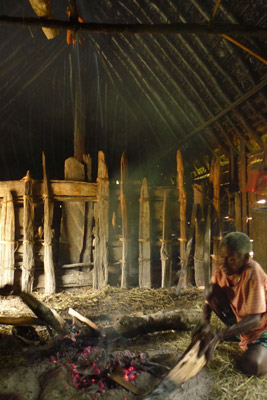
Keeping warm: An old Papuan lady tends to a fire inside a traditional Papuan house.


Smoking: Women arrange sweet potatoes in the cooking pit. Under the grass and leaves are hot stones.


Rolling the stones: Yonggime village women and men place hot stones on a pit covered by grass and leaves to prepare their earth oven.


Baggage off: A woman opens her noken, a traditional Papuan woven bag, filled with sweet potatoes next to the cooking pit, while other women bring their noken closer to the pit.
Don’t leave any behind: A man arranges stones above a wooden platform while another man squats to pick up stones. The stones will be heated up by setting the logs on fire. Keeping warm: An old Papuan lady tends to a fire inside a traditional Papuan house.
Don’t leave any behind: A man arranges stones above a wooden platform while another man squats to pick up stones. The stones will be heated up by setting the logs on fire.
Keeping warm: An old Papuan lady tends to a fire inside a traditional Papuan house.

— Text and photos by Prodita Sabarini

The Jakarta Post | Culture | Sat, March 23 2013

New province will attract newcomers

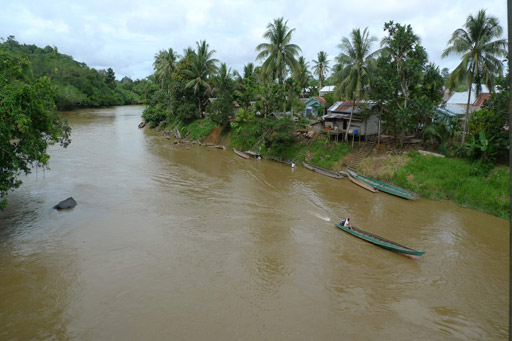
Waterways: A long boat glides along the Sekatak River in Bulungan regency. River passage is the main transportation choice in North Kalimantan, as the new province still lacks good roads. JP/Prodita Sabarini

People move far and wide to find their fortunes. In Indonesian; there’s even a word for it: merantau. Jakarta has long been the destination for migrants looking for social mobility. Now, a new province, 1,500 kilometers away across the Java Sea, offers fortune seekers a new destination.

North Kalimantan, around 70,000 square kilometers of forests and large winding rivers carved from the northern part of East Kalimantan, holds a host of business and work opportunities, according to leaders here.

Bulungan Regent Budiman Arifin said that the creation of the province would increase the region’s annual economic growth rate, tipped at 5.63 percent in 2010, by 2 percent.

Officials are not the only ones excited. Liliek Krisnamurti, a migrant from Surakarta, Central Java, says that he has found his place in North Kalimantan and is optimistic that others would feel the same.

It was earlier this month when Liliek was traveling for business from Malinau regency to Tanjung Selor, the new provincial capital. It was a bumpy four-hour journey in a rental car. Infrastructure is meager and affordable public transportation is rare in North Kalimanatan, Demand is growing, however, resulting in, for example, the emergence of several rental car businesses.

Liliek runs an up-and-coming printing business, supplying a host of customers, from lumber mills seeking invoices to schools seeking textbooks. He moved to Samarinda in 1998 after finding that there was nothing for him in Java. At the time, he was an itinerant street singer. “I’ve tried Solo, Yogyakarta and Bali,” he said.

He then tried his luck in Kalimantan, starting off as a janitor at a print shop, where he learned the trade and soon was offered a better job. Four years ago, he moved north, to Malinau, then the largest — and poorest — regency in East Kalimantan.

Liliek said he was optimistic on the new province’s prospects. “I think it’s really good that North Kalimantan is its own province. This region has a lot of potential,” he said.

He said that Malinau, the regency he now calls home, will attract a lot of investors.

Three major coal companies currently operate in Malinau — Bara Dinamika Muda Sukses, Mitra Bara Adi Perdana and Kayan Putra Utama Coal — that produced a total of 1.89 million tons of coal valued at US$133.92 million in 2010, according to the Malinau administration.

Liliek, however, said that business and work opportunities would develop outside the extractive industries. He declined to reveal how profitable his business has been, saying that over the last four years he has been able to build a house by a river that cost him more than half a billion rupiah.

Budiman said that not long after the formation of the new province was announced, automobile dealers arrived looking for land to build showrooms in Tanjung Selor.

The regent said that North Kalimantan would definitely attract new migrants from other parts of Indonesia.

Agus Tantomo, a former East Kalimantan councilor however is skeptical that North Kalimantan regions would be better off as its own province. He said that regions in North Kalimantan would lose their share of dividends from the East Kalimantan’s southern regions extractive industries.

According to law, the central government receives 70 percent of share of income from oil and 30 percent goes to the producing region. For gas, from the 30 percent, six percent goes to regencies and cities within the producing province. Meanwhile for oil, regencies and cities from the producing province receives 3 percent of
the income.

As the regencies and the city in the new North Kalimantan produce less than East Kalimantan’s southern regions, their budget would be smaller, Agus said.

Budiman however is optimistic and claims that the province has plenty of natural resources. The Bulungan Mining Agency has issued 87 mining permits (IUPs) covering 400,000 hectares between November 2009 and February 2011, to the ilk of environmental activist. Only one of the companies is in the producing stage, the rest are still exploring.

Budiman said that officials had required companies to follow environmental standards.

“If companies don’t comply then we send warning. We can even rescind their permits.”

The regent said that he was focusing on agriculture and working with the central government to open 50,000 hectares of farmland in the Delta Kayan Food Estate. He said that 50 percent of the farmers would be local residents of North Kalimantan and the rest migrants from Java, Lampung and West Nusa Tenggara.

“They are given 2 hectares of land and an 18 month living allowance. School and health facilities are available too,” he said.

The number of migrant farmers was capped to ensure that original residents of the area were not marginalized, he added.

Meanwhile, in Jakarta, Ichsan Malik, the head of the Peace-Building Institute, said that the prospects for peace in North Kalimantan were good, despite the ethnic conflicts that have emerged in other regions where migrants have settled down far from home.

“The people are heterogeneous and the economic gap between different ethnic groups is not that wide. There is no problem with injustice,” he said.

The dominant ethnic groups in the region are national-majority Javanese, Bugis and Dayak. Ichsan, known for his peace-building work during the communal conflicts in Maluku, said that the Dayaks in the province still faced challenges. In 2010, riots between ethnic Tidung and Bugis ethnic groups erupted in Tarakan.

As a new province, the government, from its beginning, should pay more attention to the Dayak people,” he said adding that an affirmative-action was required to ensure their rights.

Meanwhile, some of those who lived in the province before its inception say that the formation of North Kalimantan will be a good thing only as far as it affects their lives for the better.

Yohanes, the village leader of Sekatak, Bulungan said many young local Dayaks have not received
the same work opportunities compared to migrants, while the land they live off has been given away for mining or timber concessions. These companies, however, have not been recruiting young Dayaks for good jobs, Yohanes said. “They take Dayaks to be security guards but not as staff.”

In the long run, with more migrants coming in, Ichsan warns that these discontents should be addressed to prevent future conflicts.

Prodita Sabarini and Nurni Sulaiman, The Jakarta Post, Bulungan | Reportage | Mon, January 28 2013

Three years ahead of Governor race, possible candidates already surface

Bumpy ride: A truck drives along a dirt track in Bulungan regency. The new North Kalimantan province is hoping to speed up development in regions that lack infrastructure. JP/Prodita Sabarini

The election of the governor of North Kalimantan province is still three years away, but names are already being bounced around for the first elected leader of the new province.

Golkar party chief in Nunukan regency Ngatidjan Ahmadi said on Wednesday that his party had three names that they saw as strong candidates to support. “Jusuf SK, former mayor of Tarakan; Martin Bila****, former regent of Malinau and Anang Dahlan, former regent of Bulungan,” he said.

Jusuf Serang Kasim, a doctor who ran the Tarakan hospital before becoming mayor of Tarakan, is one of the driving forces behind North Kalimantan earning its provincial status. He founded Gerakan Kaltara Bersatu (the United North Kalimantan Movement) to intensify lobbying for North Kalimantan at the House of Representatives. Local North Kalimantan political observer from Borneo University, Yahya Ahmad Zein, says that while the initiative to form a new province came from university students of North Kalimantan origin, Jusuf SK was the man who organized and unified the movement.

“He took over, so after he finished his term as mayor he started to strengthen the movement,” he said. Yahya said that people had been sporadically advocating provincial status for North Kalimantan. “There was the KNPI (Indonesian Youth Committee) and other organizations but after he took over, the campaign for North Kalimantan was more intense and organized,” he said.

Yahya says that due to Jusuf’s work in lobbying for North Kalimantan, he is currently very popular in the region. Another potential candidate, Martin Bila, a former Malinau regent, is known for his conservation activities as Malinau mayor. In 2007, he received the Kalpataru award from President Susilo Bambang Yudhoyono for his work in preserving the environment in Malinau. Jusuf SK also received the Kalpataru award in 2006 for preserving mangroves in Tarakan.

Ngatidjan added that the incumbent Bulungan regent Budiman Arifin might be a strong contender with the backing of the Democratic Party. Budiman however declined to comment on the gubernatorial election.

The law that endorsed the establishment of North Kalimantan as a new autonomous province mandated the Home Affairs Ministry to appoint an acting governor by July 2013 at the latest. The acting governor would then prepare for the 2014 legislative election while the gubernatorial election is scheduled for 2015, three years after the passing of the law.

Jusuf, with the Gerakan Kaltara Bersatu, and politicians that sit in the East Kalimantan council representing regions that are now part of North Kalimantan territory, plans to challenge the law that leaves the new province without a local council for a year and prolongs the time until the province has an autonomous administration to three years.

“By law North Kalimantan exists, but in reality it doens’t,” Yahya said regarding the North Kalimantan administrative arrangement. In fact voters in the regions of North Kalimantan are still included on the electoral roll for the East Kalimantan gubernatorial election in 2013.

Constitutional Court expert Ni’matul Huda said that each of the prospective challengers had a chance at winning, as quoted by radartarakan.co.id. She also questioned the accountability of the acting governor in managing the budget.

Ngatidjan said that the three-year hiatus could cause the political map to change ahead of the election.

Yahya also said that it was too early to predict the candidates that would run for governor.

Prodita Sabarini and Nurni Sulaiman, The Jakarta Post, Bulungan | Reportage | Mon, January 28 2013

Law enforcers participate in sexual exploitation of children


Visitors surf the web at an Internet cafe. (JP/Wendra Ajistyatama)

She saw the boots that he wore, and in his bag she saw a uniform. “He brought his police uniform with him,” said a girl identified as W, 20, as she recounted her experience.

She was 17 when she started to meet with adult men “mostly in their 30s and married” in her hometown of Bandung for sexual transactions.

From her experience, she said that police officers and soldiers looked for underage girls for sex. Being men of the law did not stop them from looking for instant sexual satisfaction, she said.

UNICEF estimated that 30 percent of female prostitutes in Indonesia were under 18 years old and that around 40,000 to 70,000 children in Indonesia have been victims of sexual exploitation.

Indonesia has signed, but has yet to ratify, the optional protocol of the UN Convention on the Rights of the Child on the sale of children, child prostitution and child pornography.

Indonesia enacted the 2007 Anti-trafficking Law and set up an anti-trafficking task force, but few improvements have been achieved since, according to Arist Merdeka Sirait, director of the National Commission for Child Protection (Komnas PA).

In Bandung, the Bahtera Foundation, an NGO that works in child protection, has reached out to more than 600 children who are involved in child prostitution.

According to the foundation’s director, Tamami, children in Bandung became involved in commercial sexual exploitation through peer pressure and a drive toward consumerism.

Irwanto, the director of ECPAT Indonesia — an NGO that works against child pornography, exploitation and trafficking — said that in the country’s fight against sexual exploitation and sex trafficking of children, the government had not yet put forth a serious effort in protecting children.

Further, Irwanto said law enforcers were sometimes part of the problem and that the lack of proper sex education led children to search for answers in the “wrong places”.

Endang Supriyati, the director of the Bandungwangi Foundation, an NGO set up by sex workers, said that it was really difficult to break the chain of child sex trafficking as corrupt police are easily bribed.

She said the police would take bribes from owners of bars and cafes that employed underage girls as sex workers.

Endang, 28, said that she was a victim of child sex trafficking. Hailing from West Java, she was sold by her parents to work in the red-light district in Jatinegara when she was 12.

She said that corrupt police officers would tip off owners of clubs and bars that employed underage children when a raid was about to happen. “They were already paid [by the bar owners],” she said.

And if underage girls were caught in a police raid, Endang said, they were treated “as if they were robbers” and endured sexual harassment, rather than being treated as victims. “When the girls are taken away in a police van, they touch the girls’ behinds,” she said.

Worse, she said, was that there were some officers who abused their power and forced child prostitutes to have sex with them without paying.

Endang said that the children were helpless in reporting this sexual violence to the police, as they were in a marginalized position and were forced into prostitution.

The biggest factor behind the reluctance to speak out, Endang said, was that the adults involved in trafficking rings were often from the child’s own family.

“I hate that I was sold to work as a prostitute, but I could not report my own mother. She’s my own mother after all,” she said. “The uncle, the father, the grandfather, the cousin, all are related and work there,” she said.

Rather than focusing on law enforcement issues, the Bandungwangi Foundation takes a different approach to fighting child prostitution. “We find that focusing on law enforcement is futile and not our job. Here in Bandungwangi, we try to reach the girls, provide some guidance and slowly give them the confidence to say ‘no’ and walk away from forced prostitution,” she said.

Out of the 20 people that the foundation has reached, eight have stopped working in the sex industry.

“Sometimes the problem is just fear and a lack of confidence. These children feel that they cannot say no to their parents and feel that they have already been stigmatized by society,” she said.

— JP/Prodita Sabarini

The Jakarta Post | Reportage | Sun, January 27 2013

Looking for safe ground on the Internet

Children test the free Internet connection at a children’s festival in South Jakarta in this file photo. (JP/P.J. Leo)

New technologies are forever a blessing and a curse, as in the case of inevitable exposure of the young to unknown abusers in cyberspace. The Jakarta Post’s Prodita Sabarini reports on the issue from Jakarta, Bogor and Bandung, on the preparedness, or lack of it, in preventing children from falling victim to sexual predators.

According to ECPAT International, cyberspace is home to more than 1 million images of tens of thousands of children being subjected to sexual abuse and exploitation. A 2010 report from the International Watch Foundation states that 17 percent of the world’s child sex abuse web addresses are based in Asia.

From a two-month survey conducted by ECPAT this year, the foundation discovered 137 cases of commercial sexual exploitation that used social media or mobile messenger services in Jakarta, Bandung and Batam.

The director of ECPAT Indonesia, Irwanto, said that the pervasiveness of the Internet in children’s live made children to vulnerable to sexual predators lurking online. “This can happen to anyone,” he said.

The mother of a 14-year-old girl from Depok who fell prey to an online sexual predator and was nearly trafficked to Batam, said she hoped the government would take firmer action against sexual predators who exploited the Internet to search for their victims.

She endured sleepless nights when her daughter, identified as SAS, did not return home in late September after saying that she was going to visit a sick friend before heading to church choir practice.

SAS was allegedly kidnapped and taken to Bogor, drugged and repeatedly raped by Catur Sugiarto, 24, a man who befriended her on Facebook. Child activists believe a child sex trafficking ring was involved as SAS said that her kidnapper told her she was to be shipped to Batam, an island that is a notorious sex trafficking destination. SAS was found on Sept. 26 at the Depok bus terminal after her alleged captor left her there. SAS’ lawyer, Dwi Handi Pardede, said that her kidnappers probably became scared because of the media coverage of the missing girl and returned her to Depok.

SAS also said that she saw at least four other girls between the ages of 14 and 17 in the house where she was held captive.

SAS’ abduction brought the issue of online-based sexual violence against children to the fore. But it also showed a sinister side of some members of the public against victims of sexual violence. SAS was denounced and humiliated in front of other students by her former school principal on her first day back at school after the ordeal.

Education and Culture Minister Mohammad Nuh made a controversial statement about underage victims of rape, implying that a lot of girls consented to sex and then claimed rape.

The minister made this comment despite the fact that consent is irrelevant in sexual relations between an adult and a minor. Under the Penal Code and the Child Protection Law, any kind of sexual relationship between an adult and a minor is a crime.

SAS’ mother said that her daughter was trying to rebuild her life and that she had changed schools. She worried though about other girls as her daughter’s kidnapper remained at large. “The police haven’t caught the perpetrator. The government has to act more firmly. Other victims are at risk,” she said.

Indeed, SAS’s story is hardly the only incidence of sexual violence. The National Commission for Child Protection (Komnas PA) this year received 129 reports of missing children. The commission believes that 27 of them went missing after meeting their abductors through Facebook.

With the many risks that come with social media, parents should monitor their children’s online activity, a child activist says.

Irwanto, the director of ECPAT Indonesia, a child protection NGO, said that parents should be aware of the dangers posed by social media and take active steps to protect their children.

Irwanto said that one way was to install monitoring software on their computers to monitor their children’s social media accounts.

Software developers and security firms have released applications for parental monitoring. Among the paid products and services available are ZoneAlarm SocialGuard, TrueCare and SocialShield. MinorMonitor also provides free monitoring software.

These applications allow parents to monitor their children’s online activity, including alerting parents to the existence of their chidren’s acquaintances with a low number of mutual friends and identifying online friends that might be too old.

Children’s activities online leave them vulnerable to sexual predators, cyber-bullying, pornography and sharing too much personal information online.

Irwanto said that parents should also try to have an open discussion about sex education. “Many teenagers do not know who to talk to about sex,” he said. He said that children were at risk of looking for answers among their peers, which could lead to risky sexual behavior and sexual exploitation.

The Jakarta Post | Reportage | Sun, January 27 2013

Children defenseless against online crimes

The Jakarta Post
The Jakarta Post

The advent of social media and mobile messenger services has increased the risk of social exploitation for children. In Bandung, adults use BlackBerry Messenger or Facebook to approach teenagers for sexual encounters. But as the danger increases, adequate protections have failed to keep up.

While the adults — mostly male — get away with sexually exploiting young girls scot-free, their young victims are left with an experience that has been forever etched in their memories.

“If I look back, automatically I would not have done it had I knew that my life would be ruined,” said C, 20, a former child prostitute. C said that she was a curious and hard-headed child. She disliked school and got expelled when she was an eighth-grader. “They [the teachers] knew that I was troubled,” she said. She was also estranged from her family due to her sexual orientation. “My father continued to scold me because I liked women,” she said.

Ridden with teenage angst, she joined a motorbike gang, became a child prostitute and later became the “Ibu (mother)”, pimping out young girls her age to older men.

C said she used BlackBerry Messenger to communicate with clients. “We can send a video and they can see how the girl looks,” she said. Another girl, W, said that she was solicited on Facebook after men looked at her profile picture.

Irwanto, the director of ECPAT Indonesia, an NGO that works against child pornography, sexual exploitation and trafficking, said that whatever the circumstances surrounding sex with a minor, the child was always the victim. “They [children] are not emotionally developed yet. They have yet to understand the consequences of their actions,” he said.

But far from protecting the girls from sexual exploitation, C said that when the police arrested her for working as a pimp, they traded her freedom for sex with one of the young girls that she managed.

Social media is extremely popular among Indonesians, including among children. Indonesia is home to more than 50 million of the 550 million Facebook users worldwide.

A 2012 survey by Minormonitor shows that 38 percent of Facebook users are children under the age
of 13. The microblogging site Twitter is also popular among Indonesians, with the country representing the sixth-largest number of users in the world.

Further, smartphone technology has made it easier to connect with people through mobile messaging services such as BlackBerry Messenger and Whatsapp.

But the increase in children’s knowledge of using social media and networking services has not yet been met with an equal awareness of the dangers of sexual predators. Further, national legislation to protect children online from being lured into sexual exploitation is non-existent.

At an international conference on sexual violence against children online, Women’s Empowerment and Child Protection Minister Linda Amalia Sari said that sexual predators used the Internet to trick, seduce and eventually traffic children to be exploited sexually and to be forced into prostitution.

According to data from the ministry, around 100,000 children are trafficked each year. UNICEF estimates that around 40,000 to 70,000 Indonesian children have been victims of commercial sexual exploitation.

In the case of sexual violence against children online, Irwanto said that it was hard to estimate the number of cases in Indonesia.

“[The perpetrators] are hidden and they work in secret syndicates,” he said. Victims are also ashamed to come forward due to the stigma against victims of sexual violence.

Prodita Sabarini, The Jakarta Post, Jakarta | Headlines | Sun, January 27 2013

Samarinda floods blamed on mining

Panorama: A view of the East Kalimantan town of Samarinda and the Mahakam river, taken from Lipan Hill. (JP/Prodita Sabarini)

As it goes in Jakarta, so it goes in Samarinda: heavy rains bring big floods.

A lack of water catchment areas has made flooding a certainty in Samarinda, according to local residents. And many residents of the East Kalimantan provincial capital blame the ubiquitous coal mines around the city.

East Kalimantan is known for its wealth of natural resources. The last decade has seen a boom in the region, especially in Samarinda, which has given out 76 mining concessions comprising more than 70 percent of its area. East Kalimantan has more than 1,000 mining concessions in total, in addition to numerous oil and gas blocks.

The transmogrification of green hills into open mine pits has left the once-forested city bare. The East Kalimantan Mining Advocacy Network (JATAM) has reported that Samarinda has reserved only 690 hectares of forest for water catchments, about 1 percent of its total area. Further, JATAM coordinator Kahar Al Bahri said that most of the city’s swamps had been converted into residential or industrial areas.

“When it rains in Samarinda it always floods now,” Kahar said.

Environmental experts have estimated that the city needs to designate at least 27 percent of its land as urban forests for water catchment. The city is 19,000 hectares short of that target.

Conditions are different in Balikpapan, the business capital of East Kalimantan.

Bakro, a Samarinda resident who hails from Malang, Central Java, said that Samarinda and Balikpapan, two of the most important cities in the province, were run quite differently.

“Balikpapan is better managed. They don’t provide licenses to mine willy-nilly,” he said.

Samarinda, on the other hand, seemed to be managed rather haphazardly, he said. “But because of that it’s easier to survive in Samarinda. You can go and be a street vendor anywhere in that city,” according to Bakro. “You can’t do that in Balikpapan.”

Despite the ease in finding informal work in Samarinda, environmental degradation in the city has taken its toll on its residents. Early last year, the dam that held water discharged by the mine of Samarinda Prima Coal burst and inundated hundreds of houses in muddy water, JATAM reported.

Local residents and a coalition of NGOs then launched a class-action suit against the Samarinda administration, claiming that officials had mismanaged the city and harmed residents by granting too many
mining concessions.

Samarinda Deputy Mayor Nusyirwan Ismail said that he was aware of the environmental destruction that could be wreaked by mining companies. He told The Jakarta Post that the city administration had a “creative way” to intensify its monitoring of coal mining.

The local mining agency and environmental agency monitor miners based on their adherence to environmental standards.

Companies with a low level of compliance are shut down for a month and told to repair any environmental damage.

“If after one month there is no significant improvement — or in other words no progress up to 70 percent — then their permits will be rescinded,” Nusyirwan said.

According to the deputy mayor, the permits of four companies have been rescinded for poor adherence to environmental regulations.

Nusyirwan said that there have been many conflicts between local residents and mining companies on environmental issues. “Samarinda is growing and has more than 926,000 residents. There can be frictions.”

“That’s why as a political contract, we will not issue new permits.”

– JP/Prodita Sabarini and Nurni Sulaiman/Samarinda

The Jakarta Post | Special Report | Fri, January 18 2013

Mining, the big challenge in guarding the environment

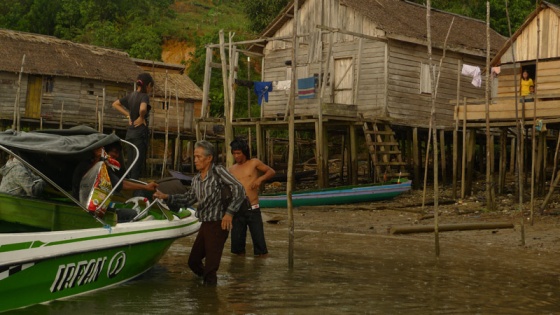
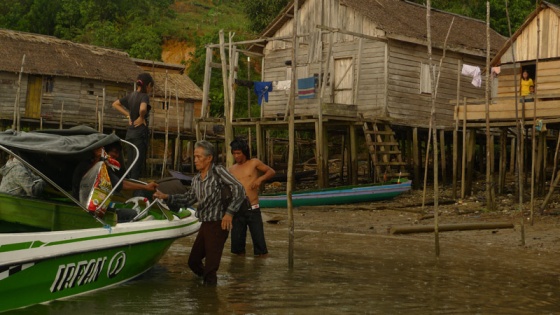
Coming home: An indigenous man unloads his belongings from a small boat in Sekatak district, Bulungan regency. (JP/Prodita Sabarini)

This is the second of a two-part report on East Kalimantan, which has recently been split into North and East Kalimantan. The Jakarta Post’s Prodita Sabarini and Nurni Sulaiman report from the richest province outside Java, which also faces severe environmental challenges. 

Young idealists in East Kalimantan dream to make a difference

Sarah Agustiorini studies biology. She loves plants, she says. The 22-year-old spent her early years marveling at the many different shades of green in the forest that surrounds her home in Samarinda, the provincial capital.

She grew up watching how the forest changed. First the trees were chopped down and were replaced with uniform trees for the timber industry. Now, from her home in Sambutan district she sees hills being scarred by the digging for the coal underneath.

Early this month, she led The Jakarta Post and a couple of curious university freshmen to Makroman village, a farming area where coalmines are quickly closing in.

Three years ago, Sarah joined the Mining Advocacy Network (JATAM), when the organization searched for volunteers through a writing workshop at Mulawarman University in Samarinda. Sarah is now the coordinator for women and mining issues, while she finishes her studies in conservation biology. Makroman is one of the areas where she works with the community.

In East Kalimantan, young people, who will inherit a land spoiled by the exploitation of natural resources, are eager to guard the environment and to learn to not make the same mistakes.

Sarah, for example, decided to advocate for the rights of the local community with JATAM after seeing mines spring up around her house and watching deforestation make many of Samarinda’s once readily available local fruits become increasingly hard to come by. At the East Kalimantan JATAM office, she is the youngest member of the team and the only woman.

In Makroman, she passes rice fields and heads towards a hill. She walks swiftly, tackling the hill, covered in tall wild grass. As she reaches the top of the hill, the vista changes abruptly from green rice paddies to grey, steep-walled pit mines. After the mines started operating in Makroman, farmers say their yields dropped by half as chemical seepage from the mines drastically reduced the quality of water used in their rice fields and fishponds.

“Everywhere I go the complaints are similar. How can they make the mines go [away]? How they have trouble getting water. How dusty the air has become. How it’s hard to sleep at night because of the noise from the mines. And they don’t know where to go, so they always come to JATAM,” Sarah said.

Next month, Sarah will graduate. “I want to be a taxonomist, but I will continue my advocacy work with JATAM,” she said.

A similar kind of idealistic drive to guard East Kalimantan’s environment has touched Muhammad Azrar Munir. A 17-year-old freshman at Mulawarman, Azrar chose to major in agriculture despite the mining boom in the region. He came along to Makroman as he was visiting JATAM’s office with a friend. “I want to learn more about how local farmers live,” he said.

Azrar comes from Penajam regency in East Kalimantan. The mining industry there has yet to flourish as it has in Samarinda, where 70 percent of the land has been given out in mining concessions; or Kutai Kartanegara regency, with the largest number of mining concessions, covering 1.2 million hectares; or East Kutai — home to Bumi Resources’ Kaltim Prima Coal. However, Sarah’s observation was that they were heading in that direction.

Azrar said he hoped that his regency would take lessons from other regencies and do a better job of planning. “Mining is fine, but mines should not be close to residential or farm areas,” he said.

“I chose agriculture because mining is booming. I want to develop the agriculture sector more,” he said.

“I have a dream to develop the agriculture sector even though the mining industry is booming because in the past few years, we have been facing a food crisis in Indonesia,” he said. He pointed out that Indonesia has been importing rice, while the country should be a rice exporter.

Sarah said that for all the progress that the mining industry had brought, she had yet to see any company significantly impact real human development. “Development here amounts to nothing much, except that consumerism is increasing rapidly. But progress for the people? I don’t see much,” she said.

She said that people’s way of life was changing as they moved from farming to working in mining. They experienced rapid increases in income, but were forced in to a consumerist lifestyle. “And still, some of the people don’t have electricity, like in Sempaja, Sambutan and North Samarinda,” she said, referring to districts in Samarinda.

For Sarah, Samarinda and East Kalimantan’s progress has merely focused on exploiting natural resources and has neglected investments in infrastructure and in human capital.

Sarah and Azrar are among the few young idealists that dream to create change in the region. But more young educated people like them are needed to effect change in the future.

The government of East Kalimantan seems to have realized its dependency on extractive industries and is starting to invest in its young people. The provincial government and the Education and Culture Ministry are planning to establish a new Institute of Technology in Kalimantan. Some 300 hectares of land had been prepared in Balikpapan for the new school, East Kalimantan governor Awang Farouk Ishak said. Construction is planned for 2013 and some 100 people were sent to study at Institute of Technology in Surabaya.

Hopes are high that the institute will churn out skilled workers that will fuel progress in the region. Whether the institute will, in the long run, instill a similar sense of idealism as Sarah and Azrar hold, remains to be seen.

The Jakarta Post | Special Report | Fri, January 18 2013